ABC Family Arquivos Brasileiros de Cardiologia International Journal of Cardiovascular Sciences ABC Heart Failure & Cardiomyopathy ABC Imagem Cardiovascular
Português English
ABC Family
Português English
  • About
    • About ABC Family
    • Internal Regulation
    • Editorial Board
    • Brazilian Society of Cardiology (SBC)
  • Issues
  • SBC Guidelines
  • Content
    • Videos
    • Podcasts
    • News
  • About
    • About ABC Family
    • Internal Regulation
    • Editorial Board
    • Brazilian Society of Cardiology (SBC)
  • Issues
  • SBC Guidelines
  • Content
    • Videos
    • Podcasts
    • News

ABC Family

  • ABC Family
  • Arquivos Brasileiros de Cardiologia
  • International Journal of Cardiovascular Sciences
  • ABC Heart Failure & Cardiomyopathy
  • ABC Imagem Cardiovascular
Search in

No content found.

Journals
Ordering
Article types
Others

  1. Home
  2. Keyword: Practice Guidelines as Topic
Figure 1
ABCIC
Original Article

Misinterpretation of Indeterminate Diastolic Function: Awareness and Insights from a Survey among Brazilian Cardiologists

Daniela do Carmo Rassi et al. Salvador Rassi Jorge Eduardo Assef Alex dos Santos Felix … Adenalva Lima de Souza Beck Cecília Beatriz Bittencourt Viana Cruz Silvio Henrique Barberato

Abstract

Background:

Diastolic dysfunction (DD) is highly prevalent and is associated with significant morbidity and mortality. More recent guidelines have introduced the classification of Indeterminate Diastolic Function or Indeterminate Diastolic Dysfunction (IDF or IDD). Nevertheless, both diagnoses are still poorly understood in clinical practice, with variable prevalence.

Objectives:

Assess the understanding of IDF and IDD among non-echocardiographer cardiologists in Brazil.

Methods:

A nationwide online survey was conducted among non-echocardiography readers cardiologists via mobile messaging platforms. A brief and anonymous questionnaire on knowledge and interpretation of Diastolic Function.

Results:

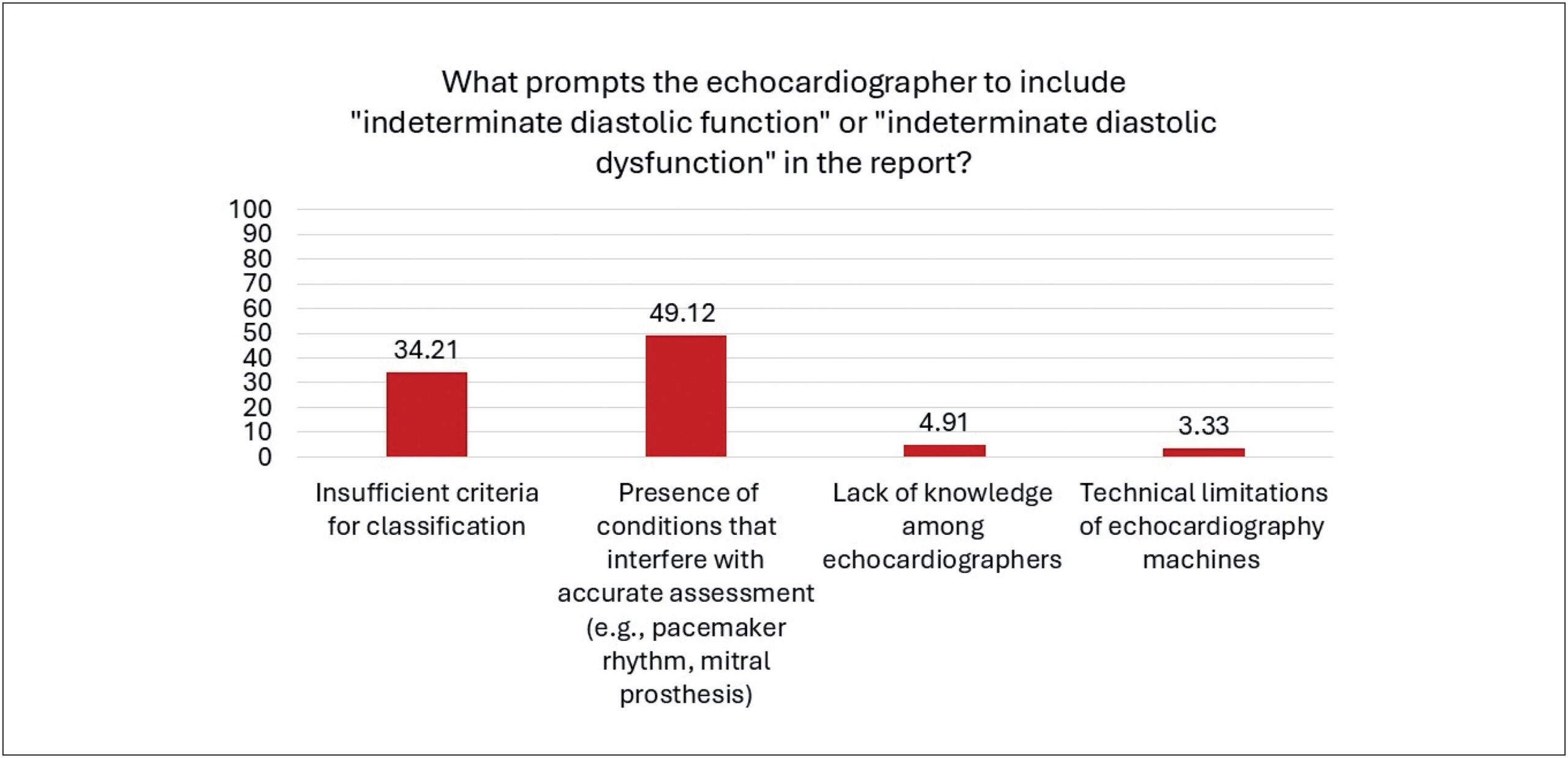
A total of 570 cardiologists from all regions of Brazil participated in the study. Most participants (64.21%) had more than ten years of clinical experience. While 71% correctly identified grades 2 or 3 as indicative of elevated filling pressures, only 34.21% accurately understood the diagnostic criteria for IDF or IDD. Among the mistakes associated with the indeterminate classification, the following stand out: attribution of this status to conditions that interfere with the assessment of diastole (49.12%), technical limitations of the echocardiography equipment (3.33%), and alleged lack of knowledge by echocardiographers (4.91%). In addition, 46.7% reported finding this diagnosis rarely in the reports, 33.5% believed that this classification influenced clinical conduct, and 43.5% considered that the examination could have been better performed.

Conclusion:

Despite knowledge about diastolic function, misinterpretation of IDF or IDD is still common among non-echocardiographer cardiologists. Investment in education, sharing these concepts with clinicians, and clear guidelines are essential to optimize the use and diagnostic accuracy of echocardiography.
  • Diastole
  • Echocardiography
  • Practice Guidelines as Topic
Read Full Article
Creative Commons Attribution (CC BY) Creative Commons license
28/03/2025 DOI: 10.36660/abcimg.20250013i Views 2
ABC
Editorial

From Journals to Bedside: We Must Improve the Compliance with Practice Guidelines

Barbara Kumagai et al. Bruno Caramelli

In this issue of “Arquivos Brasileiros de Cardiologia”, Borges et al. described the rate of non-compliance with practice guidelines in a Hospital-based study regarding the use of antiplatelet agents in the perioperative setting of non-cardiac surgery. The authors found an extremely high non-compliance rate of 80.75%, and depicted a significant negative association among non-compliance, patient education level, and the presence of previous myocardial infarction. The authors concluded that local procedures and protocols must be urgently defined.

Perioperative care underwent profound changes in the past decades. Initially, evaluation was limited to issues related to the anesthetic procedures, or to the cancellation of interventions for patients at high risk of complications. Eventually, population aging, the improvement in surgical techniques, and the development of less invasive procedures brought to operation theaters patients at an increased risk of complications, especially cardiovascular ones. Perioperative care specialists had to develop new and interdisciplinary skills to deal with several aspects of medicine, kindly deserving the nickname Chameleon doctor.–

[…]

  • medication adherence
  • Myocardial Infarction
  • Perioperative Care
  • Platelet Aggregation Inhibitors/therapeutic use
  • Practice Guidelines as Topic
  • Treatment Refusal
Read Full Article
Creative Commons Attribution (CC BY) Creative Commons license
01/10/2018 DOI: 10.5935/abc.20180186 Views 2
ABC
Editorial

The Brazilian Society of Cardiology and Hypertension: It's Time for Action

Paulo César B. Veiga Jardim

The year is 2018 and the level of scientific knowledge is unquestionable.

In medicine in general, and in cardiology, in particular, advances in diagnoses are impressive, just as the therapeutic arsenal is extraordinary, either in clinical or surgical, conventional or alternative treatment.

[…]

  • Antihypertensive Agents/administration & dosage
  • Cardiovascular Diseases / prevention & control
  • Decision/policies
  • Hypertension/drug therapy
  • Hypertension/mortality
  • Hypertension/physiopathology
  • Indicators of Morbidity and Mortality
  • Practice Guidelines as Topic
Read Full Article
Creative Commons Attribution (CC BY) Creative Commons license
01/09/2018 DOI: 10.5935/abc.20180189 Views 1
ABC
Viewpoint

Positions, Guidelines and Standardizations. Vehicles of Assistance to Medical Practice

Antônio Carlos Sobral Sousa et al. Claudio Pereira da Cunha Lucélia Batista Neves Cunha Magalhães Sergio Emanuel Kaiser José Francisco Kerr Saraiva

Positioning document

These documents aim to address a particular topic (diagnostic, therapeutic or laboratory) of recognized clinical interest, for which there are no (or unlikely to exist) evidence of substantial quality or, especially, those from randomized clinical trials. These documents are complementary to the guidelines and are prepared by a team of professionals with established experience in the subject.

As an example, we could cite the use of direct anticoagulants in pregnant patients. In general, the guidelines contained in these documents are anchored in the best evidence available; however, often incorporate the personal opinion of specialists.

[…]

  • Delivery of Health Care
  • Evidence-Based Practice
  • Practice Guidelines as Topic
Read Full Article
Creative Commons Attribution (CC BY) Creative Commons license
01/10/2017 DOI: 10.5935/abc.20170133 Views 1
Figure 1
ABC
Original Article

Cardiovascular Risk Stratification and Statin Eligibility Based on the Brazilian vs. North American Guidelines on Blood Cholesterol Management

Fernando Henpin Yue Cesena et al. Antonio Gabriele Laurinavicius Viviane A. Valente Raquel D. Conceição … Raul D. Santos Marcio S. Bittencourt

Abstract

Background:

The best way to select individuals for lipid-lowering treatment in the population is controversial.

Objective:

In healthy individuals in primary prevention:

Methods:

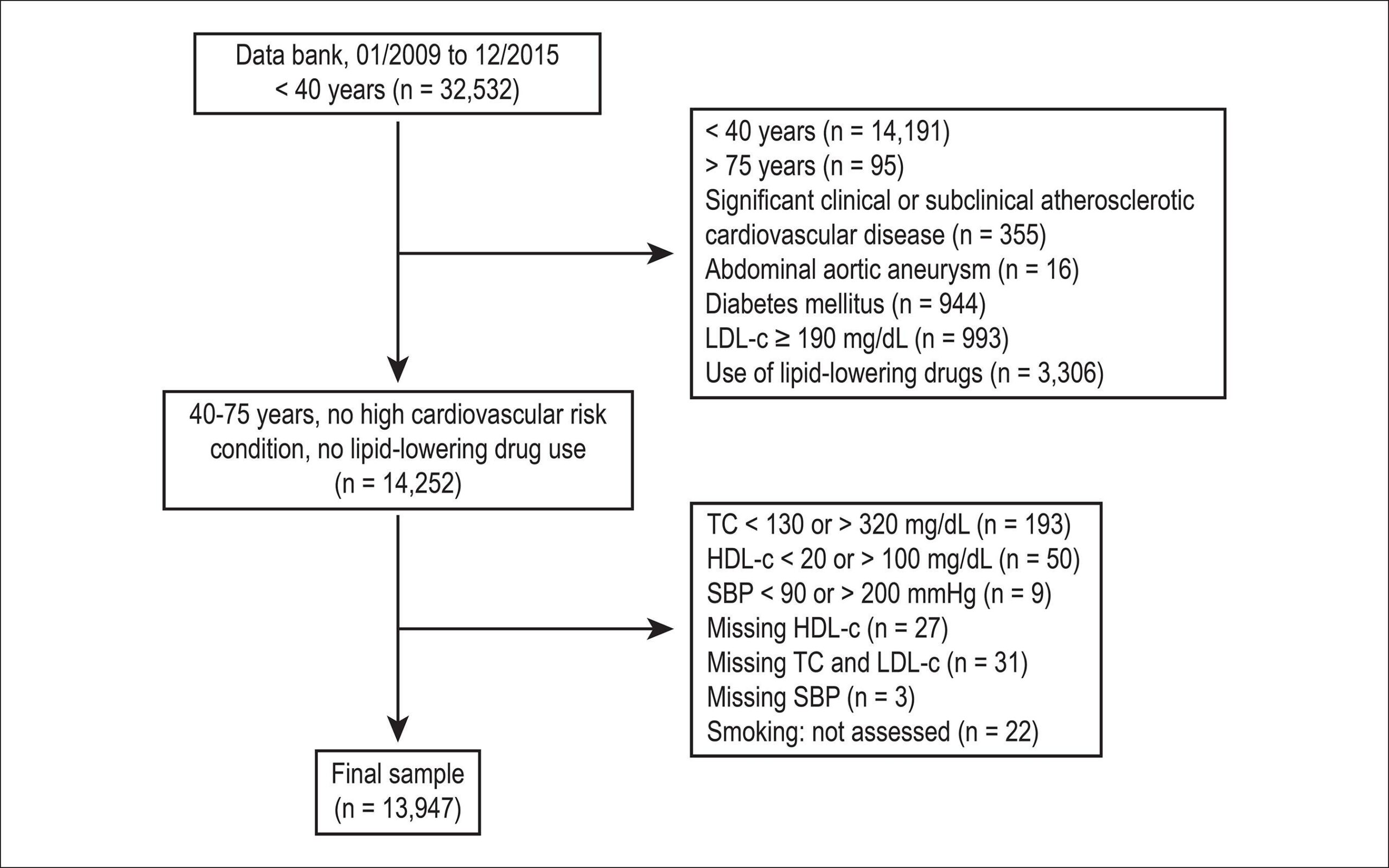
In individuals aged 40-75 years consecutively submitted to routine health assessment at one single center, four criteria of eligibility for statin were defined: BR-1, BR-2 (LDL-c above or at least 30 mg/dL above the goal recommended by the Brazilian Guideline, respectively), USA-1 and USA-2 (10-year risk estimated by the PCE ≥ 5.0% or ≥ 7.5%, respectively).

Results:

The final sample consisted of 13,947 individuals (48 ± 6 years, 71% men). Most individuals at intermediate or high risk based on the V Brazilian Guideline had a low risk calculated by the PCE, and more than 70% of those who were considered at high risk had this categorization because of the presence of aggravating factors. Among women, 24%, 17%, 4% and 2% were eligible for statin use according to the BR-1, BR-2, USA-1 and USA-2 criteria, respectively (p < 0.01). The respective figures for men were 75%, 58%, 31% and 17% (p < 0.01). Eighty-five percent of women and 60% of men who were eligible for statin based on the BR-1 criterion would not be candidates for statin based on the USA-1 criterion.

Conclusions:

As compared to the North American Guideline, the V Brazilian Guideline considers a substantially higher proportion of the population as eligible for statin use in primary prevention. This results from discrepancies between the risk stratified by the Brazilian Guideline and that calculated by the PCE, particularly because of the risk reclassification based on aggravating factors.

  • Anticholesterelemic Agents
  • Cardiovascular Diseases
  • Cholesterol
  • Hydroxymethylglutaryl-CoA Reductases
  • Practice Guidelines as Topic
  • Risk Assessment
Read Full Article
Creative Commons Attribution (CC BY) Creative Commons license
01/06/2017 DOI: 10.5935/abc.20170088 Views 1

How to cite this article

EndNote RIS

Electronic Document Format (Vancouver)

Rassi DC, Rassi S, Assef JE, Felix AS, Beck ALS, Cruz CBBV, Barberato SH, et al. Misinterpretation of Indeterminate Diastolic Function: Awareness and Insights from a Survey among Brazilian Cardiologists. ABC Imagem Cardiovascular 2025;38(1):e20250013.

Electronic Document Format (ABNT)

Rassi, Daniela do Carmo; Rassi, Salvador; Assef, Jorge Eduardo; Felix, Alex dos Santos; Beck, Adenalva Lima de Souza; Cruz, Cecília Beatriz Bittencourt Viana; Barberato, Silvio Henrique. Misinterpretation of Indeterminate Diastolic Function: Awareness and Insights from a Survey among Brazilian Cardiologists. ABC Imagem Cardiovascular, v. 38, n. 1, e20250013, Mar. 2025.

Electronic Document Format (APA)

Rassi, D. C., Rassi, S., Assef, J. E., Felix, A. S., Beck, A. L. S., Cruz, C. B. B. V., & Barberato, S. H. (2025). Misinterpretation of Indeterminate Diastolic Function: Awareness and Insights from a Survey among Brazilian Cardiologists. ABC Imagem Cardiovascular, 38(1), e20250013.

Electronic Document Format (ISO)

Rassi, Daniela do Carmo and Rassi, Salvador and Assef, Jorge Eduardo and Felix, Alex dos Santos and Beck, Adenalva Lima de Souza and Cruz, Cecília Beatriz Bittencourt Viana and Barberato, Silvio Henrique. Misinterpretation of Indeterminate Diastolic Function: Awareness and Insights from a Survey among Brazilian Cardiologists. ABC Imagem Cardiovascular [online]. 2025, vol. 38, n. 1, [cited 2026-10-14], e20250013. Available from: <https://journals.cardiol.br/en/article/misinterpretation-of-indeterminate-diastolic-function-awareness-and-insights-from-a-survey-among-brazilian-cardiologists/>. ISSN 2318-8219

EndNote RIS

Electronic Document Format (Vancouver)

Kumagai B, Caramelli B. From Journals to Bedside: We Must Improve the Compliance with Practice Guidelines. Arquivos Brasileiros de Cardiologia 2018;111(4):605-6.

Electronic Document Format (ABNT)

Kumagai, Barbara; Caramelli, Bruno. From Journals to Bedside: We Must Improve the Compliance with Practice Guidelines. Arquivos Brasileiros de Cardiologia, v. 111, n. 4, p. 605-606, Sep. 2018.

Electronic Document Format (APA)

Kumagai, B., & Caramelli, B. (2018). From Journals to Bedside: We Must Improve the Compliance with Practice Guidelines. Arquivos Brasileiros de Cardiologia, 111(4), 605-606.

Electronic Document Format (ISO)

Kumagai, Barbara and Caramelli, Bruno. From Journals to Bedside: We Must Improve the Compliance with Practice Guidelines. Arquivos Brasileiros de Cardiologia [online]. 2018, vol. 111, n. 4, [cited 2026-10-14], pp. 605-606. Available from: <https://journals.cardiol.br/en/article/from-journals-to-bedside-we-must-improve-the-compliance-with-practice-guidelines/>. ISSN 0066-782X

EndNote RIS

Electronic Document Format (Vancouver)

Jardim PCBV. The Brazilian Society of Cardiology and Hypertension: It’s Time for Action. Arquivos Brasileiros de Cardiologia 2018;111(3):343-4.

Electronic Document Format (ABNT)

Jardim, Paulo César B. Veiga. The Brazilian Society of Cardiology and Hypertension: It’s Time for Action. Arquivos Brasileiros de Cardiologia, v. 111, n. 3, p. 343-344, Aug. 2018.

Electronic Document Format (APA)

Jardim, P. C. B. V. (2018). The Brazilian Society of Cardiology and Hypertension: It’s Time for Action. Arquivos Brasileiros de Cardiologia, 111(3), 343-344.

Electronic Document Format (ISO)

Jardim, Paulo César B. Veiga. The Brazilian Society of Cardiology and Hypertension: It’s Time for Action. Arquivos Brasileiros de Cardiologia [online]. 2018, vol. 111, n. 3, [cited 2026-10-14], pp. 343-344. Available from: <https://journals.cardiol.br/en/article/the-brazilian-society-of-cardiology-and-hypertension-its-time-for-action/>. ISSN 0066-782X

EndNote RIS

Electronic Document Format (Vancouver)

Sousa ACS, Cunha CP, Magalhães LBNC, Kaiser SE, Saraiva JFK. Positions, Guidelines and Standardizations. Vehicles of Assistance to Medical Practice. Arquivos Brasileiros de Cardiologia 2017;109(4):368-9.

Electronic Document Format (ABNT)

Sousa, Antônio Carlos Sobral; Cunha, Claudio Pereira da; Magalhães, Lucélia Batista Neves Cunha; Kaiser, Sergio Emanuel; Saraiva, José Francisco Kerr. Positions, Guidelines and Standardizations. Vehicles of Assistance to Medical Practice. Arquivos Brasileiros de Cardiologia, v. 109, n. 4, p. 368-369, Sep. 2017.

Electronic Document Format (APA)

Sousa, A. C. S., Cunha, C. P. , Magalhães, L. B. N. C., Kaiser, S. E., & Saraiva, J. F. K. (2017). Positions, Guidelines and Standardizations. Vehicles of Assistance to Medical Practice. Arquivos Brasileiros de Cardiologia, 109(4), 368-369.

Electronic Document Format (ISO)

Sousa, Antônio Carlos Sobral and Cunha, Claudio Pereira da and Magalhães, Lucélia Batista Neves Cunha and Kaiser, Sergio Emanuel and Saraiva, José Francisco Kerr. Positions, Guidelines and Standardizations. Vehicles of Assistance to Medical Practice. Arquivos Brasileiros de Cardiologia [online]. 2017, vol. 109, n. 4, [cited 2026-10-14], pp. 368-369. Available from: <https://journals.cardiol.br/en/article/positions-guidelines-and-standardizations-vehicles-of-assistance-to-medical-practice/>. ISSN 0066-782X

EndNote RIS

Electronic Document Format (Vancouver)

Cesena FHY, Laurinavicius AG, Valente VA, Conceição RD, Santos RD, Bittencourt MS. Cardiovascular Risk Stratification and Statin Eligibility Based on the Brazilian vs. North American Guidelines on Blood Cholesterol Management. Arquivos Brasileiros de Cardiologia 2017;108(6):508-17.

Electronic Document Format (ABNT)

Cesena, Fernando Henpin Yue; Laurinavicius, Antonio Gabriele; Valente, Viviane A.; Conceição, Raquel D.; Santos, Raul D.; Bittencourt, Marcio S.. Cardiovascular Risk Stratification and Statin Eligibility Based on the Brazilian vs. North American Guidelines on Blood Cholesterol Management. Arquivos Brasileiros de Cardiologia, v. 108, n. 6, p. 508-517, May. 2017.

Electronic Document Format (APA)

Cesena, F. H. Y., Laurinavicius, A. G., Valente, V. A., Conceição, R. D., Santos, R. D., & Bittencourt, M. S. (2017). Cardiovascular Risk Stratification and Statin Eligibility Based on the Brazilian vs. North American Guidelines on Blood Cholesterol Management. Arquivos Brasileiros de Cardiologia, 108(6), 508-517.

Electronic Document Format (ISO)

Cesena, Fernando Henpin Yue and Laurinavicius, Antonio Gabriele and Valente, Viviane A. and Conceição, Raquel D. and Santos, Raul D. and Bittencourt, Marcio S.. Cardiovascular Risk Stratification and Statin Eligibility Based on the Brazilian vs. North American Guidelines on Blood Cholesterol Management. Arquivos Brasileiros de Cardiologia [online]. 2017, vol. 108, n. 6, [cited 2026-10-14], pp. 508-517. Available from: <https://journals.cardiol.br/en/article/cardiovascular-risk-stratification-and-statin-eligibility-based-on-the-brazilian-vs-north-american-guidelines-on-blood-cholesterol-management/>. ISSN 0066-782X

  • About ABC Family
  • Internal Regulation
  • Editorial Board
  • Brazilian Society of Cardiology (SBC)

Issues

SBC Guidelines

  • Videos
  • Podcasts
  • News