ABC Family Arquivos Brasileiros de Cardiologia International Journal of Cardiovascular Sciences ABC Heart Failure & Cardiomyopathy ABC Imagem Cardiovascular
Português English
ABC Family
Português English
  • About
    • About ABC Family
    • Internal Regulation
    • Editorial Board
    • Brazilian Society of Cardiology (SBC)
  • Issues
  • SBC Guidelines
  • Content
    • Videos
    • Podcasts
    • News
  • About
    • About ABC Family
    • Internal Regulation
    • Editorial Board
    • Brazilian Society of Cardiology (SBC)
  • Issues
  • SBC Guidelines
  • Content
    • Videos
    • Podcasts
    • News

ABC Family

  • ABC Family
  • Arquivos Brasileiros de Cardiologia
  • International Journal of Cardiovascular Sciences
  • ABC Heart Failure & Cardiomyopathy
  • ABC Imagem Cardiovascular
Search in

No content found.

Journals
Ordering
Article types
Others

  1. Home
  2. Keyword: Plaque, Atherosclerosis
ABC
Editorial

From Atheroma to Atherogenic Index, Secular Evidence

Dalton Bertolim Precoma et al. Guilherme Luiz da Rocha

The discovery of atherosclerosis was first described by the Austrian paleontologist Johan N. Nepomuk Czemark when he observed great calcified plaques in the ascending thoracic artery in mummies. Other fellow researchers had similar findings, but one particular case gained attention. Murphy et al., in 2003, using computer tomography, revealed in a 5300-year-old mummy atherosclerotic plaques in the aorta, coronaries, carotids, and iliac arteries.

In early 1900, a significant number of studies about atherosclerosis were published. Highlight for Alexander I. Ignatowski, who published in 1908 a pioneer study associating high total cholesterol (TC) foods with enhanced atherosclerosis in an animal model. In 1910, Adolf Windaus, who would win a Nobel prize in chemistry in 1928, demonstrated that the atherosclerotic plaques had 25 times more cholesterol than a normal artery wall.

[…]
  • Atheroma
  • Atherosclerosis / physiopathology
  • Coenzyme A
  • Plaque, Atherosclerosis
  • Risk Factors
  • Tomography, X-Ray Cmputed/methods
  • Vascular System Injuries
Read Full Article
Creative Commons Attribution (CC BY) Creative Commons license
04/03/2024 DOI: 10.36660/abc.20230819 Views 1
ABC
Editorial

Carotid Artery Atherosclerotic Profile as a Progression Marker for Cardiovascular Disease

Guilherme Brasileiro de Aguiar et al. José Guilherme Mendes Pereira Caldas

Conditions directly linked to atherosclerosis are among the main causes of mortality worldwide, notably ischemic stroke and coronary artery disease (CAD). Diagnosing cardiovascular disease or its progression in the early stages, aiming to apply measures that can prevent or delay its progression and subsequent complications is currently a major challenge. The identification and characterization of atherosclerotic plaques allows the identification of a significant number of patients with low or intermediate risk scores. Many of these patients would not be identified by the available algorithms for cardiovascular diseases, which could result in the lack of correct management.

The quantification of the carotid artery plaque may be a measure of atherosclerosis, which should be associated with future risk of atherosclerotic cardiovascular disease, encompassing coronary, cerebrovascular, and peripheral arterial diseases. It is already known that impaired endothelial function and increased carotid intima-media thickness are substantial events in the atherosclerotic process,, with imaging of carotid features being used to predict the risk of cardiovascular events.

[…]

  • Atherosclerosis
  • Cardiovascular Diseases
  • Coronary Artery Disease
  • Mortality
  • Plaque, Atherosclerosis
  • Stroke
Read Full Article
Creative Commons Attribution (CC BY) Creative Commons license
16/04/2021 DOI: 10.36660/abc.20210229
ABC
Editorial

High Residual Platelet Activity in Response to Acetylsalicylic Acid in Acute Coronary Syndrome: A New Challenge for Antiplatelet Treatment?

Dário C. Sobral Filho et al. José Gildo de Moura Monteiro Júnior

Cardiovascular diseases (CVD) are the leading cause of death in the world, with coronary heart disease being the main etiology, accounting in 2016 for 31% of global deaths. Myocardial infarction (MI) is usually due to changes in the arterial wall or thrombotic occlusion of a coronary vessel caused by the rupture of a vulnerable plaque., Instability in the atherosclerotic plaque is the result of local and systemic oxidative stress, thus leading to platelet activation and formation of aggregates in the circulation. The major function of platelets is as part of the homeostatic mechanism, halting blood loss after tissue trauma, but in oxidative conditions, they are associated with various CVD such as hypertension, heart failure, stroke, diabetes and atherosclerosis.

Previous studies have shown the importance of aspirin in reducing cardiovascular events in patients with coronary artery disease, hence the importance of anti-platelet aggregation in acute and chronic coronary syndromes.– However, in this issue of the Arquivos Brasileiros de Cardiologia, Dracoulakis et al. demonstrate the high residual variability in response to aspirin in patients with non-ST-elevation acute coronary syndrome, comparing acute and late phases, correlating with laboratory evaluation tests of platelet aggregation and the variation of inflammatory markers (C-reactive protein and interleukin-6). In this study, the authors demonstrate statistically significant differences in response to aspirin during the acute and late phases of acute coronary disease.

[…]

  • Acute coronary syndrome
  • aspirin/therapeutic use
  • Oxidative Stress
  • Plaque, Atherosclerosis
  • Platelet Aggregation Inhibitors
Read Full Article
Creative Commons Attribution (CC BY) Creative Commons license
10/10/2019 DOI: 10.5935/abc.20190199
Correlation between plaque composition as assessed by virtual histology and C-reactive protein
ABC
Artigo Original

Correlation between plaque composition as assessed by virtual histology and C-reactive protein

Dimytri Alexandre de Alvim Siqueira et al. Amanda Guerra Moraes R. Sousa José de Ribamar Costa Junior Ricardo Alves da Costa … Rodolfo Staico Luis Fernando Leite Tanajura Marinella Patrizia Centemero Fausto Feres Alexandre Antonio Cunha Abizaid J. Eduardo Moraes R. Sousa

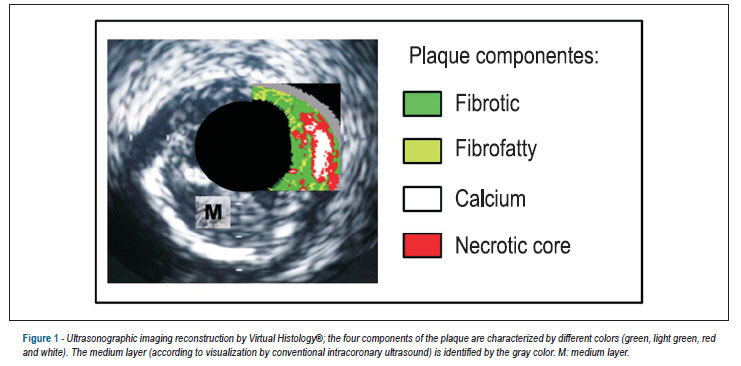
BACKGROUND: Previous studies have shown that coronary plaque composition plays a pivotal role in plaque instability, and imaging modalities and serum biomarkers have been investigated to identify vulnerable plaque. Virtual histology IVUS (VH-IVUS) characterizes plaque components as calcified, fibrotic, fibrofatty, or necrotic core. C-reactive protein (hsCRP) is an independent risk factor and a powerful predictor of future coronary events. However, a relationship between inflammatory response indicated by CRP and plaque characteristics in ACS patients remains not well established. OBJECTIVE: To determine, by using VH-IVUS, the relation between coronary plaque components and plasma high-sensitivity CRP levels in patients with acute coronary syndromes (ACS). METHODS: 52 patients with ACS were enrolled in this prospective study. Electrocardiographically-gated VH-IVUS were performed in the culprit lesion before PCI. Blood sample was drawn from all patients before the procedure and after 24 hours, and hs-CRP levels were determined. RESULTS: Mean age was 55.3±4.9 years, 76.9% were men and 30.9% had diabetes. Mean MLA was 3.9±1.3 mm², and plaque burden was 69±11.3%, as assessed by IVUS. VH-IVUS analysis at the minimum luminal site identified plaque components: fibrotic (59.6±15.8%), fibrofatty (7.6±8.2%), dense calcium (12.1±9.2%) and necrotic core (20.7±12.7%). Plasma hs-CRP (mean 16.02±18.07 mg/L) did not correlate with necrotic core (r=-0.089, p = 0.53) and other plaque components. CONCLUSIONS: In this prospective study with patients with ACS, the predominant components of the culprit plaque were fibrotic and necrotic core. Serum hs C-reactive protein levels did not correlate with plaque composition.

  • Acute coronary syndrome
  • C-Reactive Protein
  • Diagnostic Imaging
  • Histological Techniques
  • Plaque, Atherosclerosis
Read Full Article
Creative Commons Attribution (CC BY) Creative Commons license
11/06/2013 DOI: 10.1590/S0066-782X2013005000042 Views 1

How to cite this article

EndNote RIS

Electronic Document Format (Vancouver)

Precoma DB, Rocha GL. From Atheroma to Atherogenic Index, Secular Evidence. Arquivos Brasileiros de Cardiologia 2024;120(12):e20230819.

Electronic Document Format (ABNT)

Precoma, Dalton Bertolim; Rocha, Guilherme Luiz da. From Atheroma to Atherogenic Index, Secular Evidence. Arquivos Brasileiros de Cardiologia, v. 120, n. 12, e20230819, Mar. 2024.

Electronic Document Format (APA)

Precoma, D. B., & Rocha, G. L. (2024). From Atheroma to Atherogenic Index, Secular Evidence. Arquivos Brasileiros de Cardiologia, 120(12), e20230819.

Electronic Document Format (ISO)

Precoma, Dalton Bertolim and Rocha, Guilherme Luiz da. From Atheroma to Atherogenic Index, Secular Evidence. Arquivos Brasileiros de Cardiologia [online]. 2024, vol. 120, n. 12, [cited 2026-10-14], e20230819. Available from: <https://journals.cardiol.br/en/article/from-atheroma-to-atherogenic-index-secular-evidence/>. ISSN 0066-782X

EndNote RIS

Electronic Document Format (Vancouver)

Aguiar GB, Caldas JGMP. Carotid Artery Atherosclerotic Profile as a Progression Marker for Cardiovascular Disease. Arquivos Brasileiros de Cardiologia 2021;116(4):734-5.

Electronic Document Format (ABNT)

Aguiar, Guilherme Brasileiro de; Caldas, José Guilherme Mendes Pereira. Carotid Artery Atherosclerotic Profile as a Progression Marker for Cardiovascular Disease. Arquivos Brasileiros de Cardiologia, v. 116, n. 4, p. 734-735, Apr. 2021.

Electronic Document Format (APA)

Aguiar, G. B. , & Caldas, J. G. M. P. (2021). Carotid Artery Atherosclerotic Profile as a Progression Marker for Cardiovascular Disease. Arquivos Brasileiros de Cardiologia, 116(4), 734-735.

Electronic Document Format (ISO)

Aguiar, Guilherme Brasileiro de and Caldas, José Guilherme Mendes Pereira. Carotid Artery Atherosclerotic Profile as a Progression Marker for Cardiovascular Disease. Arquivos Brasileiros de Cardiologia [online]. 2021, vol. 116, n. 4, [cited 2026-10-14], pp. 734-735. Available from: <https://journals.cardiol.br/en/article/carotid-artery-atherosclerotic-profile-as-a-progression-marker-for-cardiovascular-disease/>. ISSN 0066-782X

EndNote RIS

Electronic Document Format (Vancouver)

Sobral Filho DC, Monteiro Júnior JGM. High Residual Platelet Activity in Response to Acetylsalicylic Acid in Acute Coronary Syndrome: A New Challenge for Antiplatelet Treatment?. Arquivos Brasileiros de Cardiologia 2019;113(3):364-6.

Electronic Document Format (ABNT)

Sobral Filho, Dário C.; Monteiro Júnior, José Gildo de Moura. High Residual Platelet Activity in Response to Acetylsalicylic Acid in Acute Coronary Syndrome: A New Challenge for Antiplatelet Treatment?. Arquivos Brasileiros de Cardiologia, v. 113, n. 3, p. 364-366, Oct. 2019.

Electronic Document Format (APA)

Sobral Filho, D. C., & Monteiro Júnior, J. G. M. (2019). High Residual Platelet Activity in Response to Acetylsalicylic Acid in Acute Coronary Syndrome: A New Challenge for Antiplatelet Treatment?. Arquivos Brasileiros de Cardiologia, 113(3), 364-366.

Electronic Document Format (ISO)

Sobral Filho, Dário C. and Monteiro Júnior, José Gildo de Moura. High Residual Platelet Activity in Response to Acetylsalicylic Acid in Acute Coronary Syndrome: A New Challenge for Antiplatelet Treatment?. Arquivos Brasileiros de Cardiologia [online]. 2019, vol. 113, n. 3, [cited 2026-10-14], pp. 364-366. Available from: <https://journals.cardiol.br/en/article/high-residual-platelet-activity-in-response-to-acetylsalicylic-acid-in-acute-coronary-syndrome-a-new-challenge-for-antiplatelet-treatment/>. ISSN 0066-782X

EndNote RIS

Electronic Document Format (Vancouver)

Siqueira DAA, Sousa AGMR, Costa Junior JR, Costa RA, Staico R, Tanajura LFL, Centemero MP, et al. Correlation between plaque composition as assessed by virtual histology and C-reactive protein. Arquivos Brasileiros de Cardiologia 2013;101(1):78-86.

Electronic Document Format (ABNT)

Siqueira, Dimytri Alexandre de Alvim; Sousa, Amanda Guerra Moraes R.; Costa Junior, José de Ribamar; Costa, Ricardo Alves da; Staico, Rodolfo; Tanajura, Luis Fernando Leite; Centemero, Marinella Patrizia; Feres, Fausto; Abizaid, Alexandre Antonio Cunha; Sousa, J. Eduardo Moraes R.. Correlation between plaque composition as assessed by virtual histology and C-reactive protein. Arquivos Brasileiros de Cardiologia, v. 101, n. 1, p. 78-86, Jun. 2013.

Electronic Document Format (APA)

Siqueira, D. A. A., Sousa, A. G. M. R., Costa Junior, J. R., Costa, R. A. , Staico, R., Tanajura, L. F. L., Centemero, M. P., Feres, F., Abizaid, A. A. C., & Sousa, J. E. M. R. (2013). Correlation between plaque composition as assessed by virtual histology and C-reactive protein. Arquivos Brasileiros de Cardiologia, 101(1), 78-86.

Electronic Document Format (ISO)

Siqueira, Dimytri Alexandre de Alvim and Sousa, Amanda Guerra Moraes R. and Costa Junior, José de Ribamar and Costa, Ricardo Alves da and Staico, Rodolfo and Tanajura, Luis Fernando Leite and Centemero, Marinella Patrizia and Feres, Fausto and Abizaid, Alexandre Antonio Cunha and Sousa, J. Eduardo Moraes R.. Correlation between plaque composition as assessed by virtual histology and C-reactive protein. Arquivos Brasileiros de Cardiologia [online]. 2013, vol. 101, n. 1, [cited 2026-10-14], pp. 78-86. Available from: <https://journals.cardiol.br/en/article/correlation-between-plaque-composition-as-assessed-by-virtual-histology-and-c-reactive-protein/>. ISSN 0066-782X

  • About ABC Family
  • Internal Regulation
  • Editorial Board
  • Brazilian Society of Cardiology (SBC)

Issues

SBC Guidelines

  • Videos
  • Podcasts
  • News