ABC Family Arquivos Brasileiros de Cardiologia International Journal of Cardiovascular Sciences ABC Heart Failure & Cardiomyopathy ABC Imagem Cardiovascular
Português English
ABC Family
Português English
  • About
    • About ABC Family
    • Internal Regulation
    • Editorial Board
    • Brazilian Society of Cardiology (SBC)
  • Issues
  • SBC Guidelines
  • Content
    • Videos
    • Podcasts
    • News
  • About
    • About ABC Family
    • Internal Regulation
    • Editorial Board
    • Brazilian Society of Cardiology (SBC)
  • Issues
  • SBC Guidelines
  • Content
    • Videos
    • Podcasts
    • News

ABC Family

  • ABC Family
  • Arquivos Brasileiros de Cardiologia
  • International Journal of Cardiovascular Sciences
  • ABC Heart Failure & Cardiomyopathy
  • ABC Imagem Cardiovascular
Search in

No content found.

Journals
Ordering
Article types
Others

  1. Home
  2. Keyword: Oncology
Myocardial Uptake of 18F-Fluorodeoxyglucose on Positron Emission Tomography/Computed Tomography: A Window into Cardiovascular Phenotypes and Metabolic Signatures in Patients with Cancer
ABC
Original Article

Myocardial Uptake of 18F-Fluorodeoxyglucose on Positron Emission Tomography/Computed Tomography: A Window into Cardiovascular Phenotypes and Metabolic Signatures in Patients with Cancer

João Marcelo Duarte Ribeiro Sobrinho et al. Emanuel Davi Lima de Matos Leão Beatriz Barbosa Accioly Felipe Alves Mourato … Monica de Moraes Chaves Becker Simone Cristina Soares Brandão

Abstract

Background

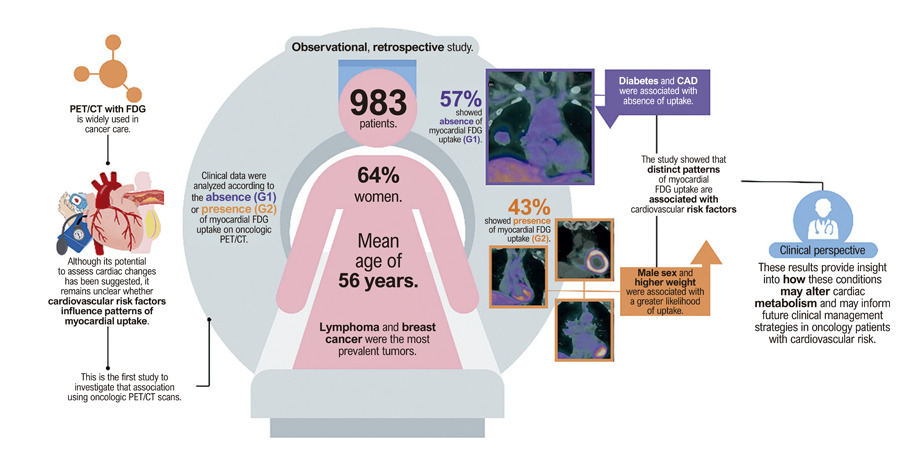
Positron emission tomography/computed tomography (PET/CT) with 18F-fluorodeoxyglucose (FDG) is widely used in cancer care, but its role in assessing cardiotoxicity remains uncertain. Understanding how cardiovascular risk factors influence myocardial glucose uptake may improve its application in this setting.

Objective

To investigate associations between cardiac metabolic patterns on oncologic PET/CT and cardiovascular risk factors.

Methods

We conducted a retrospective, cross-sectional study classifying oncologic PET/CT scans by absence (G1) or presence (G2) of myocardial FDG uptake, visually defined as greater than the aortic blood pool. Clinical data and cardiovascular risk factors were analyzed, and logistic regression identified predictors of presence or absence of uptake, adjusting for potential confounders. Statistical significance was set at p < 0.05.

Results

We included 983 scans (64% women; mean age 56 ± 15.8 years; 39.9% with hypertension; 19.7% with diabetes), of which 559 (56.8%) were G1 and 424 (43.2%) were G2. The most prevalent cancers were lymphoma (28.9%) and breast (17.6%). Male sex (p = 0.0008) and higher weight (p = 0.0001) were independent predictors of myocardial FDG uptake, whereas diabetes (p = 0.01) and coronary artery disease (p = 0.007) predicted absence of uptake.

Conclusions

Despite limitations, this study identified distinct patterns of myocardial FDG uptake on oncologic PET/CT independently associated with cardiovascular risk factors. These findings support the potential of FDG PET/CT for evaluating cardiotoxicity after cancer treatment.

  • 18F-fluorodeoxyglucose
  • Cardiovascular Risk Factors
  • Oncology
  • Positron Emission Tomography-Computed Tomography
Read Full Article
Creative Commons Attribution (CC BY) Creative Commons license
02/03/2026 DOI: 10.36660/abc.20250028i Views 1
ABC
Editorial

Renin-Angiotensin System Inhibition and Beta Blockade Adrenergic May Be Useful to Attenuate Cardiotoxicity by Anthracyclines

Mario Fritsch Neves

Cardiotoxicity related to the use of anthracyclines is a major concern in oncology, as it can increase the morbidity of many patients receiving chemotherapy for various types of cancer. This toxicity can lead to left ventricular systolic dysfunction and, therefore, a higher incidence of heart failure, which can result in mortality in severe cases. A better understanding of the mechanisms involved and a better definition of diagnostic methods have provided significant advances in detecting this complication. However, there is still no consensus on the most accurate biomarkers for early identification of cardiotoxicity. Despite this, troponin measurement after each chemotherapy cycle can be a valid tool to indicate immediate intervention. ,

Manifestations of cardiotoxicity may remain restricted to myocardial cell damage detectable only by measuring circulating biomarkers or vary between silent ventricular dysfunction and clinically manifest heart failure. Strategies to avoid or at least attenuate anthracycline-induced cardiotoxicity are essential to improve the prognosis of patients using this class. The current recommendations include treating pre-existing cardiovascular risk factors, – choosing less cardiotoxic analogues, and administering low cumulative doses of anthracyclines. ,

[…]

  • Anthracyclines / toxicity
  • Drug Therapy
  • Heart Failure
  • Oncology
  • Ventricular Dysfunction, Left
Read Full Article
Creative Commons Attribution (CC BY) Creative Commons license
16/06/2023 DOI: 10.36660/abc.20230280
ABCHF
Editorial

Cardio-Oncology: Far Beyond Doxorubicin and the Tip of the Iceberg!

Wolney de Andrade Martins et al. Ariane Vieira Scarlatelli Macedo Lidia Ana Zytynski Moura

Cardio-oncology is a new field of work and research on the adverse cardiovascular effects of cancer treatment, comorbidities and clinical conditions in cancer patients, and cardiovascular tumors. It has a wide spectrum ranging from arterial hypertension, arrhythmias, coronary and thromboembolic diseases to ventricular dysfunction, among others. In this special issue of ABC Heart Failure, we will focus on myocardial lesions, and consequently cardiomyopathies, ventricular dysfunction and heart failure (HF).

The Department of HF of the Brazilian Society of Cardiology has embraced Cardio-oncology since its beginning, by opening space for scientific discussion in its events and thematic area for abstract submissions, and now by offering this special issue addressing the main manifestations of endomyocardial/pericardial diseases and HF in cancer patients.

[…]

  • Cardio-Oncology
  • Cardiology
  • Chemotherapy/adverse effects
  • Oncology
Read Full Article
Creative Commons Attribution (CC BY) Creative Commons license
18/12/2022 DOI: 10.36660/abchf.20230003 Views 1
ABC
Editorial

The Unapparent Non-COVID Consequences of the COVID-19 Pandemic

Gilson Feitosa

The world has been facing a COVID-19 pandemics of enormous proportion. Most places were unprepared to cope with this situation and considering its occurrence in the current scenario of fast, widespread and occasionally unfiltered information, the considerable growth of fear has affected most people worldwide. Mainly considering the rapid contamination of people in the hospitals and in the communities, as announced by the news, and potentialized by pictures of unassisted patients waiting outside the medical facilities, due to the lack of adequate support.

This apocalyptic scenario was seen in many places that were considered as adequately equipped for the regular treatment of ordinary health problems. All attention was diverted to provide installations and equipment to take care of the COVID-19 affected patients and their relatives.

[…]

  • Betacoronavirus
  • Cardiology
  • COVID-19
  • Emergency Medical Services
  • Hospitalization
  • Oncology
  • Pandemics
Read Full Article
Creative Commons Attribution (CC BY) Creative Commons license
07/12/2020 DOI: 10.36660/abc.20200935 Views 1

How to cite this article

EndNote RIS

Electronic Document Format (Vancouver)

Sobrinho JMDR, Leão EDLM, Accioly BB, Mourato FA, Becker MMC, Brandão SCS. Myocardial Uptake of 18F-Fluorodeoxyglucose on Positron Emission Tomography/Computed Tomography: A Window into Cardiovascular Phenotypes and Metabolic Signatures in Patients with Cancer. Arquivos Brasileiros de Cardiologia 2026;123(1):e20250028.

Electronic Document Format (ABNT)

Sobrinho, João Marcelo Duarte Ribeiro; Leão, Emanuel Davi Lima de Matos; Accioly, Beatriz Barbosa; Mourato, Felipe Alves; Becker, Monica de Moraes Chaves; Brandão, Simone Cristina Soares. Myocardial Uptake of 18F-Fluorodeoxyglucose on Positron Emission Tomography/Computed Tomography: A Window into Cardiovascular Phenotypes and Metabolic Signatures in Patients with Cancer. Arquivos Brasileiros de Cardiologia, v. 123, n. 1, e20250028, Mar. 2026.

Electronic Document Format (APA)

Sobrinho, J. M. D. R., Leão, E. D. L. M., Accioly, B. B., Mourato, F. A., Becker, M. M. C., & Brandão, S. C. S. (2026). Myocardial Uptake of 18F-Fluorodeoxyglucose on Positron Emission Tomography/Computed Tomography: A Window into Cardiovascular Phenotypes and Metabolic Signatures in Patients with Cancer. Arquivos Brasileiros de Cardiologia, 123(1), e20250028.

Electronic Document Format (ISO)

Sobrinho, João Marcelo Duarte Ribeiro and Leão, Emanuel Davi Lima de Matos and Accioly, Beatriz Barbosa and Mourato, Felipe Alves and Becker, Monica de Moraes Chaves and Brandão, Simone Cristina Soares. Myocardial Uptake of 18F-Fluorodeoxyglucose on Positron Emission Tomography/Computed Tomography: A Window into Cardiovascular Phenotypes and Metabolic Signatures in Patients with Cancer. Arquivos Brasileiros de Cardiologia [online]. 2026, vol. 123, n. 1, [cited 2026-10-14], e20250028. Available from: <https://journals.cardiol.br/en/article/myocardial-uptake-of-18f-fluorodeoxyglucose-on-positron-emission-tomography-computed-tomography-a-window-into-cardiovascular-phenotypes-and-metabolic-signatures-in-patients-with-cancer/>. ISSN 0066-782X

EndNote RIS

Electronic Document Format (Vancouver)

Neves MF. Renin-Angiotensin System Inhibition and Beta Blockade Adrenergic May Be Useful to Attenuate Cardiotoxicity by Anthracyclines. Arquivos Brasileiros de Cardiologia 2023;120(5):e20230280.

Electronic Document Format (ABNT)

Neves, Mario Fritsch. Renin-Angiotensin System Inhibition and Beta Blockade Adrenergic May Be Useful to Attenuate Cardiotoxicity by Anthracyclines. Arquivos Brasileiros de Cardiologia, v. 120, n. 5, e20230280, Jun. 2023.

Electronic Document Format (APA)

Neves, M. F. (2023). Renin-Angiotensin System Inhibition and Beta Blockade Adrenergic May Be Useful to Attenuate Cardiotoxicity by Anthracyclines. Arquivos Brasileiros de Cardiologia, 120(5), e20230280.

Electronic Document Format (ISO)

Neves, Mario Fritsch. Renin-Angiotensin System Inhibition and Beta Blockade Adrenergic May Be Useful to Attenuate Cardiotoxicity by Anthracyclines. Arquivos Brasileiros de Cardiologia [online]. 2023, vol. 120, n. 5, [cited 2026-10-14], e20230280. Available from: <https://journals.cardiol.br/en/article/renin-angiotensin-system-inhibition-and-beta-blockade-adrenergic-may-be-useful-to-attenuate-cardiotoxicity-by-anthracyclines/>. ISSN 0066-782X

EndNote RIS

Electronic Document Format (Vancouver)

Martins WA, Macedo AVS, Moura LAZ. Cardio-Oncology: Far Beyond Doxorubicin and the Tip of the Iceberg!. ABC: Heart Failure & Cardiomyopathy 2022;2(4):331-2.

Electronic Document Format (ABNT)

Martins, Wolney de Andrade; Macedo, Ariane Vieira Scarlatelli; Moura, Lidia Ana Zytynski. Cardio-Oncology: Far Beyond Doxorubicin and the Tip of the Iceberg!. ABC: Heart Failure & Cardiomyopathy, v. 2, n. 4, p. 331-332, Dec. 2022.

Electronic Document Format (APA)

Martins, W. A., Macedo, A. V. S., & Moura, L. A. Z. (2022). Cardio-Oncology: Far Beyond Doxorubicin and the Tip of the Iceberg!. ABC: Heart Failure & Cardiomyopathy, 2(4), 331-332.

Electronic Document Format (ISO)

Martins, Wolney de Andrade and Macedo, Ariane Vieira Scarlatelli and Moura, Lidia Ana Zytynski. Cardio-Oncology: Far Beyond Doxorubicin and the Tip of the Iceberg!. ABC: Heart Failure & Cardiomyopathy [online]. 2022, vol. 2, n. 4, [cited 2026-10-14], pp. 331-332. Available from: <https://journals.cardiol.br/en/article/cardio-oncology-far-beyond-doxorubicin-and-the-tip-of-the-iceberg/>

EndNote RIS

Electronic Document Format (Vancouver)

Feitosa G. The Unapparent Non-COVID Consequences of the COVID-19 Pandemic. Arquivos Brasileiros de Cardiologia 2020;115(5):871-2.

Electronic Document Format (ABNT)

Feitosa, Gilson. The Unapparent Non-COVID Consequences of the COVID-19 Pandemic. Arquivos Brasileiros de Cardiologia, v. 115, n. 5, p. 871-872, Dec. 2020.

Electronic Document Format (APA)

Feitosa, G. (2020). The Unapparent Non-COVID Consequences of the COVID-19 Pandemic. Arquivos Brasileiros de Cardiologia, 115(5), 871-872.

Electronic Document Format (ISO)

Feitosa, Gilson. The Unapparent Non-COVID Consequences of the COVID-19 Pandemic. Arquivos Brasileiros de Cardiologia [online]. 2020, vol. 115, n. 5, [cited 2026-10-14], pp. 871-872. Available from: <https://journals.cardiol.br/en/article/the-unapparent-non-covid-consequences-of-the-covid-19-pandemic/>. ISSN 0066-782X

  • About ABC Family
  • Internal Regulation
  • Editorial Board
  • Brazilian Society of Cardiology (SBC)

Issues

SBC Guidelines

  • Videos
  • Podcasts
  • News