ABC Family Arquivos Brasileiros de Cardiologia International Journal of Cardiovascular Sciences ABC Heart Failure & Cardiomyopathy ABC Imagem Cardiovascular
Português English
ABC Family
Português English
  • About
    • About ABC Family
    • Internal Regulation
    • Editorial Board
    • Brazilian Society of Cardiology (SBC)
  • Issues
  • SBC Guidelines
  • Content
    • Videos
    • Podcasts
    • News
  • About
    • About ABC Family
    • Internal Regulation
    • Editorial Board
    • Brazilian Society of Cardiology (SBC)
  • Issues
  • SBC Guidelines
  • Content
    • Videos
    • Podcasts
    • News

ABC Family

  • ABC Family
  • Arquivos Brasileiros de Cardiologia
  • International Journal of Cardiovascular Sciences
  • ABC Heart Failure & Cardiomyopathy
  • ABC Imagem Cardiovascular
Search in

No content found.

Journals
Ordering
Article types
Others

  1. Home
  2. Keyword: Hemodynamic Monitoring
Correlating Invasive and Echocardiographic Hemodynamic Measures in Patients with Heart Failure with Reduced Ejection Fraction
ABCIC
Original Article

Correlating Invasive and Echocardiographic Hemodynamic Measures in Patients with Heart Failure with Reduced Ejection Fraction

João Pedro da Rosa Barbato et al. Fernando Luis Scolari Guilherme Pinheiro Machado André Barcellos Amon … Pedro Castilhos de Freitas Crivelaro Willian R. Menegazzo Solano Vinicius Berger Gustavo Neves de Araujo Felipe Homem Valle Rodrigo Vugman Wainstein

Abstract

Background:

The management of heart failure with reduced ejection fraction (HFrEF) has advanced with the use of invasive hemodynamic markers such as cardiac power output (CPO) and pulmonary artery pulsatility index (PAPI). Simultaneously, interest has grown in noninvasive prognostic indicators, especially the left ventricular outflow tract velocity–time integral (LVOT-VTI).

Objective:

This study aimed to assess the correlation between invasive and echocardiographic parameters, particularly CPO, PAPI, and LVOT-VTI, in patients with HFrEF.

Methods:

This cross-sectional, single-center study included inpatients and outpatients with chronic stable or acutely decompensated HFrEF. Individuals with cardiogenic shock (CS) were excluded. Right heart catheterization (RHC) and echocardiography were performed on the same day. Statistical significance was defined as a two-sided p value < 0.05.

Results:

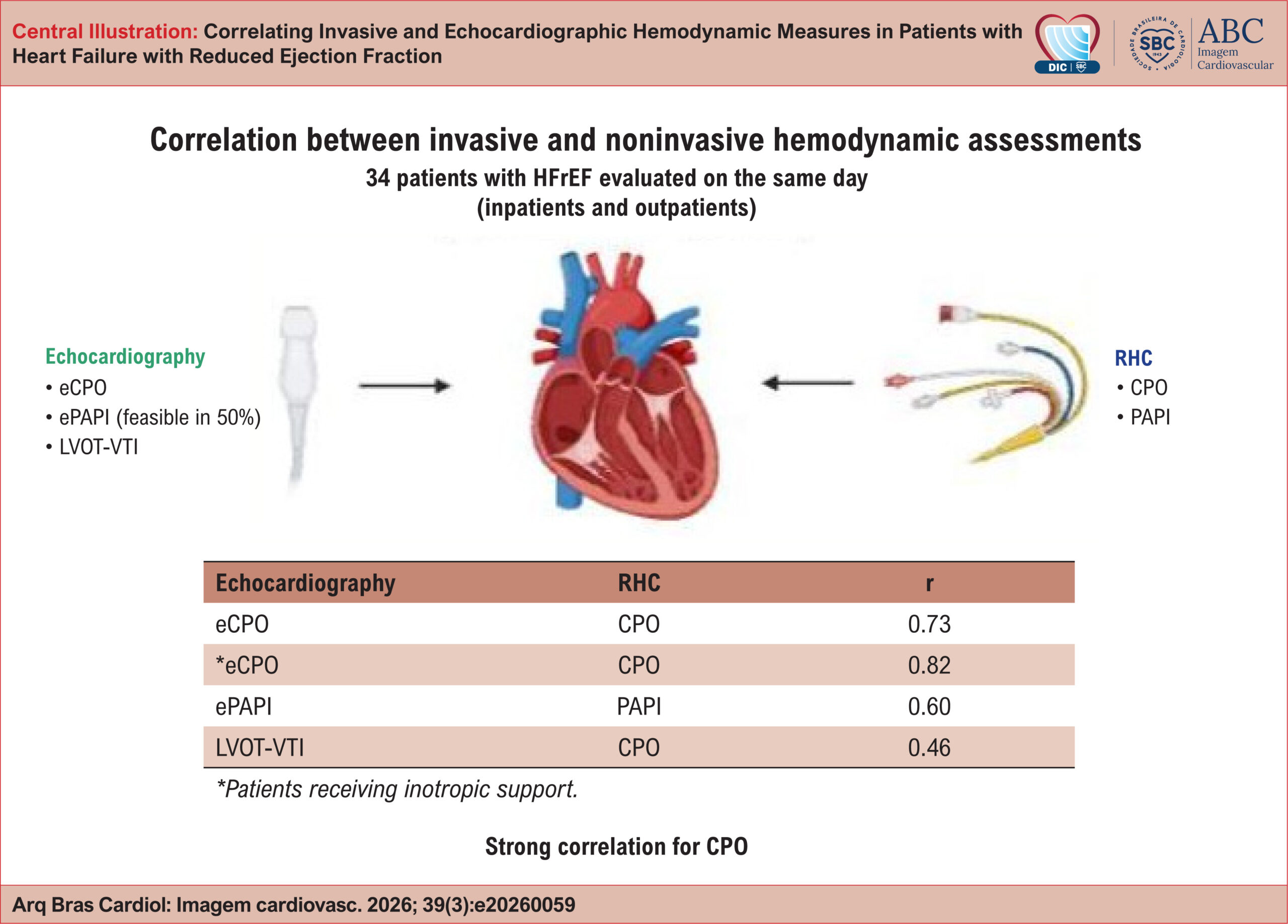
Significant correlations were observed between invasive and echocardiographic CPO (r = 0.737, p < 0.001) and PAPI (r = 0.604, p < 0.05). LVOT-VTI showed significant correlation with CPO measured via pulmonary artery catheter (PAC) (r = 0.469, p < 0.01). Echocardiographic PAPI was measurable in only 16 patients. A sensitivity analysis of those receiving inotropes showed an even stronger correlation between invasive and echocardiographic CPO (r = 0.812, p = 0.005).

Conclusion:

Echocardiographic and invasive hemodynamic parameters showed significant correlations in HFrEF, particularly CPO, supporting echocardiography as a potential alternative for hemodynamic assessment. However, the low feasibility of noninvasive PAPI measurement highlights important limitations in this population.
  • Echocardiography
  • Heart Rate
  • Hemodynamic Monitoring
  • Systolic Heart Failure
Read Full Article
Creative Commons Attribution (CC BY) Creative Commons license
03/09/2026 DOI: 10.36660/abcimg.20260059i Views 3
ABCHF
Case Report

Cardiogenic Shock with High Pressure: A Case Report

Fiamma Ferreira Nogueira et al. Patricia Bezerra Rocha Montenegro Ana Carla Alves de Souza Lyra Taciana Queiroz Medeiros Gomes Carlos Eduardo Lucena Montenegro

Introduction

Shock is defined as a state of tissue hypoperfusion due to reduced supply, increased consumption, inadequate use of oxygen, or a combination of these processes. When it is of cardiogenic etiology, it occurs as a result of left or right ventricular or biventricular dysfunction with reduced cardiac output (CO) or increased filling pressures and normal intravascular volume. Although the most classic manifestation of shock is arterial hypotension, it is essential to recognize that a patient in shock may present with normal, elevated, or decreased blood pressure (BP). Therefore, early identification of clinical, laboratory, and hemodynamic signs of tissue hypoperfusion is crucial. Timely and appropriate treatment can prevent deterioration and signs of multiple organ dysfunction.

[…]

  • Cardiogenic
  • Hemodynamic Monitoring
  • Hypertension
  • Shock
Read Full Article
Creative Commons Attribution (CC BY) Creative Commons license
31/12/2023 DOI: 10.36660/abchf.20230084 Views 1
Figure 1
ABCHF
Review Article

Invasive Cardiopulmonary Hemodynamic Assessment in Patients with Advanced Heart Failure: How to Interpret?

Bruno Biselli et al. Luis Fernando Bernal da Costa Seguro

Abstract

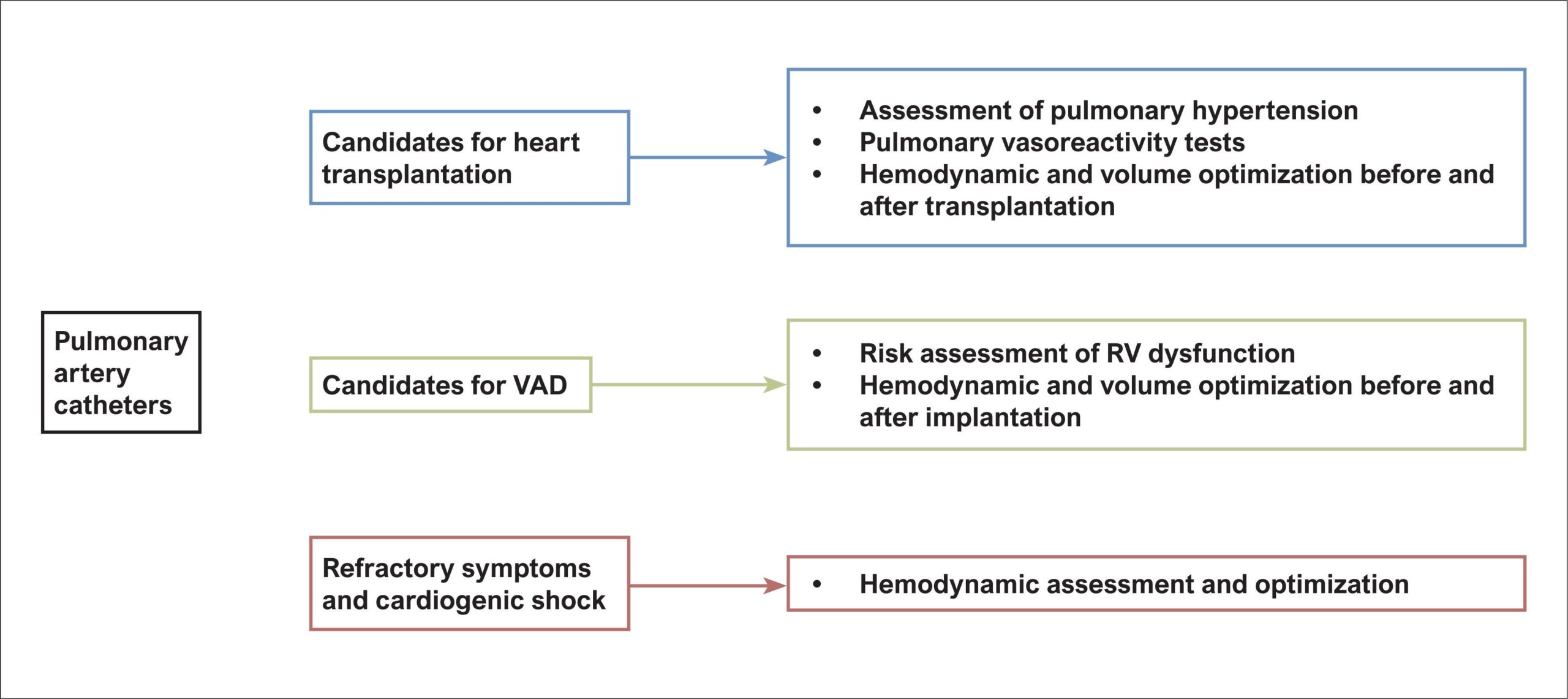
Invasive cardiopulmonary hemodynamic assessment by means of a pulmonary artery catheter is an important tool for evaluating patients with advanced heart failure. It makes it possible to definitively diagnose pulmonary hypertension and, when pulmonary hypertension is present, to classify it as isolated post-capillary or combined pre- and post-capillary. Its use is mandatory in evaluation for heart transplantation and mechanical circulatory assist device implantation. Furthermore, it can be very useful in the management of cardiogenic shock.

  • Heart Failure
  • Hemodynamic Monitoring
  • Pulmonary Hypertension
Read Full Article
Creative Commons Attribution (CC BY) Creative Commons license
29/06/2022 DOI: 10.36660/abchf.20220042 Views 1
ABC
Original Article

Physiological Responses to Maximal and Submaximal Walking in Patients with Symptomatic Peripheral Artery Disease

Marcel Chehuen et al. Aluisio Andrade-Lima Natan Silva Junior Roberto Miyasato … Rodrigo W. Alves de Souza Anthony Leicht Patricia Chakur Brum Edilamar M. Oliveira Nelson Wolosker Claudia Lucia de Moraes Forjaz

Abstract

Background:

Although maximal and submaximal walking are recommended for patients with peripheral artery disease (PAD), performing these exercises may induce different physiological responses.

Objectives:

To compare the acute effects of maximal and submaximal walking on post-exercise cardiovascular function, regulation, and associated pathophysiological processes in patients with symptomatic PAD.

Methods:

Thirty male patients underwent 2 sessions: maximal walking (Gardner’s protocol) and submaximal walking (15 bouts of 2 minutes of walking separated by 2 minutes of upright rest). In each session, blood pressure (BP), heart rate (HR), cardiac autonomic modulation (HR variability), forearm and calf blood flows (BF), vasodilatory capacity (reactive hyperemia), nitric oxide (NO), oxidative stress (lipid peroxidation), and inflammation (four markers) were measured pre- and post-walking. ANOVAs were employed, and p < 0.05 was considered significant.

Results:

Systolic and mean BP decreased after the submaximal session, but they increased after the maximal session (interactions, p 0.05), and it increased after maximal walking (interaction, p < 0.001). HR, sympathovagal balance, and BF increased similarly after both sessions (moment, p < 0.001, p = 0.04, and p 0.05). Vascular and intercellular adhesion molecules increased similarly after both maximal and submaximal walking sessions (moment, p = 0.001).

Conclusions:

In patients with symptomatic PAD, submaximal, but not maximal walking reduced post-exercise BP, while maximal walking maintained elevated cardiac overload during the recovery period. On the other hand, maximal and submaximal walking sessions similarly increased post-exercise HR, cardiac sympathovagal balance, and inflammation, while they did not change post-exercise NO bioavailability and oxidative stress.

  • Byomarkers
  • Hemodynamic Monitoring
  • Intermittent Claudication
  • Oxidative Stress
  • Peripheral Arterial Disease
  • walking
  • Walking Speed
Read Full Article
Creative Commons Attribution (CC BY) Creative Commons license
06/09/2021 DOI: 10.36660/abc.20200156 Views 2

How to cite this article

EndNote RIS

Electronic Document Format (Vancouver)

Barbato JPR, Scolari FL, Machado GP, Amon AB, Crivelaro PCF, Menegazzo WR, Berger SV, et al. Correlating Invasive and Echocardiographic Hemodynamic Measures in Patients with Heart Failure with Reduced Ejection Fraction. ABC Imagem Cardiovascular 2026;39(3):e20260059.

Electronic Document Format (ABNT)

Barbato, João Pedro da Rosa; Scolari, Fernando Luis; Machado, Guilherme Pinheiro; Amon, André Barcellos; Crivelaro, Pedro Castilhos de Freitas; Menegazzo, Willian R.; Berger, Solano Vinicius; Araujo, Gustavo Neves de; Valle, Felipe Homem; Wainstein, Rodrigo Vugman. Correlating Invasive and Echocardiographic Hemodynamic Measures in Patients with Heart Failure with Reduced Ejection Fraction. ABC Imagem Cardiovascular, v. 39, n. 3, e20260059, Sep. 2026.

Electronic Document Format (APA)

Barbato, J. P. R., Scolari, F. L., Machado, G. P., Amon, A. B., Crivelaro, P. C. F., Menegazzo, W. R., Berger, S. V., Araujo, G. N. , Valle, F. H., & Wainstein, R. V. (2026). Correlating Invasive and Echocardiographic Hemodynamic Measures in Patients with Heart Failure with Reduced Ejection Fraction. ABC Imagem Cardiovascular, 39(3), e20260059.

Electronic Document Format (ISO)

Barbato, João Pedro da Rosa and Scolari, Fernando Luis and Machado, Guilherme Pinheiro and Amon, André Barcellos and Crivelaro, Pedro Castilhos de Freitas and Menegazzo, Willian R. and Berger, Solano Vinicius and Araujo, Gustavo Neves de and Valle, Felipe Homem and Wainstein, Rodrigo Vugman. Correlating Invasive and Echocardiographic Hemodynamic Measures in Patients with Heart Failure with Reduced Ejection Fraction. ABC Imagem Cardiovascular [online]. 2026, vol. 39, n. 3, [cited 2026-10-14], e20260059. Available from: <https://journals.cardiol.br/en/article/correlating-invasive-and-echocardiographic-hemodynamic-measures-in-patients-with-heart-failure-with-reduced-ejection-fraction/>. ISSN 2318-8219

EndNote RIS

Electronic Document Format (Vancouver)

Nogueira FF, Montenegro PBR, Lyra ACAS, Gomes TQM, Montenegro CEL. Cardiogenic Shock with High Pressure: A Case Report. ABC Heart Fail Cardiomyop 2023;3(2):e20230084.

Electronic Document Format (ABNT)

Nogueira, Fiamma Ferreira; Montenegro, Patricia Bezerra Rocha; Lyra, Ana Carla Alves de Souza; Gomes, Taciana Queiroz Medeiros; Montenegro, Carlos Eduardo Lucena. Cardiogenic Shock with High Pressure: A Case Report. ABC Heart Fail Cardiomyop, v. 3, n. 2, e20230084, Dec. 2023.

Electronic Document Format (APA)

Nogueira, F. F., Montenegro, P. B. R., Lyra, A. C. A. S., Gomes, T. Q. M., & Montenegro, C. E. L. (2023). Cardiogenic Shock with High Pressure: A Case Report. ABC Heart Fail Cardiomyop, 3(2), e20230084.

Electronic Document Format (ISO)

Nogueira, Fiamma Ferreira and Montenegro, Patricia Bezerra Rocha and Lyra, Ana Carla Alves de Souza and Gomes, Taciana Queiroz Medeiros and Montenegro, Carlos Eduardo Lucena. Cardiogenic Shock with High Pressure: A Case Report. ABC Heart Fail Cardiomyop [online]. 2023, vol. 3, n. 2, [cited 2026-10-14], e20230084. Available from: <https://journals.cardiol.br/en/article/cardiogenic-shock-with-high-pressure-a-case-report/>

EndNote RIS

Electronic Document Format (Vancouver)

Biselli B, Seguro LFBC. Invasive Cardiopulmonary Hemodynamic Assessment in Patients with Advanced Heart Failure: How to Interpret?. ABC: Heart Failure & Cardiomyopathy 2022;2(2):165-72.

Electronic Document Format (ABNT)

Biselli, Bruno; Seguro, Luis Fernando Bernal da Costa. Invasive Cardiopulmonary Hemodynamic Assessment in Patients with Advanced Heart Failure: How to Interpret?. ABC: Heart Failure & Cardiomyopathy, v. 2, n. 2, p. 165-172, Jun. 2022.

Electronic Document Format (APA)

Biselli, B., & Seguro, L. F. B. C. (2022). Invasive Cardiopulmonary Hemodynamic Assessment in Patients with Advanced Heart Failure: How to Interpret?. ABC: Heart Failure & Cardiomyopathy, 2(2), 165-172.

Electronic Document Format (ISO)

Biselli, Bruno and Seguro, Luis Fernando Bernal da Costa. Invasive Cardiopulmonary Hemodynamic Assessment in Patients with Advanced Heart Failure: How to Interpret?. ABC: Heart Failure & Cardiomyopathy [online]. 2022, vol. 2, n. 2, [cited 2026-10-14], pp. 165-172. Available from: <https://journals.cardiol.br/en/article/invasive-cardiopulmonary-hemodynamic-assessment-in-patients-with-advanced-heart-failure-how-to-interpret/>

EndNote RIS

Electronic Document Format (Vancouver)

Chehuen M, Andrade-Lima A, Silva Junior N, Miyasato R, Souza RWA, Leicht A, Brum PC, et al. Physiological Responses to Maximal and Submaximal Walking in Patients with Symptomatic Peripheral Artery Disease. Arquivos Brasileiros de Cardiologia 2021;117(2):309-16.

Electronic Document Format (ABNT)

Chehuen, Marcel; Andrade-Lima, Aluisio; Silva Junior, Natan; Miyasato, Roberto; Souza, Rodrigo W. Alves de; Leicht, Anthony; Brum, Patricia Chakur; Oliveira, Edilamar M.; Wolosker, Nelson; Forjaz, Claudia Lucia de Moraes. Physiological Responses to Maximal and Submaximal Walking in Patients with Symptomatic Peripheral Artery Disease. Arquivos Brasileiros de Cardiologia, v. 117, n. 2, p. 309-316, Sep. 2021.

Electronic Document Format (APA)

Chehuen, M., Andrade-Lima, A., Silva Junior, N., Miyasato, R., Souza, R. W. A. , Leicht, A., Brum, P. C., Oliveira, E. M., Wolosker, N., & Forjaz, C. L. M. (2021). Physiological Responses to Maximal and Submaximal Walking in Patients with Symptomatic Peripheral Artery Disease. Arquivos Brasileiros de Cardiologia, 117(2), 309-316.

Electronic Document Format (ISO)

Chehuen, Marcel and Andrade-Lima, Aluisio and Silva Junior, Natan and Miyasato, Roberto and Souza, Rodrigo W. Alves de and Leicht, Anthony and Brum, Patricia Chakur and Oliveira, Edilamar M. and Wolosker, Nelson and Forjaz, Claudia Lucia de Moraes. Physiological Responses to Maximal and Submaximal Walking in Patients with Symptomatic Peripheral Artery Disease. Arquivos Brasileiros de Cardiologia [online]. 2021, vol. 117, n. 2, [cited 2026-10-14], pp. 309-316. Available from: <https://journals.cardiol.br/en/article/physiological-responses-to-maximal-and-submaximal-walking-in-patients-with-symptomatic-peripheral-artery-disease/>. ISSN 0066-782X

  • About ABC Family
  • Internal Regulation
  • Editorial Board
  • Brazilian Society of Cardiology (SBC)

Issues

SBC Guidelines

  • Videos
  • Podcasts
  • News