ABC Family Arquivos Brasileiros de Cardiologia International Journal of Cardiovascular Sciences ABC Heart Failure & Cardiomyopathy ABC Imagem Cardiovascular
Português English
ABC Family
Português English
  • About
    • About ABC Family
    • Internal Regulation
    • Editorial Board
    • Brazilian Society of Cardiology (SBC)
  • Issues
  • SBC Guidelines
  • Content
    • Videos
    • Podcasts
    • News
  • About
    • About ABC Family
    • Internal Regulation
    • Editorial Board
    • Brazilian Society of Cardiology (SBC)
  • Issues
  • SBC Guidelines
  • Content
    • Videos
    • Podcasts
    • News

ABC Family

  • ABC Family
  • Arquivos Brasileiros de Cardiologia
  • International Journal of Cardiovascular Sciences
  • ABC Heart Failure & Cardiomyopathy
  • ABC Imagem Cardiovascular
Search in

No content found.

Journals
Ordering
Article types
Others

  1. Home
  2. Keyword: Walking Speed
Gait Spatiotemporal Characteristics of Hospitalized Adult Patients with Chronic Heart Failure
ABCHF
Original Article

Gait Spatiotemporal Characteristics of Hospitalized Adult Patients with Chronic Heart Failure

Emmanuelle Melo Sarraf de Souza et al. Thiago José Santos Tássia Oliveira Ribeiro Matheus Sales Nildo Manoel da Silva Ribeiro

Abstract

Background:

Patients with chronic heart failure (CHF) have a decreased ability to walk, which has been related to the occurrence of hospitalizations and mortality and appears to be associated with the severity of the disease.

Objective:

To describe spatiotemporal gait characteristics of adult patients hospitalized with CHF.

Method:

Cross-sectional observational study. Participants diagnosed with CHF, between 18 and 60 years old, functional classification II and III, who were medically authorized to walk as prescribed in their medical records, were included. The walking cycle was based on a distance of 10 meters in a flat, marked corridor.

Results:

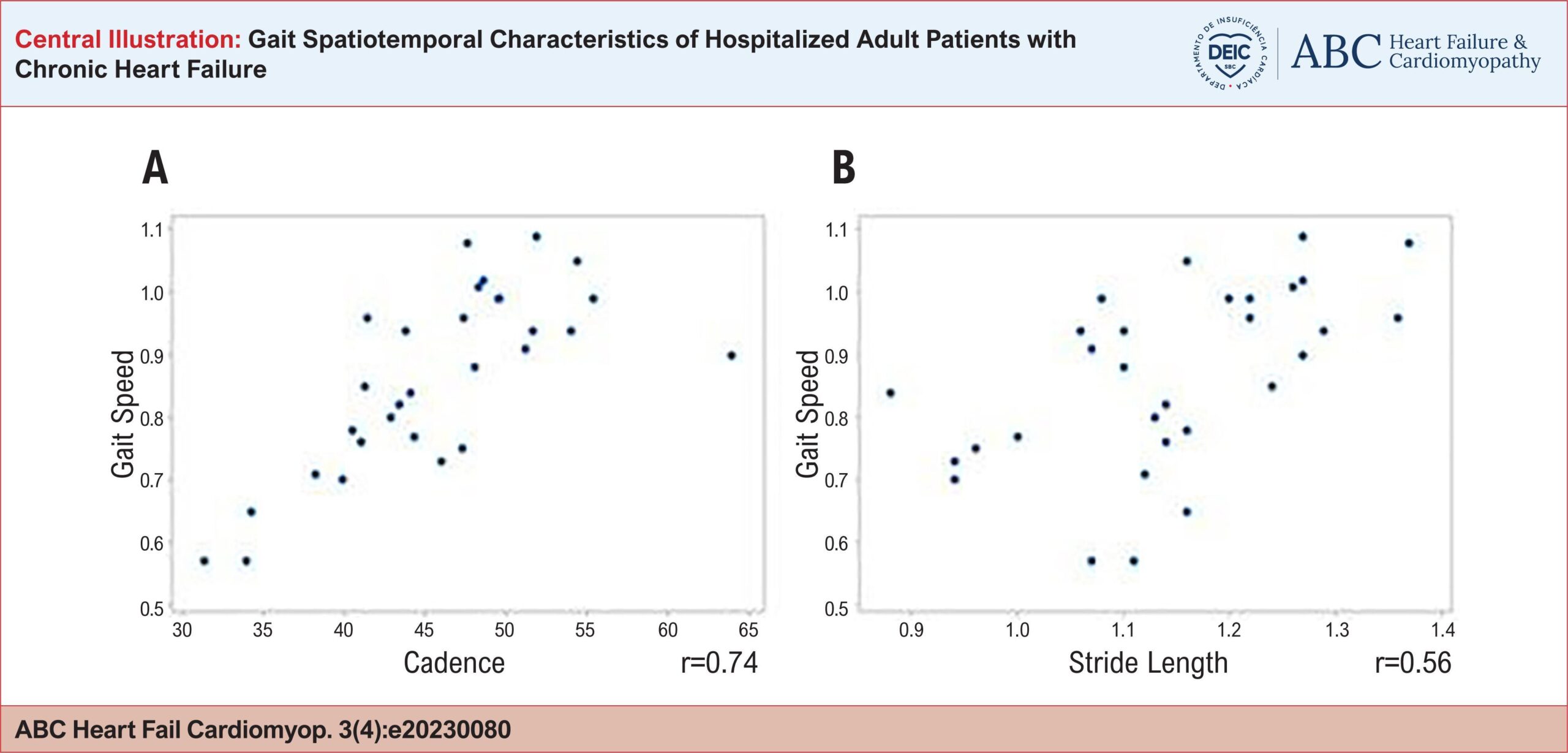
30 individuals participated in the study. The sample was mostly composed of females (n=17; 56.7%) with an average age of 44.5 years. The main etiology was valvular heart disease (n=15;50%), with an average ejection fraction of 44.6%. A strong correlation was observed between gait speed and cadence (r=0.74; p<0.01)) and a moderate correlation between gait speed and stride length (r=0.56; p<0.01). Regarding gait speed, 36.6% of those assessed had values less than or equal to 0.8 meters/second, while 16.6% obtained results above 1m/s.

Conclusion:

A strong correlation was observed between walking speed and cadence, and a moderate correlation between walking speed and stride length. The other gait parameters were not correlated with each other. According to what was observed in the literature, speed, cadence, stride length, and swing phase were reduced, while there was a slight increase in the stance phase when compared to healthy individuals.
  • Heart Diseases
  • Heart Failure
  • Spatio-Temporal Analysis
  • Walking Speed
Read Full Article
Creative Commons Attribution (CC BY) Creative Commons license
31/12/2023 DOI: 10.36660/abchf.20230080 Views 2
ABC
Editorial

Physical Activity Levels Change Over Time in Individuals with Peripheral Arterial Disease

Alexandre Pereira et al. Leandro Franzoni

Physical activity plays a key role in improving functional capacity and cardiovascular function in peripheral arterial disease (PAD). There is a direct relationship between the improvement in peak oxygen consumption (VO2peak) and the reduction in the risk of mortality; in addition, improving symptoms related to intermittent claudication provides a better quality of life (QoL)., However, the assessment of the level of physical activity is often carried out in transversal studies, showing that a higher level of physical activity is correlated with a greater functional capacity, for example. However, the studies do not consider exposure over a given period, leaving open whether there are changes in cardiovascular risk parameters and physical activity levels in these individuals after a follow-up. This is what Cucato et al., analyzed in this edition of the Arquivos Brasileiros de Cardiologia.

Initially, we will bring the methodological study issues, which began in 2015 and included, in the first phase, 268 patients. After 2 years of follow-up, 72 patients were reassessed in the second phase. Different cardiovascular risk parameters and physical activity levels were evaluated using a GT3X+ triaxial accelerometer (Actigraph, Pensacola, FL, USA). Here it is important to highlight the first positive point, which was to use an accelerometer to control physical activity levels, since many studies use a questionnaire to control the level of physical activity. All patients were instructed to use the accelerometer for 7 consecutive days, removing it only to sleep or shower. The device was fixed to the right side of the hip, and for analysis, a minimum of 10 hours of daily physical activity recording was required. Those who had at least 4 days of activity, 3 weekdays and 1 weekend day were considered valid. We highly value this part, as it is a simple method that provides us with extremely high-quality information.

[…]

  • Acceleration
  • Exercise
  • Peripheral Arterial Disease
  • Physical activity
  • Velocity
  • Walking Speed
Read Full Article
Creative Commons Attribution (CC BY) Creative Commons license
11/07/2022 DOI: 10.36660/abc.20220368 Views 1
ABC
Original Article

Physiological Responses to Maximal and Submaximal Walking in Patients with Symptomatic Peripheral Artery Disease

Marcel Chehuen et al. Aluisio Andrade-Lima Natan Silva Junior Roberto Miyasato … Rodrigo W. Alves de Souza Anthony Leicht Patricia Chakur Brum Edilamar M. Oliveira Nelson Wolosker Claudia Lucia de Moraes Forjaz

Abstract

Background:

Although maximal and submaximal walking are recommended for patients with peripheral artery disease (PAD), performing these exercises may induce different physiological responses.

Objectives:

To compare the acute effects of maximal and submaximal walking on post-exercise cardiovascular function, regulation, and associated pathophysiological processes in patients with symptomatic PAD.

Methods:

Thirty male patients underwent 2 sessions: maximal walking (Gardner’s protocol) and submaximal walking (15 bouts of 2 minutes of walking separated by 2 minutes of upright rest). In each session, blood pressure (BP), heart rate (HR), cardiac autonomic modulation (HR variability), forearm and calf blood flows (BF), vasodilatory capacity (reactive hyperemia), nitric oxide (NO), oxidative stress (lipid peroxidation), and inflammation (four markers) were measured pre- and post-walking. ANOVAs were employed, and p < 0.05 was considered significant.

Results:

Systolic and mean BP decreased after the submaximal session, but they increased after the maximal session (interactions, p 0.05), and it increased after maximal walking (interaction, p < 0.001). HR, sympathovagal balance, and BF increased similarly after both sessions (moment, p < 0.001, p = 0.04, and p 0.05). Vascular and intercellular adhesion molecules increased similarly after both maximal and submaximal walking sessions (moment, p = 0.001).

Conclusions:

In patients with symptomatic PAD, submaximal, but not maximal walking reduced post-exercise BP, while maximal walking maintained elevated cardiac overload during the recovery period. On the other hand, maximal and submaximal walking sessions similarly increased post-exercise HR, cardiac sympathovagal balance, and inflammation, while they did not change post-exercise NO bioavailability and oxidative stress.

  • Byomarkers
  • Hemodynamic Monitoring
  • Intermittent Claudication
  • Oxidative Stress
  • Peripheral Arterial Disease
  • walking
  • Walking Speed
Read Full Article
Creative Commons Attribution (CC BY) Creative Commons license
06/09/2021 DOI: 10.36660/abc.20200156 Views 2
Figure 1
IJCS
Original Article

Moderate-Intensity Walking Training Improves Depressive Symptoms and Pain in Older Adults with Good Quality of Life: A Controlled Randomized Trial

Silvio Lopes Alabarse et al. Hélio José Coelho Júnior Ricardo Yukio Asano Braulio Luna Filho … Wagner Correa Santos Japy Angelini Oliveira Filho

Abstract

Background:

Walking training can be an adequate choice to improve physical and psychological conditions in the elderly. Studies have reported positive changes in the quality of life, depressive symptoms and pain. However, baseline characteristics of volunteers have been controlled, and some of previous studies have not investigated these parameters concomitantly.

Objectives:

To assess the effects of moderate-intensity walking on quality of life, depressive symptoms and physical pain in physically active elderly individuals.

Methods:

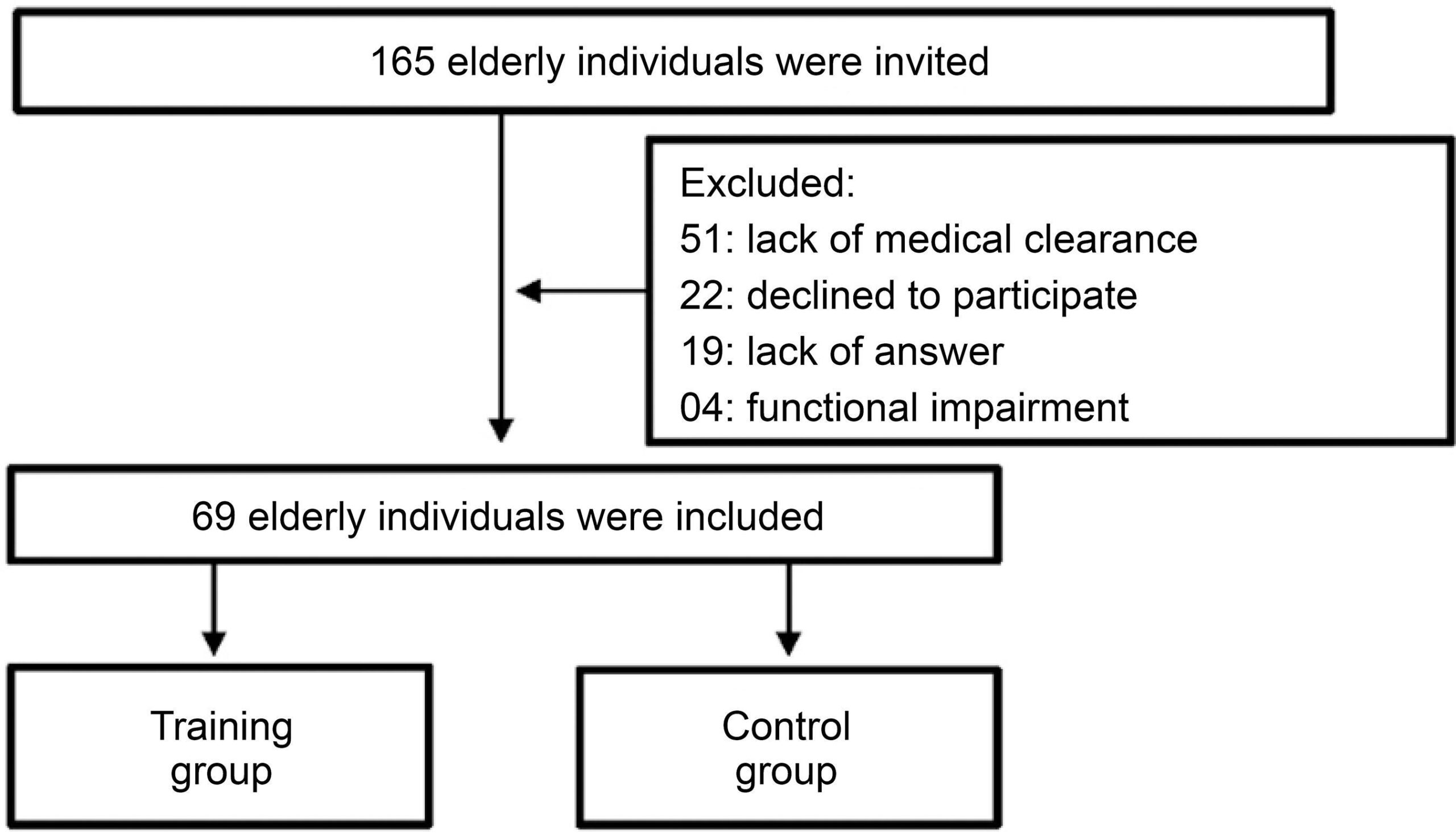
Sixty-nine subjects were recruited and allocated into two groups: training group (n = 40) and control group (n = 29). All were evaluated for quality of life, depressive symptoms and pain. Training group underwent 40 minutes of walking (50-70% of maximum heart rate), 3 days a week for 12 weeks. For statistical analysis, we used the Kolmogorov-Smirnov test, Student’s t-test and Split-Plot ANOVA with Bonferroni post hoc, Pearson correlation. Significance level was set at 5%.

Results:

After 12 weeks of training, depressive symptoms and physical pain significantly reduced in the training group (2.7 ± 2.4 to 1.9 ± 1.8 and 4.3 ± 3.1 to 2.8 ± 2.9, respectively) compared with baseline values, and remained unchanged in the control group. There was a positive, moderate correlation between depressive symptoms and pain (r = 0.30).

Conclusion:

physically active elderly individuals with good quality of life show improved depressive symptoms after a short-term moderate-intensity walking training program.

  • Aged
  • Depression
  • pain
  • Quality of life
  • walking
  • Walking Speed
Read Full Article
Creative Commons Attribution (CC BY) Creative Commons license
01/04/2019 DOI: 10.5935/2359-4802.20190026 Views 1

How to cite this article

EndNote RIS

Electronic Document Format (Vancouver)

Souza EMS, Santos TJ, Ribeiro TO, Sales M, Ribeiro NMS. Gait Spatiotemporal Characteristics of Hospitalized Adult Patients with Chronic Heart Failure. ABC Heart Fail Cardiomyop 2023;3(4):e20230080.

Electronic Document Format (ABNT)

Souza, Emmanuelle Melo Sarraf de; Santos, Thiago José; Ribeiro, Tássia Oliveira; Sales, Matheus; Ribeiro, Nildo Manoel da Silva. Gait Spatiotemporal Characteristics of Hospitalized Adult Patients with Chronic Heart Failure. ABC Heart Fail Cardiomyop, v. 3, n. 4, e20230080, Dec. 2023.

Electronic Document Format (APA)

Souza, E. M. S. , Santos, T. J., Ribeiro, T. O., Sales, M., & Ribeiro, N. M. S. (2023). Gait Spatiotemporal Characteristics of Hospitalized Adult Patients with Chronic Heart Failure. ABC Heart Fail Cardiomyop, 3(4), e20230080.

Electronic Document Format (ISO)

Souza, Emmanuelle Melo Sarraf de and Santos, Thiago José and Ribeiro, Tássia Oliveira and Sales, Matheus and Ribeiro, Nildo Manoel da Silva. Gait Spatiotemporal Characteristics of Hospitalized Adult Patients with Chronic Heart Failure. ABC Heart Fail Cardiomyop [online]. 2023, vol. 3, n. 4, [cited 2026-10-14], e20230080. Available from: <https://journals.cardiol.br/en/article/gait-spatiotemporal-characteristics-of-hospitalized-adult-patients-with-chronic-heart-failure/>

EndNote RIS

Electronic Document Format (Vancouver)

Pereira A, Franzoni L. Physical Activity Levels Change Over Time in Individuals with Peripheral Arterial Disease. Arquivos Brasileiros de Cardiologia 2022;119(1):67-8.

Electronic Document Format (ABNT)

Pereira, Alexandre; Franzoni, Leandro. Physical Activity Levels Change Over Time in Individuals with Peripheral Arterial Disease. Arquivos Brasileiros de Cardiologia, v. 119, n. 1, p. 67-68, Jul. 2022.

Electronic Document Format (APA)

Pereira, A., & Franzoni, L. (2022). Physical Activity Levels Change Over Time in Individuals with Peripheral Arterial Disease. Arquivos Brasileiros de Cardiologia, 119(1), 67-68.

Electronic Document Format (ISO)

Pereira, Alexandre and Franzoni, Leandro. Physical Activity Levels Change Over Time in Individuals with Peripheral Arterial Disease. Arquivos Brasileiros de Cardiologia [online]. 2022, vol. 119, n. 1, [cited 2026-10-14], pp. 67-68. Available from: <https://journals.cardiol.br/en/article/physical-activity-levels-change-over-time-in-individuals-with-peripheral-arterial-disease/>. ISSN 0066-782X

EndNote RIS

Electronic Document Format (Vancouver)

Chehuen M, Andrade-Lima A, Silva Junior N, Miyasato R, Souza RWA, Leicht A, Brum PC, et al. Physiological Responses to Maximal and Submaximal Walking in Patients with Symptomatic Peripheral Artery Disease. Arquivos Brasileiros de Cardiologia 2021;117(2):309-16.

Electronic Document Format (ABNT)

Chehuen, Marcel; Andrade-Lima, Aluisio; Silva Junior, Natan; Miyasato, Roberto; Souza, Rodrigo W. Alves de; Leicht, Anthony; Brum, Patricia Chakur; Oliveira, Edilamar M.; Wolosker, Nelson; Forjaz, Claudia Lucia de Moraes. Physiological Responses to Maximal and Submaximal Walking in Patients with Symptomatic Peripheral Artery Disease. Arquivos Brasileiros de Cardiologia, v. 117, n. 2, p. 309-316, Sep. 2021.

Electronic Document Format (APA)

Chehuen, M., Andrade-Lima, A., Silva Junior, N., Miyasato, R., Souza, R. W. A. , Leicht, A., Brum, P. C., Oliveira, E. M., Wolosker, N., & Forjaz, C. L. M. (2021). Physiological Responses to Maximal and Submaximal Walking in Patients with Symptomatic Peripheral Artery Disease. Arquivos Brasileiros de Cardiologia, 117(2), 309-316.

Electronic Document Format (ISO)

Chehuen, Marcel and Andrade-Lima, Aluisio and Silva Junior, Natan and Miyasato, Roberto and Souza, Rodrigo W. Alves de and Leicht, Anthony and Brum, Patricia Chakur and Oliveira, Edilamar M. and Wolosker, Nelson and Forjaz, Claudia Lucia de Moraes. Physiological Responses to Maximal and Submaximal Walking in Patients with Symptomatic Peripheral Artery Disease. Arquivos Brasileiros de Cardiologia [online]. 2021, vol. 117, n. 2, [cited 2026-10-14], pp. 309-316. Available from: <https://journals.cardiol.br/en/article/physiological-responses-to-maximal-and-submaximal-walking-in-patients-with-symptomatic-peripheral-artery-disease/>. ISSN 0066-782X

EndNote RIS

Electronic Document Format (Vancouver)

Alabarse SL, Coelho Júnior HJ, Asano RY, Luna Filho B, Santos WC, Oliveira Filho JA. Moderate-Intensity Walking Training Improves Depressive Symptoms and Pain in Older Adults with Good Quality of Life: A Controlled Randomized Trial. International Journal of Cardiovascular Sciences 2019;32(6):553-62.

Electronic Document Format (ABNT)

Alabarse, Silvio Lopes; Coelho Júnior, Hélio José; Asano, Ricardo Yukio; Luna Filho, Braulio; Santos, Wagner Correa; Oliveira Filho, Japy Angelini. Moderate-Intensity Walking Training Improves Depressive Symptoms and Pain in Older Adults with Good Quality of Life: A Controlled Randomized Trial. International Journal of Cardiovascular Sciences, v. 32, n. 6, p. 553-562, Mar. 2019.

Electronic Document Format (APA)

Alabarse, S. L., Coelho Júnior, H. J., Asano, R. Y., Luna Filho, B., Santos, W. C., & Oliveira Filho, J. A. (2019). Moderate-Intensity Walking Training Improves Depressive Symptoms and Pain in Older Adults with Good Quality of Life: A Controlled Randomized Trial. International Journal of Cardiovascular Sciences, 32(6), 553-562.

Electronic Document Format (ISO)

Alabarse, Silvio Lopes and Coelho Júnior, Hélio José and Asano, Ricardo Yukio and Luna Filho, Braulio and Santos, Wagner Correa and Oliveira Filho, Japy Angelini. Moderate-Intensity Walking Training Improves Depressive Symptoms and Pain in Older Adults with Good Quality of Life: A Controlled Randomized Trial. International Journal of Cardiovascular Sciences [online]. 2019, vol. 32, n. 6, [cited 2026-10-14], pp. 553-562. Available from: <https://journals.cardiol.br/en/article/moderate-intensity-walking-training-improves-depressive-symptoms-and-pain-in-older-adults-with-good-quality-of-life-a-controlled-randomized-trial/>. ISSN 2359-4802

  • About ABC Family
  • Internal Regulation
  • Editorial Board
  • Brazilian Society of Cardiology (SBC)

Issues

SBC Guidelines

  • Videos
  • Podcasts
  • News