ABC Family Arquivos Brasileiros de Cardiologia International Journal of Cardiovascular Sciences ABC Heart Failure & Cardiomyopathy ABC Imagem Cardiovascular
Português English
ABC Family
Português English
  • About
    • About ABC Family
    • Internal Regulation
    • Editorial Board
    • Brazilian Society of Cardiology (SBC)
  • Issues
  • SBC Guidelines
  • Content
    • Videos
    • Podcasts
    • News
  • About
    • About ABC Family
    • Internal Regulation
    • Editorial Board
    • Brazilian Society of Cardiology (SBC)
  • Issues
  • SBC Guidelines
  • Content
    • Videos
    • Podcasts
    • News

ABC Family

  • ABC Family
  • Arquivos Brasileiros de Cardiologia
  • International Journal of Cardiovascular Sciences
  • ABC Heart Failure & Cardiomyopathy
  • ABC Imagem Cardiovascular
Search in

No content found.

Journals
Ordering
Article types
Others

  1. Home
  2. Keyword: Gadolinium
Figure 1
ABC
Case Report

Acute Myocarditis as the Initial Presentation of Desmoplakin Mutation – Broadening the Differential Diagnosis

Hideki Koike et al. Amr Idris Justin Berger Victor Y. Cheng … Jay Sengupta João L. Cavalcante

Introduction

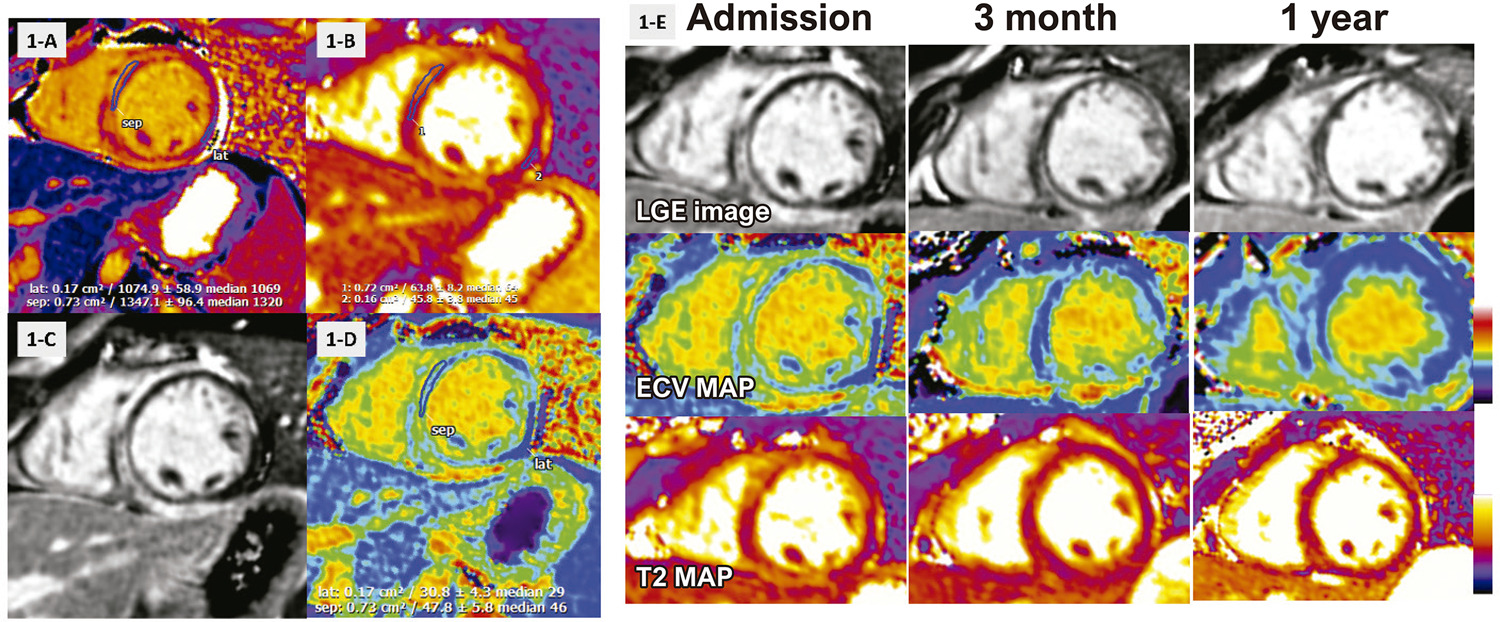
Genetic cardiomyopathy related to desmoplakin (DSP) mutation can start its clinical manifestation with chest pain symptoms, along with transient troponin elevation configuring first manifest as acute myocarditis, sometimes in a relapsing pattern. It is clear that the revised Task Force criteria for genetic cardiomyopathy will miss many cases, particularly those with left-sided dominance. This case reports highlights to understand that genetic cardiomyopathy, particularly with DSP mutation, can present with acute myocarditis and to understand that cardiovascular magnetic resonance (CMR) imaging could raise the possibility of arrhythmogenic cardiomyopathy and predict ventricular tachyarrhythmias despite preserved LVEF.

[…]

  • Dilated Cardiomyopathy
  • Gadolinium
  • Myocardium
Read Full Article
Creative Commons Attribution (CC BY) Creative Commons license
03/05/2024 DOI: 10.36660/abc.20230541i Views 1
Figure 1
ABC
Original Article

Relationship between Late Gadolinium Enhancement and Ventricular Repolarization Parameters in Heart Failure Patients with Reduced Ejection Fraction

Ali Riza Demir et al. Omer Celik Songül Ustündağ Begum Uygur … Mustafa Umut Somuncu Emre Yilmaz Yalcin Avci Gokhan Demirci Serkan Kahraman Mehmet Erturk

Abstract

Background

Heart failure with reduced ejection fraction (HFrEF) is a highly prevalent disease that requires repeating hospitalizations, causes significant morbidity and mortality. Therefore, early recognition of poor outcome predictors is essential for patient management.

Objective

The aim of the present study is to investigate the relationship between late gadolinium enhancement (LGE) detected by cardiac magnetic resonance (CMR) and repolarization parameters such as corrected QT (QTc) interval, Tp-e interval, frontal QRS-T angle detected by 12 lead electrocardiograph (ECG) in HFrEF.

Method

In this single-center, retrospective observational study included 97 consecutive HFrEF patients who had CMR scan. Study population was divided into two groups according to the presence of LGE. Echocardiographic and CMR measurements and demographic features were recorded. QTc intervals, Tp-e intervals, frontal QRS-T angles were calculated from the ECG. A p-value less than 0.05 was considered statistically significant.

Results

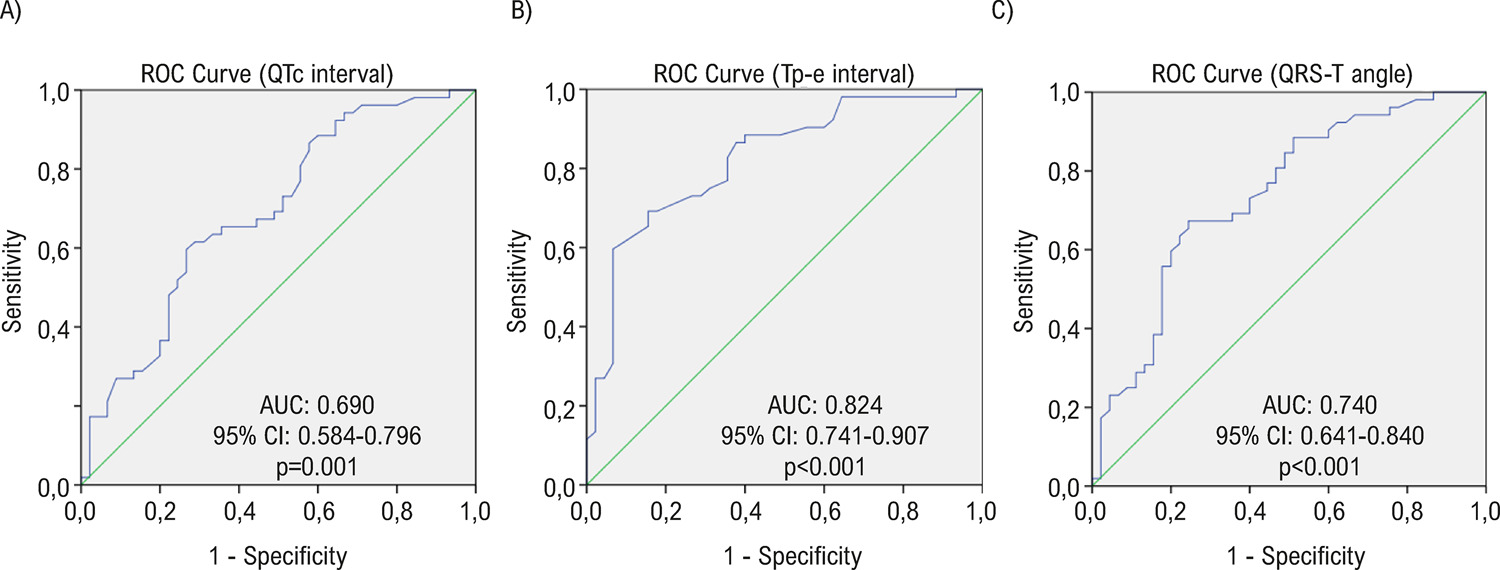
LGE was detected in 52 (53.6%) out of 97 HFrEF patients. QTc intervals (p=0.001), Tp-e intervals (p<0.001), frontal QRS-T angles (p<0.001) were found to be significantly higher in LGE group when compared to non-LGE group. In univariate regression analysis which was performed to investigate the predictors of LGE in HFrEF, all three repolarization parameters were reached significant values but in multivariate analysis the only repolarization parameter remained significant was Tp-e interval (OR=1.085 95% CI 1.032-1.140, p=0.001).

Conclusion

With the prolongation of the Tp-e interval, the presence of myocardial fibrosis which is an arrhythmogenic substrate, can be predicted in patients with HFrEF.
  • Continuity of Patient Care/ethic
  • Diagnostic Imaging
  • Electrocardiography/methods
  • Gadolinium
  • Heart Failure
  • Magnetic Resonance Spectroscopy
  • Stroke Volume
Read Full Article
Creative Commons Attribution (CC BY) Creative Commons license
02/07/2021 DOI: 10.36660/abc.20200149
ABC
Editorial

Is Magnetic Resonance Imaging Already an Appropriate Method for Evaluating Patients after Atrial Fibrillation Catheter Ablation?

Cristiano F. Pisani et al. Mauricio Scanavacca

For a long time, lack of knowledge regarding the physiopathology of atrial fibrillation (AF) limited the development of interventional techniques for treating it. Demonstrations that paroxysmal AF was triggered by extrasystoles and tachycardias mainly originating from inside the pulmonary veins ushered in a new era for treatment of AF. Since then, electrical isolation of the pulmonary veins has been the standard treatment for AF. Among specialists, achieving lasting electrical isolation of the pulmonary veins has been the main technical challenge, which has gradually been overcome in recent years with the implementation of new technology for more effective ablation, given that reconnections or previously isolated veins are the main cause of recurrences observed in these patients.

The challenge has been greater in patients with persistent AF, owing to its more complex physiopathology, which involves additional mechanisms that are little known, in addition to the pulmonary venous foci. It is known that metabolic alterations induced by excessive atrial work during repeated episodes of AF initially induce atrial electrical remodeling, characterized by functional and transient changes in ion channels of cell membranes that modulate atrial electrical activity, thus facilitating the appearance of trigger foci in other regions of the atria and conditions that favor increased persistence of AF.

[…]

  • Atria Premature Complexes
  • Atrial Fibrillation
  • Catheter Ablation
  • Gadolinium
  • Magnetic Resonance Spectroscopy/ methods
Read Full Article
Creative Commons Attribution (CC BY) Creative Commons license
29/05/2020 DOI: 10.36660/abc.20200204 Views 2
Figure 1
ABC
Original Article

Reproducibility of Gadolinium Enhancement Patterns and Wall Thickness in Hypertrophic Cardiomyopathy

Gaston A. Rodriguez-Granillo et al. Alejandro Deviggiano Carlos Capunay Macarena C. De Zan Patricia Carrascosa

Abstract

Background:

Reproducibility data of the extent and patterns of late gadolinium enhancement (LGE) in hypertrophic cardiomyopathy (HCM) is limited.

Objective:

To explore the reproducibility of regional wall thickness (WT), LGE extent, and LGE patterns in patients with HCM assessed with cardiac magnetic resonance (CMR).

Methods:

The extent of LGE was assessed by the number of segments with LGE, and by the total LV mass with LGE (% LGE); and the pattern of LGE-CMR was defined for each segment.

Results:

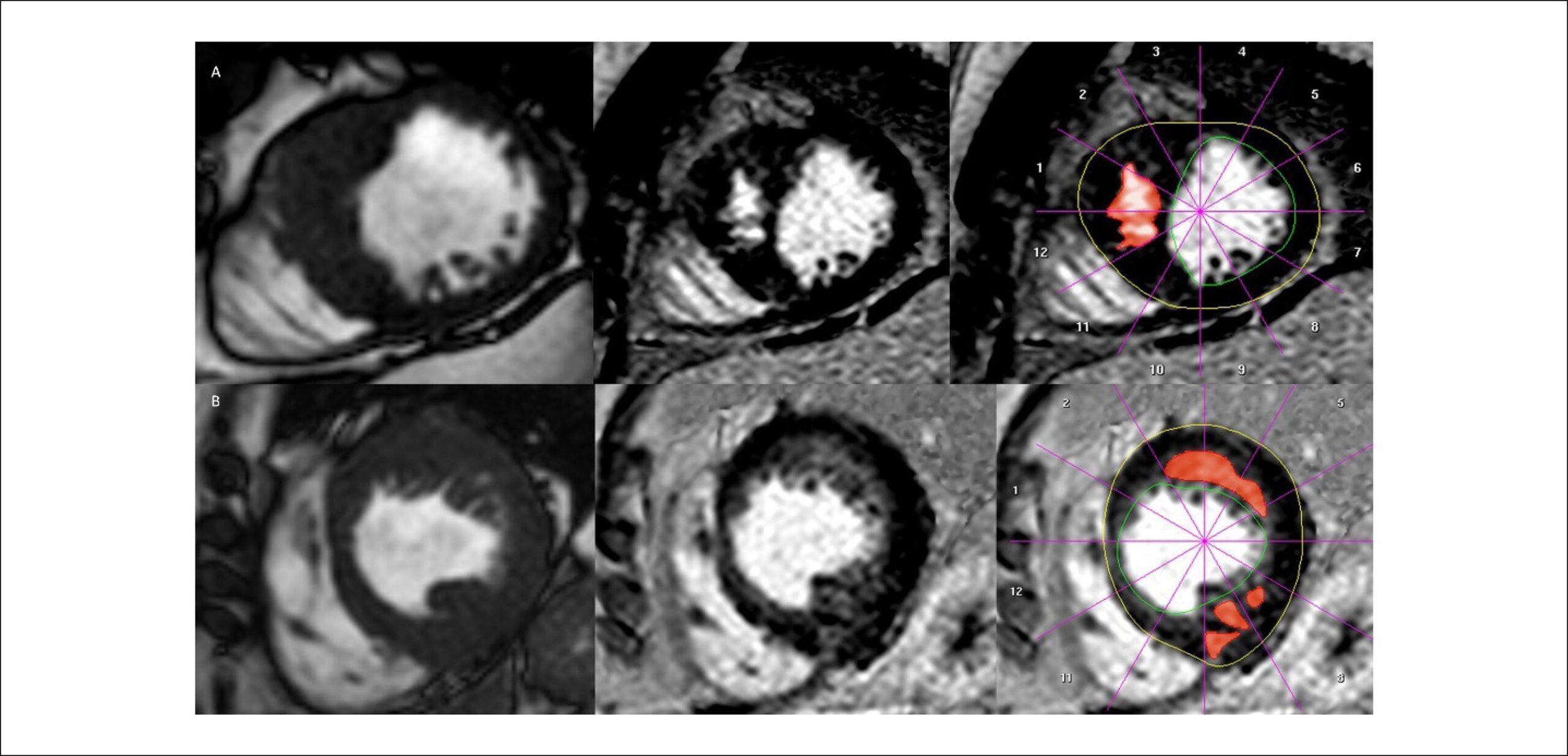
A total of 42 patients (672 segments) with HCM constituted the study population. The mean WT measurements showed a mean difference between observers of -0.62 ± 1.0 mm (6.1%), with limits of agreement of 1.36 mm; -2.60 mm and intraclass correlation coefficient (ICC) of 0.95 (95% CI 0.93-0.96). Maximum WT measurements showed a mean difference between observers of -0.19 ± 0.8 mm (0.9%), with limits of agreement of 1.32 mm; -1.70 mm, and an ICC of 0.95 (95% CI 0.91-0.98). The % LGE showed a mean difference between observers of -1.17 ± 1.2 % (21%), with limits of agreement of 1.16%; -3.49%, and an ICC of 0.94 (95% CI 0.88-0.97). The mean difference between observers regarding the number of segments with LGE was -0.40 ± 0.45 segments (11%), with limits of agreement of 0.50 segments; -1.31 segments, and an ICC of 0.97 (95% CI 0.94-0.99).

Conclusions:

The number of segments with LGE might be more reproducible than the percent of the LV mass with LGE.

  • Cardiomyopathy, Hypertrophic
  • Gadolinium
  • Magnetic Resonance Imaging
  • Reproducibility of Results
  • Ventricular Dysfunction
Read Full Article
Creative Commons Attribution (CC BY) Creative Commons license
10/06/2016 DOI: 10.5935/abc.20160087

How to cite this article

EndNote RIS

Electronic Document Format (Vancouver)

Koike H, Idris A, Berger J, Cheng VY, Sengupta J, Cavalcante JL. Acute Myocarditis as the Initial Presentation of Desmoplakin Mutation – Broadening the Differential Diagnosis. Arquivos Brasileiros de Cardiologia 2024;121(4):e20230541.

Electronic Document Format (ABNT)

Koike, Hideki; Idris, Amr; Berger, Justin; Cheng, Victor Y.; Sengupta, Jay; Cavalcante, João L.. Acute Myocarditis as the Initial Presentation of Desmoplakin Mutation – Broadening the Differential Diagnosis. Arquivos Brasileiros de Cardiologia, v. 121, n. 4, e20230541, May. 2024.

Electronic Document Format (APA)

Koike, H., Idris, A., Berger, J., Cheng, V. Y., Sengupta, J., & Cavalcante, J. L. (2024). Acute Myocarditis as the Initial Presentation of Desmoplakin Mutation – Broadening the Differential Diagnosis. Arquivos Brasileiros de Cardiologia, 121(4), e20230541.

Electronic Document Format (ISO)

Koike, Hideki and Idris, Amr and Berger, Justin and Cheng, Victor Y. and Sengupta, Jay and Cavalcante, João L.. Acute Myocarditis as the Initial Presentation of Desmoplakin Mutation – Broadening the Differential Diagnosis. Arquivos Brasileiros de Cardiologia [online]. 2024, vol. 121, n. 4, [cited 2026-10-15], e20230541. Available from: <https://journals.cardiol.br/en/article/acute-myocarditis-as-the-initial-presentation-of-desmoplakin-mutation-broadening-the-differential-diagnosis/>. ISSN 0066-782X

EndNote RIS

Electronic Document Format (Vancouver)

Demir AR, Celik O, Ustündağ S, Uygur B, Somuncu MU, Yilmaz E, Avci Y, et al. Relationship between Late Gadolinium Enhancement and Ventricular Repolarization Parameters in Heart Failure Patients with Reduced Ejection Fraction. Arquivos Brasileiros de Cardiologia 2021;117(4):678-87.

Electronic Document Format (ABNT)

Demir, Ali Riza; Celik, Omer; Ustündağ, Songül; Uygur, Begum; Somuncu, Mustafa Umut; Yilmaz, Emre; Avci, Yalcin; Demirci, Gokhan; Kahraman, Serkan; Erturk, Mehmet. Relationship between Late Gadolinium Enhancement and Ventricular Repolarization Parameters in Heart Failure Patients with Reduced Ejection Fraction. Arquivos Brasileiros de Cardiologia, v. 117, n. 4, p. 678-687, Jul. 2021.

Electronic Document Format (APA)

Demir, A. R., Celik, O., Ustündağ, S., Uygur, B., Somuncu, M. U., Yilmaz, E., Avci, Y., Demirci, G., Kahraman, S., & Erturk, M. (2021). Relationship between Late Gadolinium Enhancement and Ventricular Repolarization Parameters in Heart Failure Patients with Reduced Ejection Fraction. Arquivos Brasileiros de Cardiologia, 117(4), 678-687.

Electronic Document Format (ISO)

Demir, Ali Riza and Celik, Omer and Ustündağ, Songül and Uygur, Begum and Somuncu, Mustafa Umut and Yilmaz, Emre and Avci, Yalcin and Demirci, Gokhan and Kahraman, Serkan and Erturk, Mehmet. Relationship between Late Gadolinium Enhancement and Ventricular Repolarization Parameters in Heart Failure Patients with Reduced Ejection Fraction. Arquivos Brasileiros de Cardiologia [online]. 2021, vol. 117, n. 4, [cited 2026-10-15], pp. 678-687. Available from: <https://journals.cardiol.br/en/article/relationship-between-late-gadolinium-enhancement-and-ventricular-repolarization-parameters-in-heart-failure-patients-with-reduced-ejection-fraction/>. ISSN 0066-782X

EndNote RIS

Electronic Document Format (Vancouver)

Pisani CF, Scanavacca M. Is Magnetic Resonance Imaging Already an Appropriate Method for Evaluating Patients after Atrial Fibrillation Catheter Ablation?. Arquivos Brasileiros de Cardiologia 2020;114(4):636-7.

Electronic Document Format (ABNT)

Pisani, Cristiano F.; Scanavacca, Mauricio. Is Magnetic Resonance Imaging Already an Appropriate Method for Evaluating Patients after Atrial Fibrillation Catheter Ablation?. Arquivos Brasileiros de Cardiologia, v. 114, n. 4, p. 636-637, May. 2020.

Electronic Document Format (APA)

Pisani, C. F., & Scanavacca, M. (2020). Is Magnetic Resonance Imaging Already an Appropriate Method for Evaluating Patients after Atrial Fibrillation Catheter Ablation?. Arquivos Brasileiros de Cardiologia, 114(4), 636-637.

Electronic Document Format (ISO)

Pisani, Cristiano F. and Scanavacca, Mauricio. Is Magnetic Resonance Imaging Already an Appropriate Method for Evaluating Patients after Atrial Fibrillation Catheter Ablation?. Arquivos Brasileiros de Cardiologia [online]. 2020, vol. 114, n. 4, [cited 2026-10-15], pp. 636-637. Available from: <https://journals.cardiol.br/en/article/is-magnetic-resonance-imaging-already-an-appropriate-method-for-evaluating-patients-after-atrial-fibrillation-catheter-ablation/>. ISSN 0066-782X

EndNote RIS

Electronic Document Format (Vancouver)

Rodriguez-Granillo GA, Deviggiano A, Capunay C, Zan MCD, Carrascosa P. Reproducibility of Gadolinium Enhancement Patterns and Wall Thickness in Hypertrophic Cardiomyopathy. Arquivos Brasileiros de Cardiologia 2016;107(1):48-54.

Electronic Document Format (ABNT)

Rodriguez-Granillo, Gaston A.; Deviggiano, Alejandro; Capunay, Carlos; Zan, Macarena C. De; Carrascosa, Patricia. Reproducibility of Gadolinium Enhancement Patterns and Wall Thickness in Hypertrophic Cardiomyopathy. Arquivos Brasileiros de Cardiologia, v. 107, n. 1, p. 48-54, Jun. 2016.

Electronic Document Format (APA)

Rodriguez-Granillo, G. A., Deviggiano, A., Capunay, C., Zan, M. C. D., & Carrascosa, P. (2016). Reproducibility of Gadolinium Enhancement Patterns and Wall Thickness in Hypertrophic Cardiomyopathy. Arquivos Brasileiros de Cardiologia, 107(1), 48-54.

Electronic Document Format (ISO)

Rodriguez-Granillo, Gaston A. and Deviggiano, Alejandro and Capunay, Carlos and Zan, Macarena C. De and Carrascosa, Patricia. Reproducibility of Gadolinium Enhancement Patterns and Wall Thickness in Hypertrophic Cardiomyopathy. Arquivos Brasileiros de Cardiologia [online]. 2016, vol. 107, n. 1, [cited 2026-10-15], pp. 48-54. Available from: <https://journals.cardiol.br/en/article/reproducibility-of-gadolinium-enhancement-patterns-and-wall-thickness-in-hypertrophic-cardiomyopathy/>. ISSN 0066-782X

  • About ABC Family
  • Internal Regulation
  • Editorial Board
  • Brazilian Society of Cardiology (SBC)

Issues

SBC Guidelines

  • Videos
  • Podcasts
  • News