ABC Family Arquivos Brasileiros de Cardiologia International Journal of Cardiovascular Sciences ABC Heart Failure & Cardiomyopathy ABC Imagem Cardiovascular
Português English
ABC Family
Português English
  • About
    • About ABC Family
    • Internal Regulation
    • Editorial Board
    • Brazilian Society of Cardiology (SBC)
  • Issues
  • SBC Guidelines
  • Content
    • Videos
    • Podcasts
    • News
  • About
    • About ABC Family
    • Internal Regulation
    • Editorial Board
    • Brazilian Society of Cardiology (SBC)
  • Issues
  • SBC Guidelines
  • Content
    • Videos
    • Podcasts
    • News

ABC Family

  • ABC Family
  • Arquivos Brasileiros de Cardiologia
  • International Journal of Cardiovascular Sciences
  • ABC Heart Failure & Cardiomyopathy
  • ABC Imagem Cardiovascular
Search in

No content found.

Journals
Ordering
Article types
Others

  1. Home
  2. Keyword: Diagnostic,Imaging
ABC
Editorial

Stress CMR in the Elderly: Does It Provide the Answers?

Vera Vaz Ferreira et al. Boban Thomas

After the ISCHEMIA clinical trial, despite the ongoing debate, clinicians need to contemplate all strategies for patients with chronic stable ischemic heart disease (SIHD). The management of SIHD has two aims – improve prognosis and/or relieve symptoms. Most studies have shown that revascularisation provides greater symptom benefits than optimal medical therapy (OMT) alone, but data on hard outcomes have been elusive. Therefore, improving our clinical decision-making tools in selecting patients for revascularization is important. This becomes particularly important when we select elderly patients for revascularisation because the risk-benefit ratio is probably more tenuous than a younger cohort. The elderly present difficulties in the evaluation of SIHD due to multiple reasons. One refinement is the adequate selection of the method to evaluate SIHD. A panoply of non-invasive techniques exists for imaging, including cardiac computed tomography, echocardiography, nuclear medicine techniques and cardiac magnetic resonance (CMR). Combining the right patient and the right method of evaluation followed by the right therapeutic strategy improves outcomes. In clinical medicine, what is important is not how much we do but how well our patients do after what we do.

CMR stress perfusion is a valuable resource with a high negative predictive value in those who do not have perfusion defects irrespective of the presence or absence of coronary artery disease. Few studies exist on the prognostic value of adenosine stress perfusion CMR in elderly patients with or without established SIHD. The study by Boonyasirinant and Kaolawanich, although not the first, is a welcome addition to the repository of existing literature that provides a cogent reason for using stress CMR for the evaluation of ischemia now addressing the elderly age group. Their findings demonstrate that while clinical data were combined with information on left ventricular function, no incremental value was seen compared to clinical data alone in predicting serious cardiac events. The presence of ischemia as detected by CMR helped predict events significantly better. The predictive power was not increased with the addition of information on late gadolinium enhancement. Esteban-Fernandez et al. found that elderly patients with a moderate or severe degree of ischemia on stress CMR have a higher risk of having an event during follow-up. Taken together, these two studies provide evidence for the use of adenosine stress CMR in predicting outcomes in elderly patients. A notable feature of both studies is the absence of significant adverse events of adenosine. However, the ISCHEMIA clinical trial reflected the limited availability of both equipment and expertise, where CMR was the least chosen method to evaluate for ischemia (5%), reflecting real-world practice.

[…]
  • Aged
  • Coronary Artery Disease/surgery
  • Diagnostic,Imaging
  • Exercise Test
  • Magnetic Resonance Spectroscopy/ methods
Read Full Article
Creative Commons Attribution (CC BY) Creative Commons license
11/07/2022 DOI: 10.36660/abc.20220385
Figure 1
ABC
Review Article

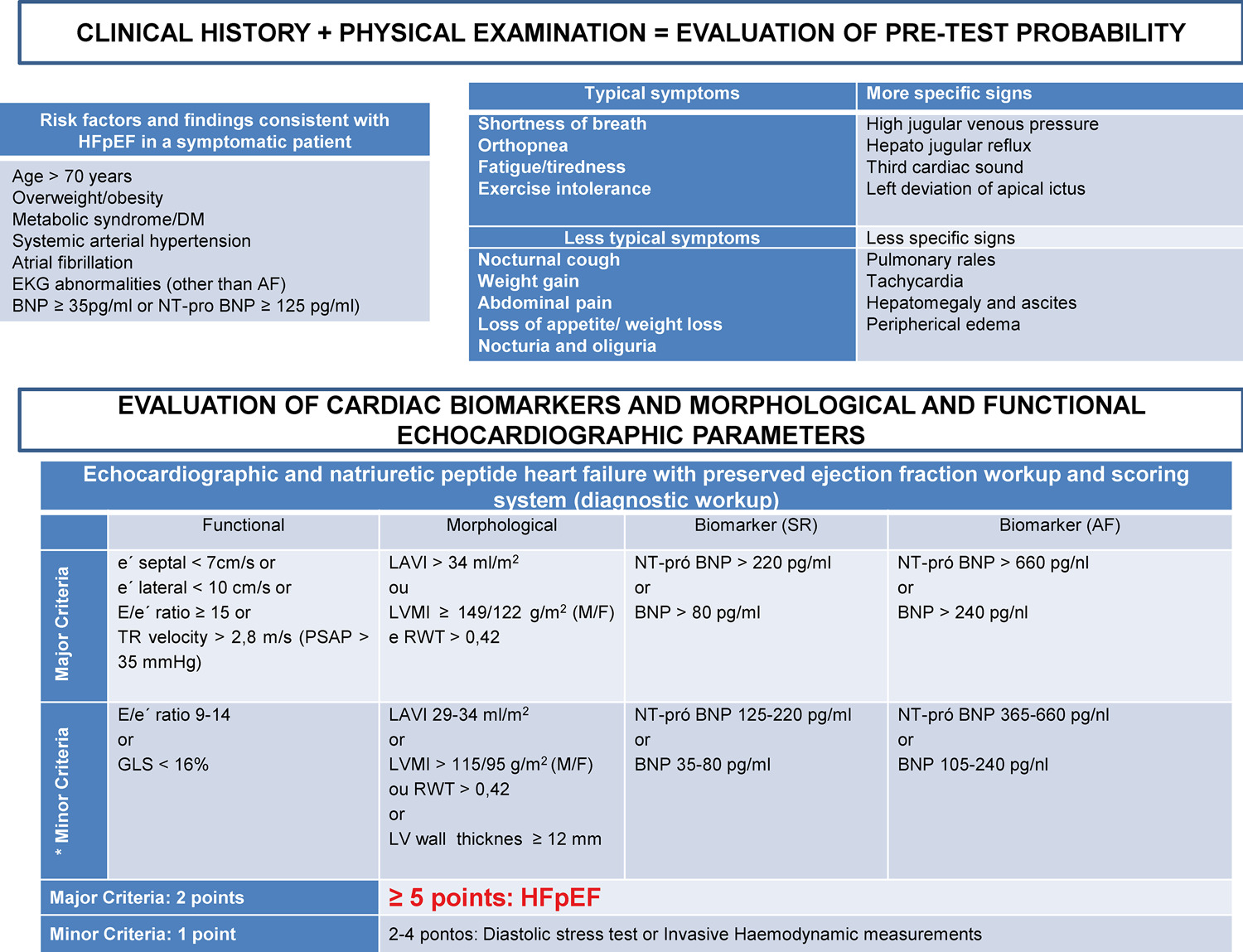
Critical Analysis and Limitations of the Diagnosis of Heart Failure with Preserved Ejection Fraction (HFpEF)

Viviane Tiemi Hotta et al. Daniela do Carmo Rassi José Luiz Barros Pena Marcelo Luiz Campos Vieira … Ana Clara Tude Rodrigues Juliano Novaes Cardoso Felix Jose Alvarez Ramires Luciano Nastari Charles Mady Fábio Fernandes

Abstract

With the increase in the population’s life expectancy and the higher frequency of risk factors such as obesity, hypertension and diabetes, an increase in the prevalence of heart failure with preserved ejection fraction (HFpEF) is expected. However, to date, the diagnosis and treatment of patients with HFpEF remain challenging. The syndromic diagnosis of HFpEF includes several etiologies and diseases with specific treatments but has points in common regarding the clinical presentation, laboratory evaluation related to biomarkers, such as BNP and NT-ProBNP, and echocardiographic evaluation of cardiac remodeling and left ventricular diastolic filling pressures. Extensive randomized clinical trials involving the treatment of this condition have failed to demonstrate benefits to the patient, making it necessary to reflect on the diagnosis, mechanisms of morbidity, mortality and reversibility in this syndrome. In this review, the current concepts, controversies and challenges, especially regarding diagnosis, will be addressed, critically analyzing the European Heart Failure Association score for the diagnosis of HFpEF.

  • Diagnostic,Imaging
  • Echocardiography/methods
  • Heart Failure/physiopathology
  • Natriuretic Peptides
Read Full Article
Creative Commons Attribution (CC BY) Creative Commons license
11/07/2022 DOI: 10.36660/abc.20210052 Views 1
ABC
Editorial

Role of Computed Tomography in Excluding Acute Coronary Syndrome: is Anatomy the Way?

Nuno Bettencourt

Chest pain is one of the most common reasons for admission to the emergency room (ER). Although only a small minority of these correspond to an acute coronary syndrome (ACS), the potential severity of a misdiagnosis or a non-diagnosis implies using systematic protocols to confirm or exclude coronary artery disease (CAD) as a cause of symptoms. In recent years, the sequential blood testing of high-sensitive troponin (cTnI-hs) levels has become a safe and effective method in this context and is commonly applied worldwide. – However, this approach is associated with prolonged times in the ER and is not error-free, as some patients with unstable angina may not be correctly identified.

New approaches using imaging methods to exclude CAD gained relevance and have generated interest from the scientific community. Cardiac CT angiography (CTA), due to its high diagnostic performance, is assumed to be the main candidate to change the status-quo of the current approach based on serial blood testing. It is a simple, fast and robust test with a high negative predictive value – which makes it particularly suitable in ER, where it is essential to quickly and effectively exclude the presence of CAD. The ROMICAT studies were among the first to document the advantages of CTA in this context and to emphasize its additive prognostic value concerning the TIMI risk score (TIMI RS). However, like the vast majority of studies that used CTA in the context of hospital ER, their results mostly apply to low-risk populations. ,

[…]

  • Cardiovascular Diseases
  • Chest Pain
  • Diagnostic,Imaging
  • Risk Factors
  • TomographyX-Ray Computed/methods
Read Full Article
Creative Commons Attribution (CC BY) Creative Commons license
13/05/2022 DOI: 10.36660/abc.20220273 Views 1
ABC
Original Article

Subclinical Left Atrial and Ventricular Dysfunction in Acromegaly Patients: A Speckle Tracking Echocardiography Study

Hasan Koca et al. Mevlüt Koc Hilmi Erdem Sumbul Yahya Kemal Icen … Erdinc Gulumsek Fadime Koca Huseyin Ali Ozturk Ahmet Oytun Baykan Onur Kaypakli

Abstract

Background

Although it is known that the left ventricular (LV) ejection fraction (EF) measured by echocardiography is preserved in patients with acromegaly, there is not enough information about the LV and left atrial strain (LV-GLS and LAS).

Objective

This study aimed to evaluate the left ventricular (LV) and left atrial (LA) functions with strain echocardiography (SE) in patients with acromegaly.

Methods

This study included 50 acromegaly patients with active disease and 50 healthy controls with similar age, gender, and body surface area. In addition to routine echocardiography examinations, LV-GLS and LAS measurements were performed with SE.

Results

LAS and LV-GLS values were significantly lower in patients with acromegaly (p<0.05 for all). In bivariate analysis, systolic blood pressure, N-terminal prohormone of brain natriuretic peptide, Insulin-like growth factor-1, LA diastolic diameter, and LVMI levels were found to be positively correlated with both LAS and LV-GLS (p <0.05). IGF-1 level was strongly correlated with LAS and LV-GLS (p<0.001 and β=0.5 vs. p<0.001 and β=0.626, respectively); 48% of patients with acromegaly have reduced LV-GLS (<20%). Left ventricular mass-index (LVMI) independently determines the presence of reduced LV-GLS and each 1g/m2increase in LVMI level increases the likelihood of reduced LV-GLS by 6%.

Conclusion

Although LV ejection fraction is normal in patients with acromegaly, LAS and LV-GLS values were significantly reduced. Apart from LVMI increase, another finding of cardiac involvement may be LAS and LV-GLS decrease. Therefore, in addition to routine echocardiography, LAS and LV-GLS may be useful to evaluate early signs of cardiac involvement before the occurrence of irreversible cardiac changes.

  • Acromegaly
  • Cardiovascular Diseases
  • Diagnostic,Imaging
  • Echocardiography/methods
  • Myocardial Deformability
  • Stroke Volume
Read Full Article
Creative Commons Attribution (CC BY) Creative Commons license
07/02/2022 DOI: 10.36660/abc.20201174
Figure 1
ABC
Editorial

Takotsubo Syndrome, Does it Exist as a Specific Disease?

Bruno Caramelli

The name syndrome combines two Greek roots to describe a condition gathering a group of signs and symptoms existing together in patients. It seems that Avicenna first used it in his 1025 publication “The Canon of Medicine”. In genetics, the use of the name syndrome generally assumes that the underlying cause of the disease is known. On the other hand, in medicine, syndrome refers to conditions both with a known and unknown cause.

Historically, associated signs and symptoms found to be of improbable correlation were eventually known to have an underlying cause responsible for all of them. Even after the cause is unraveled, the original word remains, sometimes with the name of the first describer, and this is probably the reason for the existence nowadays of syndromes with identified and unidentified causes.

[…]

  • Coronary Artery Disease
  • Diagnosis,Differencial
  • Diagnostic,Imaging
  • Takotsubo Cardiomyopathy
  • Ventricular Dysfunction
Read Full Article
Creative Commons Attribution (CC BY) Creative Commons license
28/08/2020 DOI: 10.36660/abc.20200470

How to cite this article

EndNote RIS

Electronic Document Format (Vancouver)

Ferreira VV, Thomas B. Stress CMR in the Elderly: Does It Provide the Answers?. Arquivos Brasileiros de Cardiologia 2022;119(1):107-8.

Electronic Document Format (ABNT)

Ferreira, Vera Vaz; Thomas, Boban. Stress CMR in the Elderly: Does It Provide the Answers?. Arquivos Brasileiros de Cardiologia, v. 119, n. 1, p. 107-108, Jul. 2022.

Electronic Document Format (APA)

Ferreira, V. V., & Thomas, B. (2022). Stress CMR in the Elderly: Does It Provide the Answers?. Arquivos Brasileiros de Cardiologia, 119(1), 107-108.

Electronic Document Format (ISO)

Ferreira, Vera Vaz and Thomas, Boban. Stress CMR in the Elderly: Does It Provide the Answers?. Arquivos Brasileiros de Cardiologia [online]. 2022, vol. 119, n. 1, [cited 2026-10-14], pp. 107-108. Available from: <https://journals.cardiol.br/en/article/stress-cmr-in-the-elderly-does-it-provide-the-answers/>. ISSN 0066-782X

EndNote RIS

Electronic Document Format (Vancouver)

Hotta VT, Rassi DC, Pena JLB, Vieira MLC, Rodrigues ACT, Cardoso JN, Ramires FJA, et al. Critical Analysis and Limitations of the Diagnosis of Heart Failure with Preserved Ejection Fraction (HFpEF). Arquivos Brasileiros de Cardiologia 2022;119(3):470-9.

Electronic Document Format (ABNT)

Hotta, Viviane Tiemi; Rassi, Daniela do Carmo; Pena, José Luiz Barros; Vieira, Marcelo Luiz Campos; Rodrigues, Ana Clara Tude; Cardoso, Juliano Novaes; Ramires, Felix Jose Alvarez; Nastari, Luciano; Mady, Charles; Fernandes, Fábio. Critical Analysis and Limitations of the Diagnosis of Heart Failure with Preserved Ejection Fraction (HFpEF). Arquivos Brasileiros de Cardiologia, v. 119, n. 3, p. 470-479, Jul. 2022.

Electronic Document Format (APA)

Hotta, V. T., Rassi, D. C., Pena, J. L. B., Vieira, M. L. C., Rodrigues, A. C. T., Cardoso, J. N., Ramires, F. J. A., Nastari, L., Mady, C., & Fernandes, F. (2022). Critical Analysis and Limitations of the Diagnosis of Heart Failure with Preserved Ejection Fraction (HFpEF). Arquivos Brasileiros de Cardiologia, 119(3), 470-479.

Electronic Document Format (ISO)

Hotta, Viviane Tiemi and Rassi, Daniela do Carmo and Pena, José Luiz Barros and Vieira, Marcelo Luiz Campos and Rodrigues, Ana Clara Tude and Cardoso, Juliano Novaes and Ramires, Felix Jose Alvarez and Nastari, Luciano and Mady, Charles and Fernandes, Fábio. Critical Analysis and Limitations of the Diagnosis of Heart Failure with Preserved Ejection Fraction (HFpEF). Arquivos Brasileiros de Cardiologia [online]. 2022, vol. 119, n. 3, [cited 2026-10-14], pp. 470-479. Available from: <https://journals.cardiol.br/en/article/critical-analysis-and-limitations-of-the-diagnosis-of-heart-failure-with-preserved-ejection-fraction-hfpef/>. ISSN 0066-782X

EndNote RIS

Electronic Document Format (Vancouver)

Bettencourt N. Role of Computed Tomography in Excluding Acute Coronary Syndrome: is Anatomy the Way?. Arquivos Brasileiros de Cardiologia 2022;118(5):903-4.

Electronic Document Format (ABNT)

Bettencourt, Nuno. Role of Computed Tomography in Excluding Acute Coronary Syndrome: is Anatomy the Way?. Arquivos Brasileiros de Cardiologia, v. 118, n. 5, p. 903-904, May. 2022.

Electronic Document Format (APA)

Bettencourt, N. (2022). Role of Computed Tomography in Excluding Acute Coronary Syndrome: is Anatomy the Way?. Arquivos Brasileiros de Cardiologia, 118(5), 903-904.

Electronic Document Format (ISO)

Bettencourt, Nuno. Role of Computed Tomography in Excluding Acute Coronary Syndrome: is Anatomy the Way?. Arquivos Brasileiros de Cardiologia [online]. 2022, vol. 118, n. 5, [cited 2026-10-14], pp. 903-904. Available from: <https://journals.cardiol.br/en/article/role-of-computed-tomography-in-excluding-acute-coronary-syndrome-is-anatomy-the-way/>. ISSN 0066-782X

EndNote RIS

Electronic Document Format (Vancouver)

Koca H, Koc M, Sumbul HE, Icen YK, Gulumsek E, Koca F, Ozturk HA, et al. Subclinical Left Atrial and Ventricular Dysfunction in Acromegaly Patients: A Speckle Tracking Echocardiography Study. Arquivos Brasileiros de Cardiologia 2022;118(3):634-45.

Electronic Document Format (ABNT)

Koca, Hasan; Koc, Mevlüt; Sumbul, Hilmi Erdem; Icen, Yahya Kemal; Gulumsek, Erdinc; Koca, Fadime; Ozturk, Huseyin Ali; Baykan, Ahmet Oytun; Kaypakli, Onur. Subclinical Left Atrial and Ventricular Dysfunction in Acromegaly Patients: A Speckle Tracking Echocardiography Study. Arquivos Brasileiros de Cardiologia, v. 118, n. 3, p. 634-645, Feb. 2022.

Electronic Document Format (APA)

Koca, H., Koc, M., Sumbul, H. E., Icen, Y. K., Gulumsek, E., Koca, F., Ozturk, H. A., Baykan, A. O., & Kaypakli, O. (2022). Subclinical Left Atrial and Ventricular Dysfunction in Acromegaly Patients: A Speckle Tracking Echocardiography Study. Arquivos Brasileiros de Cardiologia, 118(3), 634-645.

Electronic Document Format (ISO)

Koca, Hasan and Koc, Mevlüt and Sumbul, Hilmi Erdem and Icen, Yahya Kemal and Gulumsek, Erdinc and Koca, Fadime and Ozturk, Huseyin Ali and Baykan, Ahmet Oytun and Kaypakli, Onur. Subclinical Left Atrial and Ventricular Dysfunction in Acromegaly Patients: A Speckle Tracking Echocardiography Study. Arquivos Brasileiros de Cardiologia [online]. 2022, vol. 118, n. 3, [cited 2026-10-14], pp. 634-645. Available from: <https://journals.cardiol.br/en/article/subclinical-left-atrial-and-ventricular-dysfunction-in-acromegaly-patients-a-speckle-tracking-echocardiography-study/>. ISSN 0066-782X

EndNote RIS

Electronic Document Format (Vancouver)

Caramelli B. Takotsubo Syndrome, Does it Exist as a Specific Disease?. Arquivos Brasileiros de Cardiologia 2020;115(2):217-8.

Electronic Document Format (ABNT)

Caramelli, Bruno. Takotsubo Syndrome, Does it Exist as a Specific Disease?. Arquivos Brasileiros de Cardiologia, v. 115, n. 2, p. 217-218, Aug. 2020.

Electronic Document Format (APA)

Caramelli, B. (2020). Takotsubo Syndrome, Does it Exist as a Specific Disease?. Arquivos Brasileiros de Cardiologia, 115(2), 217-218.

Electronic Document Format (ISO)

Caramelli, Bruno. Takotsubo Syndrome, Does it Exist as a Specific Disease?. Arquivos Brasileiros de Cardiologia [online]. 2020, vol. 115, n. 2, [cited 2026-10-14], pp. 217-218. Available from: <https://journals.cardiol.br/en/article/takotsubo-syndrome-does-it-exist-as-a-specific-disease/>. ISSN 0066-782X

  • About ABC Family
  • Internal Regulation
  • Editorial Board
  • Brazilian Society of Cardiology (SBC)

Issues

SBC Guidelines

  • Videos
  • Podcasts
  • News