ABC Family Arquivos Brasileiros de Cardiologia International Journal of Cardiovascular Sciences ABC Heart Failure & Cardiomyopathy ABC Imagem Cardiovascular
Português English
ABC Family
Português English
  • About
    • About ABC Family
    • Internal Regulation
    • Editorial Board
    • Brazilian Society of Cardiology (SBC)
  • Issues
  • SBC Guidelines
  • Content
    • Videos
    • Podcasts
    • News
  • About
    • About ABC Family
    • Internal Regulation
    • Editorial Board
    • Brazilian Society of Cardiology (SBC)
  • Issues
  • SBC Guidelines
  • Content
    • Videos
    • Podcasts
    • News

ABC Family

  • ABC Family
  • Arquivos Brasileiros de Cardiologia
  • International Journal of Cardiovascular Sciences
  • ABC Heart Failure & Cardiomyopathy
  • ABC Imagem Cardiovascular
Search in

No content found.

Journals
Ordering
Article types
Others

  1. Home
  2. Keyword: Demography
Ethnic Differences in Survival among Brazilian Modern-era Olympic Medalists from 1920 to 1992: A Cohort Study
ABC
Original Article

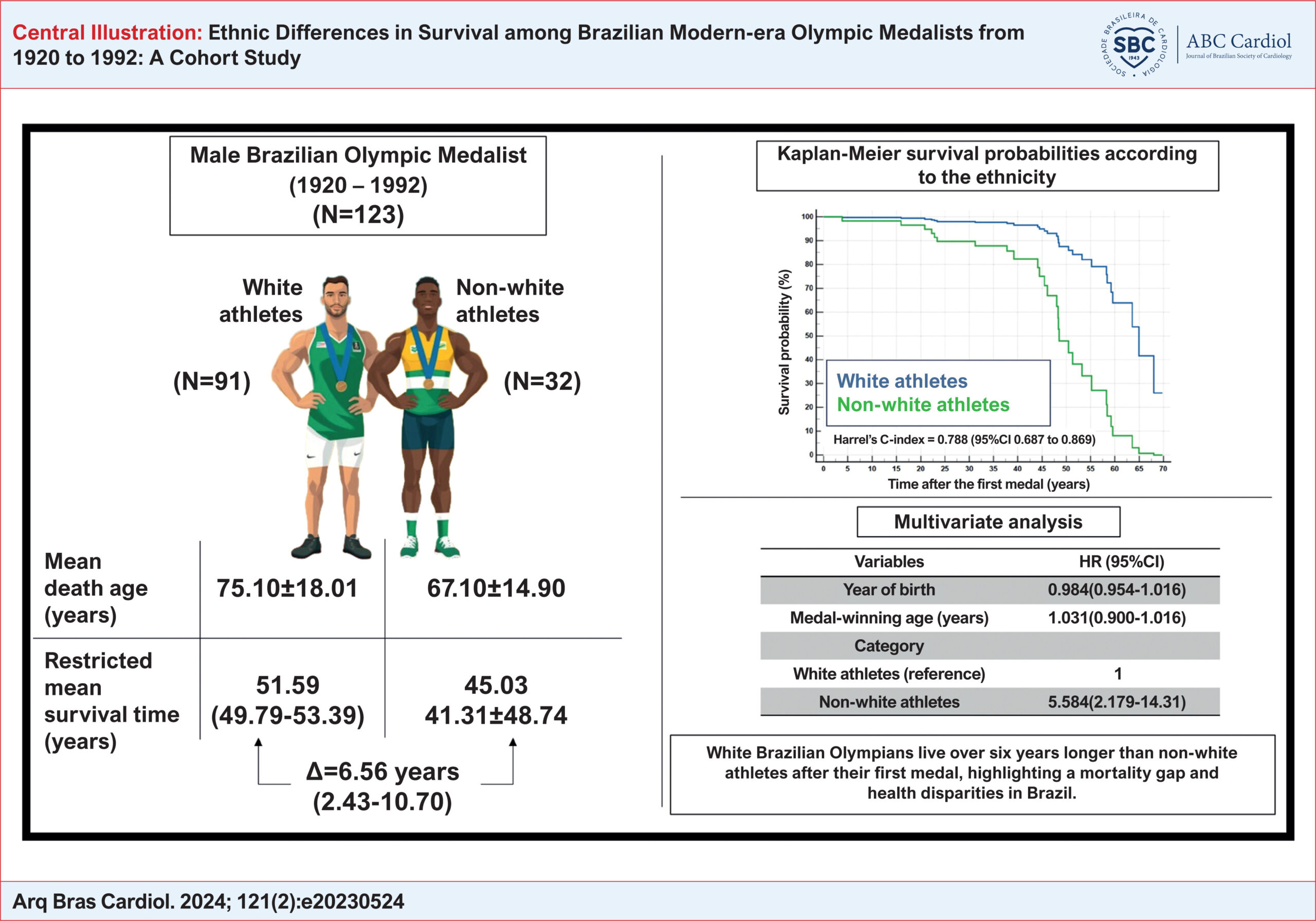
Ethnic Differences in Survival among Brazilian Modern-era Olympic Medalists from 1920 to 1992: A Cohort Study

Fabricio Braga et al. Paula de Medeiros Ana Carolina Neno Diogo Meira … João Magalhães Michael S. Emery

Abstract

Background:

Disparities in health outcomes among racial groups warrant investigation, even among elite athletes. Therefore, understanding the impact of race upon post-medal survival in Brazilian Olympians becomes essential.

Objective:

To compare post-medal survival between white and non-white Brazilian Olympic medalists from 1920 to 1992.

Methods:

This study used publicly available data for a retrospective cohort study on all Brazilian Olympic medalists from 1920 to 1992 (males only). Athletes were classified into white and non-white groups using structured ethnicity determination. Kaplan–Meier analyses computed the restricted mean survival time (RMST) for each ethnic group. A Cox proportional hazards analysis assessed ethnicity-based survival differences, adjusting for medal-winning age and birth year (p<0.05)

Results:

Among 123 athletes (73.9% white), the mean age of medal achievement was 25.03±4.8 years. During the study, 18.7% of white and 37.5% of non-white athletes died (p=0.031). White athletes had a mean age at death of 75.10±18.01 years, while non-white athletes had an age of 67.13±14.90 years (p=0.109). The RMST for white athletes was 51.59 (95% CI 49.79-53.39) years, while for non-white athletes, it was 45.026 (95% CI 41.31-48.74) years, resulting in a ΔRMST of 6.56 (95% CI 2.43-10.70; p=0.0018). Multivariate analysis showed that non-white athletes had a higher mortality risk than did white athletes (HR 5.58; 95% CI, 2.18-14.31).

Conclusion:

Following their first medal, white Brazilian Olympians typically enjoy a six-year longer lifespan than their non-white counterparts, illustrating a marked mortality gap and health disparities among healthy individuals in Brazil.
  • Demography
  • Epidemiology
  • Sports Medicine
Read Full Article
Creative Commons Attribution (CC BY) Creative Commons license
05/04/2024 DOI: 10.36660/abc.20230524 Views 2
Figure 1
ABC
Original Article

Temporal Trend of Mortality Due to Ischemic Heart Diseases in Northeastern Brazil (1996–2016): An Analysis According to Gender and Age Group

Gibson Barros de Almeida Santana et al. Thiago Cavalcanti Leal João Paulo Silva de Paiva Leonardo Feitosa da Silva … Lucas Gomes Santos Tatiana Farias de Oliveira Rodrigo da Rosa Mesquita Jéssica Alves Gomes Carlos Dornels Freire de Souza Amanda Karine Barros Ferreira Rodrigues

Abstract

Background

Ischemic heart disease (IHD) is the leading cause of death among cardiovascular diseases (CVD).

Objective

To describe the sociodemographic profile and analyze the trend in the mortality rate due to IHD, according to sex and by age group, in the states of the Northeast region of Brazil, from 1996 to 2016.

Methods

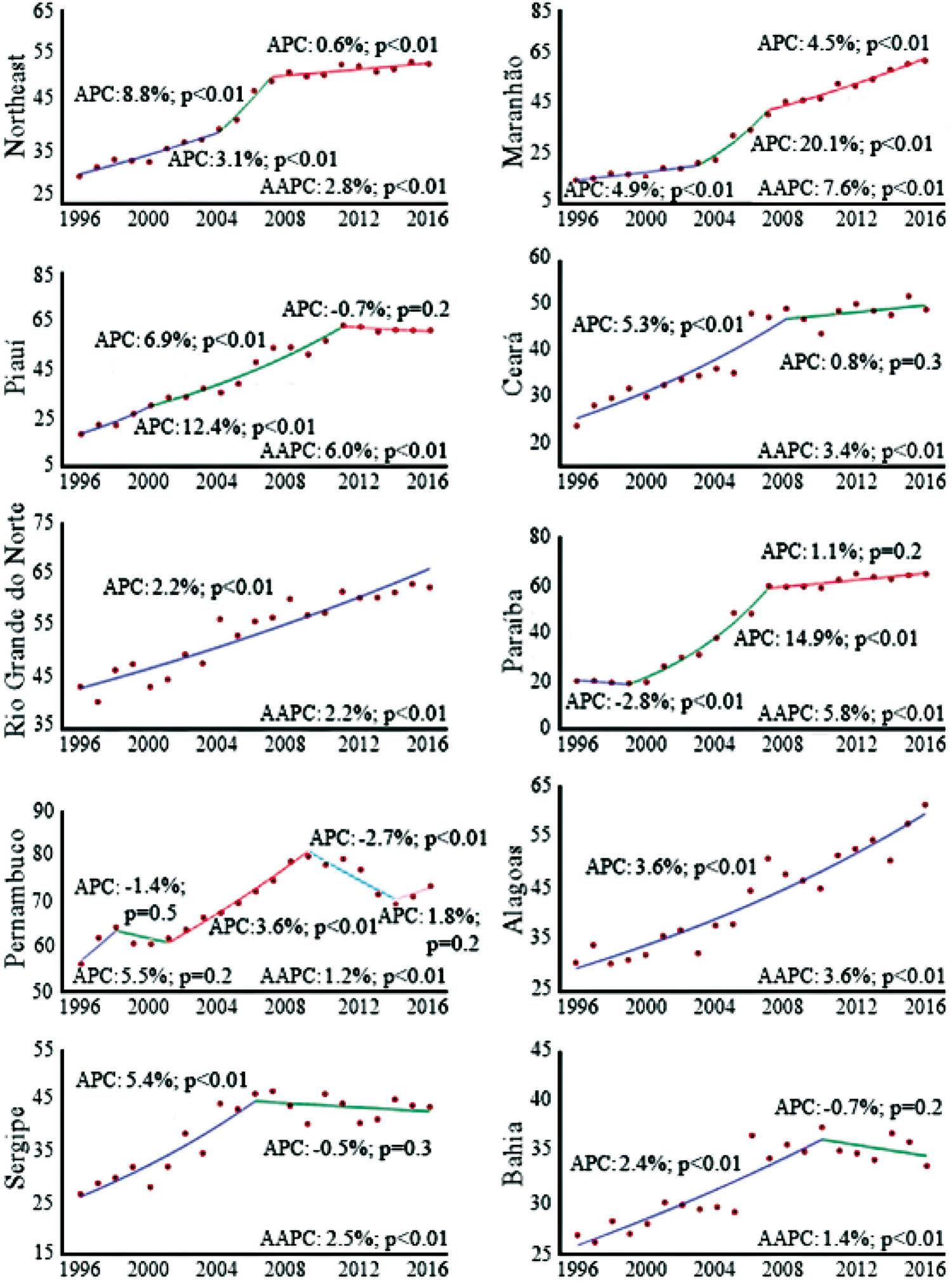
Ecological study involving IHD mortality in the northeastern states. Variables analyzed: sex, age, education, marital status, ICD-10 category and state of residence. Crude and standardized rates were calculated. Death data were collected from the Mortality Information System (SIM) and population data from the Brazilian Institute of Geography and Statistics (IBGE). In temporal analyzes the regression model by inflection points was used, with the calculation of annual percent change (APC) and average annual percent change of the period (AAPC). A 95% confidence interval and a significance level of 5% were considered.

Results

405916 deaths due to IHD were registered in the northeast region during the study period. The death profile is characterized by men (n=229006; 56,42%), elderly (n=301379; 74,25%), race/color brown (n=197936; 48,76%), elementary or <4 years at school (n=232599; 57,30%) and married (n=179599; 44,25%). There was an unusual highlight to the increase in the annual growth rate in the age group of adolescents (AAPC: 5,2%, p <0.01). The standardized regional mortality rate grew from 30,7 per 100,000 inhabitants in 1996 to 53.8 per 100,000 in 2016 (AAPC 2.8%; p<0.01). All nine states presented a statistically significant growth trend, with emphasis on Maranhão (AAPC 7,6%; p<0.01) and Piauí (AAPC 6,0%; p<0.01).

Conclusion

The prevalent observed profile was male, elderly, race/color brown, low education level and married. Mortality due to IHD presented an upward trend in all states, although with an uneven pattern among the federated units.

  • Deaths
  • Demography
  • Epidemiology
  • Myocardial Ischemia / mortality
  • Public Health
  • Socioeconomic Factors
  • Statistical Analysis
Read Full Article
Creative Commons Attribution (CC BY) Creative Commons license
26/07/2021 DOI: 10.36660/abc.20200222 Views 1
IJCS
Editorial

What is the best Cardiovascular Risk Score for the Brazilian Population?

Bruno Ferraz de Oliveira Gomes et al. Gláucia Maria Moraes de Oliveira

Although the cardiovascular disease mortality rates in Brazil still reach high numbers, they have decreased significantly in recent years. In the early 1990s, the country presented approximately 350 deaths per 100 000 inhabitants per year, and the most recently published rates were reduced to just over 200 deaths per 100 000 inhabitants. Mortality rates due to coronary artery disease are higher in men: between 1990 and 2017, the annual mortality rate due to coronary artery disease was approximately 100 deaths per 100 000 inhabitants. Disability-adjusted life years (DALYs) went from more than 6000 years per 100 000 inhabitants in the 1990s to just over 4000 years per 100 000 inhabitants in the past decade.

Strategies for measuring cardiovascular risk have changed clinical practice by promoting effective preventive measures that reduce the occurrence of major cardiovascular events and improve quality of life. Among them, the most commonly used are simple clinical criteria, clinical prediction scores, imaging examinations, and biomarkers. The clinical application of a cardiovascular risk score should be assessed for its ability to affect the therapeutic management and prognosis of individuals. A risk prediction model must be evaluated in several subsequent phases, such as the initial concept, its prospective validation in independent populations, the incremental information provided in relation to the currently available models, the confirmation of its effects in modifying the clinical conduct and prognosis of patients, and its cost-effectiveness.

[…]

  • Cardiovascular Diseases, mortality
  • Demography
  • Epidemiology
  • Ethnic Groups
  • Population Characteristics, Propensity Score
  • Risk Factors
  • Socioeconomic Factors
Read Full Article
Creative Commons Attribution (CC BY) Creative Commons license
25/11/2020 DOI: 10.36660/ijcs.20200272 Views 1
ABC
Special Article

Brazilian Society of Cardiology – The Women’s Letter

Glaucia Maria Moraes de Oliveira et al. Fátima Elizabeth Fonseca de Oliveira Negri Nadine Oliveira Clausell Maria da Consolação V. Moreira … Olga Ferreira de Souza Ariane Vieira Scarlatelli Macedo Barbara Campos Abreu Marino Carisi Anne Polanczyk Carla Janice Baister Lantieri Celi Marques-Santos Cláudia Maria Vilas Freire Deborah Christina Nercolini Fatima Cristina Monteiro Pedroti Imara Correia de Queiroz Barbosa Magaly Arrais dos Santos Maria Christiane Valéria Braga Braile Maria Sanali Moura de Oliveira Paiva Marianna Deway Andrade Dracoulakis Narriane Chaves Holanda Patricia Toscano Rocha Rolim Roberta Tavares Barreto Teixeira Sandra Mattos Sheyla Cristina Tonheiro Ferro da Silva Simone Cristina Soares Brandão Viviana de Mello Guzzo Lemke Marcelo Antônio Cartaxo Queiroga Lopes

Objective

The primary objective of this document is to stimulate improvements in women’s health conditions in Brazil, with a focus on cardiovascular disease (CVD), which is responsible for 17.5 million premature deaths yearly worldwide. This number is predicted to increase to 23 million by 2030. CVD are responsible for one third of all deaths in Brazil, with similarities between men and postmenopausal women. These data assume even greater importance when we consider that 80% of premature deaths could have been avoided by controlling four risk factors: tobacco use, inappropriate diet, physical inactivity, and harmful alcohol use.

This document further aims to create a permanent discussion group that will play a leadership role in Brazilian healthcare policies, providing administrators with an overall view of the relevance of CVD to women so that they may establish strategic actions to reduce the prevalence of risk factors and improve diagnosis and therapeutic approach, thus reducing mortality and morbidity.

[…]

  • Cardiovascular Diseases/prevention and control
  • Demography
  • Education, Medical
  • Management Quality Circles
  • Medicine/trends
  • Prevalence
  • Risk Factors
  • Societies, Medical
  • Women
Read Full Article
Creative Commons Attribution (CC BY) Creative Commons license
15/07/2019 DOI: 10.5935/abc.20190111 Views 1

How to cite this article

EndNote RIS

Electronic Document Format (Vancouver)

Braga F, Medeiros P, Neno AC, Meira D, Magalhães J, Emery MS. Ethnic Differences in Survival among Brazilian Modern-era Olympic Medalists from 1920 to 1992: A Cohort Study. Arquivos Brasileiros de Cardiologia 2024;121(2):e20230524.

Electronic Document Format (ABNT)

Braga, Fabricio; Medeiros, Paula de; Neno, Ana Carolina; Meira, Diogo; Magalhães, João; Emery, Michael S.. Ethnic Differences in Survival among Brazilian Modern-era Olympic Medalists from 1920 to 1992: A Cohort Study. Arquivos Brasileiros de Cardiologia, v. 121, n. 2, e20230524, Apr. 2024.

Electronic Document Format (APA)

Braga, F., Medeiros, P. , Neno, A. C., Meira, D., Magalhães, J., & Emery, M. S. (2024). Ethnic Differences in Survival among Brazilian Modern-era Olympic Medalists from 1920 to 1992: A Cohort Study. Arquivos Brasileiros de Cardiologia, 121(2), e20230524.

Electronic Document Format (ISO)

Braga, Fabricio and Medeiros, Paula de and Neno, Ana Carolina and Meira, Diogo and Magalhães, João and Emery, Michael S.. Ethnic Differences in Survival among Brazilian Modern-era Olympic Medalists from 1920 to 1992: A Cohort Study. Arquivos Brasileiros de Cardiologia [online]. 2024, vol. 121, n. 2, [cited 2026-10-14], e20230524. Available from: <https://journals.cardiol.br/en/article/ethnic-differences-in-survival-among-brazilian-modern-era-olympic-medalists-from-1920-to-1992-a-cohort-study/>. ISSN 0066-782X

EndNote RIS

Electronic Document Format (Vancouver)

Santana GBA, Leal TC, Paiva JPS, Silva LF, Santos LG, Oliveira TF, Mesquita RR, et al. Temporal Trend of Mortality Due to Ischemic Heart Diseases in Northeastern Brazil (1996–2016): An Analysis According to Gender and Age Group. Arquivos Brasileiros de Cardiologia 2021;117(1):51-60.

Electronic Document Format (ABNT)

Santana, Gibson Barros de Almeida; Leal, Thiago Cavalcanti; Paiva, João Paulo Silva de; Silva, Leonardo Feitosa da; Santos, Lucas Gomes; Oliveira, Tatiana Farias de; Mesquita, Rodrigo da Rosa; Gomes, Jéssica Alves; Souza, Carlos Dornels Freire de; Rodrigues, Amanda Karine Barros Ferreira. Temporal Trend of Mortality Due to Ischemic Heart Diseases in Northeastern Brazil (1996–2016): An Analysis According to Gender and Age Group. Arquivos Brasileiros de Cardiologia, v. 117, n. 1, p. 51-60, Jul. 2021.

Electronic Document Format (APA)

Santana, G. B. A., Leal, T. C., Paiva, J. P. S. , Silva, L. F. , Santos, L. G., Oliveira, T. F. , Mesquita, R. R., Gomes, J. A., Souza, C. D. F. , & Rodrigues, A. K. B. F. (2021). Temporal Trend of Mortality Due to Ischemic Heart Diseases in Northeastern Brazil (1996–2016): An Analysis According to Gender and Age Group. Arquivos Brasileiros de Cardiologia, 117(1), 51-60.

Electronic Document Format (ISO)

Santana, Gibson Barros de Almeida and Leal, Thiago Cavalcanti and Paiva, João Paulo Silva de and Silva, Leonardo Feitosa da and Santos, Lucas Gomes and Oliveira, Tatiana Farias de and Mesquita, Rodrigo da Rosa and Gomes, Jéssica Alves and Souza, Carlos Dornels Freire de and Rodrigues, Amanda Karine Barros Ferreira. Temporal Trend of Mortality Due to Ischemic Heart Diseases in Northeastern Brazil (1996–2016): An Analysis According to Gender and Age Group. Arquivos Brasileiros de Cardiologia [online]. 2021, vol. 117, n. 1, [cited 2026-10-14], pp. 51-60. Available from: <https://journals.cardiol.br/en/article/temporal-trend-of-mortality-due-to-ischemic-heart-diseases-in-northeastern-brazil-1996-2016-an-analysis-according-to-gender-and-age-group/>. ISSN 0066-782X

EndNote RIS

Electronic Document Format (Vancouver)

Gomes BFO, Oliveira GMM. What is the best Cardiovascular Risk Score for the Brazilian Population?. International Journal of Cardiovascular Sciences 2020;33(6):627-8.

Electronic Document Format (ABNT)

Gomes, Bruno Ferraz de Oliveira; Oliveira, Gláucia Maria Moraes de. What is the best Cardiovascular Risk Score for the Brazilian Population?. International Journal of Cardiovascular Sciences, v. 33, n. 6, p. 627-628, Nov. 2020.

Electronic Document Format (APA)

Gomes, B. F. O., & Oliveira, G. M. M. (2020). What is the best Cardiovascular Risk Score for the Brazilian Population?. International Journal of Cardiovascular Sciences, 33(6), 627-628.

Electronic Document Format (ISO)

Gomes, Bruno Ferraz de Oliveira and Oliveira, Gláucia Maria Moraes de. What is the best Cardiovascular Risk Score for the Brazilian Population?. International Journal of Cardiovascular Sciences [online]. 2020, vol. 33, n. 6, [cited 2026-10-14], pp. 627-628. Available from: <https://journals.cardiol.br/en/article/what-is-the-best-cardiovascular-risk-score-for-the-brazilian-population/>. ISSN 2359-4802

EndNote RIS

Electronic Document Format (Vancouver)

Oliveira GMM, Negri FEFO, Clausell NO, Moreira MCV, Souza OF, Macedo AVS, Marino BCA, et al. Brazilian Society of Cardiology – The Women’s Letter. Arquivos Brasileiros de Cardiologia 2019;112(6):713-4.

Electronic Document Format (ABNT)

Oliveira, Glaucia Maria Moraes de; Negri, Fátima Elizabeth Fonseca de Oliveira; Clausell, Nadine Oliveira; Moreira, Maria da Consolação V.; Souza, Olga Ferreira de; Macedo, Ariane Vieira Scarlatelli; Marino, Barbara Campos Abreu; Polanczyk, Carisi Anne; Lantieri, Carla Janice Baister; Marques-Santos, Celi; Freire, Cláudia Maria Vilas; Nercolini, Deborah Christina; Pedroti, Fatima Cristina Monteiro; Barbosa, Imara Correia de Queiroz; Santos, Magaly Arrais dos; Braile, Maria Christiane Valéria Braga; Paiva, Maria Sanali Moura de Oliveira; Dracoulakis, Marianna Deway Andrade; Holanda, Narriane Chaves; Rolim, Patricia Toscano Rocha; Teixeira, Roberta Tavares Barreto; Mattos, Sandra; Silva, Sheyla Cristina Tonheiro Ferro da; Brandão, Simone Cristina Soares; Lemke, Viviana de Mello Guzzo; Lopes, Marcelo Antônio Cartaxo Queiroga. Brazilian Society of Cardiology – The Women’s Letter. Arquivos Brasileiros de Cardiologia, v. 112, n. 6, p. 713-714, Jul. 2019.

Electronic Document Format (APA)

Oliveira, G. M. M. , Negri, F. E. F. O., Clausell, N. O., Moreira, M. C. V., Souza, O. F. , Macedo, A. V. S., Marino, B. C. A., Polanczyk, C. A., Lantieri, C. J. B., Marques-Santos, C., Freire, C. M. V., Nercolini, D. C., Pedroti, F. C. M., Barbosa, I. C. Q., Santos, M. A. , Braile, M. C. V. B., Paiva, M. S. M. O., Dracoulakis, M. D. A., Holanda, N. C., Rolim, P. T. R., Teixeira, R. T. B., Mattos, S., Silva, S. C. T. F. , Brandão, S. C. S., Lemke, V. M. G., & Lopes, M. A. C. Q. (2019). Brazilian Society of Cardiology – The Women’s Letter. Arquivos Brasileiros de Cardiologia, 112(6), 713-714.

Electronic Document Format (ISO)

Oliveira, Glaucia Maria Moraes de and Negri, Fátima Elizabeth Fonseca de Oliveira and Clausell, Nadine Oliveira and Moreira, Maria da Consolação V. and Souza, Olga Ferreira de and Macedo, Ariane Vieira Scarlatelli and Marino, Barbara Campos Abreu and Polanczyk, Carisi Anne and Lantieri, Carla Janice Baister and Marques-Santos, Celi and Freire, Cláudia Maria Vilas and Nercolini, Deborah Christina and Pedroti, Fatima Cristina Monteiro and Barbosa, Imara Correia de Queiroz and Santos, Magaly Arrais dos and Braile, Maria Christiane Valéria Braga and Paiva, Maria Sanali Moura de Oliveira and Dracoulakis, Marianna Deway Andrade and Holanda, Narriane Chaves and Rolim, Patricia Toscano Rocha and Teixeira, Roberta Tavares Barreto and Mattos, Sandra and Silva, Sheyla Cristina Tonheiro Ferro da and Brandão, Simone Cristina Soares and Lemke, Viviana de Mello Guzzo and Lopes, Marcelo Antônio Cartaxo Queiroga. Brazilian Society of Cardiology – The Women’s Letter. Arquivos Brasileiros de Cardiologia [online]. 2019, vol. 112, n. 6, [cited 2026-10-14], pp. 713-714. Available from: <https://journals.cardiol.br/en/article/brazilian-society-of-cardiology-the-womens-letter/>. ISSN 0066-782X

  • About ABC Family
  • Internal Regulation
  • Editorial Board
  • Brazilian Society of Cardiology (SBC)

Issues

SBC Guidelines

  • Videos
  • Podcasts
  • News