ABC Family Arquivos Brasileiros de Cardiologia International Journal of Cardiovascular Sciences ABC Heart Failure & Cardiomyopathy ABC Imagem Cardiovascular
Português English
ABC Family
Português English
  • About
    • About ABC Family
    • Internal Regulation
    • Editorial Board
    • Brazilian Society of Cardiology (SBC)
  • Issues
  • SBC Guidelines
  • Content
    • Videos
    • Podcasts
    • News
  • About
    • About ABC Family
    • Internal Regulation
    • Editorial Board
    • Brazilian Society of Cardiology (SBC)
  • Issues
  • SBC Guidelines
  • Content
    • Videos
    • Podcasts
    • News

ABC Family

  • ABC Family
  • Arquivos Brasileiros de Cardiologia
  • International Journal of Cardiovascular Sciences
  • ABC Heart Failure & Cardiomyopathy
  • ABC Imagem Cardiovascular
Search in

No content found.

Journals
Ordering
Article types
Others

  1. Home
  2. Keyword: Demographic Data
Figure 1
ABC
Original Article

The Profile of the Brazilian Cardiologist – A Sample of Members of the Brazilian Society of Cardiology

Lucas Simonetto Faganello et al. Mauricio Pimentel Carisi Anne Polanczyk Tiago Zimerman … Marcus Vinicius Bolivar Malachias Oscar Pereira Dutra Leandro Ioschpe Zimerman

Abstract

Background:

Data from the international literature have shown changes in the profile of cardiologists and in their medical practices. However, there is no data on this in Brazilian cardiologists.

Objective:

To evaluate professional and personal characteristics of a sample of Brazilian cardiologists.

Methods:

This was a cross-sectional study; a questionnaire was sent by e-mail to cardiologists, active members of the Brazilian Society of Cardiology in 2017. The results were analyzed, and the level of significance set at p < 0.05.

Results:

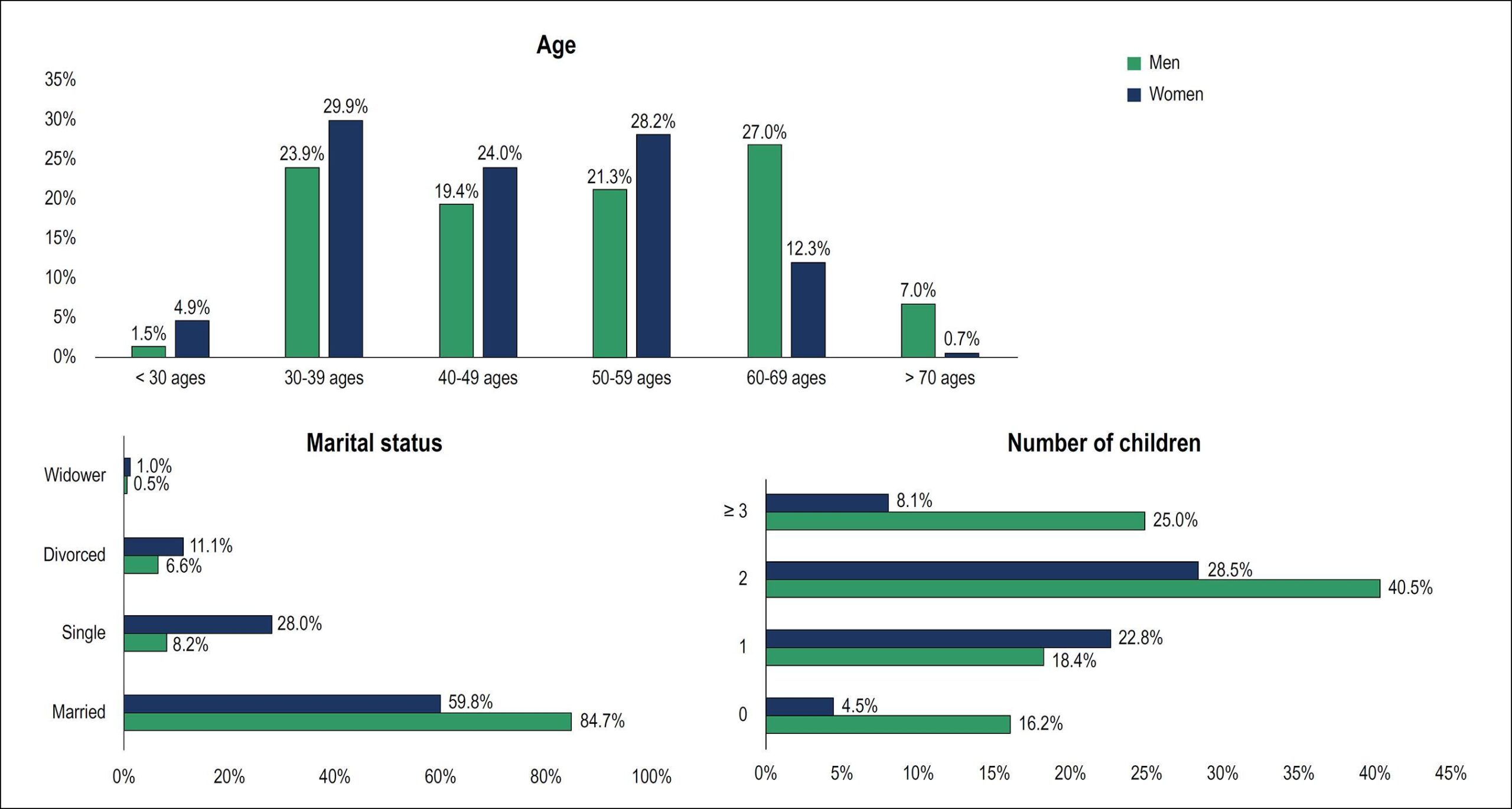
The questionnaire was sent to 13,462 cardiologists, with 2,101 (15.6%) respondents, mostly men (71.8% versus 28.2%). Age distribution and marital status were significantly different between the sexes (p < 0.001). The number of cardiologists without children was higher among women (40.5% versus 16.1%; p < 0.001). The most common place of work was the public hospital (46.5%), followed by private hospital (28.5%) and private office (21.1%). The office was the main place of work for 23.9% of men and 14% of women (p < 0.001), with predominance of individuals older than 50 years (31.7% versus 10.1%, respectively; p < 0.001). Most cardiologists (64.2%) worked more than 40 hours a week (69% of them men and 51.9% of the women; p < 0.001). Eighty-eight percent of the sample earned more than BRL 11,000 (US$ 3,473.43), and 66.5% of the men earned more than BRL 20,000 (US$ 6,315.32) per month, versus 31.2% of the women (p < 0.001). A high level of work-related stress was reported by 11.3% of respondents.

Conclusion:

Most cardiologists were men, who showed higher workload and higher income; 11.3% of the cardiologists perceived stress as a great deal.
  • Cardiologists
  • Demographic Data
  • Gender
  • Income
  • Quality of life
  • Survey and Questionnaires
Read Full Article
Creative Commons Attribution (CC BY) Creative Commons license
27/06/2019 DOI: 10.5935/abc.20190089 Views 1
ABC
Editorial

Spacetime

Aloyzio Achutti

Spacetime is a fundamental issue in physics, inherent to the basis of science. It encompasses two concepts bound to the perception of our simple reality, through which we measure and interpret our universe.

The notion of space relates to sovereignty, a characteristic that matters to all living beings to ensure species subsistence, reproduction, safety and preservation. Human beings have evolved to urban organization, a way of living together that has predominated for a few decades.

[…]

  • Cardiovascular Diseases, mortality
  • Demographic Data
  • Disease Prevention
  • Social Inequity
Read Full Article
Creative Commons Attribution (CC BY) Creative Commons license
01/02/2016 DOI: 10.5935/abc.20160022 Views 3
Figure 1
ABC
Original Article

Sex-Specific Equations to Estimate Maximum Oxygen Uptake in Cycle Ergometry

Christina G. de Souza e Silva et al. Claudio Gil S. Araújo

Abstract

Background:

Aerobic fitness, assessed by measuring VO2max in maximum cardiopulmonary exercise testing (CPX) or by estimating VO2max through the use of equations in exercise testing, is a predictor of mortality. However, the error resulting from this estimate in a given individual can be high, affecting clinical decisions.

Objective:

To determine the error of estimate of VO2max in cycle ergometry in a population attending clinical exercise testing laboratories, and to propose sex-specific equations to minimize that error.

Methods:

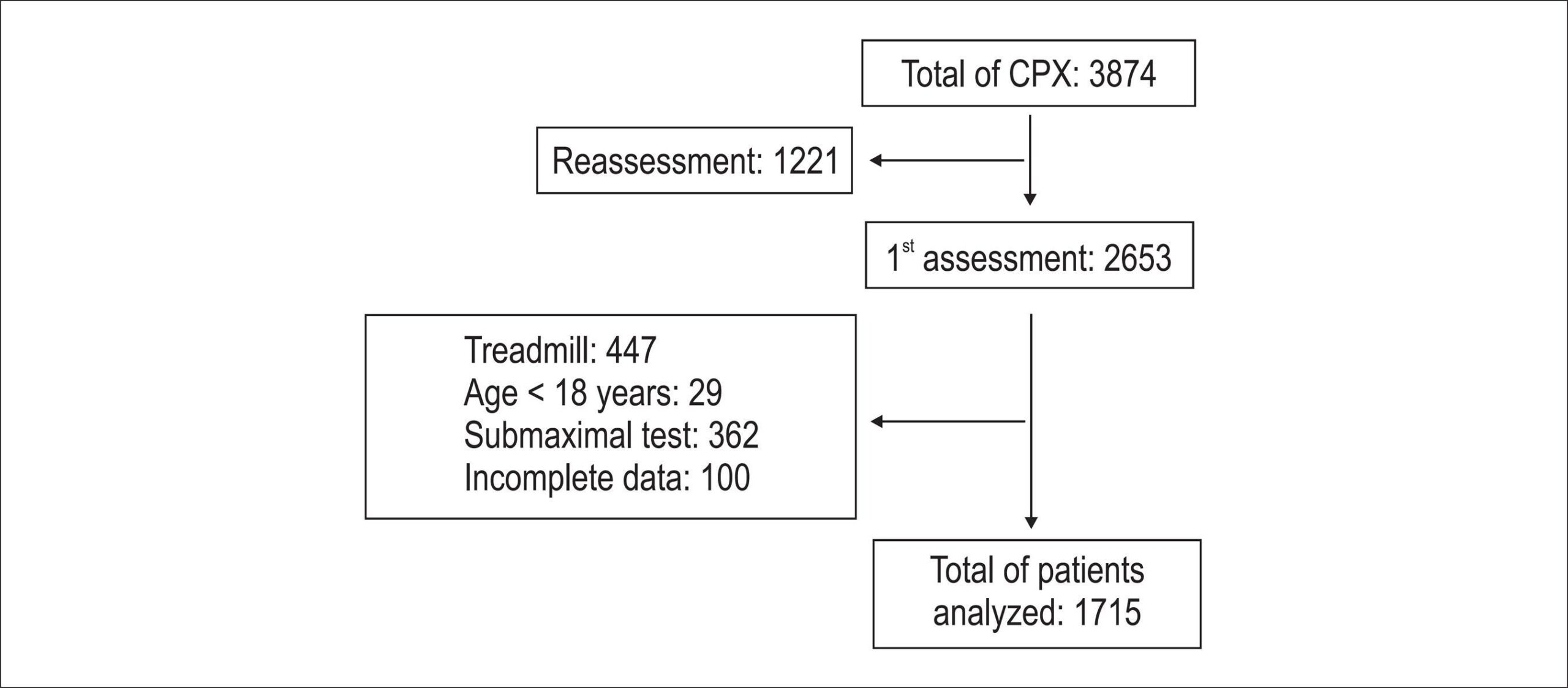
This study assessed 1715 adults (18 to 91 years, 68% men) undertaking maximum CPX in a lower limbs cycle ergometer (LLCE) with ramp protocol. The percentage error (E%) between measured VO2max and that estimated from the modified ACSM equation (Lang et al. MSSE, 1992) was calculated. Then, estimation equations were developed: 1) for all the population tested (C-GENERAL); and 2) separately by sex (C-MEN and C-WOMEN).

Results:

Measured VO2max was higher in men than in WOMEN: -29.4 ± 10.5 and 24.2 ± 9.2 mL.(kg.min)-1 (p < 0.01). The equations for estimating VO2max [in mL.(kg.min)-1] were: C-GENERAL = [final workload (W)/body weight (kg)] x 10.483 + 7; C-MEN = [final workload (W)/body weight (kg)] x 10.791 + 7; and C-WOMEN = [final workload (W)/body weight (kg)] x 9.820 + 7. The E% for MEN was: -3.4 ± 13.4% (modified ACSM); 1.2 ± 13.2% (C-GENERAL); and -0.9 ± 13.4% (C-MEN) (p < 0.01). For WOMEN: -14.7 ± 17.4% (modified ACSM); -6.3 ± 16.5% (C-GENERAL); and -1.7 ± 16.2% (C-WOMEN) (p < 0.01).

Conclusion:

The error of estimate of VO2max by use of sex-specific equations was reduced, but not eliminated, in exercise tests on LLCE.

  • Breathing Exercise / utilization
  • cardiopulmonary exercise testing
  • Demographic Data
  • Ergometry
  • Oxygen Consumption
  • Physical Exertion
Read Full Article
Creative Commons Attribution (CC BY) Creative Commons license
31/07/2015 DOI: 10.5935/abc.20150089 Views 2
Figure 1
ABC
Original Article

Evolution of Cardiovascular Diseases Mortality in the Counties of the State of Rio de Janeiro from 1979 to 2010

Gabriel Porto Soares et al. Carlos Henrique Klein Nelson Albuquerque de Souza e Silva Glaucia Maria Moraes de Oliveira

Background:

Cardiovascular Diseases (CVD) are the leading cause of death in Brazil.

Objective:

To estimate total CVD, cerebrovascular disease (CBVD), and ischemic heart disease (IHD) mortality rates in adults in the counties of the state of Rio de Janeiro (SRJ), from 1979 to 2010.

Methods:

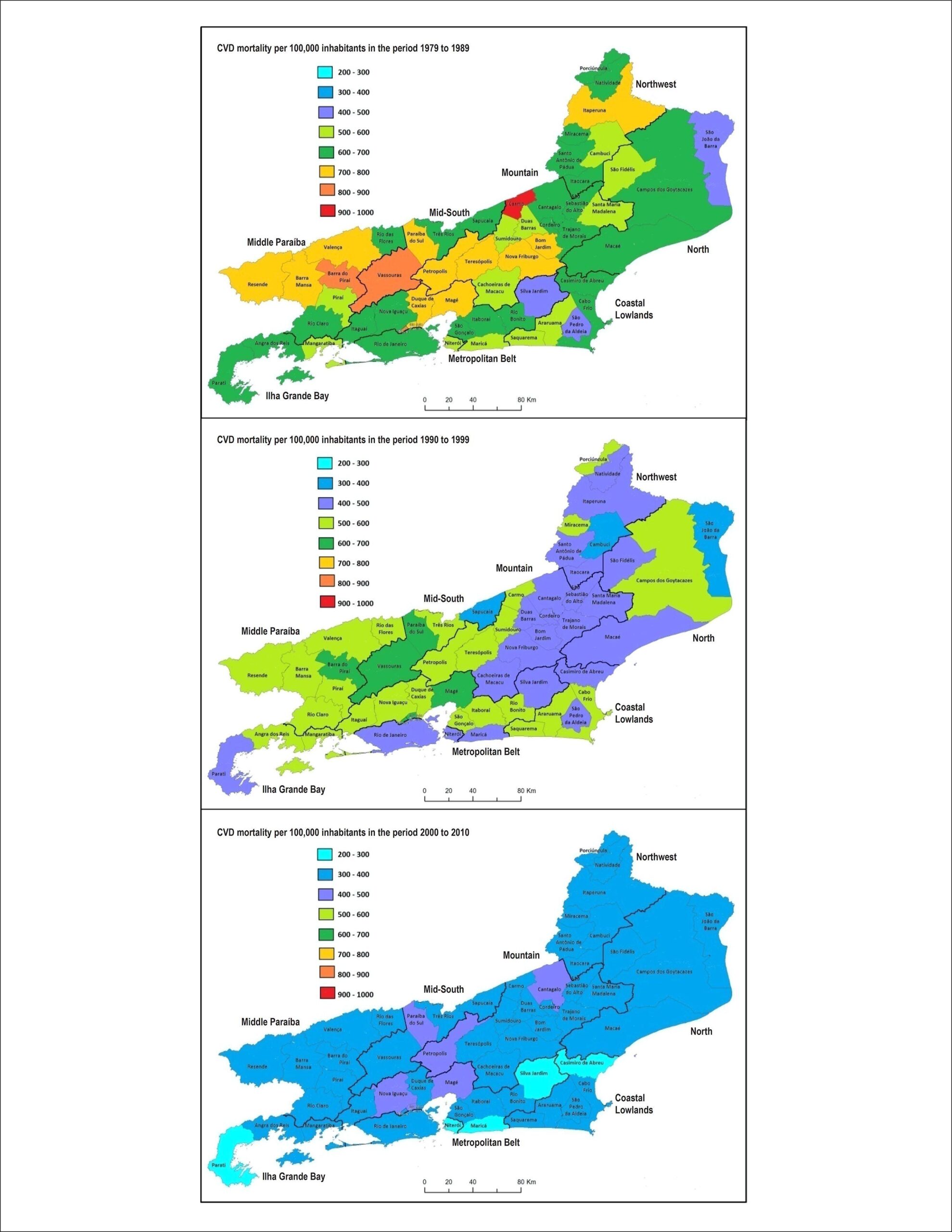
The counties of the SRJ were analysed according to their denominations stablished by the geopolitical structure of 1950, Each new county that have since been created, splitting from their original county, was grouped according to their former origin. Population Data were obtained from the Brazilian Institute of Geography and Statistics (IBGE), and data on deaths were obtained from DataSus/MS. Mean CVD, CBVD, and IHD mortality rates were estimated, compensated for deaths from ill-defined causes, and adjusted for age and sex using the direct method for three periods: 1979–1989, 1990–1999, and 2000–2010, Such results were spatially represented in maps. Tables were also constructed showing the mortality rates for each disease and year period.

Results:

There was a significant reduction in mortality rates across the three disease groups over the the three defined periods in all the county clusters analysed, Despite an initial mortality rate variation among the counties, it was observed a homogenization of such rates at the final period (2000–2010). The drop in CBVD mortality was greater than that in IHD mortality.

Conclusion:

Mortality due to CVD has steadily decreased in the SRJ in the last three decades. This reduction cannot be explained by greater access to high technology procedures or better control of cardiovascular risk factors as these facts have not occurred or happened in low proportion of cases with the exception of smoking which has decreased significantly. Therefore, it is necessary to seek explanations for this decrease, which may be related to improvements in the socioeconomic conditions of the population.

  • Cardiovascular Diseases, mortality
  • Data Interpretation, Statistical
  • Demographic Data
  • Local Government
Read Full Article
Creative Commons Attribution (CC BY) Creative Commons license
17/03/2015 DOI: 10.5935/abc.20150019 Views 2

How to cite this article

EndNote RIS

Electronic Document Format (Vancouver)

Faganello LS, Pimentel M, Polanczyk CA, Zimerman T, Malachias MVB, Dutra OP, Zimerman LI, et al. The Profile of the Brazilian Cardiologist – A Sample of Members of the Brazilian Society of Cardiology. Arquivos Brasileiros de Cardiologia 2019;113(1):62-8.

Electronic Document Format (ABNT)

Faganello, Lucas Simonetto; Pimentel, Mauricio; Polanczyk, Carisi Anne; Zimerman, Tiago; Malachias, Marcus Vinicius Bolivar; Dutra, Oscar Pereira; Zimerman, Leandro Ioschpe. The Profile of the Brazilian Cardiologist – A Sample of Members of the Brazilian Society of Cardiology. Arquivos Brasileiros de Cardiologia, v. 113, n. 1, p. 62-68, Jun. 2019.

Electronic Document Format (APA)

Faganello, L. S., Pimentel, M., Polanczyk, C. A., Zimerman, T., Malachias, M. V. B., Dutra, O. P., & Zimerman, L. I. (2019). The Profile of the Brazilian Cardiologist – A Sample of Members of the Brazilian Society of Cardiology. Arquivos Brasileiros de Cardiologia, 113(1), 62-68.

Electronic Document Format (ISO)

Faganello, Lucas Simonetto and Pimentel, Mauricio and Polanczyk, Carisi Anne and Zimerman, Tiago and Malachias, Marcus Vinicius Bolivar and Dutra, Oscar Pereira and Zimerman, Leandro Ioschpe. The Profile of the Brazilian Cardiologist – A Sample of Members of the Brazilian Society of Cardiology. Arquivos Brasileiros de Cardiologia [online]. 2019, vol. 113, n. 1, [cited 2026-10-14], pp. 62-68. Available from: <https://journals.cardiol.br/en/article/the-profile-of-the-brazilian-cardiologist-a-sample-of-members-of-the-brazilian-society-of-cardiology/>. ISSN 0066-782X

EndNote RIS

Electronic Document Format (Vancouver)

Achutti A. Spacetime. Arquivos Brasileiros de Cardiologia 2016;106(2):82-3.

Electronic Document Format (ABNT)

Achutti, Aloyzio. Spacetime. Arquivos Brasileiros de Cardiologia, v. 106, n. 2, p. 82-83, Jan. 2016.

Electronic Document Format (APA)

Achutti, A. (2016). Spacetime. Arquivos Brasileiros de Cardiologia, 106(2), 82-83.

Electronic Document Format (ISO)

Achutti, Aloyzio. Spacetime. Arquivos Brasileiros de Cardiologia [online]. 2016, vol. 106, n. 2, [cited 2026-10-14], pp. 82-83. Available from: <https://journals.cardiol.br/en/article/spacetime/>. ISSN 0066-782X

EndNote RIS

Electronic Document Format (Vancouver)

Silva CGS, Araújo CGS. Sex-Specific Equations to Estimate Maximum Oxygen Uptake in Cycle Ergometry. Arquivos Brasileiros de Cardiologia 2015;105(4):381-9.

Electronic Document Format (ABNT)

Silva, Christina G. de Souza e; Araújo, Claudio Gil S.. Sex-Specific Equations to Estimate Maximum Oxygen Uptake in Cycle Ergometry. Arquivos Brasileiros de Cardiologia, v. 105, n. 4, p. 381-389, Jul. 2015.

Electronic Document Format (APA)

Silva, C. G. S. , & Araújo, C. G. S. (2015). Sex-Specific Equations to Estimate Maximum Oxygen Uptake in Cycle Ergometry. Arquivos Brasileiros de Cardiologia, 105(4), 381-389.

Electronic Document Format (ISO)

Silva, Christina G. de Souza e and Araújo, Claudio Gil S.. Sex-Specific Equations to Estimate Maximum Oxygen Uptake in Cycle Ergometry. Arquivos Brasileiros de Cardiologia [online]. 2015, vol. 105, n. 4, [cited 2026-10-14], pp. 381-389. Available from: <https://journals.cardiol.br/en/article/sex-specific-equations-to-estimate-maximum-oxygen-uptake-in-cycle-ergometry/>. ISSN 0066-782X

EndNote RIS

Electronic Document Format (Vancouver)

Soares GP, Klein CH, Silva NAS, Oliveira GMM. Evolution of Cardiovascular Diseases Mortality in the Counties of the State of Rio de Janeiro from 1979 to 2010. Arquivos Brasileiros de Cardiologia 2015;104(5):356-65.

Electronic Document Format (ABNT)

Soares, Gabriel Porto; Klein, Carlos Henrique; Silva, Nelson Albuquerque de Souza e; Oliveira, Glaucia Maria Moraes de. Evolution of Cardiovascular Diseases Mortality in the Counties of the State of Rio de Janeiro from 1979 to 2010. Arquivos Brasileiros de Cardiologia, v. 104, n. 5, p. 356-365, Mar. 2015.

Electronic Document Format (APA)

Soares, G. P., Klein, C. H., Silva, N. A. S. , & Oliveira, G. M. M. (2015). Evolution of Cardiovascular Diseases Mortality in the Counties of the State of Rio de Janeiro from 1979 to 2010. Arquivos Brasileiros de Cardiologia, 104(5), 356-365.

Electronic Document Format (ISO)

Soares, Gabriel Porto and Klein, Carlos Henrique and Silva, Nelson Albuquerque de Souza e and Oliveira, Glaucia Maria Moraes de. Evolution of Cardiovascular Diseases Mortality in the Counties of the State of Rio de Janeiro from 1979 to 2010. Arquivos Brasileiros de Cardiologia [online]. 2015, vol. 104, n. 5, [cited 2026-10-14], pp. 356-365. Available from: <https://journals.cardiol.br/en/article/evolution-of-cardiovascular-diseases-mortality-in-the-counties-of-the-state-of-rio-de-janeiro-from-1979-to-2010/>. ISSN 0066-782X

  • About ABC Family
  • Internal Regulation
  • Editorial Board
  • Brazilian Society of Cardiology (SBC)

Issues

SBC Guidelines

  • Videos
  • Podcasts
  • News