ABC Family Arquivos Brasileiros de Cardiologia International Journal of Cardiovascular Sciences ABC Heart Failure & Cardiomyopathy ABC Imagem Cardiovascular
Português English
ABC Family
Português English
  • About
    • About ABC Family
    • Internal Regulation
    • Editorial Board
    • Brazilian Society of Cardiology (SBC)
  • Issues
  • SBC Guidelines
  • Content
    • Videos
    • Podcasts
    • News
  • About
    • About ABC Family
    • Internal Regulation
    • Editorial Board
    • Brazilian Society of Cardiology (SBC)
  • Issues
  • SBC Guidelines
  • Content
    • Videos
    • Podcasts
    • News

ABC Family

  • ABC Family
  • Arquivos Brasileiros de Cardiologia
  • International Journal of Cardiovascular Sciences
  • ABC Heart Failure & Cardiomyopathy
  • ABC Imagem Cardiovascular
Search in

No content found.

Journals
Ordering
Article types
Others

  1. Home
  2. Keyword: Income
Association of Income Level and Ischemic Heart Disease: Potential Role of Walkability
ABC
Original Article

Association of Income Level and Ischemic Heart Disease: Potential Role of Walkability

Rodrigo Julio Cerci et al. Miguel Morita Fernandes-Silva João Vicente Vitola Juliano Julio Cerci … Carlos Cunha Pereira Neto Margaret Masukawa Ana Paula Weller Gracia Lara Luiza Silvello Pedro Prado Murilo Guedes Adriano Akira Ferreira Hino Cristina Pellegrino Baena

Abstract

Background

Socioeconomic status has been linked to ischemic heart disease (IHD). High-income neighborhoods may expose individuals to a walking-promoting built environment for daily activities (walkability). Data from the association between income and IHD is lacking in middle-income countries. It is also uncertain whether walkability mediates this association.

Objectives

To investigate whether income is associated with IHD in a middle-income country and whether neighborhood walkability mediates the income-IHD association.

Methods

This cross-sectional study evaluated 44,589 patients referred for myocardial perfusion imaging (SPECT-MPI). Income and walkability were derived from participants’ residential census tract. Walkability quantitative score combined 4 variables: street connectivity, residential density, commercial density, and mixed land use. IHD was defined by abnormal myocardial perfusion during a SPECT-MPI study. We used adjusted mixed effects models to evaluate the association between income level and IHD, and we performed a mediation analysis to measure the percentage of the income-IHD association mediated by walkability. We considered p values below 0.01 as statistically significant.

Results

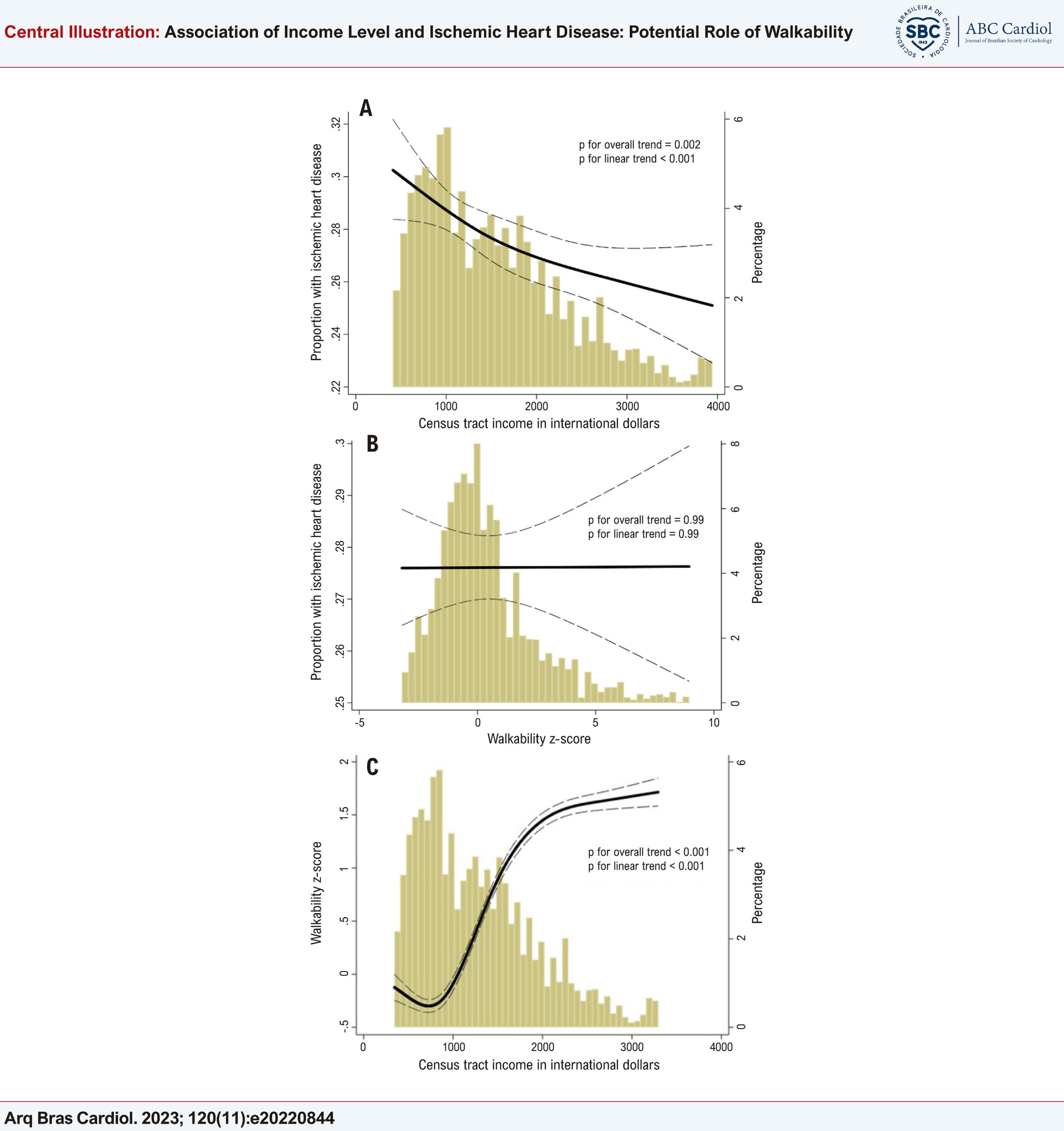
From 26,415 participants, those living in the lowest-income tertile census tract were more physically inactive (79.1% versus 75.8% versus 72.7%) when compared to higher-income tertile census tracts (p < 0.001). Income was associated with IHD (odds ratio: 0.91 [95% confidence interval: 0.87 to 0.96] for each 1,000.00 international dollars increase in income) for both men and women equally (p for interaction = 0.47). Census tracts with a higher income were associated with better walkability (p < 0.001); however, walkability did not mediate the income-IHD association (percent mediated = −0.3%).

Conclusions

Income was independently associated with higher prevalence of IHD in a middle-income country irrespective of gender. Although walkability was associated with census tract income, it did not mediate the income-IHD association.
  • Income
  • Myocardial Ischemia
  • Myocardial Perfusion Imaging
Read Full Article
Creative Commons Attribution (CC BY) Creative Commons license
04/12/2023 DOI: 10.36660/abc.20220844 Views 1
Figure 1
ABC
Original Article

The Profile of the Brazilian Cardiologist – A Sample of Members of the Brazilian Society of Cardiology

Lucas Simonetto Faganello et al. Mauricio Pimentel Carisi Anne Polanczyk Tiago Zimerman … Marcus Vinicius Bolivar Malachias Oscar Pereira Dutra Leandro Ioschpe Zimerman

Abstract

Background:

Data from the international literature have shown changes in the profile of cardiologists and in their medical practices. However, there is no data on this in Brazilian cardiologists.

Objective:

To evaluate professional and personal characteristics of a sample of Brazilian cardiologists.

Methods:

This was a cross-sectional study; a questionnaire was sent by e-mail to cardiologists, active members of the Brazilian Society of Cardiology in 2017. The results were analyzed, and the level of significance set at p < 0.05.

Results:

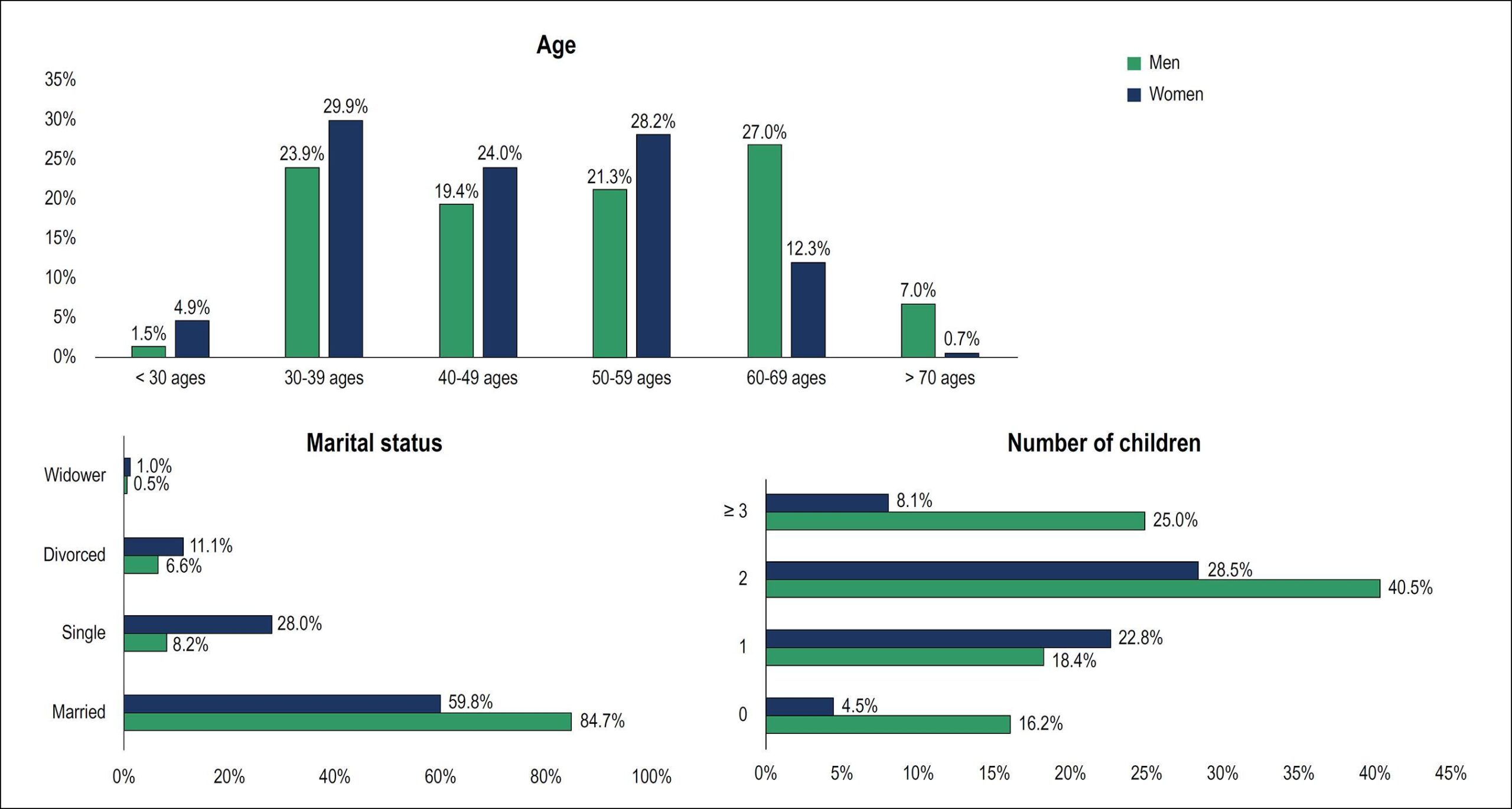
The questionnaire was sent to 13,462 cardiologists, with 2,101 (15.6%) respondents, mostly men (71.8% versus 28.2%). Age distribution and marital status were significantly different between the sexes (p < 0.001). The number of cardiologists without children was higher among women (40.5% versus 16.1%; p < 0.001). The most common place of work was the public hospital (46.5%), followed by private hospital (28.5%) and private office (21.1%). The office was the main place of work for 23.9% of men and 14% of women (p < 0.001), with predominance of individuals older than 50 years (31.7% versus 10.1%, respectively; p < 0.001). Most cardiologists (64.2%) worked more than 40 hours a week (69% of them men and 51.9% of the women; p < 0.001). Eighty-eight percent of the sample earned more than BRL 11,000 (US$ 3,473.43), and 66.5% of the men earned more than BRL 20,000 (US$ 6,315.32) per month, versus 31.2% of the women (p < 0.001). A high level of work-related stress was reported by 11.3% of respondents.

Conclusion:

Most cardiologists were men, who showed higher workload and higher income; 11.3% of the cardiologists perceived stress as a great deal.

  • Cardiologists
  • Demographic Data
  • Gender
  • Income
  • Quality of life
  • Survey and Questionnaires
Read Full Article
Creative Commons Attribution (CC BY) Creative Commons license
27/06/2019 DOI: 10.5935/abc.20190089 Views 1

How to cite this article

EndNote RIS

Electronic Document Format (Vancouver)

Cerci RJ, Fernandes-Silva MM, Vitola JV, Cerci JJ, Pereira Neto CC, Masukawa M, Gracia APW, et al. Association of Income Level and Ischemic Heart Disease: Potential Role of Walkability. Arquivos Brasileiros de Cardiologia 2023;120(11):e20220844.

Electronic Document Format (ABNT)

Cerci, Rodrigo Julio; Fernandes-Silva, Miguel Morita; Vitola, João Vicente; Cerci, Juliano Julio; Pereira Neto, Carlos Cunha; Masukawa, Margaret; Gracia, Ana Paula Weller; Silvello, Lara Luiza; Prado, Pedro; Guedes, Murilo; Hino, Adriano Akira Ferreira; Baena, Cristina Pellegrino. Association of Income Level and Ischemic Heart Disease: Potential Role of Walkability. Arquivos Brasileiros de Cardiologia, v. 120, n. 11, e20220844, Dec. 2023.

Electronic Document Format (APA)

Cerci, R. J., Fernandes-Silva, M. M., Vitola, J. V., Cerci, J. J., Pereira Neto, C. C., Masukawa, M., Gracia, A. P. W., Silvello, L. L., Prado, P., Guedes, M., Hino, A. A. F., & Baena, C. P. (2023). Association of Income Level and Ischemic Heart Disease: Potential Role of Walkability. Arquivos Brasileiros de Cardiologia, 120(11), e20220844.

Electronic Document Format (ISO)

Cerci, Rodrigo Julio and Fernandes-Silva, Miguel Morita and Vitola, João Vicente and Cerci, Juliano Julio and Pereira Neto, Carlos Cunha and Masukawa, Margaret and Gracia, Ana Paula Weller and Silvello, Lara Luiza and Prado, Pedro and Guedes, Murilo and Hino, Adriano Akira Ferreira and Baena, Cristina Pellegrino. Association of Income Level and Ischemic Heart Disease: Potential Role of Walkability. Arquivos Brasileiros de Cardiologia [online]. 2023, vol. 120, n. 11, [cited 2026-10-14], e20220844. Available from: <https://journals.cardiol.br/en/article/association-of-income-level-and-ischemic-heart-disease-potential-role-of-walkability/>. ISSN 0066-782X

EndNote RIS

Electronic Document Format (Vancouver)

Faganello LS, Pimentel M, Polanczyk CA, Zimerman T, Malachias MVB, Dutra OP, Zimerman LI, et al. The Profile of the Brazilian Cardiologist – A Sample of Members of the Brazilian Society of Cardiology. Arquivos Brasileiros de Cardiologia 2019;113(1):62-8.

Electronic Document Format (ABNT)

Faganello, Lucas Simonetto; Pimentel, Mauricio; Polanczyk, Carisi Anne; Zimerman, Tiago; Malachias, Marcus Vinicius Bolivar; Dutra, Oscar Pereira; Zimerman, Leandro Ioschpe. The Profile of the Brazilian Cardiologist – A Sample of Members of the Brazilian Society of Cardiology. Arquivos Brasileiros de Cardiologia, v. 113, n. 1, p. 62-68, Jun. 2019.

Electronic Document Format (APA)

Faganello, L. S., Pimentel, M., Polanczyk, C. A., Zimerman, T., Malachias, M. V. B., Dutra, O. P., & Zimerman, L. I. (2019). The Profile of the Brazilian Cardiologist – A Sample of Members of the Brazilian Society of Cardiology. Arquivos Brasileiros de Cardiologia, 113(1), 62-68.

Electronic Document Format (ISO)

Faganello, Lucas Simonetto and Pimentel, Mauricio and Polanczyk, Carisi Anne and Zimerman, Tiago and Malachias, Marcus Vinicius Bolivar and Dutra, Oscar Pereira and Zimerman, Leandro Ioschpe. The Profile of the Brazilian Cardiologist – A Sample of Members of the Brazilian Society of Cardiology. Arquivos Brasileiros de Cardiologia [online]. 2019, vol. 113, n. 1, [cited 2026-10-14], pp. 62-68. Available from: <https://journals.cardiol.br/en/article/the-profile-of-the-brazilian-cardiologist-a-sample-of-members-of-the-brazilian-society-of-cardiology/>. ISSN 0066-782X

  • About ABC Family
  • Internal Regulation
  • Editorial Board
  • Brazilian Society of Cardiology (SBC)

Issues

SBC Guidelines

  • Videos
  • Podcasts
  • News