ABC Family Arquivos Brasileiros de Cardiologia International Journal of Cardiovascular Sciences ABC Heart Failure & Cardiomyopathy ABC Imagem Cardiovascular
Português English
ABC Family
Português English
  • About
    • About ABC Family
    • Internal Regulation
    • Editorial Board
    • Brazilian Society of Cardiology (SBC)
  • Issues
  • SBC Guidelines
  • Content
    • Videos
    • Podcasts
    • News
  • About
    • About ABC Family
    • Internal Regulation
    • Editorial Board
    • Brazilian Society of Cardiology (SBC)
  • Issues
  • SBC Guidelines
  • Content
    • Videos
    • Podcasts
    • News

ABC Family

  • ABC Family
  • Arquivos Brasileiros de Cardiologia
  • International Journal of Cardiovascular Sciences
  • ABC Heart Failure & Cardiomyopathy
  • ABC Imagem Cardiovascular
Search in

No content found.

Journals
Ordering
Article types
Others

  1. Home
  2. Keyword: Ergometry
Figure 1
ABC
Original Article

Sex-Specific Equations to Estimate Maximum Oxygen Uptake in Cycle Ergometry

Christina G. de Souza e Silva et al. Claudio Gil S. Araújo

Abstract

Background:

Aerobic fitness, assessed by measuring VO2max in maximum cardiopulmonary exercise testing (CPX) or by estimating VO2max through the use of equations in exercise testing, is a predictor of mortality. However, the error resulting from this estimate in a given individual can be high, affecting clinical decisions.

Objective:

To determine the error of estimate of VO2max in cycle ergometry in a population attending clinical exercise testing laboratories, and to propose sex-specific equations to minimize that error.

Methods:

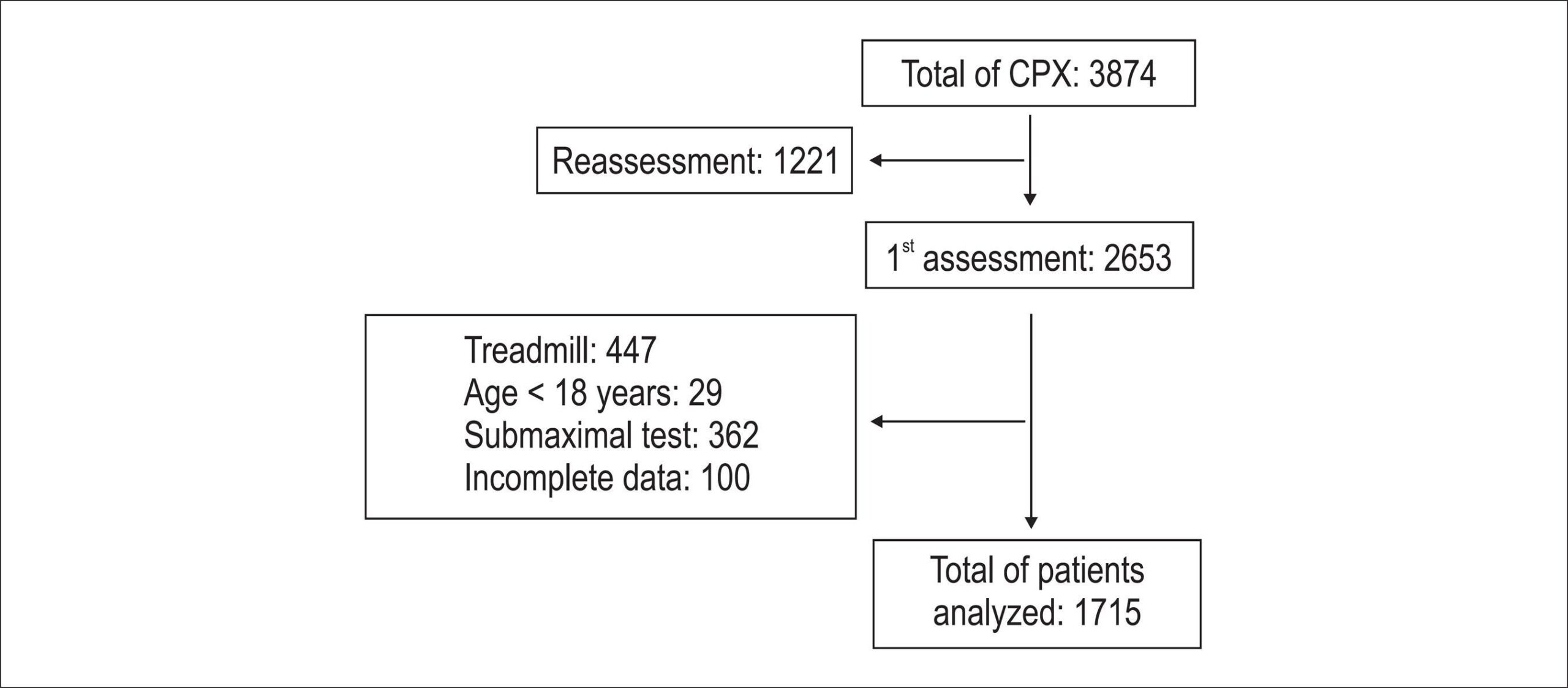
This study assessed 1715 adults (18 to 91 years, 68% men) undertaking maximum CPX in a lower limbs cycle ergometer (LLCE) with ramp protocol. The percentage error (E%) between measured VO2max and that estimated from the modified ACSM equation (Lang et al. MSSE, 1992) was calculated. Then, estimation equations were developed: 1) for all the population tested (C-GENERAL); and 2) separately by sex (C-MEN and C-WOMEN).

Results:

Measured VO2max was higher in men than in WOMEN: -29.4 ± 10.5 and 24.2 ± 9.2 mL.(kg.min)-1 (p < 0.01). The equations for estimating VO2max [in mL.(kg.min)-1] were: C-GENERAL = [final workload (W)/body weight (kg)] x 10.483 + 7; C-MEN = [final workload (W)/body weight (kg)] x 10.791 + 7; and C-WOMEN = [final workload (W)/body weight (kg)] x 9.820 + 7. The E% for MEN was: -3.4 ± 13.4% (modified ACSM); 1.2 ± 13.2% (C-GENERAL); and -0.9 ± 13.4% (C-MEN) (p < 0.01). For WOMEN: -14.7 ± 17.4% (modified ACSM); -6.3 ± 16.5% (C-GENERAL); and -1.7 ± 16.2% (C-WOMEN) (p < 0.01).

Conclusion:

The error of estimate of VO2max by use of sex-specific equations was reduced, but not eliminated, in exercise tests on LLCE.

  • Breathing Exercise / utilization
  • cardiopulmonary exercise testing
  • Demographic Data
  • Ergometry
  • Oxygen Consumption
  • Physical Exertion
Read Full Article
Creative Commons Attribution (CC BY) Creative Commons license
31/07/2015 DOI: 10.5935/abc.20150089 Views 2
Figure 1
ABC
Artigo Original

Time of Exercise as Indicator of Quality Control in Ergometry Services

Romeu Sergio Meneghelo et al. Samira Saady Morhy Paola Zucchi

Background:

The search for quality requires assessment tools in the various subdivisions of a health complex. In diagnostic medicine, they are scarce and in ergometry suggestions of indicators were not found.

Objective:

To establish indicator for quality control on ergometry based on III Guidelines of the Brazilian Cardiology Society About Ergometric Test; to verify the percentage of tests that have presented the indicator within the compliance in two services of the same institution before and after the publication of the document.

Methods:

A critical analysis of the guidelines in the search for indicator that would present: accuracy, reliability, simplicity, validity, sensitivity and ability to quantitatively measure the variations in the behavior of quality criteria and that would be applicable to all tests. The indicator was applied in tests of 2010 and 2011 prior to the publication, and after it was adopted by two services of the same institution.

Results:

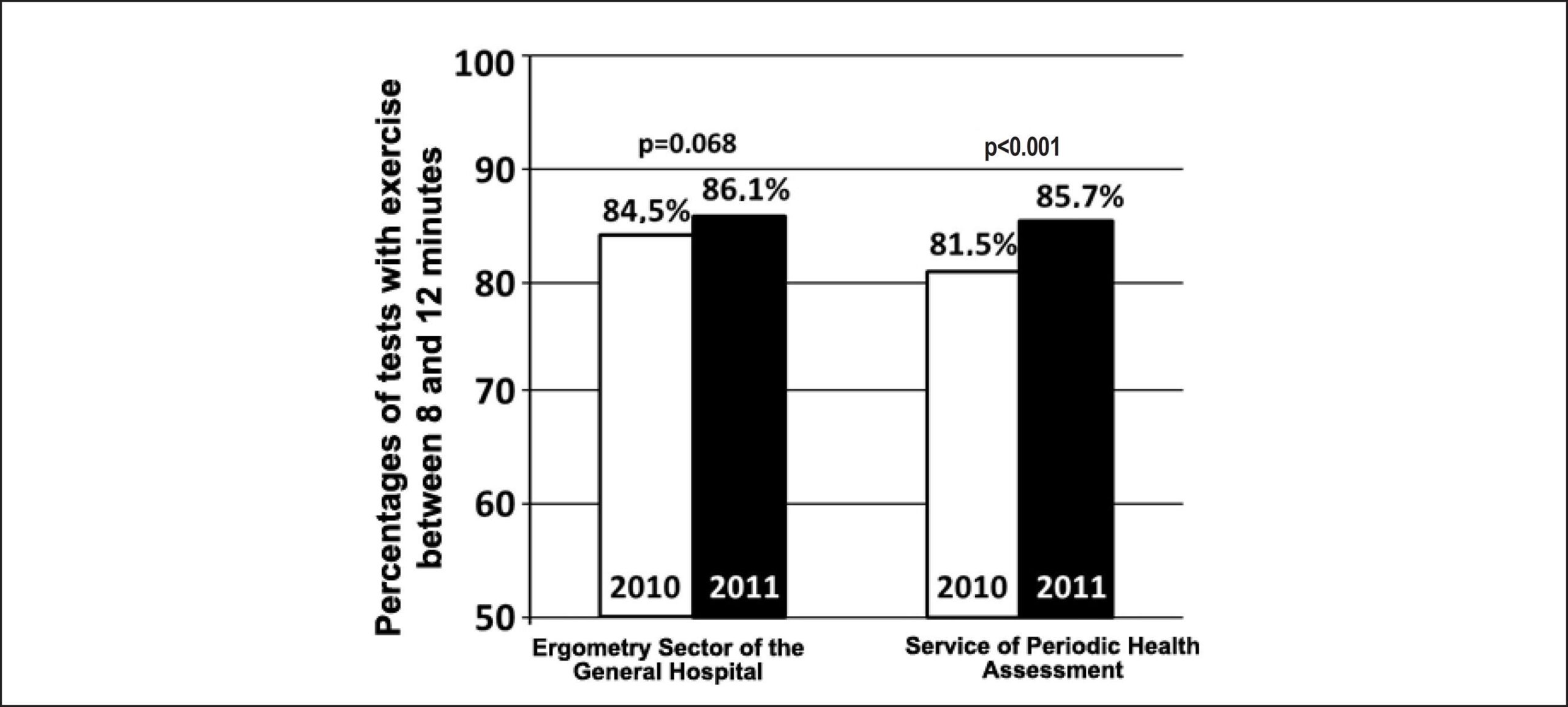
The indicator that has met the criteria was the percentage of ergometric tests with exercise duration between 8 and 12 minutes. In the years 2010 and 2011, respectively, the percentage of ergometric tests within compliance were 85.5% and 86.1% (p = 0.068) at the General Hospital, and 81.5% and 85.7% (p <0.001) the Service of Periodic Health Assessment.

Conclusion:

The exercise time between 8 and 12 minutes can be used as a quality criterion in ergometric and services where it was applied, at least 80% of the ergometric tests were compliant.

  • Ergometry
  • Exercise
  • Measures
  • Quality Indicators, Health Care
Read Full Article
Creative Commons Attribution (CC BY) Creative Commons license
25/03/2014 DOI: 10.5935/abc.20140005 Views 1
Maximal heart rate: influence of sport practice during childhood and adolescence
ABC
Artigo Original

Maximal heart rate: influence of sport practice during childhood and adolescence

Débora Helena Balassiano et al. Claudio Gil Soares de Araújo

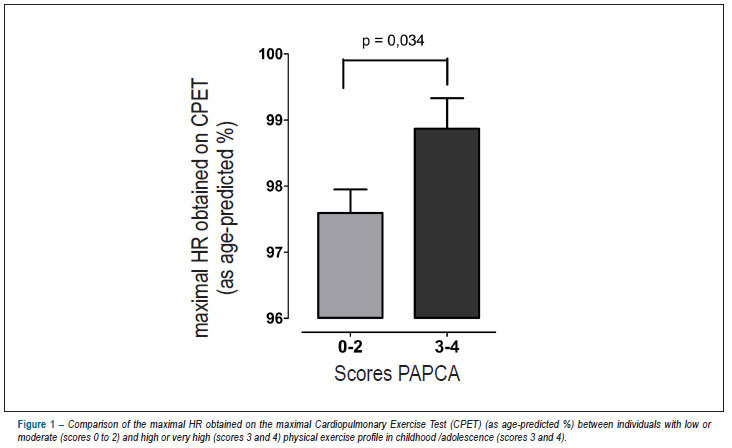
BACKGROUND: The heart rate (HR) achieved at the end of an exercise test (ET) is called maximal HR and is known to have clinical and epidemiological relevance. For its correct measurement, it is necessary that the ET be truly maximal. OBJECTIVE: To evaluate the influence of a history of intense physical activity and/or participation in sports competitions during youth on the maximal HR (% of age-predicted HR) on a clinical cardiopulmonary exercise test (CPET). METHODS: A total of 600 non-athlete individuals (65.8% males) with a mean age of 46 ± 13.7 years, under primary prevention of cardiovascular diseases and who underwent maximal CPET, were retrospectively selected. Their physical activity profile during childhood/adolescence (PAPCA) was classified in scores growing from 0 to 4, with value 2 corresponding to their respective age-predicted levels. RESULTS: None of the 20 individuals with maximal HR values equal to or greater than 200 bpm had been inactive or somewhat active during childhood/adolescence. A significant association was observed between PAPCA scores and maximal HR (% of age-predicted HR) (p = 0.02), with a 7-bpm higher value for PAPCA scores 3-4 (32.9% of the sample) in comparison to PAPCA 0-2. CONCLUSION: Two hypotheses exist to explain these results in individuals who had been more active during youth: a) persistence of chronic adaptations to training on the cardiac chronotropism, or b) higher ability and/or motivation to achieve a truly maximal CPET. Information on the physical activity profile during childhood / adolescence may contribute to the interpretation of maximal HR on ET.

  • Adolescents
  • Child
  • Ergometry
  • Exercise
  • Heart Failure
  • Physical Exertion
  • Sports
Read Full Article
Creative Commons Attribution (CC BY) Creative Commons license
02/04/2013 DOI: 10.5935/abc.20130055 Views 1
Electrocardiographic score: application in exercise test for the assessment of ischemic preconditioning
ABC
Artigo Original

Electrocardiographic score: application in exercise test for the assessment of ischemic preconditioning

Augusto Uchida et al. Paulo Moffa Whady Hueb Luiz Antonio Machado Cesar … Beatriz Moreira Ayub Ferreira Jose Antonio Franchini Ramires

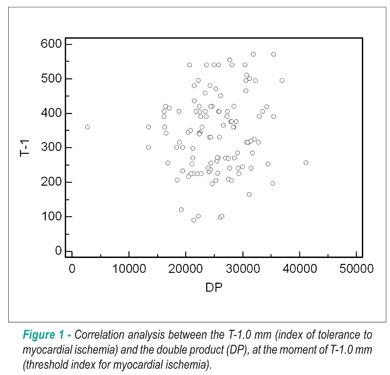
BACKGROUND: The time for 1.0 mm ST-segment depression (T-1.0mm) adopted to characterize ischemic preconditioning (IPC) in sequential exercise tests is consistent and reproducible; however, it has several limitations. OBJECTIVE: To apply an electrocardiographic score of myocardial ischemia in sequential exercise tests, comparing it to the conventional T-1.0 mm index. METHODS: Sixty one patients with mean age of 62.2 ± 7.5 years were evaluated; 86.9% were males. A total of 151 tests were analyzed, 116 of which were from patients who completed two assessment phases. The first phase comprised two sequential exercise tests for the documentation of IPC; the second phase, initiated one week later, comprised two more tests carried out under the effect of repaglinide. Two observers who were blind to the tests applied the score. RESULTS: Perfect inter and intraobserver agreement was found (Kendall tau-b = 0.96, p < 0.0001, and Kendall tau-b = 0.98, p < 0.0001, respectively). Values of sensitivity and specificity, negative predictive value, positive predictive value and accuracy were 72.41%, 89.29%, 75.8%, 87.5% and 81.0%, respectively. CONCLUSION: The ischemic score is a consistent and reproducible method for the documentation of IPC, and is a feasible alternative to T-1.0 mm.

  • Angina Pectoris
  • Ergometry
  • Ischemic Preconditioning Myocardial
  • Myocardial Infarction
Read Full Article
Creative Commons Attribution (CC BY) Creative Commons license
08/09/2010 DOI: 10.1590/S0066-782X2010005000122 Views 1

How to cite this article

EndNote RIS

Electronic Document Format (Vancouver)

Silva CGS, Araújo CGS. Sex-Specific Equations to Estimate Maximum Oxygen Uptake in Cycle Ergometry. Arquivos Brasileiros de Cardiologia 2015;105(4):381-9.

Electronic Document Format (ABNT)

Silva, Christina G. de Souza e; Araújo, Claudio Gil S.. Sex-Specific Equations to Estimate Maximum Oxygen Uptake in Cycle Ergometry. Arquivos Brasileiros de Cardiologia, v. 105, n. 4, p. 381-389, Jul. 2015.

Electronic Document Format (APA)

Silva, C. G. S. , & Araújo, C. G. S. (2015). Sex-Specific Equations to Estimate Maximum Oxygen Uptake in Cycle Ergometry. Arquivos Brasileiros de Cardiologia, 105(4), 381-389.

Electronic Document Format (ISO)

Silva, Christina G. de Souza e and Araújo, Claudio Gil S.. Sex-Specific Equations to Estimate Maximum Oxygen Uptake in Cycle Ergometry. Arquivos Brasileiros de Cardiologia [online]. 2015, vol. 105, n. 4, [cited 2026-10-14], pp. 381-389. Available from: <https://journals.cardiol.br/en/article/sex-specific-equations-to-estimate-maximum-oxygen-uptake-in-cycle-ergometry/>. ISSN 0066-782X

EndNote RIS

Electronic Document Format (Vancouver)

Meneghelo RS, Morhy SS, Zucchi P. Time of Exercise as Indicator of Quality Control in Ergometry Services. Arquivos Brasileiros de Cardiologia 2014;102(2):151-6.

Electronic Document Format (ABNT)

Meneghelo, Romeu Sergio; Morhy, Samira Saady; Zucchi, Paola. Time of Exercise as Indicator of Quality Control in Ergometry Services. Arquivos Brasileiros de Cardiologia, v. 102, n. 2, p. 151-156, Mar. 2014.

Electronic Document Format (APA)

Meneghelo, R. S., Morhy, S. S., & Zucchi, P. (2014). Time of Exercise as Indicator of Quality Control in Ergometry Services. Arquivos Brasileiros de Cardiologia, 102(2), 151-156.

Electronic Document Format (ISO)

Meneghelo, Romeu Sergio and Morhy, Samira Saady and Zucchi, Paola. Time of Exercise as Indicator of Quality Control in Ergometry Services. Arquivos Brasileiros de Cardiologia [online]. 2014, vol. 102, n. 2, [cited 2026-10-14], pp. 151-156. Available from: <https://journals.cardiol.br/en/article/time-of-exercise-as-indicator-of-quality-control-in-ergometry-services/>. ISSN 0066-782X

EndNote RIS

Electronic Document Format (Vancouver)

Balassiano DH, Araújo CGS. Maximal heart rate: influence of sport practice during childhood and adolescence. Arquivos Brasileiros de Cardiologia 2013;100(4):333-8.

Electronic Document Format (ABNT)

Balassiano, Débora Helena; Araújo, Claudio Gil Soares de. Maximal heart rate: influence of sport practice during childhood and adolescence. Arquivos Brasileiros de Cardiologia, v. 100, n. 4, p. 333-338, Apr. 2013.

Electronic Document Format (APA)

Balassiano, D. H., & Araújo, C. G. S. (2013). Maximal heart rate: influence of sport practice during childhood and adolescence. Arquivos Brasileiros de Cardiologia, 100(4), 333-338.

Electronic Document Format (ISO)

Balassiano, Débora Helena and Araújo, Claudio Gil Soares de. Maximal heart rate: influence of sport practice during childhood and adolescence. Arquivos Brasileiros de Cardiologia [online]. 2013, vol. 100, n. 4, [cited 2026-10-14], pp. 333-338. Available from: <https://journals.cardiol.br/en/article/maximal-heart-rate-influence-of-sport-practice-during-childhood-and-adolescence/>. ISSN 0066-782X

EndNote RIS

Electronic Document Format (Vancouver)

Uchida A, Moffa P, Hueb W, Cesar LAM, Ferreira BMA, Ramires JAF. Electrocardiographic score: application in exercise test for the assessment of ischemic preconditioning. Arquivos Brasileiros de Cardiologia 2010;95(4):486-92.

Electronic Document Format (ABNT)

Uchida, Augusto; Moffa, Paulo; Hueb, Whady; Cesar, Luiz Antonio Machado; Ferreira, Beatriz Moreira Ayub; Ramires, Jose Antonio Franchini. Electrocardiographic score: application in exercise test for the assessment of ischemic preconditioning. Arquivos Brasileiros de Cardiologia, v. 95, n. 4, p. 486-492, Sep. 2010.

Electronic Document Format (APA)

Uchida, A., Moffa, P., Hueb, W., Cesar, L. A. M., Ferreira, B. M. A., & Ramires, J. A. F. (2010). Electrocardiographic score: application in exercise test for the assessment of ischemic preconditioning. Arquivos Brasileiros de Cardiologia, 95(4), 486-492.

Electronic Document Format (ISO)

Uchida, Augusto and Moffa, Paulo and Hueb, Whady and Cesar, Luiz Antonio Machado and Ferreira, Beatriz Moreira Ayub and Ramires, Jose Antonio Franchini. Electrocardiographic score: application in exercise test for the assessment of ischemic preconditioning. Arquivos Brasileiros de Cardiologia [online]. 2010, vol. 95, n. 4, [cited 2026-10-14], pp. 486-492. Available from: <https://journals.cardiol.br/en/article/electrocardiographic-score-application-in-exercise-test-for-the-assessment-of-ischemic-preconditioning/>. ISSN 0066-782X

  • About ABC Family
  • Internal Regulation
  • Editorial Board
  • Brazilian Society of Cardiology (SBC)

Issues

SBC Guidelines

  • Videos
  • Podcasts
  • News