ABC Family Arquivos Brasileiros de Cardiologia International Journal of Cardiovascular Sciences ABC Heart Failure & Cardiomyopathy ABC Imagem Cardiovascular
Português English
ABC Family
Português English
  • About
    • About ABC Family
    • Internal Regulation
    • Editorial Board
    • Brazilian Society of Cardiology (SBC)
  • Issues
  • SBC Guidelines
  • Content
    • Videos
    • Podcasts
    • News
  • About
    • About ABC Family
    • Internal Regulation
    • Editorial Board
    • Brazilian Society of Cardiology (SBC)
  • Issues
  • SBC Guidelines
  • Content
    • Videos
    • Podcasts
    • News

ABC Family

  • ABC Family
  • Arquivos Brasileiros de Cardiologia
  • International Journal of Cardiovascular Sciences
  • ABC Heart Failure & Cardiomyopathy
  • ABC Imagem Cardiovascular
Search in

No content found.

Journals
Ordering
Article types
Others

  1. Home
  2. Keyword: cardiopulmonary exercise testing
ABC
Editorial

Photobiomodulation Therapy with Cardiac Rehabilitation in HFrEF/HFmrEF: Promise, Parameters, and the Primacy of Exercise

Ricardo Carvalheiro et al. Ana Raquel Santos António Valentim Gonçalves

Exercise intolerance in heart failure (HF) is not solely a central pump problem. Peripheral mechanisms, such as impaired skeletal-muscle oxygen extraction and mitochondrial dysfunction, are major limiting factors and correlate with early fatigue and poorer outcomes. On this basis, low-level light/laser photobiomodulation therapy (PBMT) has attracted interest as an adjunct to rehabilitation: by targeting cytochrome-c oxidase, PBMT may boost mitochondrial ATP generation, modulate redox signaling, and enhance microvascular perfusion.

In this edition, the article by Busin et al. evaluates whether the addition of PBMT to either continuous moderate-intensity training (CMT) or high-intensity interval training (HIIT) augments gains in peak oxygen uptake (VO2peak) and other CPET indices among symptomatic, clinically stable HFrEF/HFmrEF patients. In a non-randomized, five-arm design (CMT, HIIT, CMT+PBMT, HIIT+PBMT, and a control group) with 49 participants, the authors observed significant improvements in exercise tolerance across all intervention groups, but no additional benefit from PBMT on VO2peak, ventilatory efficiency (VE/VCO2 slope), or oxygen uptake efficiency slope (OUES). Numerical trends favored some PBMT arms, yet between-group differences were not statistically significant. The HIIT arms performed particularly well, but PBMT (applied only before sessions and at a modest dose) did not yield additional improvements.

[…]
  • Cardiac Rehabilitation
  • cardiopulmonary exercise testing
  • Heart failure with reduced ejection fraction
  • High-Intensity Interval Training
  • Photobiomodulation Therapy
Read Full Article
Creative Commons Attribution (CC BY) Creative Commons license
19/01/2026 DOI: 10.36660/abc.20250677i
Figure 1
IJCS
Original Article

High Cardiorespiratory Optimal Point Values Are Related to Cardiovascular Mortality in Men Aged 46 to 70 Years: a Prospective Cohort Study

Claudio Gil Araújo et al. Plínio Santos Ramos Jari A. Laukkanen Jonathan Myers … Setor K. Kunutsor Matthew P. Harber Thijs M. H. Eijsvogels Beatriz D. Marinho Christina Grüne de Souza e Silva

Abstract

Background:

Several hemodynamic and respiratory variables measured during cardiopulmonary exercise testing (CPX) have been shown to predict survival. One such measure is the cardiorespiratory optimal point (COP) that reflects the best possible circulation-respiration interaction, but there are still limited data on its relationship with adverse outcomes.

Objective:

To assess the association between COP and cardiovascular mortality in men aged 46 to 70 years.

Methods:

A sample of 2201 men who had anthropometric, clinical, and COP data obtained during cycling CPX between 1995 and 2022 was extracted from the CLINIMEX Exercise cohort. COP was identified as the minimal minute-to-minute VE/VO2 during CPX. Vital data were censored on October 31, 2022 for ICD-10-identified cardiovascular deaths. Cox proportional hazard models were used to estimate hazard ratios (HRs) with 95% confidence intervals (95% CIs).

Results:

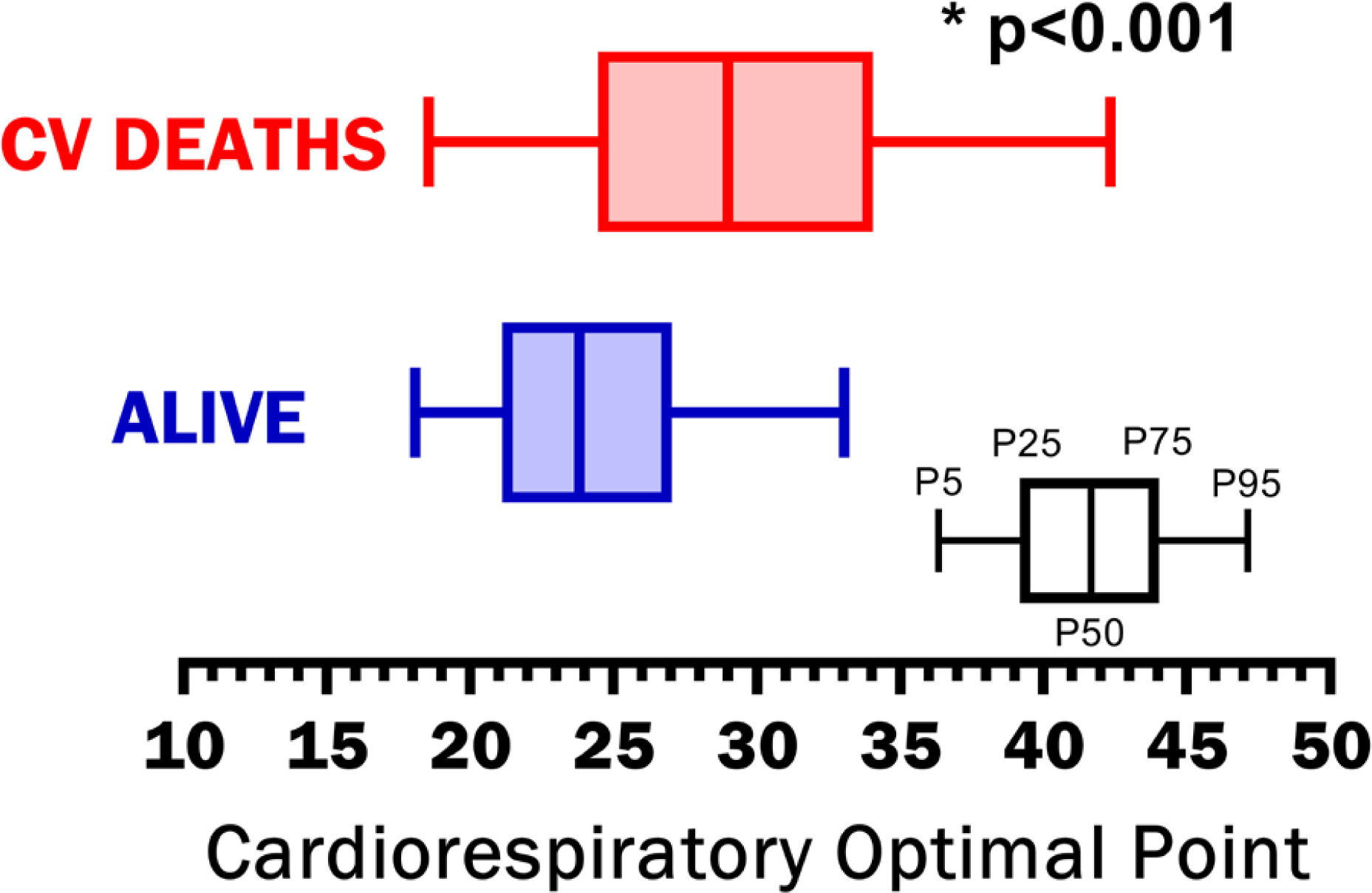
The mean ± standard deviation age was 57 ± 6 years and the median COP value was 24 (interquartile range = 21.2 to 27.4). During a mean follow-up of 4688 ± 2416 days, 129 (5.6%) patients died from cardiovascular causes. The death rates for low ( 30) categories of COP were 3.2%, 9.6%, and 18.7%, respectively. Following adjustment for age, history of myocardial infarction, diagnosis of coronary artery disease, and diabetes mellitus, the HR (95% CI) for cardiovascular mortality comparing very high versus low COP was 2.76 (1.87 to 4.07; p < 0.001).

Conclusions:

Our data indicate that, for a general population-based sample of men, COP > 30 represents a considerably higher risk for cardiovascular death. Information on COP could assist cardiovascular risk assessment in men.

  • cardiopulmonary exercise testing
  • Cardiovascular Diseases
  • exercise testing
  • physical fitness
Read Full Article
Creative Commons Attribution (CC BY) Creative Commons license
15/09/2023 DOI: 10.36660/ijcs.20230090 Views 2
Figure 1
ABC
Original Article

Sex-Specific Equations to Estimate Maximum Oxygen Uptake in Cycle Ergometry

Christina G. de Souza e Silva et al. Claudio Gil S. Araújo

Abstract

Background:

Aerobic fitness, assessed by measuring VO2max in maximum cardiopulmonary exercise testing (CPX) or by estimating VO2max through the use of equations in exercise testing, is a predictor of mortality. However, the error resulting from this estimate in a given individual can be high, affecting clinical decisions.

Objective:

To determine the error of estimate of VO2max in cycle ergometry in a population attending clinical exercise testing laboratories, and to propose sex-specific equations to minimize that error.

Methods:

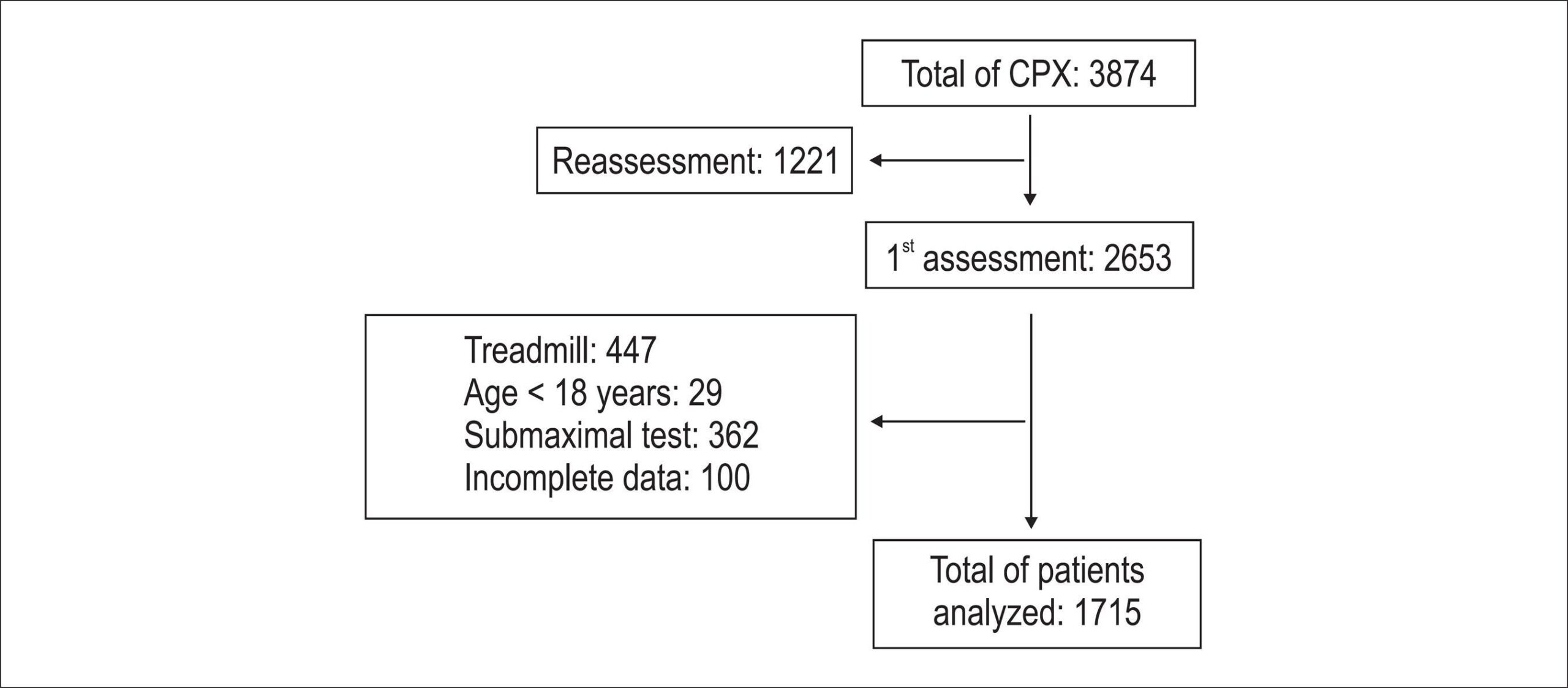
This study assessed 1715 adults (18 to 91 years, 68% men) undertaking maximum CPX in a lower limbs cycle ergometer (LLCE) with ramp protocol. The percentage error (E%) between measured VO2max and that estimated from the modified ACSM equation (Lang et al. MSSE, 1992) was calculated. Then, estimation equations were developed: 1) for all the population tested (C-GENERAL); and 2) separately by sex (C-MEN and C-WOMEN).

Results:

Measured VO2max was higher in men than in WOMEN: -29.4 ± 10.5 and 24.2 ± 9.2 mL.(kg.min)-1 (p < 0.01). The equations for estimating VO2max [in mL.(kg.min)-1] were: C-GENERAL = [final workload (W)/body weight (kg)] x 10.483 + 7; C-MEN = [final workload (W)/body weight (kg)] x 10.791 + 7; and C-WOMEN = [final workload (W)/body weight (kg)] x 9.820 + 7. The E% for MEN was: -3.4 ± 13.4% (modified ACSM); 1.2 ± 13.2% (C-GENERAL); and -0.9 ± 13.4% (C-MEN) (p < 0.01). For WOMEN: -14.7 ± 17.4% (modified ACSM); -6.3 ± 16.5% (C-GENERAL); and -1.7 ± 16.2% (C-WOMEN) (p < 0.01).

Conclusion:

The error of estimate of VO2max by use of sex-specific equations was reduced, but not eliminated, in exercise tests on LLCE.

  • Breathing Exercise / utilization
  • cardiopulmonary exercise testing
  • Demographic Data
  • Ergometry
  • Oxygen Consumption
  • Physical Exertion
Read Full Article
Creative Commons Attribution (CC BY) Creative Commons license
31/07/2015 DOI: 10.5935/abc.20150089 Views 2
ABC
Artigo Original

Effects of cimetidine on chronotropic response to cardiopulmonary exercise t esting

Gicela Risso Rocha et al. Ricardo Stein Márcio R. Guimarães Jorge Pinto Ribeiro

OBJECTIVE: To test the hypothesis that the administration of cimetidine will modify the chronotropic response to exercise testing through a random clinical trial. METHODS: The study selected 24 eligible healthy subjects, ages between 20 and 68 years, not athletes, who agreed to undergo cardiopulmonary exercise testing after the administration of placebo and 400 mg of cimetidine twice a day for one week. The tests were performed on a treadmill using a ramp protocol and direct analysis of the expired gases. Peak, resting and anaerobic threshold heart rate were recorded. RESULTS: The twenty subjects studied were equally distributed across sex with mean (± SD) age 43 ± 11 years. Tests on placebo and on cimetidine presented similar duration (578 ± 90 sec vs 603 ± 131 sec) and similar peak oxygen uptake (35 ± 8 ml/kg.min vs 35 ± 8 ml/kg.min). Cimetidine administration had no significant effect on resting heart rate (75 ± 10 bpm vs 74 ± 8 bpm), heart rate at peak exercise (176 ± 12 bpm vs 176 ± 11 bpm), and on the difference between the peak and the resting heart rates – delta HR (101 ± 14 bpm vs 101 ± 13 bpm). CONCLUSION: The administration of cimetidine for 7 days has no significant effect on the chronotropic response to exercise testing.

  • cardiopulmonary exercise testing
  • Chronotropic response
  • cimetidine
  • H1 and H2 receptors
  • histamine
Read Full Article
Creative Commons Attribution (CC BY) Creative Commons license
30/03/2006 DOI: 10.1590/S0066-782X2006000300008

How to cite this article

EndNote RIS

Electronic Document Format (Vancouver)

Carvalheiro R, Santos AR, Gonçalves AV. Photobiomodulation Therapy with Cardiac Rehabilitation in HFrEF/HFmrEF: Promise, Parameters, and the Primacy of Exercise. Arquivos Brasileiros de Cardiologia 2026;122(11):e20250677.

Electronic Document Format (ABNT)

Carvalheiro, Ricardo; Santos, Ana Raquel; Gonçalves, António Valentim. Photobiomodulation Therapy with Cardiac Rehabilitation in HFrEF/HFmrEF: Promise, Parameters, and the Primacy of Exercise. Arquivos Brasileiros de Cardiologia, v. 122, n. 11, e20250677, Jan. 2026.

Electronic Document Format (APA)

Carvalheiro, R., Santos, A. R., & Gonçalves, A. V. (2026). Photobiomodulation Therapy with Cardiac Rehabilitation in HFrEF/HFmrEF: Promise, Parameters, and the Primacy of Exercise. Arquivos Brasileiros de Cardiologia, 122(11), e20250677.

Electronic Document Format (ISO)

Carvalheiro, Ricardo and Santos, Ana Raquel and Gonçalves, António Valentim. Photobiomodulation Therapy with Cardiac Rehabilitation in HFrEF/HFmrEF: Promise, Parameters, and the Primacy of Exercise. Arquivos Brasileiros de Cardiologia [online]. 2026, vol. 122, n. 11, [cited 2026-10-14], e20250677. Available from: <https://journals.cardiol.br/en/article/photobiomodulation-therapy-with-cardiac-rehabilitation-in-hfref-hfmref-promise-parameters-and-the-primacy-of-exercise/>. ISSN 0066-782X

EndNote RIS

Electronic Document Format (Vancouver)

Araújo CG, Ramos PS, Laukkanen JA, Myers J, Kunutsor SK, Harber MP, Eijsvogels TMH, et al. High Cardiorespiratory Optimal Point Values Are Related to Cardiovascular Mortality in Men Aged 46 to 70 Years: a Prospective Cohort Study. International Journal of Cardiovascular Sciences 2023;36:e20230090.

Electronic Document Format (ABNT)

Araújo, Claudio Gil; Ramos, Plínio Santos; Laukkanen, Jari A.; Myers, Jonathan; Kunutsor, Setor K.; Harber, Matthew P.; Eijsvogels, Thijs M. H.; Marinho, Beatriz D.; Silva, Christina Grüne de Souza e. High Cardiorespiratory Optimal Point Values Are Related to Cardiovascular Mortality in Men Aged 46 to 70 Years: a Prospective Cohort Study. International Journal of Cardiovascular Sciences, v. 36, e20230090, Sep. 2023.

Electronic Document Format (APA)

Araújo, C. G., Ramos, P. S., Laukkanen, J. A., Myers, J., Kunutsor, S. K., Harber, M. P., Eijsvogels, T. M. H., Marinho, B. D., & Silva, C. G. S. (2023). High Cardiorespiratory Optimal Point Values Are Related to Cardiovascular Mortality in Men Aged 46 to 70 Years: a Prospective Cohort Study. International Journal of Cardiovascular Sciences, 36, e20230090.

Electronic Document Format (ISO)

Araújo, Claudio Gil and Ramos, Plínio Santos and Laukkanen, Jari A. and Myers, Jonathan and Kunutsor, Setor K. and Harber, Matthew P. and Eijsvogels, Thijs M. H. and Marinho, Beatriz D. and Silva, Christina Grüne de Souza e. High Cardiorespiratory Optimal Point Values Are Related to Cardiovascular Mortality in Men Aged 46 to 70 Years: a Prospective Cohort Study. International Journal of Cardiovascular Sciences [online]. 2023, vol. 36, [cited 2026-10-14], e20230090. Available from: <https://journals.cardiol.br/en/article/high-cardiorespiratory-optimal-point-values-are-related-to-cardiovascular-mortality-in-men-aged-46-to-70-years-a-prospective-cohort-study/>. ISSN 2359-4802

EndNote RIS

Electronic Document Format (Vancouver)

Silva CGS, Araújo CGS. Sex-Specific Equations to Estimate Maximum Oxygen Uptake in Cycle Ergometry. Arquivos Brasileiros de Cardiologia 2015;105(4):381-9.

Electronic Document Format (ABNT)

Silva, Christina G. de Souza e; Araújo, Claudio Gil S.. Sex-Specific Equations to Estimate Maximum Oxygen Uptake in Cycle Ergometry. Arquivos Brasileiros de Cardiologia, v. 105, n. 4, p. 381-389, Jul. 2015.

Electronic Document Format (APA)

Silva, C. G. S. , & Araújo, C. G. S. (2015). Sex-Specific Equations to Estimate Maximum Oxygen Uptake in Cycle Ergometry. Arquivos Brasileiros de Cardiologia, 105(4), 381-389.

Electronic Document Format (ISO)

Silva, Christina G. de Souza e and Araújo, Claudio Gil S.. Sex-Specific Equations to Estimate Maximum Oxygen Uptake in Cycle Ergometry. Arquivos Brasileiros de Cardiologia [online]. 2015, vol. 105, n. 4, [cited 2026-10-14], pp. 381-389. Available from: <https://journals.cardiol.br/en/article/sex-specific-equations-to-estimate-maximum-oxygen-uptake-in-cycle-ergometry/>. ISSN 0066-782X

EndNote RIS

Electronic Document Format (Vancouver)

Rocha GR, Stein R, Guimarães MR, Ribeiro JP. Effects of cimetidine on chronotropic response to cardiopulmonary exercise t esting. Arquivos Brasileiros de Cardiologia 2006;86(3):206-10.

Electronic Document Format (ABNT)

Rocha, Gicela Risso; Stein, Ricardo; Guimarães, Márcio R.; Ribeiro, Jorge Pinto. Effects of cimetidine on chronotropic response to cardiopulmonary exercise t esting. Arquivos Brasileiros de Cardiologia, v. 86, n. 3, p. 206-210, Mar. 2006.

Electronic Document Format (APA)

Rocha, G. R., Stein, R., Guimarães, M. R., & Ribeiro, J. P. (2006). Effects of cimetidine on chronotropic response to cardiopulmonary exercise t esting. Arquivos Brasileiros de Cardiologia, 86(3), 206-210.

Electronic Document Format (ISO)

Rocha, Gicela Risso and Stein, Ricardo and Guimarães, Márcio R. and Ribeiro, Jorge Pinto. Effects of cimetidine on chronotropic response to cardiopulmonary exercise t esting. Arquivos Brasileiros de Cardiologia [online]. 2006, vol. 86, n. 3, [cited 2026-10-14], pp. 206-210. Available from: <https://journals.cardiol.br/en/article/effects-of-cimetidine-on-chronotropic-response-to-cardiopulmonary-exercise-t-esting/>. ISSN 0066-782X

  • About ABC Family
  • Internal Regulation
  • Editorial Board
  • Brazilian Society of Cardiology (SBC)

Issues

SBC Guidelines

  • Videos
  • Podcasts
  • News