ABC Family Arquivos Brasileiros de Cardiologia International Journal of Cardiovascular Sciences ABC Heart Failure & Cardiomyopathy ABC Imagem Cardiovascular
Português English
ABC Family
Português English
  • About
    • About ABC Family
    • Internal Regulation
    • Editorial Board
    • Brazilian Society of Cardiology (SBC)
  • Issues
  • SBC Guidelines
  • Content
    • Videos
    • Podcasts
    • News
  • About
    • About ABC Family
    • Internal Regulation
    • Editorial Board
    • Brazilian Society of Cardiology (SBC)
  • Issues
  • SBC Guidelines
  • Content
    • Videos
    • Podcasts
    • News

ABC Family

  • ABC Family
  • Arquivos Brasileiros de Cardiologia
  • International Journal of Cardiovascular Sciences
  • ABC Heart Failure & Cardiomyopathy
  • ABC Imagem Cardiovascular
Search in

No content found.

Journals
Ordering
Article types
Others

  1. Home
  2. Keyword: Ventricular
ABC
Editorial

Coronary Arteries after Jatene Operation for Transposition of Great Arteries: The Role of CT Coronary Angiography on Follow-up

Antonio Joaquim Marinho-da-Silva

The correction of transposition of the great arteries (TGA) by the Jatene technique was one of the greatest achievements of cardiac surgery in congenital heart disease. By replacing the transposed arteries in their proper anatomical arrangement, this technique — atrial switch operation (ASO) – achieves a normal spatial arterial relationship. However, this new arrangement requires excision of the coronary artery buttons and their implantation in the new aorta. The difficulty of this step relates to the type of coronary origin and distance to the new insertion site.

Once this anatomical normalization step has been achieved, cardiac functional normalization is sought. The most common post-surgical complications are related to the complexity of associated anomalies (ventricular septal defect (VSD), coarctation of the aorta, valve stenosis, and others), suture sites of the neovessels, pulmonary ramification and dilation of the neoaorta, Not neglectable and object of concern, late complications of either congenital or acquired coronary circulation are well known. The actual incidence of such complications ranges from 0,8% to 27,5% according to reporting series and time of follow-up. ,

[…]

  • Aortic Stenosis, Subvalvular
  • Arterial Switch Operation
  • coronary circulation
  • Heart Defects, Congenital/surgery
  • Heart septal defects
  • Ventricular
Read Full Article
Creative Commons Attribution (CC BY) Creative Commons license
14/06/2021 DOI: 10.36660/abc.20210403 Views 1
Figure 1
ABC
Original Article

Non-Sustained Ventricular Tachycardia Episodes Predict Future Hospitalization in ICD Recipients with Heart Failure

Fatih Mehmet Uçar et al. Mustafa Adem Yilmaztepe Gökay Taylan Meryem Aktoz

Abstract

Background:

Implantable cardioverter-defibrillator (ICD) therapy is well known to reduce mortality in selected patients with heart failure (HF).

Objective:

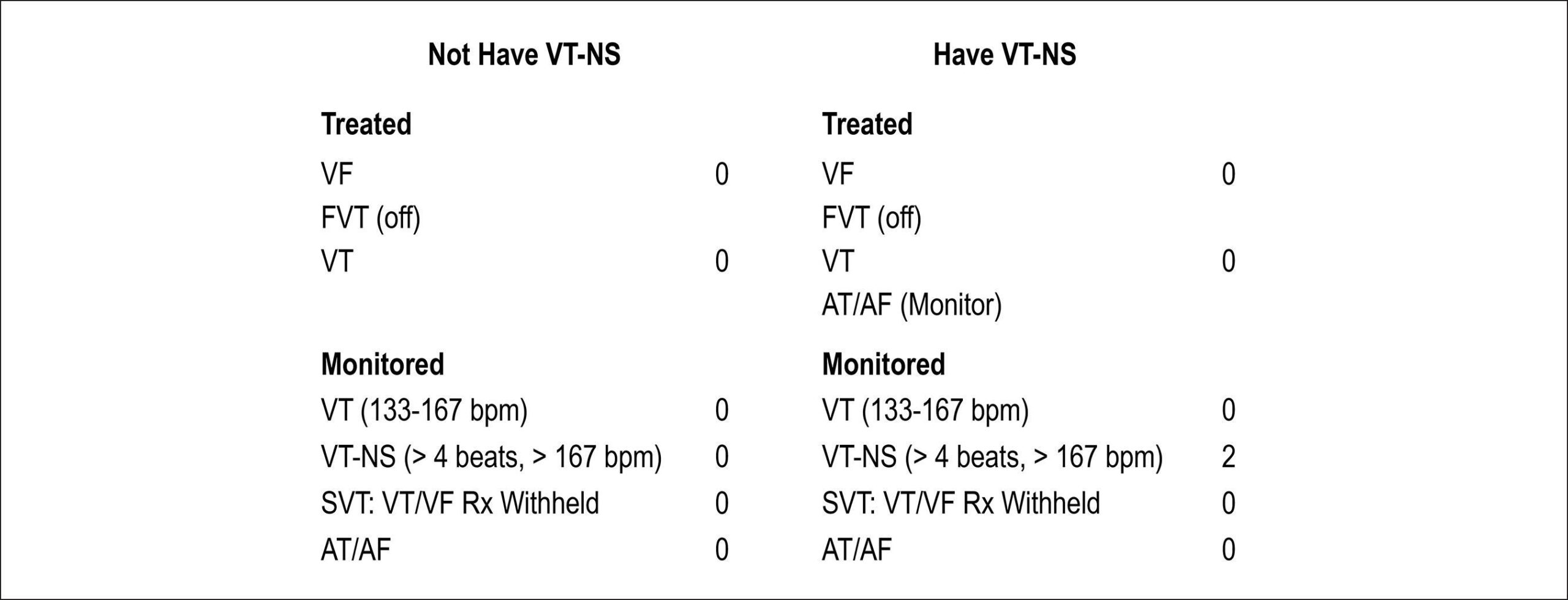
To investigate whether monitored episodes of non-sustained ventricular tachycardia (NSVT) might predict future HF hospitalizations in ICD recipients with HF.

Methods:

We examined 104 ICD recipients (mean age: 60 ± 10.1 years, 80.8 % male) with HF who were referred to our outpatient clinic for device follow-up. After device interrogation, patients were divided into NSVT positive and negative groups. The primary endpoint was the rate of hospitalization within the next 6 months after initial ICD evaluation.

Results:

Device evaluation demonstrated at least one episode of monitored NSVT in 50 out of 104 patients. As expected, no device therapy (shock or anti-tachycardia) was needed for such episodes. At 6 months, 24 patients were hospitalized due to acute decompensated HF. Hospitalization rate was significantly lower in the NSVT negative as compared with positive groups (38% versus 62%; adjusted hazard ratio [HR] 0.166 ; 95% CI 0.056 to 0.492; p = 0.01).

Conclusions:

Monitored NSVT bouts in ICD recordings may serve as a predictor of future HF hospitalizations in ICD recipients with HF suggesting optimization of therapeutic modalities in these patients along with a close supervision in the clinical setting.

  • Defibrillators
  • Heart Failure
  • Hospitalization
  • Implantable
  • Tachycardia
  • Ventricular
Read Full Article
Creative Commons Attribution (CC BY) Creative Commons license
01/10/2017 DOI: 10.5935/abc.20170141
Delayed enhancement cardiac magnetic resonance Imaging can identify the risk for ventricular tachycardia in chronic Chagas' heart disease
ABC
Artigo Original

Delayed enhancement cardiac magnetic resonance Imaging can identify the risk for ventricular tachycardia in chronic Chagas' heart disease

Ronaldo Peixoto de Mello et al. Gilberto Szarf Paulo Roberto Schvartzman Edson Minoru Nakano … Mariano Martinez Espinosa Denis Szejnfeld Verônica Fernandes João A. C. Lima Claudio Cirenza Angelo A.V. De Paola

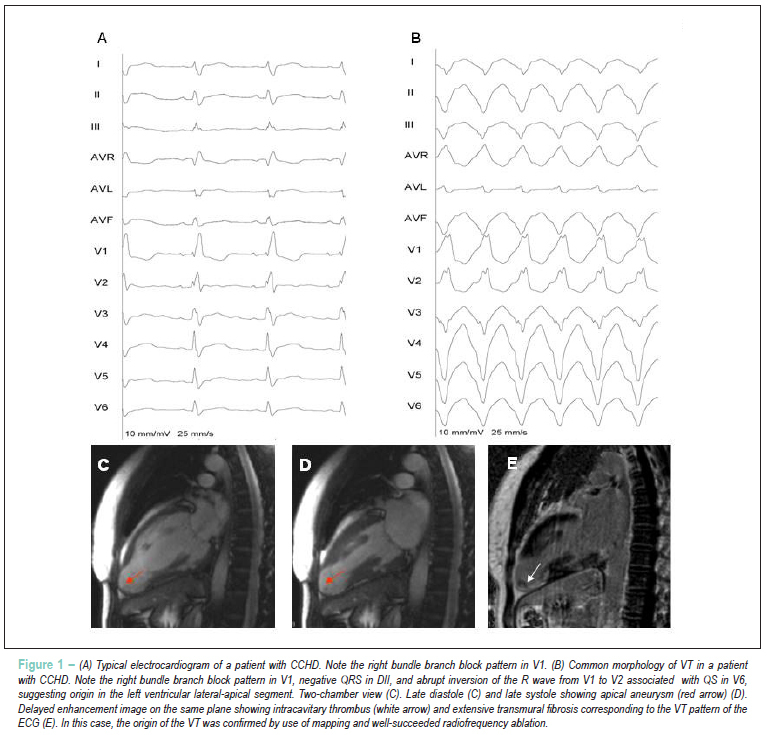
BACKGROUND: Invasive and non-invasive tests have been used to identify the risk of ventricular tachycardia (VT) in patients with chronic Chagas’ heart disease (CCHD). Cardiac magnetic resonance imaging (CMRI) using the delayed enhancement (DE) technique can be useful to select patients with global or segmentary ventricular dysfunction, with high degree of fibrosis and at higher risk for clinical VT. OBJECTIVE: To improve the identification of predictors of VT in patients with CCHD. METHOD: This study assessed 41 patients with CCHD [30 (72%) males; mean age, 55.1 ± 11.9 years]. Twenty-six patients had history of VT (VT group), and 15 had no VT (NVT group). All patients enrolled had DE and segmentary ventricular dysfunction. In each case, the following variables were determined: left ventricular volume; percentage of ventricular wall thickness impairment in each segment; and DE distribution. RESULTS: No statistical difference regarding the DE volume between both groups was observed: VT group = 30.0 ± 16.2%; NVT group = 21.7 ± 15.7%; p = 0.118. The probability of VT was greater in the presence of two or more contiguous transmural fibrosis areas, and that was a predictive factor of clinical VT (RR 4.1; p = 0,04). Agreement between observers was 100% regarding that criterion (p < 0.001). CONCLUSION: The identification of two or more segments of transmural DE by use of CMRI is associated with the occurrence of clinical VT in patients with CCHD. Thus, CMRI improved risk stratification in the population studied. (Arq Bras Cardiol. 2012; [online].ahead print, PP.0-0)

  • Chagas Cardiomyopathy
  • Magnetic Resonance
  • spectroscopy
  • Tachycardia
  • Ventricular
Read Full Article
Creative Commons Attribution (CC BY) Creative Commons license
29/03/2012 DOI: 10.1590/S0066-782X2012005000031

How to cite this article

EndNote RIS

Electronic Document Format (Vancouver)

Marinho-da-Silva AJ. Coronary Arteries after Jatene Operation for Transposition of Great Arteries: The Role of CT Coronary Angiography on Follow-up. Arquivos Brasileiros de Cardiologia 2021;116(6):1117-8.

Electronic Document Format (ABNT)

Marinho-da-Silva, Antonio Joaquim. Coronary Arteries after Jatene Operation for Transposition of Great Arteries: The Role of CT Coronary Angiography on Follow-up. Arquivos Brasileiros de Cardiologia, v. 116, n. 6, p. 1117-1118, Jun. 2021.

Electronic Document Format (APA)

Marinho-da-Silva, A. J. (2021). Coronary Arteries after Jatene Operation for Transposition of Great Arteries: The Role of CT Coronary Angiography on Follow-up. Arquivos Brasileiros de Cardiologia, 116(6), 1117-1118.

Electronic Document Format (ISO)

Marinho-da-Silva, Antonio Joaquim. Coronary Arteries after Jatene Operation for Transposition of Great Arteries: The Role of CT Coronary Angiography on Follow-up. Arquivos Brasileiros de Cardiologia [online]. 2021, vol. 116, n. 6, [cited 2026-10-14], pp. 1117-1118. Available from: <https://journals.cardiol.br/en/article/coronary-arteries-after-jatene-operation-for-transposition-of-great-arteries-the-role-of-ct-coronary-angiography-on-follow-up/>. ISSN 0066-782X

EndNote RIS

Electronic Document Format (Vancouver)

Uçar FM, Yilmaztepe MA, Taylan G, Aktoz M. Non-Sustained Ventricular Tachycardia Episodes Predict Future Hospitalization in ICD Recipients with Heart Failure. Arquivos Brasileiros de Cardiologia 2017;109(4):284-9.

Electronic Document Format (ABNT)

Uçar, Fatih Mehmet; Yilmaztepe, Mustafa Adem; Taylan, Gökay; Aktoz, Meryem. Non-Sustained Ventricular Tachycardia Episodes Predict Future Hospitalization in ICD Recipients with Heart Failure. Arquivos Brasileiros de Cardiologia, v. 109, n. 4, p. 284-289, Sep. 2017.

Electronic Document Format (APA)

Uçar, F. M., Yilmaztepe, M. A., Taylan, G., & Aktoz, M. (2017). Non-Sustained Ventricular Tachycardia Episodes Predict Future Hospitalization in ICD Recipients with Heart Failure. Arquivos Brasileiros de Cardiologia, 109(4), 284-289.

Electronic Document Format (ISO)

Uçar, Fatih Mehmet and Yilmaztepe, Mustafa Adem and Taylan, Gökay and Aktoz, Meryem. Non-Sustained Ventricular Tachycardia Episodes Predict Future Hospitalization in ICD Recipients with Heart Failure. Arquivos Brasileiros de Cardiologia [online]. 2017, vol. 109, n. 4, [cited 2026-10-14], pp. 284-289. Available from: <https://journals.cardiol.br/en/article/non-sustained-ventricular-tachycardia-episodes-predict-future-hospitalization-in-icd-recipients-with-heart-failure/>. ISSN 0066-782X

EndNote RIS

Electronic Document Format (Vancouver)

Mello RP, Szarf G, Schvartzman PR, Nakano EM, Espinosa MM, Szejnfeld D, Fernandes V, et al. Delayed enhancement cardiac magnetic resonance Imaging can identify the risk for ventricular tachycardia in chronic Chagas’ heart disease. Arquivos Brasileiros de Cardiologia 2012;98(5):421-30.

Electronic Document Format (ABNT)

Mello, Ronaldo Peixoto de; Szarf, Gilberto; Schvartzman, Paulo Roberto; Nakano, Edson Minoru; Espinosa, Mariano Martinez; Szejnfeld, Denis; Fernandes, Verônica; Lima, João A. C.; Cirenza, Claudio; Paola, Angelo A.V. De. Delayed enhancement cardiac magnetic resonance Imaging can identify the risk for ventricular tachycardia in chronic Chagas’ heart disease. Arquivos Brasileiros de Cardiologia, v. 98, n. 5, p. 421-430, Mar. 2012.

Electronic Document Format (APA)

Mello, R. P. , Szarf, G., Schvartzman, P. R., Nakano, E. M., Espinosa, M. M., Szejnfeld, D., Fernandes, V., Lima, J. A. C., Cirenza, C., & Paola, A. A. D. (2012). Delayed enhancement cardiac magnetic resonance Imaging can identify the risk for ventricular tachycardia in chronic Chagas’ heart disease. Arquivos Brasileiros de Cardiologia, 98(5), 421-430.

Electronic Document Format (ISO)

Mello, Ronaldo Peixoto de and Szarf, Gilberto and Schvartzman, Paulo Roberto and Nakano, Edson Minoru and Espinosa, Mariano Martinez and Szejnfeld, Denis and Fernandes, Verônica and Lima, João A. C. and Cirenza, Claudio and Paola, Angelo A.V. De. Delayed enhancement cardiac magnetic resonance Imaging can identify the risk for ventricular tachycardia in chronic Chagas’ heart disease. Arquivos Brasileiros de Cardiologia [online]. 2012, vol. 98, n. 5, [cited 2026-10-14], pp. 421-430. Available from: <https://journals.cardiol.br/en/article/delayed-enhancement-cardiac-magnetic-resonance-imaging-can-identify-the-risk-for-ventricular-tachycardia-in-chronic-chagas-heart-disease/>. ISSN 0066-782X

  • About ABC Family
  • Internal Regulation
  • Editorial Board
  • Brazilian Society of Cardiology (SBC)

Issues

SBC Guidelines

  • Videos
  • Podcasts
  • News