ABC Family Arquivos Brasileiros de Cardiologia International Journal of Cardiovascular Sciences ABC Heart Failure & Cardiomyopathy ABC Imagem Cardiovascular
Português English
ABC Family
Português English
  • About
    • About ABC Family
    • Internal Regulation
    • Editorial Board
    • Brazilian Society of Cardiology (SBC)
  • Issues
  • SBC Guidelines
  • Content
    • Videos
    • Podcasts
    • News
  • About
    • About ABC Family
    • Internal Regulation
    • Editorial Board
    • Brazilian Society of Cardiology (SBC)
  • Issues
  • SBC Guidelines
  • Content
    • Videos
    • Podcasts
    • News

ABC Family

  • ABC Family
  • Arquivos Brasileiros de Cardiologia
  • International Journal of Cardiovascular Sciences
  • ABC Heart Failure & Cardiomyopathy
  • ABC Imagem Cardiovascular
Search in

No content found.

Journals
Ordering
Article types
Others

  1. Home
  2. Keyword: cyanosis
ABC
Editorial

Transcatheter Palliation for Tetralogy of Fallot

Francisco Chamié

The Tetralogy of Fallot (TOF) is the most common cyanotic congenital heart defect. The morphologic key feature of TOF is the malalignment of the infundibular septum. The infundibular septum malalignment makes the aorta override interventricular septum (dextroposition) over a large ventricular septal defect (VSD) and promotes obstruction to the right ventricular infundibular tract. The pulmonary valve is also stenotic, and the pulmonary trunk and arteries are, to some degree, hypoplastic. Severe obstruction to pulmonary blood flow (PBF) leads to more systemic unsaturation and, thus, prolonged hypoxia.

Open heart surgery is the traditional treatment modality, augmenting the right ventricular outflow tract (RVOT), closing the VSD, thus redirecting the aorta to the left ventricle, correcting the cardiac anatomy, and normalizing systemic flow saturation.

[…]

  • Cardiac Catheterization
  • cyanosis
  • Stents
  • Tetralogy of Fallot
Read Full Article
Creative Commons Attribution (CC BY) Creative Commons license
25/10/2021 DOI: 10.36660/abc.20210735 Views 1
Figure 1
ABC
Original Article

Coronary Artery Fistula: Association between Pathway Patterns, Clinical Features and Congenital Heart Disease

Daniel L. Cobo et al. Fernando Batigalia Ulisses A. Croti Adilia M.P. Sciarra … Marcos H.D. Foss Rafaela G.F. Cobo

Abstract

Background

Coronary artery fistula (CAF) is a direct connection of one or more coronary arteries to cardiac chambers or a large vessel; it may be associated with congenital heart disease.

Objective

To establish CAF pathway patterns from echocardiographic data and to correlate them with clinical aspects and congenital heart disease.

Methods

A total of 7.183 medical records of children under the age of five years with cardiac disease submitted to color Doppler echocardiography and Spearman’s Correlation test were used to associate signs and symptoms and cardiopathy to CAF with a significance level of 5%.

Results

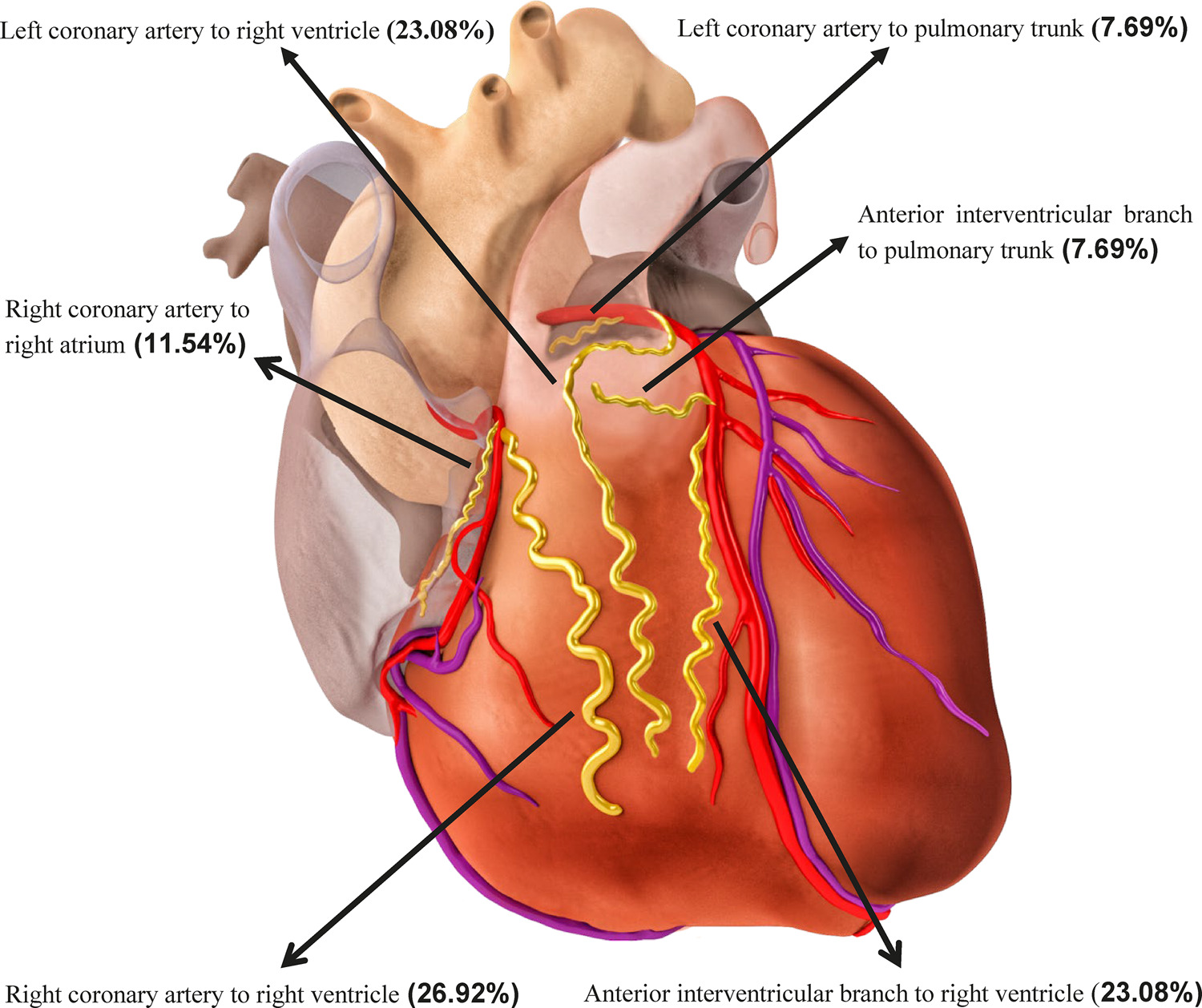
Twenty six children (0.0036%) presented CAF: from the right coronary artery (RCA) to the right ventricle (RV) 26.92%, from the left coronary artery (LCA) to the RV 23.08%, from the anterior interventricular branch (AIVB) to RV 23.08%, RCA to right atrium (RA) 11.54%, LCA for pulmonary trunk (PT) 7.69% or AIVB for PT 7.69%. In 57.69% of the patients, there was a positively correlated symptomatology to CAF with p=0.445 related to dyspnea or cyanosis (53.84%); in 96.15%, congenital heart disease associated with CAF, mainly interventricular communication (IVC) or interatrial communication (IAC) in 34.62% positively correlated to CAF with p=0.295. CAF pathway was represented in three dimensions by software modeling, texturing and animation Cinema 4D R19.

Conclusion

CAF is an uncommon anatomical entity that presents a clinical picture compatible with dyspnea and cyanosis, and this is associated with congenital heart disease, mainly with IVC or IAC. According to echocardiographic analyzes, fistulas in RCA, LCA, or AIVB represent about one-third of the patients, with a priority pathway for right heart chambers.

  • Anatomy
  • Arterio-Arterial Fistula, Congenital Heart Diseases
  • Coronary Artery Disease
  • cyanosis
  • Dyspnea
  • Echocardiography/methods
  • Imaging Three-Dimensional/methods
Read Full Article
Creative Commons Attribution (CC BY) Creative Commons license
26/07/2021 DOI: 10.36660/abc.20190578
Figure 1
ABC
Original Article

Knowledge about the Disease and the Practice of Physical Activity in Children and Adolescents with Congenital Heart Disease

Elisandra Furlan de Lima Campos et al. Lisiane Perin Melina Assmann Fernanda Lucchese Lucia Campos Pellanda

Abstract

Background

Knowledge about the disease itself can be important for self-care in patients with several problems and comprehends information about the diagnosis up to the most important clinical implications.

Objective

To identify the level of knowledge of children and adolescents with congenital heart disease (CHD) about their illness, and to analyze the association between the level of knowledge and the practice of physical activity.

Methods

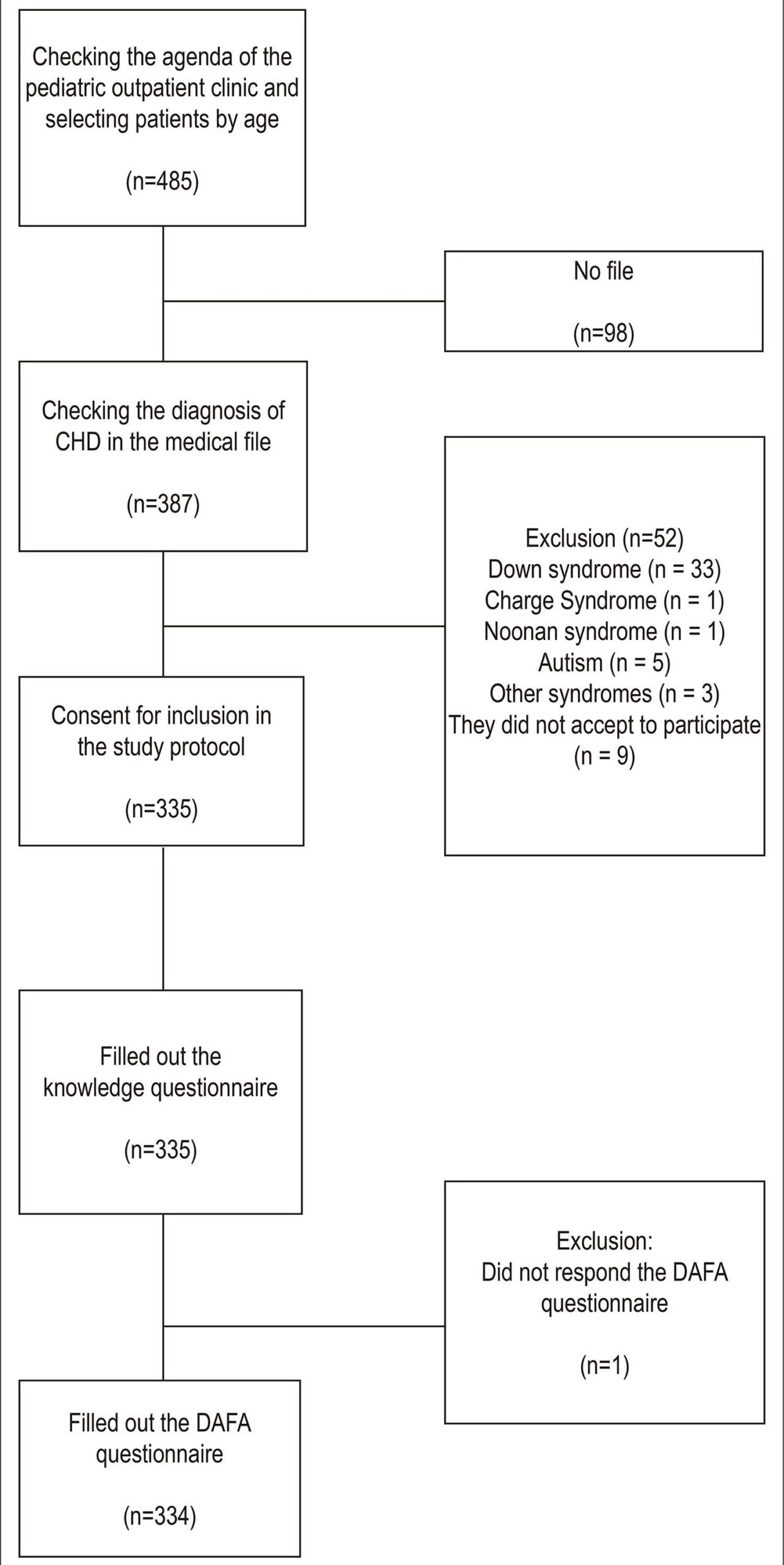
Cross-sectional study with 335 patients with CHD, aged 8 to 13 years, followed at a referral pediatric cardiology service in Southern Brazil. Patients were interviewed regarding their knowledge about CHD and a review of medical records was performed to obtain details on heart disease and procedures. A significance level p<0.05 was used.

Results

More than 50% of the children and adolescents did not know how to say the name of their disease or explain it. After adjusted OR (AOR), cyanotic patients in comparison to acyanotic ones (AOR: 2.29; 95%CI: 1.76-6.71; p = 0.019); children with lower level of schooling (AOR: 2.20; 95%CI: 1.81-5.86; p = 0.025); and those who did not practice physical activity (AOR: 1.88; 95%CI: 1.09-3.45; p = 0.011) showed potential for incorrect answers or did not know their disease.

Conclusion

Cyanotic children and adolescents, with a lower level of schooling and who did not practice physical activity, had little knowledge about their disease. It is necessary to develop educational intervention strategies to increase knowledge and change behavior in physical activity promotion, according to the CHD complexity. (Arq Bras Cardiol. 2020; 114(5):786-792)

  • Child, Adolescents
  • cyanosis
  • Health Information Systems
  • Heart Defects, Congenital/physiopathology
  • Physical activity
Read Full Article
Creative Commons Attribution (CC BY) Creative Commons license
01/06/2020 DOI: 10.36660/abc.20180417
IJCS
Original Article

Hemodynamic, Metabolic and Ventilatory Responses to Exercise in Adults with Congenital Heart Disease

Pablo Marino Corrêa Nascimento et al. Daniel Arkader Kopiler Fernando Cesar de Castro e Souza Maria Carolina Terra Cola … Marina Pereira Coelho Gabriella de Oliveira Lopes Eduardo Tibiriçá

Abstract

Background:

Congenital heart disease in adults shares some features with heart failure (HF), including exercise intolerance, ventilatory inefficiency, inflammatory and neurohormonal activation, cardiac arrhythmias and myocardial fibrosis. Over the last years, cardiopulmonary exercise test has gained importance in the diagnostic and prognostic evaluation of congenital heart diseases, as has already occurred in HF.

Objective:

To describe the behavior of hemodynamic, metabolic and ventilatory parameters in response to exercise in adults with congenital heart disease.

Methods:

Observational cross-sectional study evaluating 31 adults with congenital acyanotic or cyanotic heart disease, treated clinically, surgically or percutaneously, referred for cardiopulmonary exercise test. A descriptive analysis of the data was performed.

Results:

Patients aged 35.7 ± 14.2 years were included. Oxygen consumption (VO2) was 44.86 ± 18.01% of predicted at peak exercise and 36.92 ± 12.93% of predicted maximal VO2 at anaerobic threshold. We found an oxygen uptake efficiency slope (OUES) of 1.49 ± 0.89 (61.43 ± 26.63% of predicted), oxygen pulse of 58.90 ± 22.24% and increment in systolic arterial pressure during exercise was 31.42 ± 21.60 mmHg.

Conclusion:

Adults with congenital heart disease had similar responses to heart failure patients during exercise – reduced aerobic capacity, ventilatory inefficiency for oxygen consumption and limited inotropic response to exercise, characterized by reduced oxygen pulse and small increase in systolic arterial pressure.

  • Adults
  • cyanosis
  • Exercise
  • Exercise Test
  • Heart Defects, Congenital
  • Hemodynamics
  • Metabolism
Read Full Article
Creative Commons Attribution (CC BY) Creative Commons license
01/01/2019 DOI: 10.5935/2359-4802.20180073
ABC
Case Report

Use of beta-blockers in the post-operative period of Sano modification of the Norwood procedure with persistent cyanosis

Eli Szwarc et al. Maria H. S. Rodrigues Simone F. Pedra Marcelo B. Jatene … Edson R. Romano Carlos R. Ferreiro

Persistent cyanosis is a frequent complication in the post-operative period of Sano modification of the Norwood procedure. It may be explained by a dynamic proximal shunt stenosis of the synthetic conduit that links the right ventricle to the pulmonary artery, as detected by echo cardiographic study. The use of beta-blockers in the post-operative period has been recently described in order to improve the arterial oxygen saturation. In this report, we describe the use of propranolol in two patients undergoing Sano modification of the Norwood procedure, in whom a gradient reduction in the synthetic conduit, increase in the levels of arterial oxygen saturation, decrease in heart rate, and increase in blood pressure were observed, thus resulting in clinical improvement. We conclude that the use of beta-blockers in these cases was beneficial.

  • Adrenergic beta-Antagonists
  • beta-blockers
  • cyanosis
  • Heart Defects, Congenital
  • Norwood procedure
  • Thoracic Surgery
Read Full Article
Creative Commons Attribution (CC BY) Creative Commons license
23/07/2007 DOI: 10.1590/S0066-782X2007000600012 Views 1
Complete repair in total atrioventricular canal defect with cyanosis
ABC
Case Report

Complete repair in total atrioventricular canal defect with cyanosis

Carla Tanamati et al. Renata Lure Suguimoto Edmar Atik Solange Gimenez Copolla … Filomena Regina Galles Vera Demarchi Aiello Miguel Lorenzo Barbero-Marcial

Atrioventricular septal defects account for 4% of congenital cardiac malformations and over 50% of cardiac defects seen in Down syndrome¹. Clinical presentation is marked by congestive heart failure early in infancy. Cyanosis is rarely found in infants and suggests irreversible pulmonary hypertension or associated cardiac defects as tetralogy of Fallot, double outlet right ventricle², Ebstein anomaly³, persistent left superior vena cava draining in the left atrium (Barbero Marcial, personal communication). Children with Down’s syndrome is particularly difficult to assess because they often suffer from upper airways obstruction4, which may contribute to the increased pulmonary vascular resistance determined at cardiac catheterization. This association of factors becomes a challenge for operability and, we will report one such case.

  • Complete atrioventricular septal defect
  • cyanosis
  • surgical repair
Read Full Article
Creative Commons Attribution (CC BY) Creative Commons license
16/10/2006 DOI: 10.1590/S0066-782X2006001600025

How to cite this article

EndNote RIS

Electronic Document Format (Vancouver)

Chamié F. Transcatheter Palliation for Tetralogy of Fallot. Arquivos Brasileiros de Cardiologia 2021;117(4):664-5.

Electronic Document Format (ABNT)

Chamié, Francisco. Transcatheter Palliation for Tetralogy of Fallot. Arquivos Brasileiros de Cardiologia, v. 117, n. 4, p. 664-665, Oct. 2021.

Electronic Document Format (APA)

Chamié, F. (2021). Transcatheter Palliation for Tetralogy of Fallot. Arquivos Brasileiros de Cardiologia, 117(4), 664-665.

Electronic Document Format (ISO)

Chamié, Francisco. Transcatheter Palliation for Tetralogy of Fallot. Arquivos Brasileiros de Cardiologia [online]. 2021, vol. 117, n. 4, [cited 2026-10-14], pp. 664-665. Available from: <https://journals.cardiol.br/en/article/transcatheter-palliation-for-tetralogy-of-fallot/>. ISSN 0066-782X

EndNote RIS

Electronic Document Format (Vancouver)

Cobo DL, Batigalia F, Croti UA, Sciarra AM, Foss MH, Cobo RG. Coronary Artery Fistula: Association between Pathway Patterns, Clinical Features and Congenital Heart Disease. Arquivos Brasileiros de Cardiologia 2021;117(1):84-8.

Electronic Document Format (ABNT)

Cobo, Daniel L.; Batigalia, Fernando; Croti, Ulisses A.; Sciarra, Adilia M.P.; Foss, Marcos H.D.; Cobo, Rafaela G.F.. Coronary Artery Fistula: Association between Pathway Patterns, Clinical Features and Congenital Heart Disease. Arquivos Brasileiros de Cardiologia, v. 117, n. 1, p. 84-88, Jul. 2021.

Electronic Document Format (APA)

Cobo, D. L., Batigalia, F., Croti, U. A., Sciarra, A. M., Foss, M. H., & Cobo, R. G. (2021). Coronary Artery Fistula: Association between Pathway Patterns, Clinical Features and Congenital Heart Disease. Arquivos Brasileiros de Cardiologia, 117(1), 84-88.

Electronic Document Format (ISO)

Cobo, Daniel L. and Batigalia, Fernando and Croti, Ulisses A. and Sciarra, Adilia M.P. and Foss, Marcos H.D. and Cobo, Rafaela G.F.. Coronary Artery Fistula: Association between Pathway Patterns, Clinical Features and Congenital Heart Disease. Arquivos Brasileiros de Cardiologia [online]. 2021, vol. 117, n. 1, [cited 2026-10-14], pp. 84-88. Available from: <https://journals.cardiol.br/en/article/coronary-artery-fistula-association-between-pathway-patterns-clinical-features-and-congenital-heart-disease/>. ISSN 0066-782X

EndNote RIS

Electronic Document Format (Vancouver)

Campos EFL, Perin L, Assmann M, Lucchese F, Pellanda LC. Knowledge about the Disease and the Practice of Physical Activity in Children and Adolescents with Congenital Heart Disease. Arquivos Brasileiros de Cardiologia 2020;114(5):786-92.

Electronic Document Format (ABNT)

Campos, Elisandra Furlan de Lima; Perin, Lisiane; Assmann, Melina; Lucchese, Fernanda; Pellanda, Lucia Campos. Knowledge about the Disease and the Practice of Physical Activity in Children and Adolescents with Congenital Heart Disease. Arquivos Brasileiros de Cardiologia, v. 114, n. 5, p. 786-792, May. 2020.

Electronic Document Format (APA)

Campos, E. F. L., Perin, L., Assmann, M., Lucchese, F., & Pellanda, L. C. (2020). Knowledge about the Disease and the Practice of Physical Activity in Children and Adolescents with Congenital Heart Disease. Arquivos Brasileiros de Cardiologia, 114(5), 786-792.

Electronic Document Format (ISO)

Campos, Elisandra Furlan de Lima and Perin, Lisiane and Assmann, Melina and Lucchese, Fernanda and Pellanda, Lucia Campos. Knowledge about the Disease and the Practice of Physical Activity in Children and Adolescents with Congenital Heart Disease. Arquivos Brasileiros de Cardiologia [online]. 2020, vol. 114, n. 5, [cited 2026-10-14], pp. 786-792. Available from: <https://journals.cardiol.br/en/article/knowledge-about-the-disease-and-the-practice-of-physical-activity-in-children-and-adolescents-with-congenital-heart-disease/>. ISSN 0066-782X

EndNote RIS

Electronic Document Format (Vancouver)

Nascimento PMC, Kopiler DA, Souza FCC, Cola MCT, Coelho MP, Lopes GO, Tibiriçá E, et al. Hemodynamic, Metabolic and Ventilatory Responses to Exercise in Adults with Congenital Heart Disease. International Journal of Cardiovascular Sciences 2019;32(1):41-7.

Electronic Document Format (ABNT)

Nascimento, Pablo Marino Corrêa; Kopiler, Daniel Arkader; Souza, Fernando Cesar de Castro e; Cola, Maria Carolina Terra; Coelho, Marina Pereira; Lopes, Gabriella de Oliveira; Tibiriçá, Eduardo. Hemodynamic, Metabolic and Ventilatory Responses to Exercise in Adults with Congenital Heart Disease. International Journal of Cardiovascular Sciences, v. 32, n. 1, p. 41-47, Dec. 2018.

Electronic Document Format (APA)

Nascimento, P. M. C., Kopiler, D. A., Souza, F. C. C. , Cola, M. C. T., Coelho, M. P., Lopes, G. O., & Tibiriçá, E. (2019). Hemodynamic, Metabolic and Ventilatory Responses to Exercise in Adults with Congenital Heart Disease. International Journal of Cardiovascular Sciences, 32(1), 41-47.

Electronic Document Format (ISO)

Nascimento, Pablo Marino Corrêa and Kopiler, Daniel Arkader and Souza, Fernando Cesar de Castro e and Cola, Maria Carolina Terra and Coelho, Marina Pereira and Lopes, Gabriella de Oliveira and Tibiriçá, Eduardo. Hemodynamic, Metabolic and Ventilatory Responses to Exercise in Adults with Congenital Heart Disease. International Journal of Cardiovascular Sciences [online]. 2019, vol. 32, n. 1, [cited 2026-10-14], pp. 41-47. Available from: <https://journals.cardiol.br/en/article/hemodynamic-metabolic-and-ventilatory-responses-to-exercise-in-adults-with-congenital-heart-disease/>. ISSN 2359-4802

EndNote RIS

Electronic Document Format (Vancouver)

Szwarc E, Rodrigues MHS, Pedra SF, Jatene MB, Romano ER, Ferreiro CR. Use of beta-blockers in the post-operative period of Sano modification of the Norwood procedure with persistent cyanosis. Arquivos Brasileiros de Cardiologia 2007;88(6):e182-4.

Electronic Document Format (ABNT)

Szwarc, Eli; Rodrigues, Maria H. S.; Pedra, Simone F.; Jatene, Marcelo B.; Romano, Edson R.; Ferreiro, Carlos R.. Use of beta-blockers in the post-operative period of Sano modification of the Norwood procedure with persistent cyanosis. Arquivos Brasileiros de Cardiologia, v. 88, n. 6, p. e182-e184, Jul. 2007.

Electronic Document Format (APA)

Szwarc, E., Rodrigues, M. H. S., Pedra, S. F., Jatene, M. B., Romano, E. R., & Ferreiro, C. R. (2007). Use of beta-blockers in the post-operative period of Sano modification of the Norwood procedure with persistent cyanosis. Arquivos Brasileiros de Cardiologia, 88(6), e182-e184.

Electronic Document Format (ISO)

Szwarc, Eli and Rodrigues, Maria H. S. and Pedra, Simone F. and Jatene, Marcelo B. and Romano, Edson R. and Ferreiro, Carlos R.. Use of beta-blockers in the post-operative period of Sano modification of the Norwood procedure with persistent cyanosis. Arquivos Brasileiros de Cardiologia [online]. 2007, vol. 88, n. 6, [cited 2026-10-14], pp. e182-e184. Available from: <https://journals.cardiol.br/en/article/use-of-beta-blockers-in-the-post-operative-period-of-sano-modification-of-the-norwood-procedure-with-persistent-cyanosis/>. ISSN 0066-782X

EndNote RIS

Electronic Document Format (Vancouver)

Tanamati C, Suguimoto RL, Atik E, Copolla SG, Galles FR, Aiello VD, Barbero-Marcial ML, et al. Complete repair in total atrioventricular canal defect with cyanosis. Arquivos Brasileiros de Cardiologia 2006;87(3):e1-3.

Electronic Document Format (ABNT)

Tanamati, Carla; Suguimoto, Renata Lure; Atik, Edmar; Copolla, Solange Gimenez; Galles, Filomena Regina; Aiello, Vera Demarchi; Barbero-Marcial, Miguel Lorenzo. Complete repair in total atrioventricular canal defect with cyanosis. Arquivos Brasileiros de Cardiologia, v. 87, n. 3, p. e1-e3, Oct. 2006.

Electronic Document Format (APA)

Tanamati, C., Suguimoto, R. L., Atik, E., Copolla, S. G., Galles, F. R., Aiello, V. D., & Barbero-Marcial, M. L. (2006). Complete repair in total atrioventricular canal defect with cyanosis. Arquivos Brasileiros de Cardiologia, 87(3), e1-e3.

Electronic Document Format (ISO)

Tanamati, Carla and Suguimoto, Renata Lure and Atik, Edmar and Copolla, Solange Gimenez and Galles, Filomena Regina and Aiello, Vera Demarchi and Barbero-Marcial, Miguel Lorenzo. Complete repair in total atrioventricular canal defect with cyanosis. Arquivos Brasileiros de Cardiologia [online]. 2006, vol. 87, n. 3, [cited 2026-10-14], pp. e1-e3. Available from: <https://journals.cardiol.br/en/article/complete-repair-in-total-atrioventricular-canal-defect-with-cyanosis/>. ISSN 0066-782X

  • About ABC Family
  • Internal Regulation
  • Editorial Board
  • Brazilian Society of Cardiology (SBC)

Issues

SBC Guidelines

  • Videos
  • Podcasts
  • News