ABC Family Arquivos Brasileiros de Cardiologia International Journal of Cardiovascular Sciences ABC Heart Failure & Cardiomyopathy ABC Imagem Cardiovascular
Português English
ABC Family
Português English
  • About
    • About ABC Family
    • Internal Regulation
    • Editorial Board
    • Brazilian Society of Cardiology (SBC)
  • Issues
  • SBC Guidelines
  • Content
    • Videos
    • Podcasts
    • News
  • About
    • About ABC Family
    • Internal Regulation
    • Editorial Board
    • Brazilian Society of Cardiology (SBC)
  • Issues
  • SBC Guidelines
  • Content
    • Videos
    • Podcasts
    • News

ABC Family

  • ABC Family
  • Arquivos Brasileiros de Cardiologia
  • International Journal of Cardiovascular Sciences
  • ABC Heart Failure & Cardiomyopathy
  • ABC Imagem Cardiovascular
Search in

No content found.

Journals
Ordering
Article types
Others

  1. Home
  2. Keyword: Anatomy
Figure 1
ABCIC
Original Article

Use of a 3D Printer in the Prototyping of an Anatomical Model of the Human Heart with Morphophysiological Alterations

Kaio Gomes de Freitas et al. Ana Laura Barros Lana Vinícius Lana Ferreira Melissa Araújo Ulhôa Quintão

Abstract

Background:

Three-dimensional (3D) printing has a wide range of applications, including medicine and medical education. It presents itself as an alternative to traditional teaching-learning methods of human morphophysiology.

Objectives:

To report the initial experience in prototyping a 3D-printed anatomical model of the human heart with valvular heart disease, as well as its potential use in the active teaching-learning process in human morphophysiology.

Methods:

This is an experimental, descriptive study developed in three distinct stages: 1) Selection of the morphofunctional structure for manufacturing the 3D part; 2) design and adaptation of the object in 3D computer-aided design (CAD) software; and 3) printing and application of the prototype. Models extracted from the Thingiverse website, simulating cardiac structures, were used.

Results:

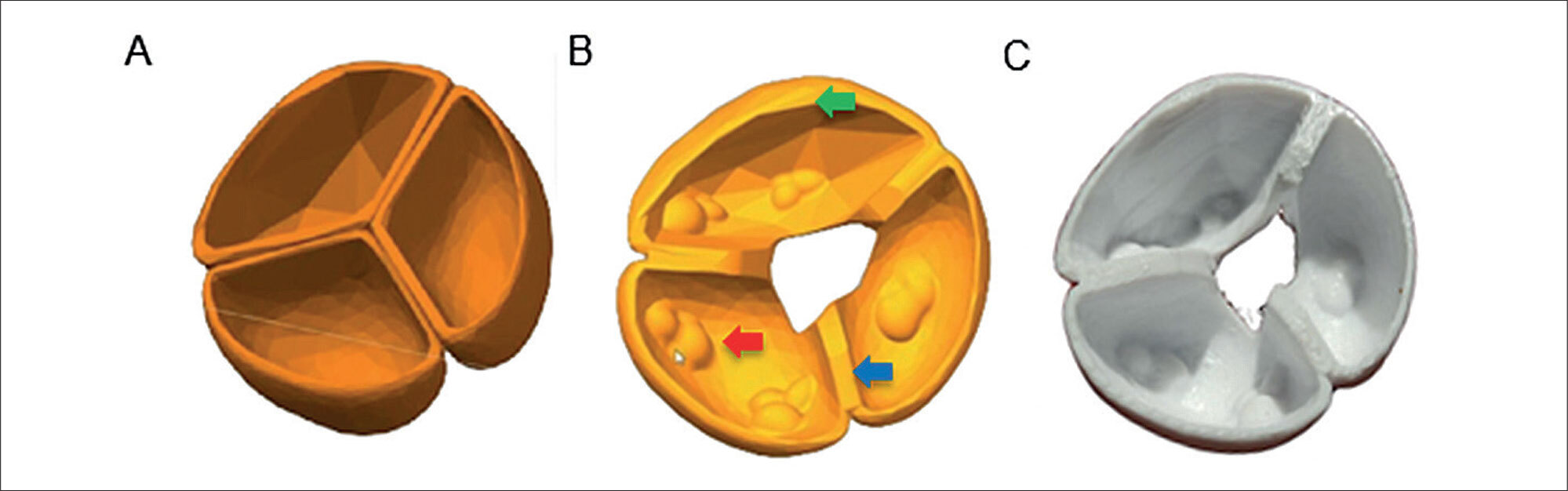
A cardiac prototype was 3D-printed to illustrate morphophysiological changes, including aortic stenosis and mitral insufficiency, modeled on the aortic and mitral valves, respectively.

Conclusion:

The valve diseases represented in the prototype accurately reflect the pathological changes used as the basis for the study, providing a detailed and precise view of the anatomy, which shows significant potential for enhancing the teaching-learning approaches in morphophysiology and medical pathology.
  • Anatomy
  • Medical Education
  • Proof of Concept Study
  • Three-Dimensional Printing
Read Full Article
Creative Commons Attribution (CC BY) Creative Commons license
28/05/2024 DOI: 10.36660/abcimg.20240012i Views 1
Use of Echocardiography as a Supplementary Tool in Teaching Cardiac Anatomy and Physiology to Medical Students
ABCIC
Original Article

Use of Echocardiography as a Supplementary Tool in Teaching Cardiac Anatomy and Physiology to Medical Students

Caroline de Oliveira Fischer Bacca et al. Silvia R. Froes Toniazzo Franciani Rodrigues da Rocha Luiz Fernando Matias … Thais Naiara Mees Ana Luiza Nardelli Kuhl Nicolas Ramos Marcelo Vier Gambetta

Abstract

Background:

Ultrasonography has been increasingly used in teaching basic medicine. The simultaneous observation of the echocardiographic image and the electrocardiogram allows students to understand the physiological process of the heart and its function within the cardiovascular system.

Objective:

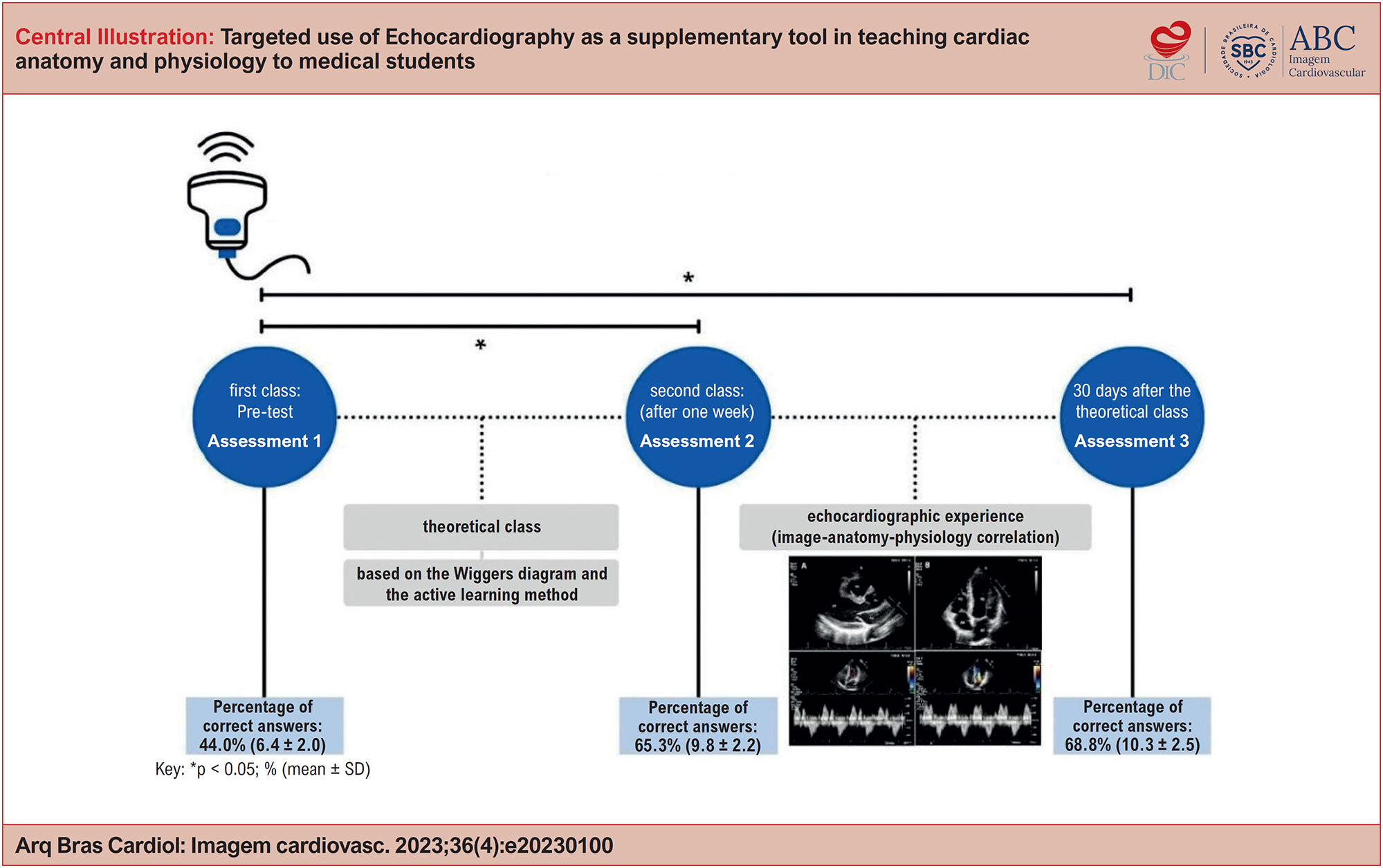
Evaluate the acquisition and retention of knowledge among medical students during the study of cardiac anatomy and physiology through the use of echocardiography.

Methods:

Thirty-four (34) students in the third semester took a pre-test (assessment 1) consisting of 20 multiple-choice questions, 15 of which were related to cardiac anatomy and physiology and 5 were “confusion-inducing questions.” The test was designed by one of the authors, blind to the others. After the theoretical meeting, assessment 2 was carried out with the same questions. The following week, a practical echocardiography meeting was held, aimed at evaluating anatomy and physiology. A post-test (assessment 3) was carried out 30 days after the first meeting to assess knowledge retention. The variables were analyzed by the Kolmogorov-Smirnov, Student’s T, and Wilcoxon tests, with a statistical significance level of p < 0.05.

Results:

The average number of correct answers in assessment 1 was 6.37 ± 2.0 (42.4%), 9.8 ± 2.2 (65.3%) in the second assessment, and 10.3 ± 2.5 (68.6%) in assessment 3. There was a statistical difference between assessment 1 and the other assessments (p = 0.01).

Conclusion:

Early introduction of echocardiography in the medical curriculum proves beneficial for imparting knowledge in cardiac physiology and anatomy, reinforcing theoretical understanding.

  • Anatomy
  • Cardiovascular Physiological Phenomena
  • Echocardiography
  • Education, Medical
  • Students, Medical
Read Full Article
Creative Commons Attribution (CC BY) Creative Commons license
18/12/2023 DOI: 10.36660/abcimg.20230100i
Central Illustration
ABC
Original Article

Incidence and Morphological Study of Myocardial Bridge in the State of Ceará: A Cadaveric Study

Jalles Dantas de Lucena et al. Hudson Martins de Brito João Victor Souza Sanders Jonathan Barros Cavalcante … Michelly Carneiro Collyer Cecília de Lima Leite Helson Freitas da Silveira Julio Cesar Campos Ferreira Filho

Abstract

Background

Myocardial bridges (MB) are anatomical anomalies with possible clinical repercussions; hence, their understanding deserves attention.

Objective

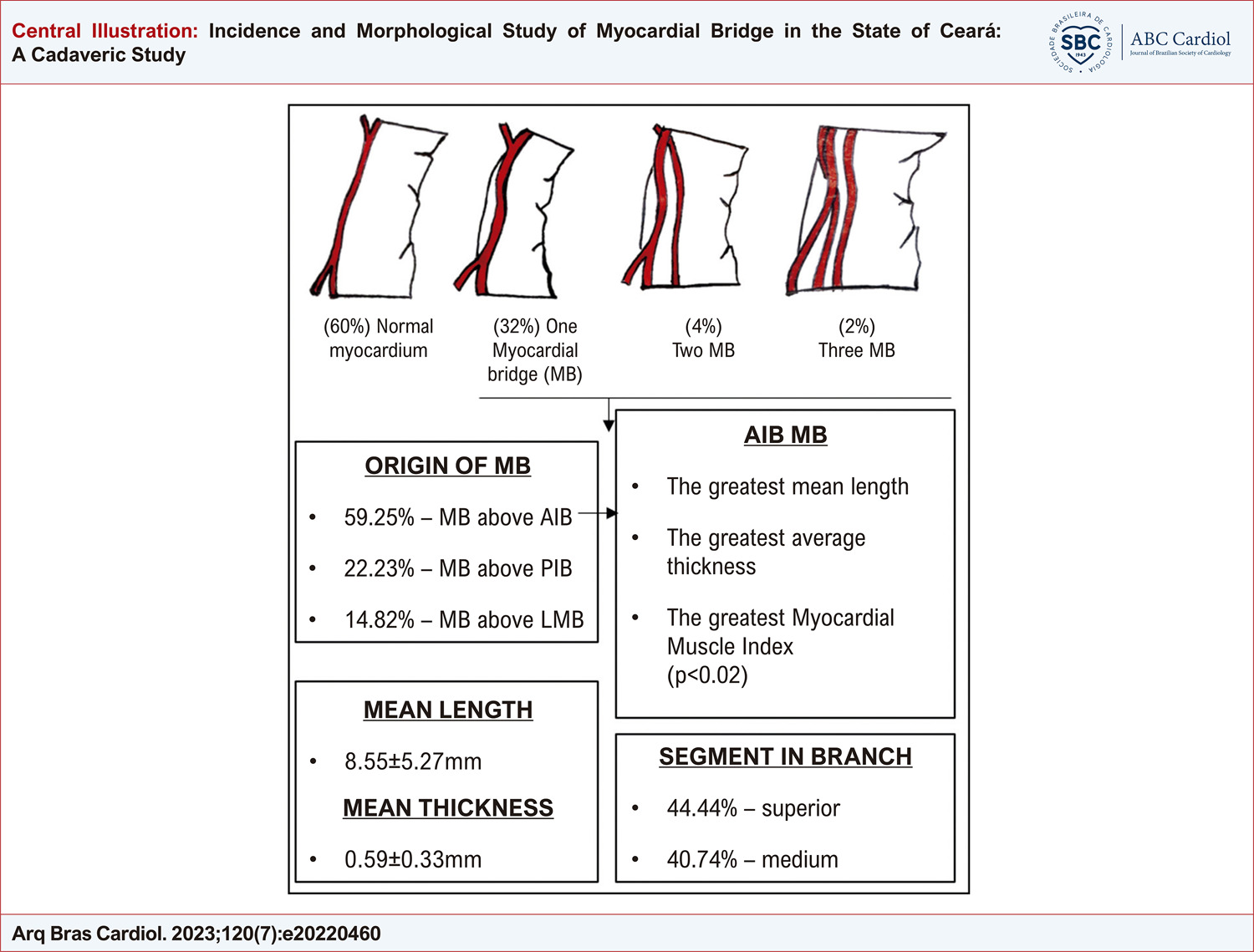
To determinate the prevalence and characterize MB in human hearts from the state of Ceará. Methods: Fifty hearts of adult human cadavers from the Medicine School of Federal University of Ceará, Brazil. The hearts were dissected to identify MBs that pass over part of the coronary artery. The segment of the artery (proximal, middle, and distal) with a bridge was identified. The external diameter of the artery at the proximal and distal points of the MB was measured. The length and thickness of the MB were also measured with an electronic caliper. The muscle index (MMI) of the MB was calculated as the product of length and thickness expressed in millimeters. The significance level adopted in the statistical analysis was 5%.

Results

MB was confirmed in 40% of sample. Approximately one third of the sample had only 1 MB. MB was most frequently found over the anterior interventricular branch of the left coronary artery (59.25%, p=0.02), and its prevalence in other branches was much lower (22.23%). The most affected segments of arteries were the superior (44.44%) and medium (40.74%). The mean diameter of arteries proximal to the MB was 2.38±0.97mm (range=0.78-5.15mm), and the diameter distal to the MB was 1.71±0.75mm (range=0.42-3.58mm). The length was measured as mean=8.55±5.27mm, while the mean thickness was 0.89±0.33mm.

Conclusion

A high prevalence of MB is more likely to affect the left coronary artery system with larger MMI than other affected branches.

  • Anatomy
  • Cardiovascular Abnormalities
  • Incidence
  • Myocardial Bridging
Read Full Article
Creative Commons Attribution (CC BY) Creative Commons license
17/07/2023 DOI: 10.36660/abc.20220460 Views 1
Figure 1
ABC
Original Article

Coronary Artery Fistula: Association between Pathway Patterns, Clinical Features and Congenital Heart Disease

Daniel L. Cobo et al. Fernando Batigalia Ulisses A. Croti Adilia M.P. Sciarra … Marcos H.D. Foss Rafaela G.F. Cobo

Abstract

Background

Coronary artery fistula (CAF) is a direct connection of one or more coronary arteries to cardiac chambers or a large vessel; it may be associated with congenital heart disease.

Objective

To establish CAF pathway patterns from echocardiographic data and to correlate them with clinical aspects and congenital heart disease.

Methods

A total of 7.183 medical records of children under the age of five years with cardiac disease submitted to color Doppler echocardiography and Spearman’s Correlation test were used to associate signs and symptoms and cardiopathy to CAF with a significance level of 5%.

Results

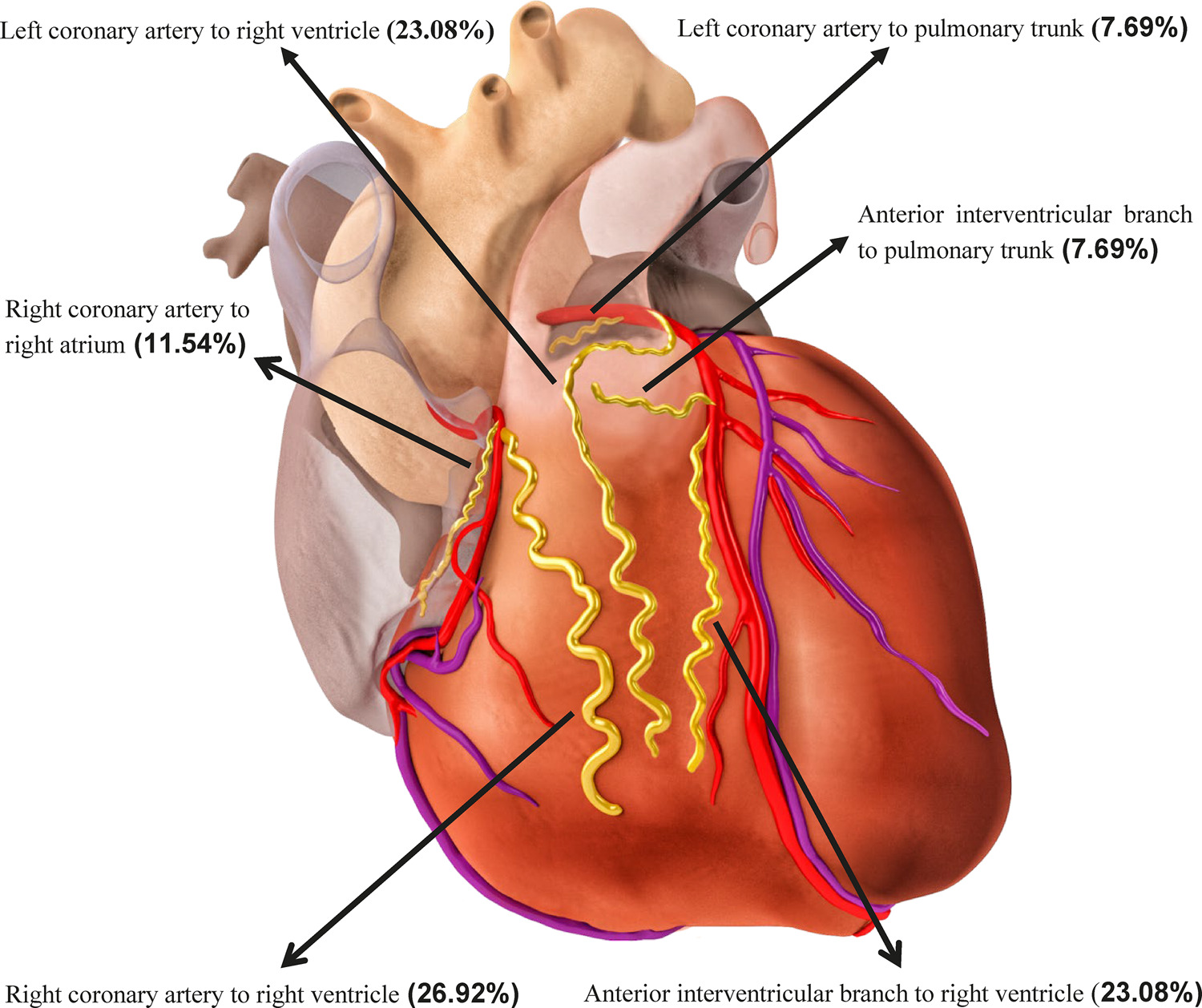
Twenty six children (0.0036%) presented CAF: from the right coronary artery (RCA) to the right ventricle (RV) 26.92%, from the left coronary artery (LCA) to the RV 23.08%, from the anterior interventricular branch (AIVB) to RV 23.08%, RCA to right atrium (RA) 11.54%, LCA for pulmonary trunk (PT) 7.69% or AIVB for PT 7.69%. In 57.69% of the patients, there was a positively correlated symptomatology to CAF with p=0.445 related to dyspnea or cyanosis (53.84%); in 96.15%, congenital heart disease associated with CAF, mainly interventricular communication (IVC) or interatrial communication (IAC) in 34.62% positively correlated to CAF with p=0.295. CAF pathway was represented in three dimensions by software modeling, texturing and animation Cinema 4D R19.

Conclusion

CAF is an uncommon anatomical entity that presents a clinical picture compatible with dyspnea and cyanosis, and this is associated with congenital heart disease, mainly with IVC or IAC. According to echocardiographic analyzes, fistulas in RCA, LCA, or AIVB represent about one-third of the patients, with a priority pathway for right heart chambers.

  • Anatomy
  • Arterio-Arterial Fistula, Congenital Heart Diseases
  • Coronary Artery Disease
  • cyanosis
  • Dyspnea
  • Echocardiography/methods
  • Imaging Three-Dimensional/methods
Read Full Article
Creative Commons Attribution (CC BY) Creative Commons license
26/07/2021 DOI: 10.36660/abc.20190578
The posterior ventricular branches of the coronary arteries in the human heart
ABC
Artigo Original

The posterior ventricular branches of the coronary arteries in the human heart

José Roberto Ortale et al. Luisa Carolina Borges Keiralla Luciana Sacilotto

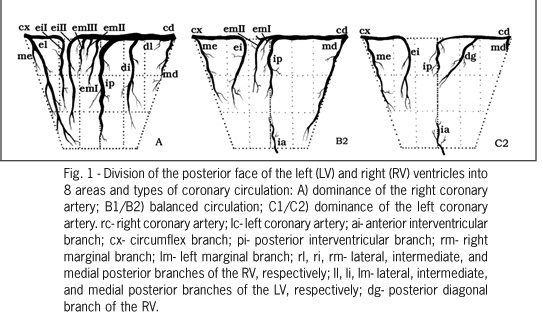
OBJECTIVE: To describe the trajectory of the posterior ventricular branches of the coronary arteries in the epicardial adipose tissue, and to propose a new criterion for analyzing the distribution of these branches, according to the traditional classification, to determine the predominance or balance of the coronary arteries in the arterial supply to the heart. METHODS: Forty hearts obtained from autopsies of adults were dissected and fixed in a formol solution. The posterior face of each ventricle was divided into 8 approximately equal areas for the morphological classification of the coronary circulation. The following 3 traditional types were considered: A) right dominance, B) balanced, and C) left dominance. The number, diameter, and terminal areas of the posterior ventricular branches in the epicardium were analyzed. RESULTS: The following branches and respective frequencies were found: left marginal branch – 100%; posterior left ventricular branches: lateral – 75%, intermediate – 82.5%, and medial – 87.5%; interventricular posterior branch – 95%; posterior right ventricular branch: medial – 40%, intermediate – 32.5%, and lateral – 40%; posterior diagonal branch of the right ventricle – 17.5%; right marginal branch – 95%. In regard to dominance, the following values were found: dominance of the right coronary artery – 62.5%; balanced type – 25%; and dominance of the left coronary artery – 12.5%. CONCLUSION: The method adopted allowed a more precise classification of the types of coronary artery distribution found. The right coronary artery dominance type was the most prevalent, followed by the balanced type and the left coronary artery dominance.

  • Anatomy
  • coronary circulation
  • Heart
Read Full Article
Creative Commons Attribution (CC BY) Creative Commons license
08/06/2004 DOI: 10.1590/S0066-782X2004000500009 Views 1
Aortic valve assessment. Anatomical study of 100 healthy human hearts
ABC
Original Article

Aortic valve assessment. Anatomical study of 100 healthy human hearts

Marcelo Biscegli Jatene et al. Rosangela Monteiro Maria Helena Guimarães Siomara Christina Veronezi … Márcia Kyiomi Koike Fabio Biscegli Jatene Adib Domingos Jatene

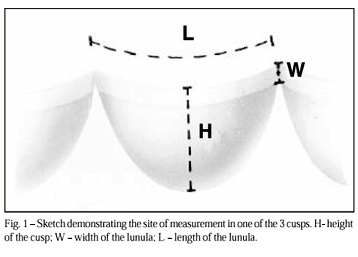
PURPOSE: To assess anatomical characteristics of the aortic valve, so that they may be useful in diagnostic situations and surgical treatment. METHODS: The study analyzed 100 healthy fixed human hearts; 84% of them obtained from males, 61% of them from Caucasian individuals. The ages of the individuals ranged from 9 to 86 years (mean 30±15.5 years). The characteristics assessed related to age, sex, and race were the following: number and height of the cusps, size of the lunulae, internal and external intercommissural distance, position of the coronary ostium in relation to the aortic valve, position of the ventricular septum in relation to the aortic valve, thickness of the cusps. RESULTS: All hearts assessed had a tricuspidal aortic valve. In regard to the height of the cusps and size of the lunula, the left coronary cusp was larger, followed by the right coronary cusp and the noncoronary cusp. The internal and external intercommissural distances had mean values of 24.6±5.7mm and 19.7±7mm, respectively. In regard to the position of the coronary ostia, in one heart two ostia emerged from the left coronary sinus, and in another, the ostium was supracommissural. The mean diameter of the aorta was 21.8±3.6mm, and there were no significant sexual or racial differences, but the diameter increased progressively with the increase in age. The thickness of the cusps did not show any significant difference in the 3 points assessed. CONCLUSION: The aortic valve annulus did not show a perfect circumference, with some variations in the measurements of the annulus, in the cusps and in the relation with the ventricular septum.

  • Anatomy
  • Aortic Valve
  • Heart
Read Full Article
Creative Commons Attribution (CC BY) Creative Commons license
24/10/2000 DOI: 10.1590/S0066-782X1999000700007 Views 1

How to cite this article

EndNote RIS

Electronic Document Format (Vancouver)

Freitas KG, Lana ALB, Ferreira VL, Quintão MAU. Use of a 3D Printer in the Prototyping of an Anatomical Model of the Human Heart with Morphophysiological Alterations. ABC Imagem Cardiovascular 2024;37(2):e20240012.

Electronic Document Format (ABNT)

Freitas, Kaio Gomes de; Lana, Ana Laura Barros; Ferreira, Vinícius Lana; Quintão, Melissa Araújo Ulhôa. Use of a 3D Printer in the Prototyping of an Anatomical Model of the Human Heart with Morphophysiological Alterations. ABC Imagem Cardiovascular, v. 37, n. 2, e20240012, May. 2024.

Electronic Document Format (APA)

Freitas, K. G. , Lana, A. L. B., Ferreira, V. L., & Quintão, M. A. U. (2024). Use of a 3D Printer in the Prototyping of an Anatomical Model of the Human Heart with Morphophysiological Alterations. ABC Imagem Cardiovascular, 37(2), e20240012.

Electronic Document Format (ISO)

Freitas, Kaio Gomes de and Lana, Ana Laura Barros and Ferreira, Vinícius Lana and Quintão, Melissa Araújo Ulhôa. Use of a 3D Printer in the Prototyping of an Anatomical Model of the Human Heart with Morphophysiological Alterations. ABC Imagem Cardiovascular [online]. 2024, vol. 37, n. 2, [cited 2026-10-14], e20240012. Available from: <https://journals.cardiol.br/en/article/use-of-a-3d-printer-in-the-prototyping-of-an-anatomical-model-of-the-human-heart-with-morphophysiological-alterations/>. ISSN 2318-8219

EndNote RIS

Electronic Document Format (Vancouver)

Bacca COF, Toniazzo SRF, Rocha FR, Matias LF, Mees TN, Kuhl ALN, Ramos N, et al. Use of Echocardiography as a Supplementary Tool in Teaching Cardiac Anatomy and Physiology to Medical Students. ABC Imagem Cardiovascular 2023;36(4):e20230100.

Electronic Document Format (ABNT)

Bacca, Caroline de Oliveira Fischer; Toniazzo, Silvia R. Froes; Rocha, Franciani Rodrigues da; Matias, Luiz Fernando; Mees, Thais Naiara; Kuhl, Ana Luiza Nardelli; Ramos, Nicolas; Gambetta, Marcelo Vier. Use of Echocardiography as a Supplementary Tool in Teaching Cardiac Anatomy and Physiology to Medical Students. ABC Imagem Cardiovascular, v. 36, n. 4, e20230100, Dec. 2023.

Electronic Document Format (APA)

Bacca, C. O. F., Toniazzo, S. R. F., Rocha, F. R. , Matias, L. F., Mees, T. N., Kuhl, A. L. N., Ramos, N., & Gambetta, M. V. (2023). Use of Echocardiography as a Supplementary Tool in Teaching Cardiac Anatomy and Physiology to Medical Students. ABC Imagem Cardiovascular, 36(4), e20230100.

Electronic Document Format (ISO)

Bacca, Caroline de Oliveira Fischer and Toniazzo, Silvia R. Froes and Rocha, Franciani Rodrigues da and Matias, Luiz Fernando and Mees, Thais Naiara and Kuhl, Ana Luiza Nardelli and Ramos, Nicolas and Gambetta, Marcelo Vier. Use of Echocardiography as a Supplementary Tool in Teaching Cardiac Anatomy and Physiology to Medical Students. ABC Imagem Cardiovascular [online]. 2023, vol. 36, n. 4, [cited 2026-10-14], e20230100. Available from: <https://journals.cardiol.br/en/article/use-of-echocardiography-as-a-supplementary-tool-in-teaching-cardiac-anatomy-and-physiology-to-medical-students/>. ISSN 2318-8219

EndNote RIS

Electronic Document Format (Vancouver)

Lucena JD, Brito HM, Sanders JVS, Cavalcante JB, Collyer MC, Leite CL, Silveira HF, et al. Incidence and Morphological Study of Myocardial Bridge in the State of Ceará: A Cadaveric Study. Arquivos Brasileiros de Cardiologia 2023;120(7):e20220460.

Electronic Document Format (ABNT)

Lucena, Jalles Dantas de; Brito, Hudson Martins de; Sanders, João Victor Souza; Cavalcante, Jonathan Barros; Collyer, Michelly Carneiro; Leite, Cecília de Lima; Silveira, Helson Freitas da; Ferreira Filho, Julio Cesar Campos. Incidence and Morphological Study of Myocardial Bridge in the State of Ceará: A Cadaveric Study. Arquivos Brasileiros de Cardiologia, v. 120, n. 7, e20220460, Jul. 2023.

Electronic Document Format (APA)

Lucena, J. D. , Brito, H. M. , Sanders, J. V. S., Cavalcante, J. B., Collyer, M. C., Leite, C. L., Silveira, H. F. , & Ferreira Filho, J. C. C. (2023). Incidence and Morphological Study of Myocardial Bridge in the State of Ceará: A Cadaveric Study. Arquivos Brasileiros de Cardiologia, 120(7), e20220460.

Electronic Document Format (ISO)

Lucena, Jalles Dantas de and Brito, Hudson Martins de and Sanders, João Victor Souza and Cavalcante, Jonathan Barros and Collyer, Michelly Carneiro and Leite, Cecília de Lima and Silveira, Helson Freitas da and Ferreira Filho, Julio Cesar Campos. Incidence and Morphological Study of Myocardial Bridge in the State of Ceará: A Cadaveric Study. Arquivos Brasileiros de Cardiologia [online]. 2023, vol. 120, n. 7, [cited 2026-10-14], e20220460. Available from: <https://journals.cardiol.br/en/article/incidence-and-morphological-study-of-myocardial-bridge-in-the-state-of-ceara-a-cadaveric-study/>. ISSN 0066-782X

EndNote RIS

Electronic Document Format (Vancouver)

Cobo DL, Batigalia F, Croti UA, Sciarra AM, Foss MH, Cobo RG. Coronary Artery Fistula: Association between Pathway Patterns, Clinical Features and Congenital Heart Disease. Arquivos Brasileiros de Cardiologia 2021;117(1):84-8.

Electronic Document Format (ABNT)

Cobo, Daniel L.; Batigalia, Fernando; Croti, Ulisses A.; Sciarra, Adilia M.P.; Foss, Marcos H.D.; Cobo, Rafaela G.F.. Coronary Artery Fistula: Association between Pathway Patterns, Clinical Features and Congenital Heart Disease. Arquivos Brasileiros de Cardiologia, v. 117, n. 1, p. 84-88, Jul. 2021.

Electronic Document Format (APA)

Cobo, D. L., Batigalia, F., Croti, U. A., Sciarra, A. M., Foss, M. H., & Cobo, R. G. (2021). Coronary Artery Fistula: Association between Pathway Patterns, Clinical Features and Congenital Heart Disease. Arquivos Brasileiros de Cardiologia, 117(1), 84-88.

Electronic Document Format (ISO)

Cobo, Daniel L. and Batigalia, Fernando and Croti, Ulisses A. and Sciarra, Adilia M.P. and Foss, Marcos H.D. and Cobo, Rafaela G.F.. Coronary Artery Fistula: Association between Pathway Patterns, Clinical Features and Congenital Heart Disease. Arquivos Brasileiros de Cardiologia [online]. 2021, vol. 117, n. 1, [cited 2026-10-14], pp. 84-88. Available from: <https://journals.cardiol.br/en/article/coronary-artery-fistula-association-between-pathway-patterns-clinical-features-and-congenital-heart-disease/>. ISSN 0066-782X

EndNote RIS

Electronic Document Format (Vancouver)

Ortale JR, Keiralla LCB, Sacilotto L. The posterior ventricular branches of the coronary arteries in the human heart. Arquivos Brasileiros de Cardiologia 2004;82(5):463-7.

Electronic Document Format (ABNT)

Ortale, José Roberto; Keiralla, Luisa Carolina Borges; Sacilotto, Luciana. The posterior ventricular branches of the coronary arteries in the human heart. Arquivos Brasileiros de Cardiologia, v. 82, n. 5, p. 463-467, Jun. 2004.

Electronic Document Format (APA)

Ortale, J. R., Keiralla, L. C. B., & Sacilotto, L. (2004). The posterior ventricular branches of the coronary arteries in the human heart. Arquivos Brasileiros de Cardiologia, 82(5), 463-467.

Electronic Document Format (ISO)

Ortale, José Roberto and Keiralla, Luisa Carolina Borges and Sacilotto, Luciana. The posterior ventricular branches of the coronary arteries in the human heart. Arquivos Brasileiros de Cardiologia [online]. 2004, vol. 82, n. 5, [cited 2026-10-14], pp. 463-467. Available from: <https://journals.cardiol.br/en/article/the-posterior-ventricular-branches-of-the-coronary-arteries-in-the-human-heart/>. ISSN 0066-782X

EndNote RIS

Electronic Document Format (Vancouver)

Jatene MB, Monteiro R, Guimarães MH, Veronezi SC, Koike MK, Jatene FB, Jatene AD, et al. Aortic valve assessment. Anatomical study of 100 healthy human hearts. Arquivos Brasileiros de Cardiologia 2000;73(1):81-6.

Electronic Document Format (ABNT)

Jatene, Marcelo Biscegli; Monteiro, Rosangela; Guimarães, Maria Helena; Veronezi, Siomara Christina; Koike, Márcia Kyiomi; Jatene, Fabio Biscegli; Jatene, Adib Domingos. Aortic valve assessment. Anatomical study of 100 healthy human hearts. Arquivos Brasileiros de Cardiologia, v. 73, n. 1, p. 81-86, Oct. 2000.

Electronic Document Format (APA)

Jatene, M. B., Monteiro, R., Guimarães, M. H., Veronezi, S. C., Koike, M. K., Jatene, F. B., & Jatene, A. D. (2000). Aortic valve assessment. Anatomical study of 100 healthy human hearts. Arquivos Brasileiros de Cardiologia, 73(1), 81-86.

Electronic Document Format (ISO)

Jatene, Marcelo Biscegli and Monteiro, Rosangela and Guimarães, Maria Helena and Veronezi, Siomara Christina and Koike, Márcia Kyiomi and Jatene, Fabio Biscegli and Jatene, Adib Domingos. Aortic valve assessment. Anatomical study of 100 healthy human hearts. Arquivos Brasileiros de Cardiologia [online]. 2000, vol. 73, n. 1, [cited 2026-10-14], pp. 81-86. Available from: <https://journals.cardiol.br/en/article/aortic-valve-assessment-anatomical-study-of-100-healthy-human-hearts/>. ISSN 0066-782X

  • About ABC Family
  • Internal Regulation
  • Editorial Board
  • Brazilian Society of Cardiology (SBC)

Issues

SBC Guidelines

  • Videos
  • Podcasts
  • News