ABC Family Arquivos Brasileiros de Cardiologia International Journal of Cardiovascular Sciences ABC Heart Failure & Cardiomyopathy ABC Imagem Cardiovascular
Português English
ABC Family
Português English
  • About
    • About ABC Family
    • Internal Regulation
    • Editorial Board
    • Brazilian Society of Cardiology (SBC)
  • Issues
  • SBC Guidelines
  • Content
    • Videos
    • Podcasts
    • News
  • About
    • About ABC Family
    • Internal Regulation
    • Editorial Board
    • Brazilian Society of Cardiology (SBC)
  • Issues
  • SBC Guidelines
  • Content
    • Videos
    • Podcasts
    • News

ABC Family

  • ABC Family
  • Arquivos Brasileiros de Cardiologia
  • International Journal of Cardiovascular Sciences
  • ABC Heart Failure & Cardiomyopathy
  • ABC Imagem Cardiovascular
Search in

No content found.

Journals
Ordering
Article types
Others

  1. Home
  2. Keyword: Cardiovascular Physiological Phenomena
Association between Cardiovascular Responses to Muscle Metaboreflex and Markers of Physical Fitness in Patients with Coronary Artery Disease
IJCS
Original Article

Association between Cardiovascular Responses to Muscle Metaboreflex and Markers of Physical Fitness in Patients with Coronary Artery Disease

Vanessa Cunha de Oliveira Coelho et al. Gabriel da Silva Gama Caio Luan Farias Costa Marcus Vinicius dos Santos Rangel Juliana Borges

Abstract

Background:

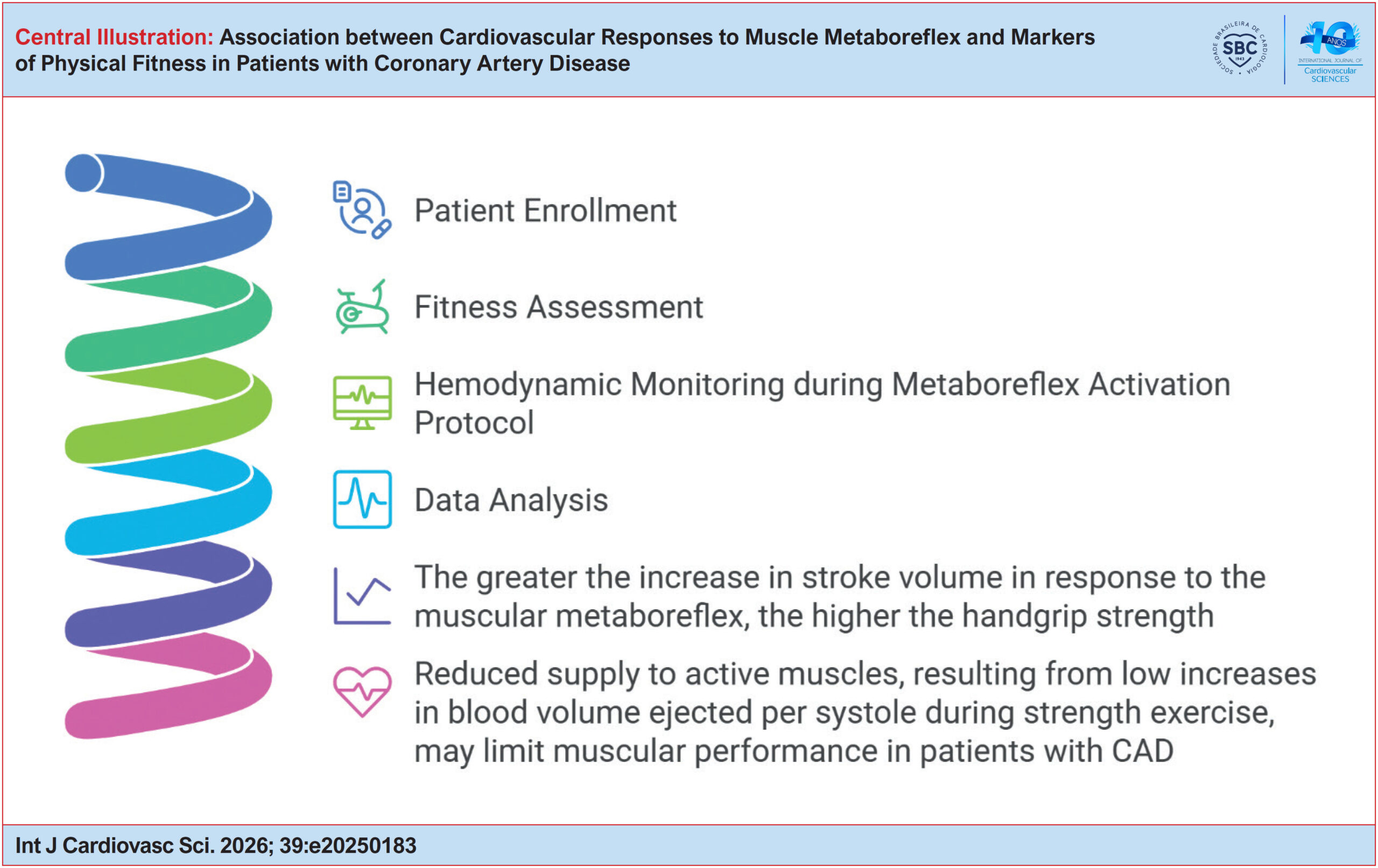
The muscle metaboreflex regulates cardiovascular responses during exercise. In patients with coronary artery disease (CAD), this reflex primarily increases blood pressure via sympathetic-mediated vasoconstriction, thereby increasing peripheral vascular resistance (PVR) rather than enhancing stroke volume (SV). This response may result in early fatigue during physical exertion. However, the specific mediators of this response are unclear.

Objective:

To investigate the association between cardiorespiratory and muscle fitness with cardiovascular responses to muscle metaboreflex activation in patients with CAD.

Methods:

Twenty patients underwent an exercise test and a maximal voluntary contraction (MVC) test using handgrip strength. Hemodynamic variables were assessed using photoplethysmography during muscle metaboreflex activation via a post-exercise circulatory arrest (PECA) protocol. Changes (Δ) in mean arterial pressure (MAP), SV, and PVR at rest were used to assess the metaboreflex response.

Results:

Participants (61.7±8.0 years; 28.4±3.9 kg/m²) had a mean VO2max of 31.96±5.70 mL/kg/min, and a MVC of 90.5±21.1 lbs. Metaboreflex activation significantly increased MAP (+14.74±9.56 mmHg, p<0.0001) and PVR (+0.13±0.07 mmHg.s/mL, p<0.0001), but not SV (+1.91±5.54 mL, p=0.13). MVC was directly associated with ΔSV (R=0.54 and p=0.01), but not with ΔMAP (R=0.23 and p=0.31) or ΔPVR (R=-0.10 and p=0.65). In multiple linear regression models adjusted for age and sex, ΔSV emerged as a predictor of MVC (β=+1.37 and p=0.03). Conversely, no significant associations were found between VO2max and ΔSV (R=0.29 and p=0.22), ΔMAP (R=0.14 and p=0.54), or ΔPVR (R=0.05 and p=0.83).

Conclusions:

These findings underscore the association between SV and muscle fitness during metaboreflex activation in patients with CAD.
  • Cardiovascular Physiological Phenomena
  • Exercise Pressor Reflex
  • Exercise Tolerance
  • Myocardial Ischemia
Read Full Article
Creative Commons Attribution (CC BY) Creative Commons license
13/03/2026 DOI: 10.36660/ijcs.20250183
Use of Echocardiography as a Supplementary Tool in Teaching Cardiac Anatomy and Physiology to Medical Students
ABCIC
Original Article

Use of Echocardiography as a Supplementary Tool in Teaching Cardiac Anatomy and Physiology to Medical Students

Caroline de Oliveira Fischer Bacca et al. Silvia R. Froes Toniazzo Franciani Rodrigues da Rocha Luiz Fernando Matias … Thais Naiara Mees Ana Luiza Nardelli Kuhl Nicolas Ramos Marcelo Vier Gambetta

Abstract

Background:

Ultrasonography has been increasingly used in teaching basic medicine. The simultaneous observation of the echocardiographic image and the electrocardiogram allows students to understand the physiological process of the heart and its function within the cardiovascular system.

Objective:

Evaluate the acquisition and retention of knowledge among medical students during the study of cardiac anatomy and physiology through the use of echocardiography.

Methods:

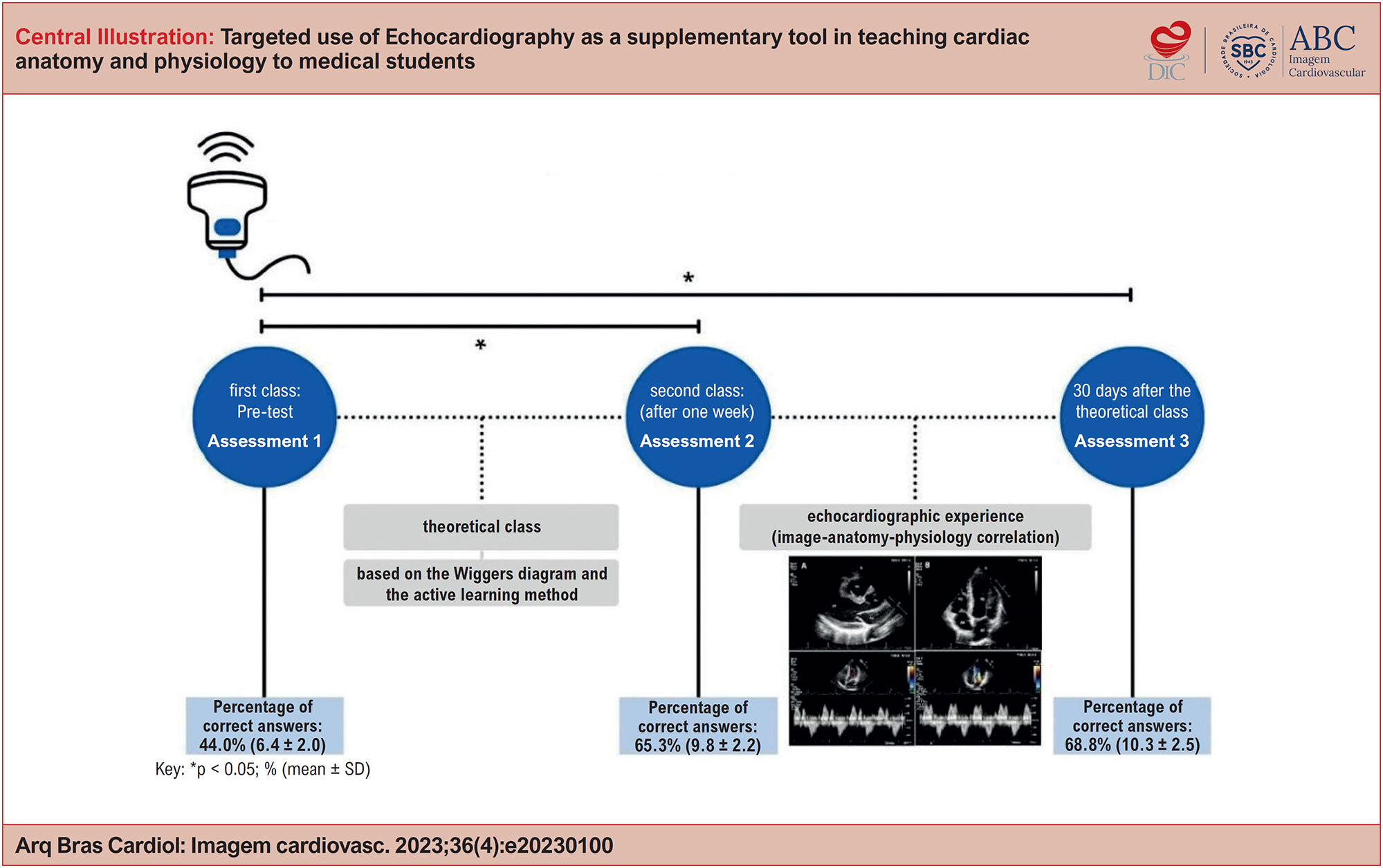
Thirty-four (34) students in the third semester took a pre-test (assessment 1) consisting of 20 multiple-choice questions, 15 of which were related to cardiac anatomy and physiology and 5 were “confusion-inducing questions.” The test was designed by one of the authors, blind to the others. After the theoretical meeting, assessment 2 was carried out with the same questions. The following week, a practical echocardiography meeting was held, aimed at evaluating anatomy and physiology. A post-test (assessment 3) was carried out 30 days after the first meeting to assess knowledge retention. The variables were analyzed by the Kolmogorov-Smirnov, Student’s T, and Wilcoxon tests, with a statistical significance level of p < 0.05.

Results:

The average number of correct answers in assessment 1 was 6.37 ± 2.0 (42.4%), 9.8 ± 2.2 (65.3%) in the second assessment, and 10.3 ± 2.5 (68.6%) in assessment 3. There was a statistical difference between assessment 1 and the other assessments (p = 0.01).

Conclusion:

Early introduction of echocardiography in the medical curriculum proves beneficial for imparting knowledge in cardiac physiology and anatomy, reinforcing theoretical understanding.

  • Anatomy
  • Cardiovascular Physiological Phenomena
  • Echocardiography
  • Education, Medical
  • Students, Medical
Read Full Article
Creative Commons Attribution (CC BY) Creative Commons license
18/12/2023 DOI: 10.36660/abcimg.20230100i
ABC
Viewpoint

Physical Activity And Reducing Sedentary Behavior During The Coronavirus Pandemic

Francisco José Gondim Pitanga et al. Carmem Cristina Beck Cristiano Penas Seara Pitanga

Introduction

The novel coronavirus pandemic recently declared by the World Health Organization has led several municipal and state health departments to issue decrees closing different spaces intended for practicing physical activity. Furthermore, the Ministry of Health has prepared a manual with several initiatives to prevent the spread of the disease, in addition to making decisions suggesting social isolation and recommending that people remain at home. All of these measures have made it more difficult for the Brazilian population to practice physical activity.

On the other hand, the literature has consistently provided evidence regarding the diverse health benefits that physical activity promotes, especially to the cardiovascular/metabolic and immunological system. More recently, the literature began to show evidence that health is related not only to regular practice of physical activity, but also to reduced sedentary behavior, in other words, time spent sitting, lying down, or reclining during the day, excluding sleep hours.

[…]

  • Cardiovascular Physiological Phenomena
  • Coronavirus
  • Exercise
  • Leisure Activities
  • Pandemics
  • Physical activity
  • Population Dynamics
  • Screen Time
Read Full Article
Creative Commons Attribution (CC BY) Creative Commons license
03/07/2020 DOI: 10.36660/abc.20200238 Views 1
Effects of rest interval between exercise sets on blood pressure after resistance exercises
ABC
Artigo Original

Effects of rest interval between exercise sets on blood pressure after resistance exercises

João Veloso et al. Marcos D. Polito Tiago Riera Rodrigo Celes … José Carlos Vidal Martim Bottaro

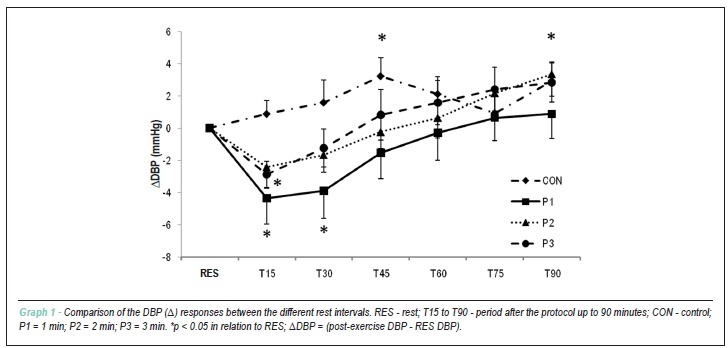
BACKGROUND: Although studies have demonstrated the occurrence of postexercise hypotension (PEH) in resistance exercises, there is still no consensus on an ideal protocol. OBJECTIVE: To evaluate the effects of different rest intervals (RI) between resistance exercise (RE) sets on postexercise blood pressure (BP). METHODS: Sixteen sedentary non-hypertensive young men performed three RE protocols with RI of 1 (P1), 2 (2) and 3 (P3) minutes between the sets, as well as a control protocol (CON), in a counterbalanced manner. The RE protocols consisted of three sets of eight repetitions in six exercises. The loads used in the 1st, 2nd, and 3rd exercise sets were 80%, 70% and 60% of one repetition maximum (1RM), respectively. Measurements were taken at rest (RES), 15 (T15), 30 (T30), 45 (T45), 60 (T60), 75 (T75), and 90 (T90) minutes after the session. Factorial analysis of variance (Anova) was carried out, followed by post hoc LSD. RESULTS: No significant change was found in systolic BP after the protocols. A significant increase in diastolic BP was verified after CON at timepoints T45 and T90. Significant reduction in diastolic BP occurred after P1 and P3, with duration of 30 and 15 minutes, respectively. No significant differences were found in the systolic and diastolic BP responses between the protocols with different RI. CONCLUSION: RI does not seem to influence systolic BP reduction after an RE session. However, reductions in diastolic BP (P1 and P3) lasting up to 30 minutes were observed.

  • Cardiovascular Physiological Phenomena
  • Exercise
  • Hypotension
Read Full Article
Creative Commons Attribution (CC BY) Creative Commons license
26/03/2010 DOI: 10.1590/S0066-782X2010005000019 Views 1

How to cite this article

EndNote RIS

Electronic Document Format (Vancouver)

Coelho VCO, Gama GS, Costa CLF, Rangel MVS, Borges J. Association between Cardiovascular Responses to Muscle Metaboreflex and Markers of Physical Fitness in Patients with Coronary Artery Disease. International Journal of Cardiovascular Sciences 2026;39:e20250183.

Electronic Document Format (ABNT)

Coelho, Vanessa Cunha de Oliveira; Gama, Gabriel da Silva; Costa, Caio Luan Farias; Rangel, Marcus Vinicius dos Santos; Borges, Juliana. Association between Cardiovascular Responses to Muscle Metaboreflex and Markers of Physical Fitness in Patients with Coronary Artery Disease. International Journal of Cardiovascular Sciences, v. 39, e20250183, Mar. 2026.

Electronic Document Format (APA)

Coelho, V. C. O., Gama, G. S., Costa, C. L. F., Rangel, M. V. S., & Borges, J. (2026). Association between Cardiovascular Responses to Muscle Metaboreflex and Markers of Physical Fitness in Patients with Coronary Artery Disease. International Journal of Cardiovascular Sciences, 39, e20250183.

Electronic Document Format (ISO)

Coelho, Vanessa Cunha de Oliveira and Gama, Gabriel da Silva and Costa, Caio Luan Farias and Rangel, Marcus Vinicius dos Santos and Borges, Juliana. Association between Cardiovascular Responses to Muscle Metaboreflex and Markers of Physical Fitness in Patients with Coronary Artery Disease. International Journal of Cardiovascular Sciences [online]. 2026, vol. 39, [cited 2026-10-14], e20250183. Available from: <https://journals.cardiol.br/en/article/association-between-cardiovascular-responses-to-muscle-metaboreflex-and-markers-of-physical-fitness-in-patients-with-coronary-artery-disease/>. ISSN 2359-4802

EndNote RIS

Electronic Document Format (Vancouver)

Bacca COF, Toniazzo SRF, Rocha FR, Matias LF, Mees TN, Kuhl ALN, Ramos N, et al. Use of Echocardiography as a Supplementary Tool in Teaching Cardiac Anatomy and Physiology to Medical Students. ABC Imagem Cardiovascular 2023;36(4):e20230100.

Electronic Document Format (ABNT)

Bacca, Caroline de Oliveira Fischer; Toniazzo, Silvia R. Froes; Rocha, Franciani Rodrigues da; Matias, Luiz Fernando; Mees, Thais Naiara; Kuhl, Ana Luiza Nardelli; Ramos, Nicolas; Gambetta, Marcelo Vier. Use of Echocardiography as a Supplementary Tool in Teaching Cardiac Anatomy and Physiology to Medical Students. ABC Imagem Cardiovascular, v. 36, n. 4, e20230100, Dec. 2023.

Electronic Document Format (APA)

Bacca, C. O. F., Toniazzo, S. R. F., Rocha, F. R. , Matias, L. F., Mees, T. N., Kuhl, A. L. N., Ramos, N., & Gambetta, M. V. (2023). Use of Echocardiography as a Supplementary Tool in Teaching Cardiac Anatomy and Physiology to Medical Students. ABC Imagem Cardiovascular, 36(4), e20230100.

Electronic Document Format (ISO)

Bacca, Caroline de Oliveira Fischer and Toniazzo, Silvia R. Froes and Rocha, Franciani Rodrigues da and Matias, Luiz Fernando and Mees, Thais Naiara and Kuhl, Ana Luiza Nardelli and Ramos, Nicolas and Gambetta, Marcelo Vier. Use of Echocardiography as a Supplementary Tool in Teaching Cardiac Anatomy and Physiology to Medical Students. ABC Imagem Cardiovascular [online]. 2023, vol. 36, n. 4, [cited 2026-10-14], e20230100. Available from: <https://journals.cardiol.br/en/article/use-of-echocardiography-as-a-supplementary-tool-in-teaching-cardiac-anatomy-and-physiology-to-medical-students/>. ISSN 2318-8219

EndNote RIS

Electronic Document Format (Vancouver)

Pitanga FJG, Beck CC, Pitanga CPS. Physical Activity And Reducing Sedentary Behavior During The Coronavirus Pandemic. Arquivos Brasileiros de Cardiologia 2020;114(6):1058-60.

Electronic Document Format (ABNT)

Pitanga, Francisco José Gondim; Beck, Carmem Cristina; Pitanga, Cristiano Penas Seara. Physical Activity And Reducing Sedentary Behavior During The Coronavirus Pandemic. Arquivos Brasileiros de Cardiologia, v. 114, n. 6, p. 1058-1060, Jul. 2020.

Electronic Document Format (APA)

Pitanga, F. J. G., Beck, C. C., & Pitanga, C. P. S. (2020). Physical Activity And Reducing Sedentary Behavior During The Coronavirus Pandemic. Arquivos Brasileiros de Cardiologia, 114(6), 1058-1060.

Electronic Document Format (ISO)

Pitanga, Francisco José Gondim and Beck, Carmem Cristina and Pitanga, Cristiano Penas Seara. Physical Activity And Reducing Sedentary Behavior During The Coronavirus Pandemic. Arquivos Brasileiros de Cardiologia [online]. 2020, vol. 114, n. 6, [cited 2026-10-14], pp. 1058-1060. Available from: <https://journals.cardiol.br/en/article/physical-activity-and-reducing-sedentary-behavior-during-the-coronavirus-pandemic/>. ISSN 0066-782X

EndNote RIS

Electronic Document Format (Vancouver)

Veloso J, Polito MD, Riera T, Celes R, Vidal JC, Bottaro M. Effects of rest interval between exercise sets on blood pressure after resistance exercises. Arquivos Brasileiros de Cardiologia 2010;94(4):512-8.

Electronic Document Format (ABNT)

Veloso, João; Polito, Marcos D.; Riera, Tiago; Celes, Rodrigo; Vidal, José Carlos; Bottaro, Martim. Effects of rest interval between exercise sets on blood pressure after resistance exercises. Arquivos Brasileiros de Cardiologia, v. 94, n. 4, p. 512-518, Mar. 2010.

Electronic Document Format (APA)

Veloso, J., Polito, M. D., Riera, T., Celes, R., Vidal, J. C., & Bottaro, M. (2010). Effects of rest interval between exercise sets on blood pressure after resistance exercises. Arquivos Brasileiros de Cardiologia, 94(4), 512-518.

Electronic Document Format (ISO)

Veloso, João and Polito, Marcos D. and Riera, Tiago and Celes, Rodrigo and Vidal, José Carlos and Bottaro, Martim. Effects of rest interval between exercise sets on blood pressure after resistance exercises. Arquivos Brasileiros de Cardiologia [online]. 2010, vol. 94, n. 4, [cited 2026-10-14], pp. 512-518. Available from: <https://journals.cardiol.br/en/article/effects-of-rest-interval-between-exercise-sets-on-blood-pressure-after-resistance-exercises/>. ISSN 0066-782X

  • About ABC Family
  • Internal Regulation
  • Editorial Board
  • Brazilian Society of Cardiology (SBC)

Issues

SBC Guidelines

  • Videos
  • Podcasts
  • News