ABC Family Arquivos Brasileiros de Cardiologia International Journal of Cardiovascular Sciences ABC Heart Failure & Cardiomyopathy ABC Imagem Cardiovascular
Português English
ABC Family
Português English
  • About
    • About ABC Family
    • Internal Regulation
    • Editorial Board
    • Brazilian Society of Cardiology (SBC)
  • Issues
  • SBC Guidelines
  • Content
    • Videos
    • Podcasts
    • News
  • About
    • About ABC Family
    • Internal Regulation
    • Editorial Board
    • Brazilian Society of Cardiology (SBC)
  • Issues
  • SBC Guidelines
  • Content
    • Videos
    • Podcasts
    • News

ABC Family

  • ABC Family
  • Arquivos Brasileiros de Cardiologia
  • International Journal of Cardiovascular Sciences
  • ABC Heart Failure & Cardiomyopathy
  • ABC Imagem Cardiovascular
Search in

No content found.

Journals
Ordering
Article types
Others

  1. Home
  2. Keyword: Atrial Fibrillation/complications
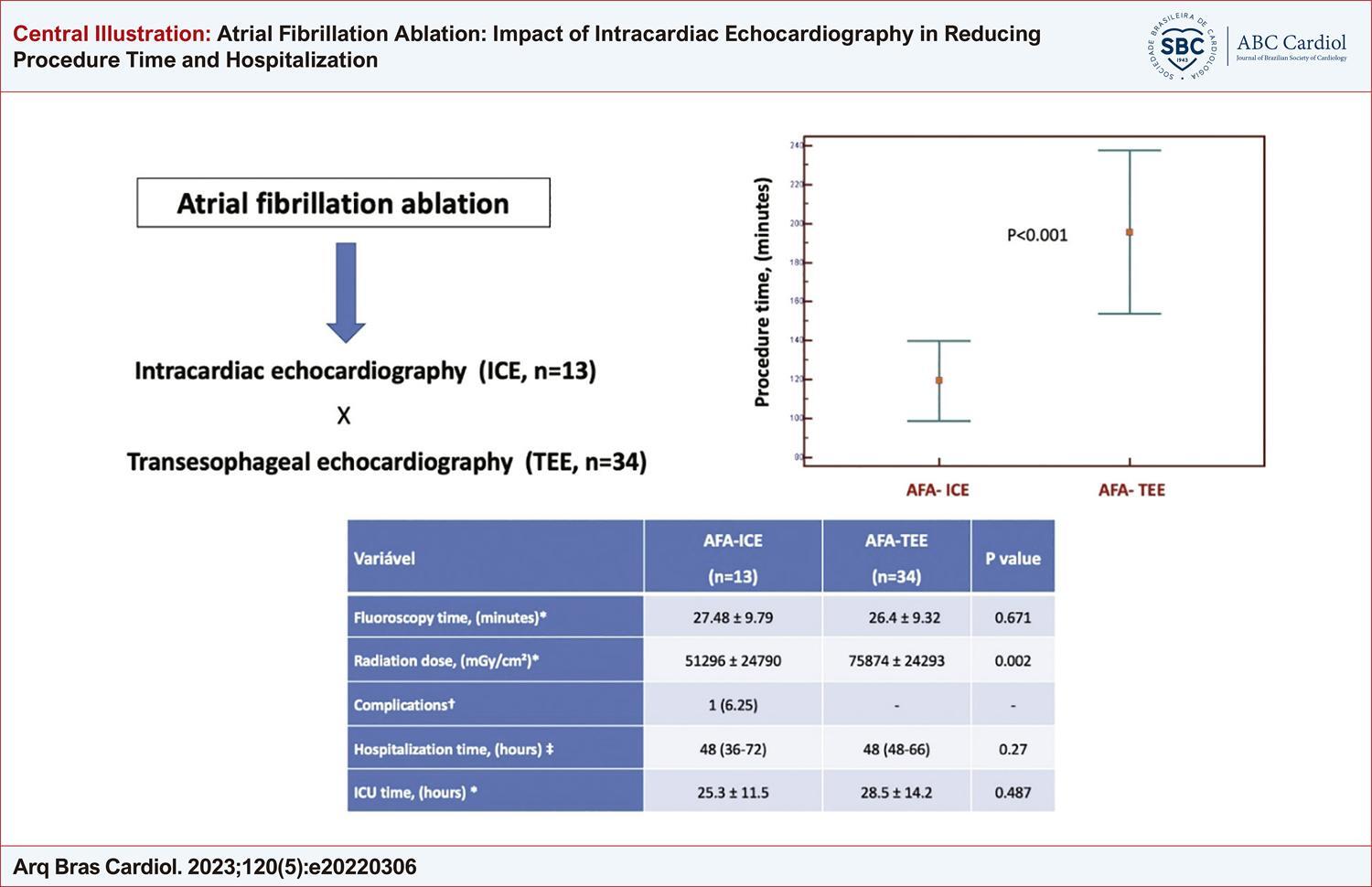
Central Illustration
ABC
Original Article

Atrial Fibrillation Ablation: Impact of Intracardiac Echocardiography in Reducing Procedure Time and Hospitalization

Roberto Tofani Sant`Anna et al. Gustavo Glotz de Lima Marco Aurélio Lumertz Saffi Marcelo Lapa Kruse Tiago Luiz Luz Leiria

Abstract

Background

Intracardiac echocardiography (ICE) allows visualization of cardiac structures and recognition of complications during atrial fibrillation ablation (AFA). Compared to transesophageal echocardiography (TEE), ICE is less sensitive to detecting thrombus in the atrial appendage but requires minimal sedation and fewer operators, making it attractive in a resource-constrained setting.

Objective

To compare 13 cases of AFA using ICE (AFA-ICE group) with 36 cases of AFA using TEE (AFA-TEE group).

Methods

This is a single-center prospective cohort study. The main outcome was procedure time. Secondary outcomes: fluoroscopy time, radiation dose (mGy/cm2), major complications, and length of hospital stay in hours. The clinical profile was compared using the CHA2DS2-VASc score. A p-value <0.05 was considered a statistically significant difference between groups.

Results

The median CHA2DS2-VASc score was 1 (0-3) in the AFA-ICE group and 1 (0-4) in the AFA-TEE group. The total procedure time was 129 ± 27 min in the AFA-ICE group and 189 ± 41 min in the AFA-TEE group (p<0.001); the AFA-ICE group received a lower dose of radiation (mGy/cm2, 51296 ± 24790 vs. 75874 ± 24293; p=0.002), despite the similar fluoroscopy time (27.48 ± 9. 79 vs. 26.4 ± 9.32; p=0.671). The median length of hospital stay did not differ; 48 (36-72) hours (AFA-ICE) and 48 (48-66) hours (AFA-TEE) (p=0.27).

Conclusions

In this cohort, AFA-ICE was related to shorter procedure times and less exposure to radiation without increasing the risk of complications or the length of hospital stay.
  • Atrial Fibrillation/complications
  • Catheter Ablation
  • Echocadiography/methods
  • Hospitalization
  • Pulmonary Veins/diagnostic imaging
Read Full Article
Creative Commons Attribution (CC BY) Creative Commons license
15/05/2023 DOI: 10.36660/abc.20220306 Views 1
ABC
Editorial

Catheter Ablation as First-Line Therapy in the Treatment of Atrial Fibrillation – Should We Always Indicate it?

Luiz Eduardo Montenegro Camanho et al. Gustavo Vignoli dos Santos

Atrial fibrillation (AF) is the most common cardiac arrhythmia in clinical practice, affecting approximately 1 to 2% of the general population and is associated with an increased risk of cardioembolic events and a negative impact on quality of life. The cardiovascular mortality rate described is approximately 5% per year, and it is estimated that the risk of cardiovascular complications is higher in the first year after the diagnosis of arrhythmia. The recurrence rate of AF without adequate preventive treatment is around 90%, which expresses the magnitude of the problem.

Thus, it seems quite reasonable to postulate the concept that an early approach to AF brings relevant clinical benefits to these patients. Recent data obtained from the EAST-AFNET4 study clearly demonstrated that this approach is a valid and effective strategy. The study involved 2789 patients diagnosed with AF for at least 12 months who were randomized to early treatment of AF (ablation: 8% and AAD: 87%) or conservative treatment. At a median follow-up period of 5.1 years, the early treatment group demonstrated a significant reduction in the primary endpoint of cardiovascular death compared to the conservative group. The risk of stroke, hospitalization for HF or acute coronary syndrome was also lower in the early approach group. The study design was not primarily intended to assess the safety and effectiveness of early treatment components (ablation vs. antiarrhythmic drugs – AAD). Therefore, the authors concluded that an early heart rhythm control strategy was associated with a lower risk of unfavorable outcomes than usual care in patients with AF and associated cardiovascular conditions.

[…]

  • Arrhythmias, Cardiac/complications
  • Atrial Fibrillation/complications
  • Catheter Ablation/methods
  • Thromboembolism/mortality
  • Thrombolytic Therapy/adverse effects
Read Full Article
Creative Commons Attribution (CC BY) Creative Commons license
11/07/2022 DOI: 10.36660/abc.20220362
ABC
Editorial

Clinical Management of Patients with First-Episode Atrial Fibrillation Detected in the Acute Phase of Myocardial Infarction

Mauricio Scanavacca et al. Tan Chen Wu

Atrial fibrillation (AF) episodes have been traditionally observed in up to 20% of the patients who suffer an acute myocardial infarction (AMI); 5-10% of them, as a “first episode”, during hospital admission. The etiology of AF, in this phase of AMI, includes several factors, such as elevated atrial pressure resulting from acute ventricular dysfunction, associated atrial ischemia (more common in inferior wall AMI), secondary inflammatory reaction, changes in autonomic nervous system behavior and in the neurohumoral pattern related to the pathophysiology of AMI, especially in those with ventricular dysfunction.–

A recent study published in the Arquivos Brasileiros de Cardiologia by Congo et al. suggest that, in the last years, the incidence of AF in the acute phase of AMI may be decreasing, due to the greater access of patients to early reperfusion and to better clinical treatment, associated with the more frequent use of angiotensin converting enzyme inhibitors (ACE inhibitors), beta blockers, statins and antiplatelet therapy. In addition, the study corroborates previous observations that new onset AF is associated to poorer clinical evolution and raises awareness of the clinical management of these patients, in particular in relation to the non-use of oral anticoagulants at hospital discharge.

[…]

  • Anthypertensive Agents
  • Anticoagulants
  • Atrial Fibrillation/complications
  • Myocardial Infarction/complications
  • Stroke
  • Ventricular Dysfunction
Read Full Article
Creative Commons Attribution (CC BY) Creative Commons license
02/12/2019 DOI: 10.36660/abc.20190733 Views 1
ABC
Letter to the Editor

Incidence of Atrial High-Rate Episodes in Chagas Disease Patients

Emanoela Lima Freitas et al. Elieusa e Silva Sampaio Roque Aras

A

t

[…]

  • Atrial Fibrillation/complications
  • Cardiac Pacing, Artificial/methods
  • Chagas Disease/complications
  • Defibrillators, Implantable
  • Risk
  • Stroke/etiology
Read Full Article
Creative Commons Attribution (CC BY) Creative Commons license
01/04/2018 DOI: 10.5935/abc.20180060 Views 1
Figure 1
ABC
Original Article

Thromboembolism and bleeding risk scores and predictors of cardiac death in a population with atrial fibrillation

Rose Mary Ferreira Lisboa da Silva et al. Pollyana Ardavicius e Silva Marcos Correia Lima Lívia Tanure Sant'Anna … Túlio Corrêa Silva Pedro Henrique Vilela Moreira Robert Moreira Gandra Túlio Ramos Cavalcanti Plínio Henrique Vaz Mourão

Abstract

Background:

Atrial fibrillation (AF) is a common arrhythmia, with risk of systemic embolism and death. It presents rheumatic etiology in up to 32% of developing countries, whose anticoagulation and evolution data are scarce.

Objectives:

to determine the predictors of cardiac death considering the clinical profile, thromboembolism and bleeding scores of patients with AF of a single center, with high prevalence of rheumatic heart disease.

Methods:

302 patients with AF were studied, mean age 58.1 years; 161 women; 96 pts with rheumatic etiology. Patients underwent clinical and laboratory evaluation, measurement of risk scores and the mean follow-up of 12.8 months.

Results:

174 were using warfarin. The averages of the HAS-BLED and ATRIA scores were 1.4 and 1.2, respectively. Percent time in therapeutic range of international normalized ratio was 45.8%. Thirty patients (9.9%) had cardiac death and 41 had some type of bleeding due to warfarin. By univariate analysis, there was statistical significance between cardiac death and permanent AF, blood pressure, systolic dysfunction, R2CHADS2, CCS, EHRA and HAS-BLED. There was no association with valvular AF. By multivariate analysis, systemic arterial and pulmonary artery pressures, classification CCS and systolic dysfunction showed statistical significance.

Conclusions:

There was no association between cardiac death and valvular AF. Independent predictors of cardiac death were low measures of blood pressure, higher score CCS classification and the presence of systolic ventricular dysfunction.

  • Atrial Fibrillation/complications
  • Cardiovascular Diseases, mortality
  • Hemorrhage
  • Thromboembolism/complications
Read Full Article
Creative Commons Attribution (CC BY) Creative Commons license
25/05/2017 DOI: 10.5935/abc.20170064

How to cite this article

EndNote RIS

Electronic Document Format (Vancouver)

Sant`Anna RT, Lima GG, Saffi MAL, Kruse ML, Leiria TLL. Atrial Fibrillation Ablation: Impact of Intracardiac Echocardiography in Reducing Procedure Time and Hospitalization. Arquivos Brasileiros de Cardiologia 2023;120(5):e20220306.

Electronic Document Format (ABNT)

Sant`Anna, Roberto Tofani; Lima, Gustavo Glotz de; Saffi, Marco Aurélio Lumertz; Kruse, Marcelo Lapa; Leiria, Tiago Luiz Luz. Atrial Fibrillation Ablation: Impact of Intracardiac Echocardiography in Reducing Procedure Time and Hospitalization. Arquivos Brasileiros de Cardiologia, v. 120, n. 5, e20220306, May. 2023.

Electronic Document Format (APA)

Sant`Anna, R. T., Lima, G. G. , Saffi, M. A. L., Kruse, M. L., & Leiria, T. L. L. (2023). Atrial Fibrillation Ablation: Impact of Intracardiac Echocardiography in Reducing Procedure Time and Hospitalization. Arquivos Brasileiros de Cardiologia, 120(5), e20220306.

Electronic Document Format (ISO)

Sant`Anna, Roberto Tofani and Lima, Gustavo Glotz de and Saffi, Marco Aurélio Lumertz and Kruse, Marcelo Lapa and Leiria, Tiago Luiz Luz. Atrial Fibrillation Ablation: Impact of Intracardiac Echocardiography in Reducing Procedure Time and Hospitalization. Arquivos Brasileiros de Cardiologia [online]. 2023, vol. 120, n. 5, [cited 2026-10-14], e20220306. Available from: <https://journals.cardiol.br/en/article/atrial-fibrillation-ablation-impact-of-intracardiac-echocardiography-in-reducing-procedure-time-and-hospitalization/>. ISSN 0066-782X

EndNote RIS

Electronic Document Format (Vancouver)

Camanho LEM, Santos GV. Catheter Ablation as First-Line Therapy in the Treatment of Atrial Fibrillation – Should We Always Indicate it?. Arquivos Brasileiros de Cardiologia 2022;119(1):95-6.

Electronic Document Format (ABNT)

Camanho, Luiz Eduardo Montenegro; Santos, Gustavo Vignoli dos. Catheter Ablation as First-Line Therapy in the Treatment of Atrial Fibrillation – Should We Always Indicate it?. Arquivos Brasileiros de Cardiologia, v. 119, n. 1, p. 95-96, Jul. 2022.

Electronic Document Format (APA)

Camanho, L. E. M., & Santos, G. V. (2022). Catheter Ablation as First-Line Therapy in the Treatment of Atrial Fibrillation – Should We Always Indicate it?. Arquivos Brasileiros de Cardiologia, 119(1), 95-96.

Electronic Document Format (ISO)

Camanho, Luiz Eduardo Montenegro and Santos, Gustavo Vignoli dos. Catheter Ablation as First-Line Therapy in the Treatment of Atrial Fibrillation – Should We Always Indicate it?. Arquivos Brasileiros de Cardiologia [online]. 2022, vol. 119, n. 1, [cited 2026-10-14], pp. 95-96. Available from: <https://journals.cardiol.br/en/article/catheter-ablation-as-first-line-therapy-in-the-treatment-of-atrial-fibrillation-should-we-always-indicate-it/>. ISSN 0066-782X

EndNote RIS

Electronic Document Format (Vancouver)

Scanavacca M, Wu TC. Clinical Management of Patients with First-Episode Atrial Fibrillation Detected in the Acute Phase of Myocardial Infarction. Arquivos Brasileiros de Cardiologia 2019;113(5):958-9.

Electronic Document Format (ABNT)

Scanavacca, Mauricio; Wu, Tan Chen. Clinical Management of Patients with First-Episode Atrial Fibrillation Detected in the Acute Phase of Myocardial Infarction. Arquivos Brasileiros de Cardiologia, v. 113, n. 5, p. 958-959, Dec. 2019.

Electronic Document Format (APA)

Scanavacca, M., & Wu, T. C. (2019). Clinical Management of Patients with First-Episode Atrial Fibrillation Detected in the Acute Phase of Myocardial Infarction. Arquivos Brasileiros de Cardiologia, 113(5), 958-959.

Electronic Document Format (ISO)

Scanavacca, Mauricio and Wu, Tan Chen. Clinical Management of Patients with First-Episode Atrial Fibrillation Detected in the Acute Phase of Myocardial Infarction. Arquivos Brasileiros de Cardiologia [online]. 2019, vol. 113, n. 5, [cited 2026-10-14], pp. 958-959. Available from: <https://journals.cardiol.br/en/article/clinical-management-of-patients-with-first-episode-atrial-fibrillation-detected-in-the-acute-phase-of-myocardial-infarction/>. ISSN 0066-782X

EndNote RIS

Electronic Document Format (Vancouver)

Freitas EL, Sampaio ES, Aras R. Incidence of Atrial High-Rate Episodes in Chagas Disease Patients. Arquivos Brasileiros de Cardiologia 2018;110(4):399.

Electronic Document Format (ABNT)

Freitas, Emanoela Lima; Sampaio, Elieusa e Silva; Aras, Roque. Incidence of Atrial High-Rate Episodes in Chagas Disease Patients. Arquivos Brasileiros de Cardiologia, v. 110, n. 4, p. 399-399, Mar. 2018.

Electronic Document Format (APA)

Freitas, E. L., Sampaio, E. S., & Aras, R. (2018). Incidence of Atrial High-Rate Episodes in Chagas Disease Patients. Arquivos Brasileiros de Cardiologia, 110(4), 399-399.

Electronic Document Format (ISO)

Freitas, Emanoela Lima and Sampaio, Elieusa e Silva and Aras, Roque. Incidence of Atrial High-Rate Episodes in Chagas Disease Patients. Arquivos Brasileiros de Cardiologia [online]. 2018, vol. 110, n. 4, [cited 2026-10-14], pp. 399-399. Available from: <https://journals.cardiol.br/en/article/incidence-of-atrial-high-rate-episodes-in-chagas-disease-patients/>. ISSN 0066-782X

EndNote RIS

Electronic Document Format (Vancouver)

Silva RMFL, Silva PA, Lima MC, Sant’Anna LT, Silva TC, Moreira PHV, Gandra RM, et al. Thromboembolism and bleeding risk scores and predictors of cardiac death in a population with atrial fibrillation. Arquivos Brasileiros de Cardiologia 2017;109(1):05-13.

Electronic Document Format (ABNT)

Silva, Rose Mary Ferreira Lisboa da; Silva, Pollyana Ardavicius e; Lima, Marcos Correia; Sant’Anna, Lívia Tanure; Silva, Túlio Corrêa; Moreira, Pedro Henrique Vilela; Gandra, Robert Moreira; Cavalcanti, Túlio Ramos; Mourão, Plínio Henrique Vaz. Thromboembolism and bleeding risk scores and predictors of cardiac death in a population with atrial fibrillation. Arquivos Brasileiros de Cardiologia, v. 109, n. 1, p. 05-13, May. 2017.

Electronic Document Format (APA)

Silva, R. M. F. L. , Silva, P. A. , Lima, M. C., Sant’Anna, L. T., Silva, T. C., Moreira, P. H. V., Gandra, R. M., Cavalcanti, T. R., & Mourão, P. H. V. (2017). Thromboembolism and bleeding risk scores and predictors of cardiac death in a population with atrial fibrillation. Arquivos Brasileiros de Cardiologia, 109(1), 05-13.

Electronic Document Format (ISO)

Silva, Rose Mary Ferreira Lisboa da and Silva, Pollyana Ardavicius e and Lima, Marcos Correia and Sant’Anna, Lívia Tanure and Silva, Túlio Corrêa and Moreira, Pedro Henrique Vilela and Gandra, Robert Moreira and Cavalcanti, Túlio Ramos and Mourão, Plínio Henrique Vaz. Thromboembolism and bleeding risk scores and predictors of cardiac death in a population with atrial fibrillation. Arquivos Brasileiros de Cardiologia [online]. 2017, vol. 109, n. 1, [cited 2026-10-14], pp. 05-13. Available from: <https://journals.cardiol.br/en/article/thromboembolism-and-bleeding-risk-scores-and-predictors-of-cardiac-death-in-a-population-with-atrial-fibrillation/>. ISSN 0066-782X

  • About ABC Family
  • Internal Regulation
  • Editorial Board
  • Brazilian Society of Cardiology (SBC)

Issues

SBC Guidelines

  • Videos
  • Podcasts
  • News