ABC Family Arquivos Brasileiros de Cardiologia International Journal of Cardiovascular Sciences ABC Heart Failure & Cardiomyopathy ABC Imagem Cardiovascular
Português English
ABC Family
Português English
  • About
    • About ABC Family
    • Internal Regulation
    • Editorial Board
    • Brazilian Society of Cardiology (SBC)
  • Issues
  • SBC Guidelines
  • Content
    • Videos
    • Podcasts
    • News
  • About
    • About ABC Family
    • Internal Regulation
    • Editorial Board
    • Brazilian Society of Cardiology (SBC)
  • Issues
  • SBC Guidelines
  • Content
    • Videos
    • Podcasts
    • News

ABC Family

  • ABC Family
  • Arquivos Brasileiros de Cardiologia
  • International Journal of Cardiovascular Sciences
  • ABC Heart Failure & Cardiomyopathy
  • ABC Imagem Cardiovascular
Search in

No content found.

Journals
Ordering
Article types
Others

  1. Home
  2. Keyword: Public Health Policy
ABC
Editorial

High Mortality for Myocardial Infarction in Latin America and the Caribbean: Making the Case for Systems of Care Implementation in Brazil

Luisa C. C. Brant et al. Luiz G. Passaglia

Ischemic heart disease (IHD) is the leading cause of death worldwide, and while in high-income countries (HIC), substantial declines in mortality rates for IHD were observed in the last decades, the same did not occur in low- and middle-income countries (LMIC). The final event in the chain of IHD is myocardial infarction (MI), which can be classified based on the electrocardiogram in ST-segment elevation MI (STEMI), and non-ST-segment elevation MI (NSTEMI) – the first having higher lethality. Mortality rates for both MI presentations can be reduced by timely diagnosis and treatment according to current guidelines, including reperfusion therapy for STEMI. In HIC, such as the US, STEMI in-hospital mortality varied from 3.5% for individuals receiving primary percutaneous coronary angioplasty to 14.9% for those receiving no reperfusion, while in European countries, mortality as low as 2.5% has been reported.,

In this issue of the Journal, the article “Hospital Mortality from Myocardial Infarction in Latin America and the Caribbean: Systematic Review and Meta-Analysis” brings a welcome addition regarding MI in-hospital mortality in LMIC from Latin America and the Caribbean from 2000 to 2020. Using sound methodology, the authors made a meta-analysis of data from 38 studies, mostly conducted in Brazil, Cuba, and Argentina: 35 for STEMI with 28,878 individuals, and 9 for NSTEMI with 2,377 individuals. Pooled analysis demonstrated that in-hospital mortality for STEMI was 9.9% (95%CI: 9.1–10.7), with moderate to high heterogeneity (I2=74%). Chile had the lowest mortality (8.5%; 95%CI: 5.3-13.5), and Colombia the highest (15%; 95%CI: 10.1-21.7), with Brazil showing a mortality of 9.6% (95%CI: 8.3-11.0); however, no statistical difference was found among countries (p=0.47). For NSTEMI, in-hospital mortality was 7.2% (95% CI: 5.5 – 9.3), also with moderate to high heterogeneity (I2 = 63%), explained (I2=0%) by the exclusion of one outlier study.

[…]

  • Acute coronary syndrome
  • Epidemiology
  • Mortality
  • Myocardial Infarction
  • Public Health Policy
Read Full Article
Creative Commons Attribution (CC BY) Creative Commons license
19/12/2022 DOI: 10.36660/abc.20220825
Figure 1
ABC
Original Article

Creation and Implementation of a Prospective and Multicentric Database of Patients with Acute Myocardial Infarction: RIAM

Jacqueline Vaz et al. Anibal Pereira Abelin Marcia Moura Schmidt Pedro Piccaro de Oliveira … Carlos A. M. Gottschall Clarissa Garcia Rodrigues Alexandre Schaan de Quadros

Abstract

Background

Multicenter registries representing the real world can be a significant source of information, but few studies exist describing the methodology to implement these tools.

Objective

To describe the process of implementing a database of ST-segment elevation acute myocardial infarction (STEMI) at a reference hospital, and the application of this process to other centers by means of an online platform.

Methods

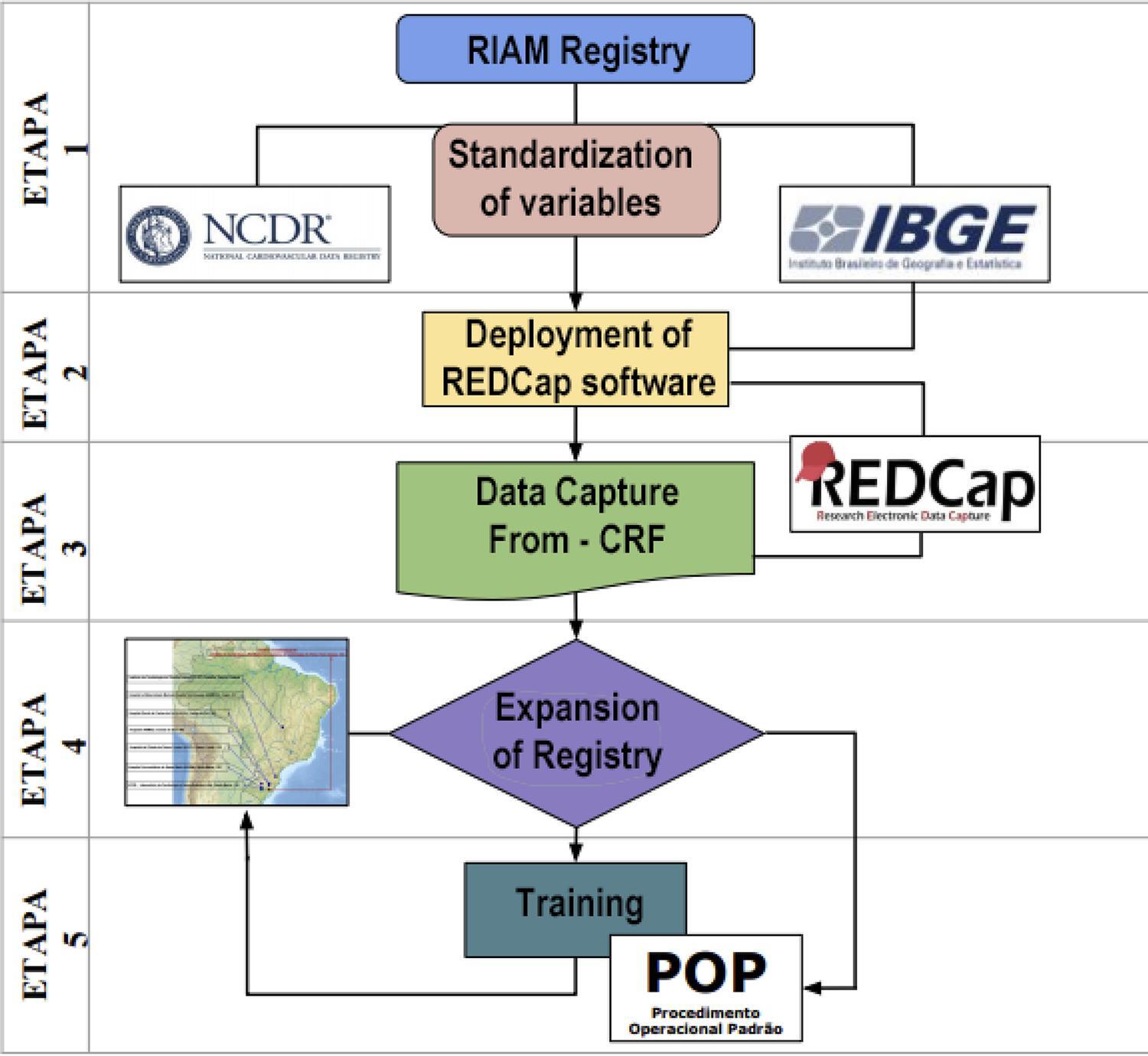
In 2009, our institution implemented an Registry of Acute Myocardial Infarction (RIAM), with the prospective and consecutive inclusion of every patient admitted to the institution who received a diagnosis of STEMI. From March 2014 to April 2016, the registries were uploaded to a web-based system using the REDCap software and the registry was expanded to other centers. Upon subscription, the REDCap platform is a noncommercial software made available by Vanderbilt University to institutions interested in research.

Results

The following steps were taken to improve and expand the registry: 1. Standardization of variables; 2. Implementation of institutional REDCap (Research Electronic Data Capture); 3. Development of data collection forms (Case Report Form – CRF); 4. Expansion of registry to other reference centers using the REDCap software; 5. Training of teams and participating centers following an SOP (Standard Operating Procedure).

Conclusion

The description of the methodology used to implement and expand the RIAM may help other centers and researchers to conduct similar studies, share information between institutions, develop new health technologies, and assist public policies regarding cardiovascular diseases. (Arq Bras Cardiol. 2020; 114(3):446-455)

  • Cardiovascular Diseases, mortality
  • Database
  • Multicenter Study
  • Myocardial Infarction/physiopathology
  • Myocardial Ischemia / physiopathology
  • Public Health Policy
Read Full Article
Creative Commons Attribution (CC BY) Creative Commons license
06/04/2020 DOI: 10.36660/abc.20190036
ABC
Editorial

Short Editorial: “Creation and Implementation of a Prospective Multicenter Registry of Acute Myocardial Infarction: RIAM”

José Mariani Junior

Cardiovascular diseases, including acute myocardial infarction (AMI), represent a major public health issue in Brazil and worldwide, with elevated incidence and mortality rates. The rates of Brazilian mortality for this group of causes (183.3/100,000), are amongst the highest in the world and is similar to that of countries such as China and areas such as the east of Europe.,

The implementation of health promotion policies, early diagnosis and effective treatment are some of the most important prevention and treatment strategies for these diseases, which remain the leading cause of mortality among adult patients globally. However, the recognition of these diseases, as well as their real and effective measurements, are among the strategies that must be optimized in our field.

[…]

  • Cardiovascular Diseases, mortality
  • Database
  • Decision Making
  • Epidemiology
  • Myocardial Infarction/prevention and control
  • Public Health Policy
Read Full Article
Creative Commons Attribution (CC BY) Creative Commons license
06/04/2020 DOI: 10.36660/abc.20200158 Views 1
ABC
Editorial

Rheumatic Fever in Brazil: What Color Should It Be?

Chris T. Longenecker

Rheumatic fever (RF) and its valvular sequela rheumatic heart disease (RHD) have been a scourge on humanity for ages, and it is only relatively recently that high-income countries have seen rates of RF decline dramatically. Yet, the Global Burden of Disease Study estimates that more than 275,000 deaths due to RHD still occur every year around the world, especially in low and middle-income countries including Brazil.

In this issue of the journal, Figueiredo et al. have presented ambitious modeling of the disease burden and costs of RF and RHD in Brazil. Using data from the Hospital Information System of Brazil, their central findings are that mortality rates for RF and RHD have increased by 215% and 42.5% respectively from 1998 to 2016. Additionally, the estimated cost for procedures related to RF/RHD diagnosis, interventions such as valve surgery, and hospitalizations for RHD complications like stroke and endocarditis was nearly $27 million USD in 2019.

[…]

  • Antibiotic Prophylaxys/economics
  • Hospitalization/economics
  • Public Health Policy
  • Rheumatic Fever/ecomomics Heart Disease/economics, Cardiovascular Surgical Procedures/mortality
Read Full Article
Creative Commons Attribution (CC BY) Creative Commons license
10/10/2019 DOI: 10.5935/abc.20190178 Views 1
Figure 1
ABC
Original Article

Rheumatic Fever: A Disease without Color

Estevão Tavares de Figueiredo et al. Luciana Azevedo Marcelo Lacerda Rezende Cristina Garcia Alves

Abstract

Background:

Brazil has approximately 30.000 cases of Acute Rheumatic Fever (ARF) annually. A third of cardiovascular surgeries performed in the country are due to the sequelae of rheumatic heart disease (RHD), which is an important public health problem.

Objectives:

to analyze the historical series of mortality rates and disease costs, projecting future trends to offer new data that may justify the need to implement a public health program for RF.

Methods:

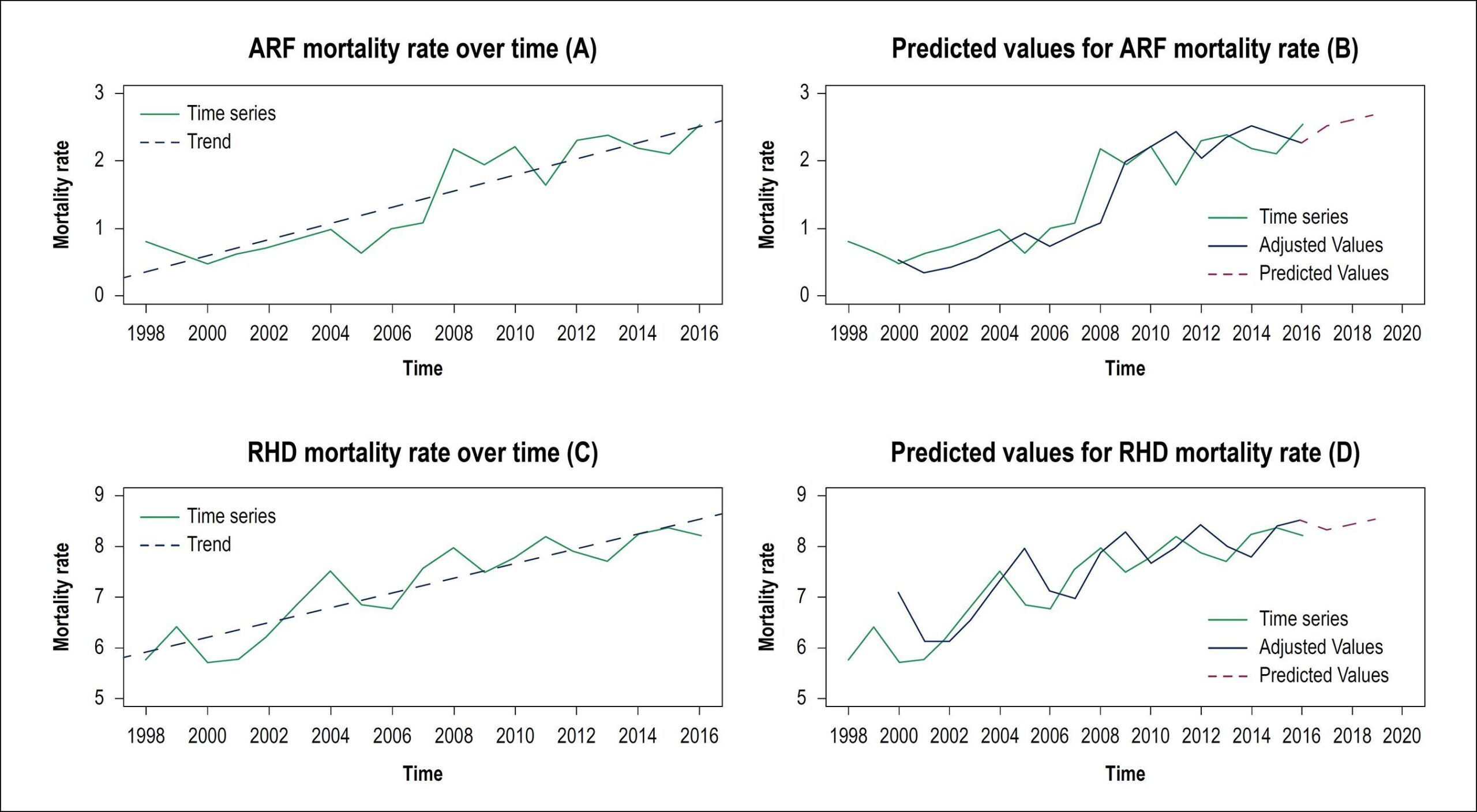
we performed a cross-sectional study with a time series analysis based on data from the Hospital Information System of Brazil from 1998 to 2016. Simple linear regression models and Holt’s Exponential Smoothing Method were used to model the behavior of the series and to do forecasts. The results of the tests with a value of p < 0.05 were considered statistically significant.

Results:

each year, the number of deaths due to RHD increased by an average of 16.94 units and the mortality rate from ARF increased by 215%. There was a 264% increase in hospitalization expenses for RHD and RHD mortality rates increased 42.5% (p-value < 0.05). The estimated mortality rates for ARF and RHD were, respectively, 2.68 and 8.53 for 2019. The estimated cost for RHD in 2019 was US$ 26.715.897,70.

Conclusions:

according to the Brazilian reality, the 1-year RHD expenses would be sufficient for secondary prophylaxis (considering a Benzatin Penicillin G dose every 3 weeks) in 22.574 people for 10 years. This study corroborates the need for public health policies aimed at RHD.

  • Antibiotic Prophylaxys/economics
  • Cardiovascular Surgical Procedures/mortality
  • Hospitalization/economics
  • Public Health Policy
  • Rheumatic Fever
  • rheumatic heart disease
Read Full Article
Creative Commons Attribution (CC BY) Creative Commons license
29/07/2019 DOI: 10.5935/abc.20190141 Views 1
ABC
Viewpoint

Medical Societies and Public Universities

Charles Mady

Medical societies are important and strong institutions in our country. We can take as an example the Brazilian Society of Cardiology (Sociedade Brasileira de Cardiologia, SBC), of which most of those reading this text are members. I have never done corporate politics, but I follow it with interest. I am impressed by the determination observed in the fierce disputes between competitors at election time.

These groups, which always include members of university faculties, spend a lot of energy to achieve command positions. Such is the game, which often drifts into tortuous paths. Therefore, the human resources of societies and universities have much in common, since they promote scientific and didactic activities, educating professionals all over the country, using both the face-to-face and the media modalities.

[…]

  • Education, Medical
  • Public Health Policy
  • Societies, Medical/trends
  • Universities/trends
Read Full Article
Creative Commons Attribution (CC BY) Creative Commons license
01/03/2019 DOI: 10.5935/abc.20180241

How to cite this article

EndNote RIS

Electronic Document Format (Vancouver)

Brant LCC, Passaglia LG. High Mortality for Myocardial Infarction in Latin America and the Caribbean: Making the Case for Systems of Care Implementation in Brazil. Arquivos Brasileiros de Cardiologia 2022;119(6):979-80.

Electronic Document Format (ABNT)

Brant, Luisa C. C.; Passaglia, Luiz G.. High Mortality for Myocardial Infarction in Latin America and the Caribbean: Making the Case for Systems of Care Implementation in Brazil. Arquivos Brasileiros de Cardiologia, v. 119, n. 6, p. 979-980, Dec. 2022.

Electronic Document Format (APA)

Brant, L. C. C., & Passaglia, L. G. (2022). High Mortality for Myocardial Infarction in Latin America and the Caribbean: Making the Case for Systems of Care Implementation in Brazil. Arquivos Brasileiros de Cardiologia, 119(6), 979-980.

Electronic Document Format (ISO)

Brant, Luisa C. C. and Passaglia, Luiz G.. High Mortality for Myocardial Infarction in Latin America and the Caribbean: Making the Case for Systems of Care Implementation in Brazil. Arquivos Brasileiros de Cardiologia [online]. 2022, vol. 119, n. 6, [cited 2026-10-14], pp. 979-980. Available from: <https://journals.cardiol.br/en/article/high-mortality-for-myocardial-infarction-in-latin-america-and-the-caribbean-making-the-case-for-systems-of-care-implementation-in-brazil/>. ISSN 0066-782X

EndNote RIS

Electronic Document Format (Vancouver)

Vaz J, Abelin AP, Schmidt MM, Oliveira PP, Gottschall CAM, Rodrigues CG, Quadros AS, et al. Creation and Implementation of a Prospective and Multicentric Database of Patients with Acute Myocardial Infarction: RIAM. Arquivos Brasileiros de Cardiologia 2020;114(3):446-55.

Electronic Document Format (ABNT)

Vaz, Jacqueline; Abelin, Anibal Pereira; Schmidt, Marcia Moura; Oliveira, Pedro Piccaro de; Gottschall, Carlos A. M.; Rodrigues, Clarissa Garcia; Quadros, Alexandre Schaan de. Creation and Implementation of a Prospective and Multicentric Database of Patients with Acute Myocardial Infarction: RIAM. Arquivos Brasileiros de Cardiologia, v. 114, n. 3, p. 446-455, Apr. 2020.

Electronic Document Format (APA)

Vaz, J., Abelin, A. P., Schmidt, M. M., Oliveira, P. P. , Gottschall, C. A. M., Rodrigues, C. G., & Quadros, A. S. (2020). Creation and Implementation of a Prospective and Multicentric Database of Patients with Acute Myocardial Infarction: RIAM. Arquivos Brasileiros de Cardiologia, 114(3), 446-455.

Electronic Document Format (ISO)

Vaz, Jacqueline and Abelin, Anibal Pereira and Schmidt, Marcia Moura and Oliveira, Pedro Piccaro de and Gottschall, Carlos A. M. and Rodrigues, Clarissa Garcia and Quadros, Alexandre Schaan de. Creation and Implementation of a Prospective and Multicentric Database of Patients with Acute Myocardial Infarction: RIAM. Arquivos Brasileiros de Cardiologia [online]. 2020, vol. 114, n. 3, [cited 2026-10-14], pp. 446-455. Available from: <https://journals.cardiol.br/en/article/creation-and-implementation-of-a-prospective-and-multicentric-database-of-patients-with-acute-myocardial-infarction-riam/>. ISSN 0066-782X

EndNote RIS

Electronic Document Format (Vancouver)

Mariani Junior J. Short Editorial: “Creation and Implementation of a Prospective Multicenter Registry of Acute Myocardial Infarction: RIAM”. Arquivos Brasileiros de Cardiologia 2020;114(3):456.

Electronic Document Format (ABNT)

Mariani Junior, José. Short Editorial: “Creation and Implementation of a Prospective Multicenter Registry of Acute Myocardial Infarction: RIAM”. Arquivos Brasileiros de Cardiologia, v. 114, n. 3, p. 456-456, Apr. 2020.

Electronic Document Format (APA)

Mariani Junior, J. (2020). Short Editorial: “Creation and Implementation of a Prospective Multicenter Registry of Acute Myocardial Infarction: RIAM”. Arquivos Brasileiros de Cardiologia, 114(3), 456-456.

Electronic Document Format (ISO)

Mariani Junior, José. Short Editorial: “Creation and Implementation of a Prospective Multicenter Registry of Acute Myocardial Infarction: RIAM”. Arquivos Brasileiros de Cardiologia [online]. 2020, vol. 114, n. 3, [cited 2026-10-14], pp. 456-456. Available from: <https://journals.cardiol.br/en/article/short-editorial-creation-and-implementation-of-a-prospective-multicenter-registry-of-acute-myocardial-infarction-riam/>. ISSN 0066-782X

EndNote RIS

Electronic Document Format (Vancouver)

Longenecker CT. Rheumatic Fever in Brazil: What Color Should It Be?. Arquivos Brasileiros de Cardiologia 2019;113(3):355-6.

Electronic Document Format (ABNT)

Longenecker, Chris T.. Rheumatic Fever in Brazil: What Color Should It Be?. Arquivos Brasileiros de Cardiologia, v. 113, n. 3, p. 355-356, Oct. 2019.

Electronic Document Format (APA)

Longenecker, C. T. (2019). Rheumatic Fever in Brazil: What Color Should It Be?. Arquivos Brasileiros de Cardiologia, 113(3), 355-356.

Electronic Document Format (ISO)

Longenecker, Chris T.. Rheumatic Fever in Brazil: What Color Should It Be?. Arquivos Brasileiros de Cardiologia [online]. 2019, vol. 113, n. 3, [cited 2026-10-14], pp. 355-356. Available from: <https://journals.cardiol.br/en/article/rheumatic-fever-in-brazil-what-color-should-it-be/>. ISSN 0066-782X

EndNote RIS

Electronic Document Format (Vancouver)

Figueiredo ET, Azevedo L, Rezende ML, Alves CG. Rheumatic Fever: A Disease without Color. Arquivos Brasileiros de Cardiologia 2019;113(3):345-54.

Electronic Document Format (ABNT)

Figueiredo, Estevão Tavares de; Azevedo, Luciana; Rezende, Marcelo Lacerda; Alves, Cristina Garcia. Rheumatic Fever: A Disease without Color. Arquivos Brasileiros de Cardiologia, v. 113, n. 3, p. 345-354, Jul. 2019.

Electronic Document Format (APA)

Figueiredo, E. T. , Azevedo, L., Rezende, M. L., & Alves, C. G. (2019). Rheumatic Fever: A Disease without Color. Arquivos Brasileiros de Cardiologia, 113(3), 345-354.

Electronic Document Format (ISO)

Figueiredo, Estevão Tavares de and Azevedo, Luciana and Rezende, Marcelo Lacerda and Alves, Cristina Garcia. Rheumatic Fever: A Disease without Color. Arquivos Brasileiros de Cardiologia [online]. 2019, vol. 113, n. 3, [cited 2026-10-14], pp. 345-354. Available from: <https://journals.cardiol.br/en/article/rheumatic-fever-a-disease-without-color/>. ISSN 0066-782X

EndNote RIS

Electronic Document Format (Vancouver)

Mady C. Medical Societies and Public Universities. Arquivos Brasileiros de Cardiologia 2019;112(3):317-8.

Electronic Document Format (ABNT)

Mady, Charles. Medical Societies and Public Universities. Arquivos Brasileiros de Cardiologia, v. 112, n. 3, p. 317-318, Feb. 2019.

Electronic Document Format (APA)

Mady, C. (2019). Medical Societies and Public Universities. Arquivos Brasileiros de Cardiologia, 112(3), 317-318.

Electronic Document Format (ISO)

Mady, Charles. Medical Societies and Public Universities. Arquivos Brasileiros de Cardiologia [online]. 2019, vol. 112, n. 3, [cited 2026-10-14], pp. 317-318. Available from: <https://journals.cardiol.br/en/article/medical-societies-and-public-universities/>. ISSN 0066-782X

  • About ABC Family
  • Internal Regulation
  • Editorial Board
  • Brazilian Society of Cardiology (SBC)

Issues

SBC Guidelines

  • Videos
  • Podcasts
  • News