ABC Family Arquivos Brasileiros de Cardiologia International Journal of Cardiovascular Sciences ABC Heart Failure & Cardiomyopathy ABC Imagem Cardiovascular
Português English
ABC Family
Português English
  • About
    • About ABC Family
    • Internal Regulation
    • Editorial Board
    • Brazilian Society of Cardiology (SBC)
  • Issues
  • SBC Guidelines
  • Content
    • Videos
    • Podcasts
    • News
  • About
    • About ABC Family
    • Internal Regulation
    • Editorial Board
    • Brazilian Society of Cardiology (SBC)
  • Issues
  • SBC Guidelines
  • Content
    • Videos
    • Podcasts
    • News

ABC Family

  • ABC Family
  • Arquivos Brasileiros de Cardiologia
  • International Journal of Cardiovascular Sciences
  • ABC Heart Failure & Cardiomyopathy
  • ABC Imagem Cardiovascular
Search in

No content found.

Journals
Ordering
Article types
Others

  1. Home
  2. Keyword: Physical Conditioning Human
ABC
Letter to the Editor

Reply to the Letter to the Editor: "Should Resistance Training Also Be Considered a Mandatory Component?"

Cibele Isaac Saad Rodrigues et al. Claudia Lucia de Moraes Forjaz Luiz Aparecido Bortolotto Wilson Nadruz Andréa A. Brandão

Resistance training (RT) is undoubtedly an essential component of a comprehensive exercise program for improving and maintaining physical fitness, global health, and quality of life. Aerobic, resistance, and stretching exercises performed together on a regular basis promote significant physiological, motor, cognitive, and emotional benefits and are recommended for adults and older adults.,

Although both aerobic training (AT) and RT have impacts on different health dimensions, there is high quality, robust evidence that RT is the most efficient mode of training for improving muscle structure and function, and it is mandatory for prevention and treatment of musculoskeletal diseases, making it particularly important for older adults.– On the other hand, evidence about the effects of RT on cardiovascular parameters and diseases is more recent and less robust.

[…]
  • Endurance Training
  • Hypertension
  • Physical Conditioning Human
  • Practice Guideline
  • Resistance Training
Read Full Article
Creative Commons Attribution (CC BY) Creative Commons license
27/07/2026 DOI: 10.36660/abc.20260362i Views 1
Figure 1
ABC
Original Article

Clinical Implementation of Different Strategies for Exercise-Based Rehabilitation in Kidney and Liver Transplant Recipients: A Pilot Study

Paula A. B. Ribeiro et al. Mathieu Gradassi Sarah-Maude Martin Jonathan Leenknegt … Mathilde Baudet VyVan Le Marie-Pascale Pomey Agnes Räkel François Tournoux

Abstract

Background:

Cardiovascular disease is among the leading causes of death in solid organ transplant recipients with a functional graft. Although these patients could theoretically benefit from exercise-based rehabilitation (EBR) programs, their implementation is a challenge.

Objective:

We present our initial experience on different delivery modes of a pilot EBR program in kidney and liver transplant recipients.

Methods:

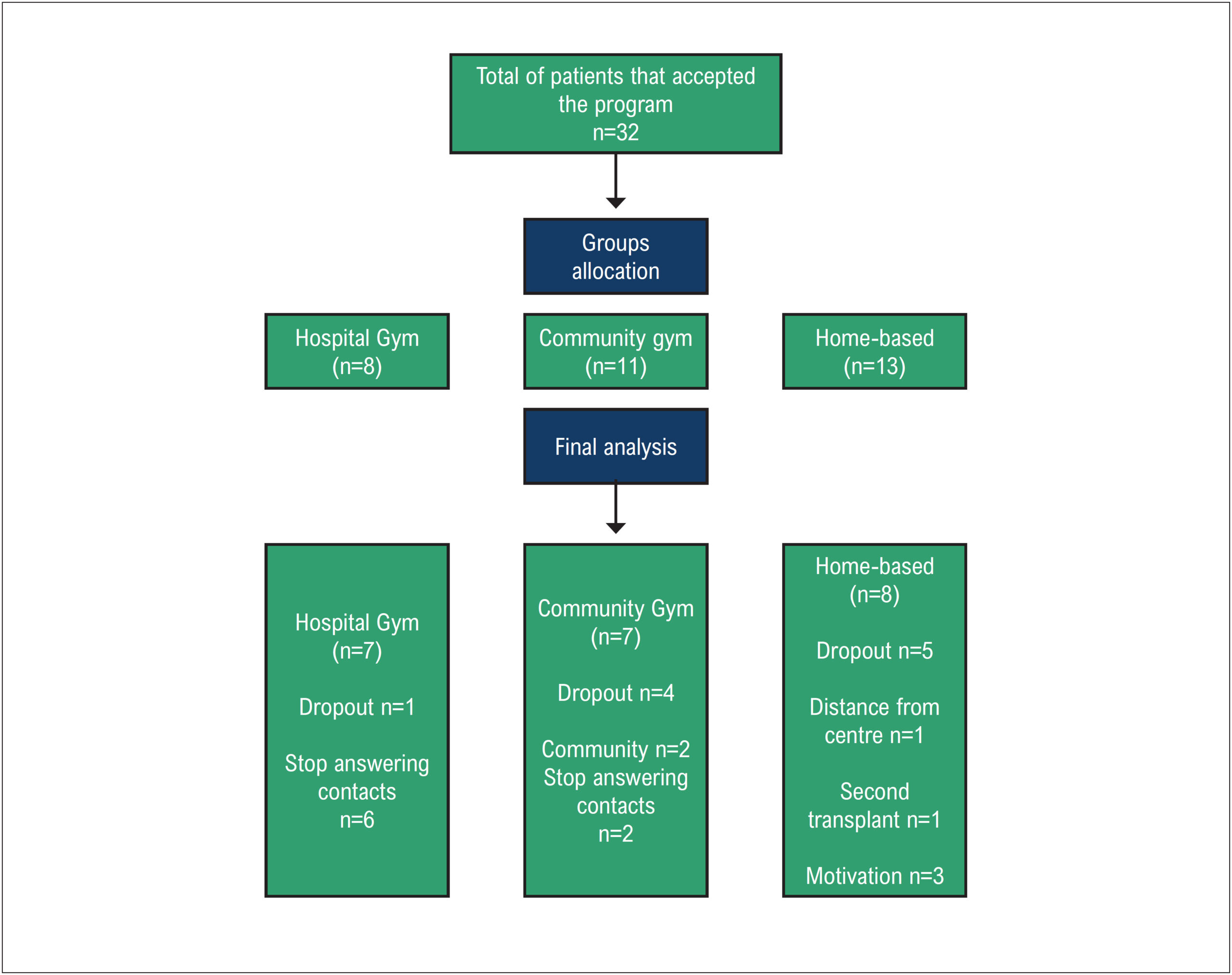
Thirty-two kidney or liver transplant recipients were invited for a 6-month EBR program delivered at the hospital gym, community gym or at home, according to the patient’s preference. The significance level adopted was 5%.

Results:

Ten patients (31%) did not complete their program. Among the 22 who did, 7 trained at the hospital gym, 7 at the community gym, and 8 at home. The overall effect was an 11.4% increase in maximum METs (Hedges’ effect size g = 0.39). The hospital gym group had an increase in METs of 25.5% (g= 0.58, medium effect size) versus 10% (g= 0.25), and 6.5% (g= 0.20) for the community gym and home groups, respectively. There was a beneficial effect on systolic and diastolic blood pressures, greater for the hospital gym (g= 0.51 and 0.40) and community gym (g= 0.60 and 1.15) groups than for the patients training at home (g= 0.07 and 0.10). No significant adverse event was reported during the follow-up.

Conclusion:

EBR programs in kidney and liver transplant recipients should be encouraged, even if they are delivered outside a hospital gym, since they are safe with positive effects on exercise capacity and cardiovascular risk factors.

  • Exercise
  • Exercise Movement Techniques
  • Exercise Therapy
  • Kidney Transplantation
  • Liver Transplantation
  • Physical Conditioning Human
Read Full Article
Creative Commons Attribution (CC BY) Creative Commons license
05/08/2022 DOI: 10.36660/abc.20210159 Views 2
IJCS
Editorial

We need to talk about why we don’t talk about exercise!

Fabrício Braga da Silva

We usually avoid subjects that make us feel uncomfortable. As in general these subjects are those we cannot deal with, the consequences of such omission can be really bad. Problems with our children are classical examples of topics we avoid. Published in 2003, “We Need to Talk About Kevin” is a novel written by Lionel Shriver, adapted to the big screen in 2011. The film addresses the vicious cycle of problems caused by the mother who neglects her child with overt psychopathy, culminating in a catastrophe. In this fiction, avoiding the subject cost the lives of many people.

This introductory metaphor was the preamble to the following question: based on available evidence, why do we not have proper conversation about exercise with our patients? Why is physical exercise little addressed in medical visits? Why are healthcare providers not concerned about individual and collective consequences of physical inactivity?

[…]

  • Blood Pressure
  • Endothelium Dependent Relaxing Factors
  • Exercise
  • Hypertension
  • Nitric Oxide
  • Physical Conditioning Human
Read Full Article
Creative Commons Attribution (CC BY) Creative Commons license
09/03/2022 DOI: 10.36660/ijcs.20220008 Views 2
Figure 1
IJCS
Review Article

Effect of Physical Training on Nitric Oxide Levels in Patients with Arterial Hypertension: An Integrative Review

Tábata de Paula Facioli et al. Mariana Colombini Buranello Eloisa Maria Gatti Regueiro Renata Pedrolongo Basso-Vanelli Marina de Toledo Durand

Abstract

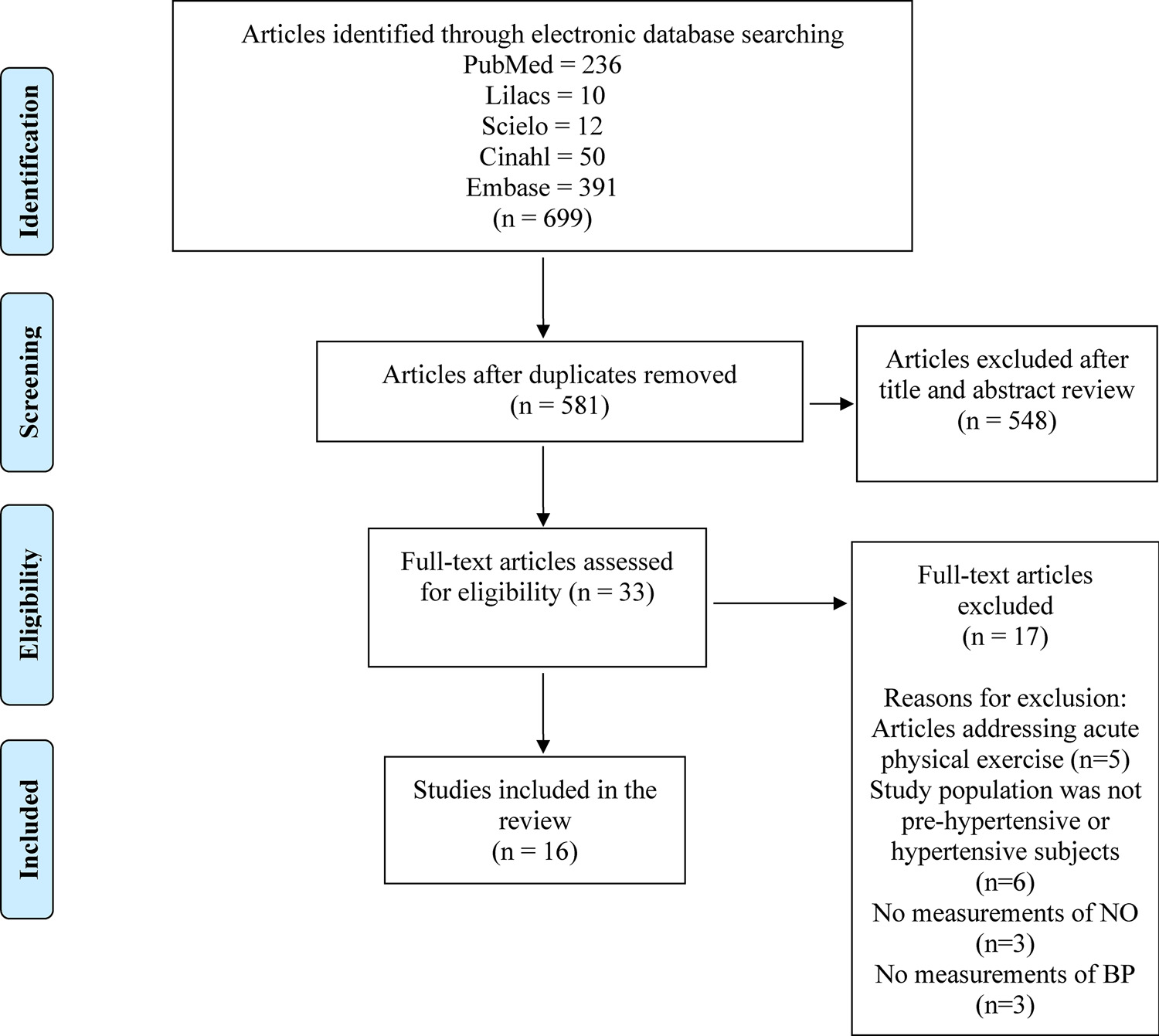
The regular practice of physical exercise as a non-pharmacological treatment of arterial hypertension (AH) has been encouraged due to causing a series of physiological responses in the cardiovascular system, such as the production of vasoactive substances, including nitric oxide (NO). NO is a relaxation factor released by the endothelium, and the decrease in its bioavailability is related to coronary and arterial diseases, such as AH. This study aimed to perform an integrative literature review to elucidate the effect of physical training on NO levels in patients with AH and to establish a relationship between these levels and blood pressure (BP) control. A literature review was was performed by searching PubMed / MEDLINE, Lilacs, Scielo, Cinahl and Embase databases. The search string used was (“arterial hypertension” OR hypertension) AND (exercise OR “physical exercise” OR “aerobic exercise” OR “exercise training” or “physical activity”) AND (“nitric oxide”). We included fully available controlled and uncontrolled clinical trials published in English and Portuguese languages in the last 10 years. The review consisted of 16 articles, of which 13 reported an increase in NO production after the physical training intervention, and three studies found no change. In addition, 15 studies observed a reduction in BP after the intervention. In conclusion, regular practice of physical exercises, advocating moderate intensity, can improve NO bioavailability in pre-hypertensive and hypertensive individuals, which seems to be one of the mechanisms responsible for BP reduction.

  • Blood Pressure
  • Cardiovascular System
  • Endothelium Dependent Relaxing Factors
  • Exercise
  • Hypertension
  • Nitric Oxide
  • Physical Conditioning Human
  • Vasoactive Substances
Read Full Article
Creative Commons Attribution (CC BY) Creative Commons license
09/06/2021 DOI: 10.36660/ijcs.20200244

How to cite this article

EndNote RIS

Electronic Document Format (Vancouver)

Rodrigues CIS, Forjaz CLM, Bortolotto LA, Nadruz W, Brandão AA. Reply to the Letter to the Editor: “Should Resistance Training Also Be Considered a Mandatory Component?”. Arquivos Brasileiros de Cardiologia 2026;123(6):e20260362.

Electronic Document Format (ABNT)

Rodrigues, Cibele Isaac Saad; Forjaz, Claudia Lucia de Moraes; Bortolotto, Luiz Aparecido; Nadruz, Wilson; Brandão, Andréa A.. Reply to the Letter to the Editor: “Should Resistance Training Also Be Considered a Mandatory Component?”. Arquivos Brasileiros de Cardiologia, v. 123, n. 6, e20260362, Jul. 2026.

Electronic Document Format (APA)

Rodrigues, C. I. S., Forjaz, C. L. M., Bortolotto, L. A., Nadruz, W., & Brandão, A. A. (2026). Reply to the Letter to the Editor: “Should Resistance Training Also Be Considered a Mandatory Component?”. Arquivos Brasileiros de Cardiologia, 123(6), e20260362.

Electronic Document Format (ISO)

Rodrigues, Cibele Isaac Saad and Forjaz, Claudia Lucia de Moraes and Bortolotto, Luiz Aparecido and Nadruz, Wilson and Brandão, Andréa A.. Reply to the Letter to the Editor: “Should Resistance Training Also Be Considered a Mandatory Component?”. Arquivos Brasileiros de Cardiologia [online]. 2026, vol. 123, n. 6, [cited 2026-10-14], e20260362. Available from: <https://journals.cardiol.br/en/article/reply-to-the-letter-to-the-editor-should-resistance-training-also-be-considered-a-mandatory-component/>. ISSN 0066-782X

EndNote RIS

Electronic Document Format (Vancouver)

Ribeiro PAB, Gradassi M, Martin S, Leenknegt J, Baudet M, Le V, Pomey M, et al. Clinical Implementation of Different Strategies for Exercise-Based Rehabilitation in Kidney and Liver Transplant Recipients: A Pilot Study. Arquivos Brasileiros de Cardiologia 2022;119(2):246-54.

Electronic Document Format (ABNT)

Ribeiro, Paula A. B.; Gradassi, Mathieu; Martin, Sarah-Maude; Leenknegt, Jonathan; Baudet, Mathilde; Le, VyVan; Pomey, Marie-Pascale; Räkel, Agnes; Tournoux, François. Clinical Implementation of Different Strategies for Exercise-Based Rehabilitation in Kidney and Liver Transplant Recipients: A Pilot Study. Arquivos Brasileiros de Cardiologia, v. 119, n. 2, p. 246-254, Aug. 2022.

Electronic Document Format (APA)

Ribeiro, P. A. B., Gradassi, M., Martin, S., Leenknegt, J., Baudet, M., Le, V., Pomey, M., Räkel, A., & Tournoux, F. (2022). Clinical Implementation of Different Strategies for Exercise-Based Rehabilitation in Kidney and Liver Transplant Recipients: A Pilot Study. Arquivos Brasileiros de Cardiologia, 119(2), 246-254.

Electronic Document Format (ISO)

Ribeiro, Paula A. B. and Gradassi, Mathieu and Martin, Sarah-Maude and Leenknegt, Jonathan and Baudet, Mathilde and Le, VyVan and Pomey, Marie-Pascale and Räkel, Agnes and Tournoux, François. Clinical Implementation of Different Strategies for Exercise-Based Rehabilitation in Kidney and Liver Transplant Recipients: A Pilot Study. Arquivos Brasileiros de Cardiologia [online]. 2022, vol. 119, n. 2, [cited 2026-10-14], pp. 246-254. Available from: <https://journals.cardiol.br/en/article/clinical-implementation-of-different-strategies-for-exercise-based-rehabilitation-in-kidney-and-liver-transplant-recipients-a-pilot-study/>. ISSN 0066-782X

EndNote RIS

Electronic Document Format (Vancouver)

Silva FB. We need to talk about why we don’t talk about exercise!. International Journal of Cardiovascular Sciences 2022;35(2):265-6.

Electronic Document Format (ABNT)

Silva, Fabrício Braga da. We need to talk about why we don’t talk about exercise!. International Journal of Cardiovascular Sciences, v. 35, n. 2, p. 265-266, Mar. 2022.

Electronic Document Format (APA)

Silva, F. B. (2022). We need to talk about why we don’t talk about exercise!. International Journal of Cardiovascular Sciences, 35(2), 265-266.

Electronic Document Format (ISO)

Silva, Fabrício Braga da. We need to talk about why we don’t talk about exercise!. International Journal of Cardiovascular Sciences [online]. 2022, vol. 35, n. 2, [cited 2026-10-14], pp. 265-266. Available from: <https://journals.cardiol.br/en/article/we-need-to-talk-about-why-we-dont-talk-about-exercise/>. ISSN 2359-4802

EndNote RIS

Electronic Document Format (Vancouver)

Facioli TP, Buranello MC, Regueiro EMG, Basso-Vanelli RP, Durand MT. Effect of Physical Training on Nitric Oxide Levels in Patients with Arterial Hypertension: An Integrative Review. International Journal of Cardiovascular Sciences 2021;35(2):253-64.

Electronic Document Format (ABNT)

Facioli, Tábata de Paula; Buranello, Mariana Colombini; Regueiro, Eloisa Maria Gatti; Basso-Vanelli, Renata Pedrolongo; Durand, Marina de Toledo. Effect of Physical Training on Nitric Oxide Levels in Patients with Arterial Hypertension: An Integrative Review. International Journal of Cardiovascular Sciences, v. 35, n. 2, p. 253-264, Jun. 2021.

Electronic Document Format (APA)

Facioli, T. P., Buranello, M. C., Regueiro, E. M. G., Basso-Vanelli, R. P., & Durand, M. T. (2021). Effect of Physical Training on Nitric Oxide Levels in Patients with Arterial Hypertension: An Integrative Review. International Journal of Cardiovascular Sciences, 35(2), 253-264.

Electronic Document Format (ISO)

Facioli, Tábata de Paula and Buranello, Mariana Colombini and Regueiro, Eloisa Maria Gatti and Basso-Vanelli, Renata Pedrolongo and Durand, Marina de Toledo. Effect of Physical Training on Nitric Oxide Levels in Patients with Arterial Hypertension: An Integrative Review. International Journal of Cardiovascular Sciences [online]. 2021, vol. 35, n. 2, [cited 2026-10-14], pp. 253-264. Available from: <https://journals.cardiol.br/en/article/effect-of-physical-training-on-nitric-oxide-levels-in-patients-with-arterial-hypertension-an-integrative-review/>. ISSN 2359-4802

  • About ABC Family
  • Internal Regulation
  • Editorial Board
  • Brazilian Society of Cardiology (SBC)

Issues

SBC Guidelines

  • Videos
  • Podcasts
  • News