ABC Family Arquivos Brasileiros de Cardiologia International Journal of Cardiovascular Sciences ABC Heart Failure & Cardiomyopathy ABC Imagem Cardiovascular
Português English
ABC Family
Português English
  • About
    • About ABC Family
    • Internal Regulation
    • Editorial Board
    • Brazilian Society of Cardiology (SBC)
  • Issues
  • SBC Guidelines
  • Content
    • Videos
    • Podcasts
    • News
  • About
    • About ABC Family
    • Internal Regulation
    • Editorial Board
    • Brazilian Society of Cardiology (SBC)
  • Issues
  • SBC Guidelines
  • Content
    • Videos
    • Podcasts
    • News

ABC Family

  • ABC Family
  • Arquivos Brasileiros de Cardiologia
  • International Journal of Cardiovascular Sciences
  • ABC Heart Failure & Cardiomyopathy
  • ABC Imagem Cardiovascular
Search in

No content found.

Journals
Ordering
Article types
Others

  1. Home
  2. Keyword: Hypertension / prevention & control
ABC
Editorial

Short Editorial: Hypertension in Special Populations: An Epidemiological Challenge

Rui Póvoa

Arterial hypertension (AH) is the most prevalent chronic disease worldwide and the main risk factor for most cardio-cerebrovascular diseases. The true prevalence in Brazil is still unknown, and the available data are from the Vigitel Study, where the information is obtained by telephone contact. The prevalence of hypertension in Brazil is estimated at around 31% in adult individuals. In recent data from the Vigitel Study, the prevalence was 25.7% of the adult Brazilian population. Knowledge of the real prevalence and geographic distribution is not only important for prevention and treatment measures, but also contribute to the knowledge of the genesis of the disease.

In some populations, particularly individuals of African descent, AH has its own characteristics, including prevalence, therapeutic response and severity., The multifactorial aspect of AH is only understood when assessing special populations considering their own habitats and habits, as in the case of quilombolas, where individuals with African ancestry still retain some genetic and cultural characteristics of the African origin. The analysis in this context is important, since we can detect aspects inherent to factors related to AH development.

[…]

  • African Continental Ancestry Group/genetics
  • Alcoholism
  • Hypertension / prevention & control
  • Hypertension/epidemiology
  • Risk Factors
  • Tobacco Use Disorder
Read Full Article
Creative Commons Attribution (CC BY) Creative Commons license
10/10/2019 DOI: 10.5935/abc.20190180 Views 1
ABC
Editorial

Hypertension and Exercise: A Search for Mechanisms

Bertha F. Polegato et al. Sergio A. R. de Paiva

Arterial hypertension is a chronic disease that affects approximately 40% of the population, with higher incidence at older ages. Arterial hypertension is a risk factor for other cardiovascular diseases, such as heart failure, stroke, atherosclerosis and also chronic renal disease. It is estimated that more than 50% of deaths from coronary diseases and stroke occur in hypertensive patients; for this reason, hypertension produces high costs in health and constitutes a public health problem. In this context, the development of nonpharmacological therapies is a cost-effective strategy with few side effects, that helps in the prevention of comorbidities, such as diabetes and obesity, and increases the cardiovascular risk of the patient. Among nonpharmacological strategies, physical exercise deserves consideration.

Rodrigues et al., in the study published in this issue of Arquivos Brasileiros de Cardiologia, evaluated the effect of moderate aerobic exercise on a treadmill in spontaneously hypertensive rats. The animals ran at 18-22m/min for 60 minutes, five times a week, for eight weeks. The study confirmed the anti-hypertensive effects of aerobic exercise, as already reported previously. More recently, other types of exercise in addition to aerobic training, such as resistance and interval training, have been shown to be promising in preventing hypertension. Prescription of physical exercise for the treatment and prevention of hypertension is well established, and more recent guidelines for the treatment of hypertension strongly recommend exercise as a therapeutic option.,

[…]

  • Exercise
  • Exercise Therapy
  • Hypertension / prevention & control
  • Hypertension/physiopathology
  • MicroRNAs/genetics
  • Molecular Targeted Therapy
Read Full Article
Creative Commons Attribution (CC BY) Creative Commons license
01/08/2018 DOI: 10.5935/abc.20180146 Views 1
ABC
Original Article

Development and Psychometric Validation of HIPER-Q to Assess Knowledge of Hypertensive Patients in Cardiac Rehabilitation

Rafaella Zulianello dos Santos et al. Christiani Decker Batista Bonin Eliara Ten Caten Martins Moacir Pereira Junior … Gabriela Lima de Melo Ghisi Kassia Rosangela Paz de Macedo Magnus Benetti

Abstract

Background:

The absence of instruments capable of measuring the level of knowledge of hypertensive patients in cardiac rehabilitation programs about their disease reflects the lack of specific recommendations for these patients.

Objective:

To develop and validate a questionnaire to evaluate the knowledge of hypertensive patients in cardiac rehabilitation programs about their disease.

Methods:

A total of 184 hypertensive patients (mean age 60.5 ± 10 years, 66.8% men) were evaluated. Reproducibility was assessed by calculation of the intraclass correlation coefficient using the test-retest method. Internal consistency was assessed by the Cronbach’s alpha and the construct validity by the exploratory factorial analysis.

Results:

The final version of the instrument had 17 questions organized in areas considered important for patient education. The instrument proposed showed a clarity index of 8.7 (0.25). The intraclass correlation coefficient was 0.804 and the Cronbach’s correlation coefficient was 0.648. Factor analysis revealed five factors associated with knowledge areas. Regarding the criterion validity, patients with higher education level and higher family income showed greater knowledge about hypertension.

Conclusion:

The instrument has a satisfactory clarity index and adequate validity, and can be used to evaluate the knowledge of hypertensive participants in cardiac rehabilitation programs.

  • Health Education
  • Hypertension / prevention & control
  • Rehabilitation
  • Validation Studies as Topic
Read Full Article
Creative Commons Attribution (CC BY) Creative Commons license
01/02/2018 DOI: 10.5935/abc.20170183
IJCS
Original Article

Matricial Support and Arterial Hypertension Control

Clóvis Hoepfner et al. Morgana Longo Andressa de Oliveira Coiradas Laíssa Mara Rodrigues Teixeira

Abstract

Background:

A continuing education program for health professionals improves their performance and increases hypertension control rates.

Objective:

To estimate the prevalence of hypertension control and therapeutic inertia among adults treated at Primary Health Care Units after a continuing education program focused on cardiology for health professionals.

Methods:

A cross-sectional study was carried out, which included cluster sampling and analysis of medical records. We evaluated 463 patients with high blood pressure and analyzed the blood pressure, medications, and therapeutic increments in 2013, which were compared to the data obtained in 2007.

Results:

There was prevalence of female patients and appointments at the Family Health Care Units. The age ranged between 24 and 92 years (mean of 61.7 years). There was a reduction in the mean blood pressure (148.62/91.60 ± 23.52/14.51 mmHg to 137.60/84.03 ± 21.84/12.72) between the first and last records, and BP control in 58% of the sample, that is, higher than the 36.6% found in 2007. In the analyzed period, there was a therapeutic increment of 39% in appointments, which benefited 52% patients with high blood pressure, higher than the 12% and 29.5%, respectively, found in 2007. The mean number of drugs per patient increased from 1.85 to 2.05, with a predominance of diuretics and angiotensin-converting-enzyme inhibitors.

Conclusion:

There was a reduction in the clinical inertia and increased control of arterial hypertension was observed, compared with the findings of the previous study. The result suggests that the matricial support program for health professionals and other measures to improve disease control in the Primary Health Care Units were effective.

  • health centers
  • Health Education
  • Hypertension / prevention & control
  • Hypertension/epidemiology
  • Inertia
  • Prevalence
  • Primary Health Care
Read Full Article
Creative Commons Attribution (CC BY) Creative Commons license
01/01/2017 DOI: 10.5935/2359-4802.20170045 Views 2
Figure 1
ABC
Original Article

Hypertensives' Knowledge About High-Sodium Foods and Their Behavior

Juliana de Fátima Teixeira et al. Maíra Ribas Goulart Fernanda Michielin Busnello Lucia Campos Pellanda

Abstract

Background:

In Brazil, the prevalence of systemic arterial hypertension (SAH) is approximately 30% of the total population. In 2010, SAH was the cause of death of about 9.4 million people worldwide. A healthy dietary pattern is important to maintain proper blood pressure levels and, consequently, disease control.

Objectives:

To describe the knowledge and practices of hypertensive patients cared for at a public hypertension outpatient clinic, and its relationship with high-sodium food.

Methods:

We applied a questionnaire to patients with questions related to sociodemographics, dietary pattern, frequency of ingestion of certain foods, and knowledge about their own disease.

Results:

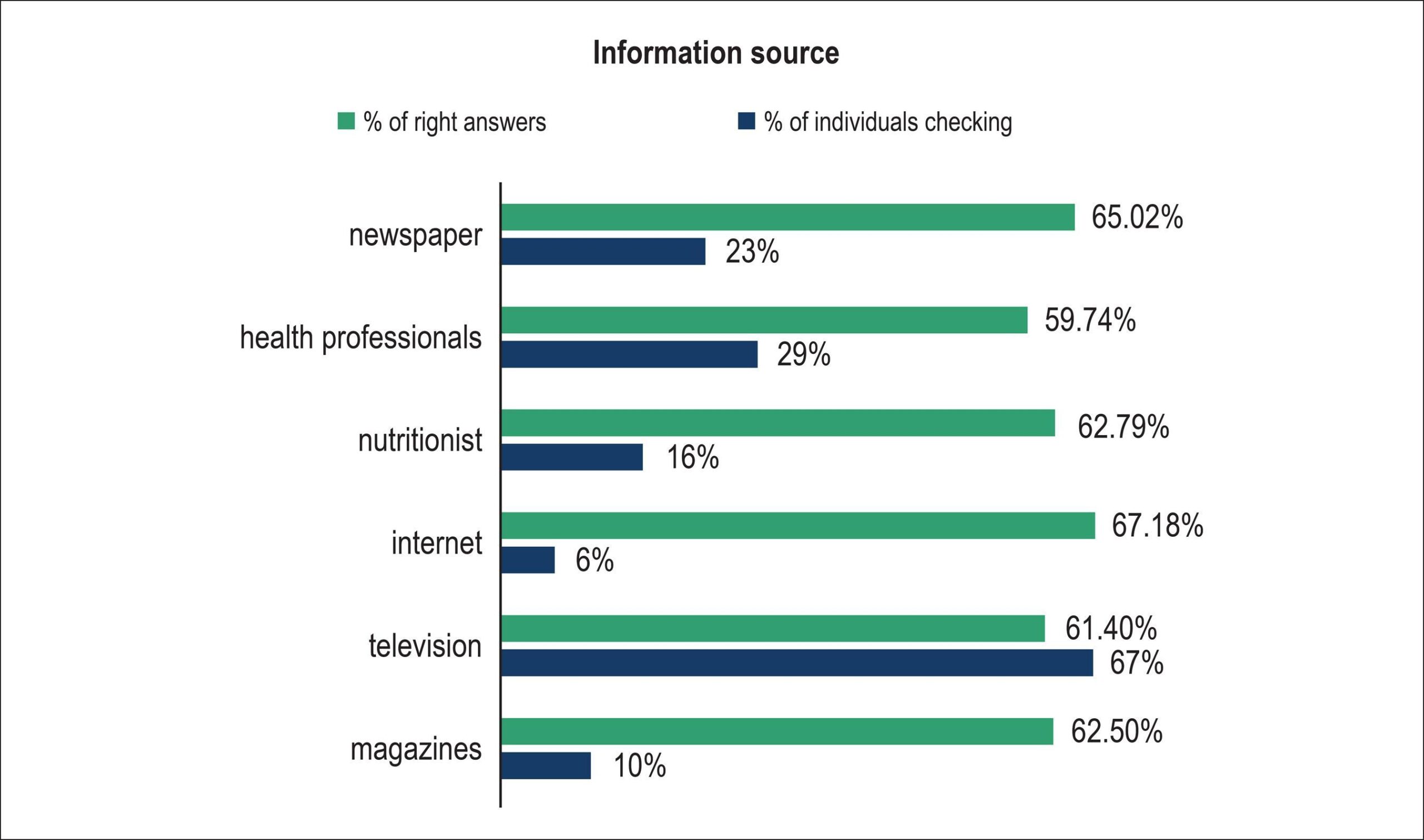
We studied 221 patients, 56.1% of whom were women, and 53.8% had only elementary education. Their mean age was 57.7 ±13.5 years, and 75.6% of them reported having high blood pressure, and 11.3%, diabetes mellitus. Regarding dietary pattern, 62% used ready-to-use seasonings, but 94.1% reported not adding extra salt to their ready meals. Regarding patients’ knowledge about high-sodium foods and SAH, only 8 patients had 100% of right answers, 37 patients had 73.8%, and 42 patients, 57% of right answers.

Conclusion:

Knowledge about SAH prevention and high-sodium foods was insufficient. Based on this study’s findings, more effective educational strategies targeted at this population can be developed.

  • Food habits
  • Hypertension / prevention & control
  • Hypertension/mortality
  • Sodium Chloride, Dietary
Read Full Article
Creative Commons Attribution (CC BY) Creative Commons license
15/04/2016 DOI: 10.5935/abc.20160049 Views 1

How to cite this article

EndNote RIS

Electronic Document Format (Vancouver)

Póvoa R. Short Editorial: Hypertension in Special Populations: An Epidemiological Challenge. Arquivos Brasileiros de Cardiologia 2019;113(3):391.

Electronic Document Format (ABNT)

Póvoa, Rui. Short Editorial: Hypertension in Special Populations: An Epidemiological Challenge. Arquivos Brasileiros de Cardiologia, v. 113, n. 3, p. 391-391, Oct. 2019.

Electronic Document Format (APA)

Póvoa, R. (2019). Short Editorial: Hypertension in Special Populations: An Epidemiological Challenge. Arquivos Brasileiros de Cardiologia, 113(3), 391-391.

Electronic Document Format (ISO)

Póvoa, Rui. Short Editorial: Hypertension in Special Populations: An Epidemiological Challenge. Arquivos Brasileiros de Cardiologia [online]. 2019, vol. 113, n. 3, [cited 2026-10-14], pp. 391-391. Available from: <https://journals.cardiol.br/en/article/short-editorial-hypertension-in-special-populations-an-epidemiological-challenge/>. ISSN 0066-782X

EndNote RIS

Electronic Document Format (Vancouver)

Polegato BF, Paiva SAR. Hypertension and Exercise: A Search for Mechanisms. Arquivos Brasileiros de Cardiologia 2018;111(2):180-1.

Electronic Document Format (ABNT)

Polegato, Bertha F.; Paiva, Sergio A. R. de. Hypertension and Exercise: A Search for Mechanisms. Arquivos Brasileiros de Cardiologia, v. 111, n. 2, p. 180-181, Jul. 2018.

Electronic Document Format (APA)

Polegato, B. F., & Paiva, S. A. R. (2018). Hypertension and Exercise: A Search for Mechanisms. Arquivos Brasileiros de Cardiologia, 111(2), 180-181.

Electronic Document Format (ISO)

Polegato, Bertha F. and Paiva, Sergio A. R. de. Hypertension and Exercise: A Search for Mechanisms. Arquivos Brasileiros de Cardiologia [online]. 2018, vol. 111, n. 2, [cited 2026-10-14], pp. 180-181. Available from: <https://journals.cardiol.br/en/article/hypertension-and-exercise-a-search-for-mechanisms/>. ISSN 0066-782X

EndNote RIS

Electronic Document Format (Vancouver)

Santos RZ, Bonin CDB, Martins ETC, Pereira Junior M, Ghisi GLM, Macedo KRP, Benetti M, et al. Development and Psychometric Validation of HIPER-Q to Assess Knowledge of Hypertensive Patients in Cardiac Rehabilitation. Arquivos Brasileiros de Cardiologia 2018;110(1):60-7.

Electronic Document Format (ABNT)

Santos, Rafaella Zulianello dos; Bonin, Christiani Decker Batista; Martins, Eliara Ten Caten; Pereira Junior, Moacir; Ghisi, Gabriela Lima de Melo; Macedo, Kassia Rosangela Paz de; Benetti, Magnus. Development and Psychometric Validation of HIPER-Q to Assess Knowledge of Hypertensive Patients in Cardiac Rehabilitation. Arquivos Brasileiros de Cardiologia, v. 110, n. 1, p. 60-67, Jan. 2018.

Electronic Document Format (APA)

Santos, R. Z. , Bonin, C. D. B., Martins, E. T. C., Pereira Junior, M., Ghisi, G. L. M., Macedo, K. R. P. , & Benetti, M. (2018). Development and Psychometric Validation of HIPER-Q to Assess Knowledge of Hypertensive Patients in Cardiac Rehabilitation. Arquivos Brasileiros de Cardiologia, 110(1), 60-67.

Electronic Document Format (ISO)

Santos, Rafaella Zulianello dos and Bonin, Christiani Decker Batista and Martins, Eliara Ten Caten and Pereira Junior, Moacir and Ghisi, Gabriela Lima de Melo and Macedo, Kassia Rosangela Paz de and Benetti, Magnus. Development and Psychometric Validation of HIPER-Q to Assess Knowledge of Hypertensive Patients in Cardiac Rehabilitation. Arquivos Brasileiros de Cardiologia [online]. 2018, vol. 110, n. 1, [cited 2026-10-14], pp. 60-67. Available from: <https://journals.cardiol.br/en/article/development-and-psychometric-validation-of-hiper-q-to-assess-knowledge-of-hypertensive-patients-in-cardiac-rehabilitation/>. ISSN 0066-782X

EndNote RIS

Electronic Document Format (Vancouver)

Hoepfner C, Longo M, Coiradas AO, Teixeira LMR. Matricial Support and Arterial Hypertension Control. International Journal of Cardiovascular Sciences 2017;30(3):199-206.

Electronic Document Format (ABNT)

Hoepfner, Clóvis; Longo, Morgana; Coiradas, Andressa de Oliveira; Teixeira, Laíssa Mara Rodrigues. Matricial Support and Arterial Hypertension Control. International Journal of Cardiovascular Sciences, v. 30, n. 3, p. 199-206, Dec. 2016.

Electronic Document Format (APA)

Hoepfner, C., Longo, M., Coiradas, A. O., & Teixeira, L. M. R. (2017). Matricial Support and Arterial Hypertension Control. International Journal of Cardiovascular Sciences, 30(3), 199-206.

Electronic Document Format (ISO)

Hoepfner, Clóvis and Longo, Morgana and Coiradas, Andressa de Oliveira and Teixeira, Laíssa Mara Rodrigues. Matricial Support and Arterial Hypertension Control. International Journal of Cardiovascular Sciences [online]. 2017, vol. 30, n. 3, [cited 2026-10-14], pp. 199-206. Available from: <https://journals.cardiol.br/en/article/matricial-support-and-arterial-hypertension-control/>. ISSN 2359-4802

EndNote RIS

Electronic Document Format (Vancouver)

Teixeira JF, Goulart MR, Busnello FM, Pellanda LC. Hypertensives’ Knowledge About High-Sodium Foods and Their Behavior. Arquivos Brasileiros de Cardiologia 2016;106(5):404-10.

Electronic Document Format (ABNT)

Teixeira, Juliana de Fátima; Goulart, Maíra Ribas; Busnello, Fernanda Michielin; Pellanda, Lucia Campos. Hypertensives’ Knowledge About High-Sodium Foods and Their Behavior. Arquivos Brasileiros de Cardiologia, v. 106, n. 5, p. 404-410, Apr. 2016.

Electronic Document Format (APA)

Teixeira, J. F., Goulart, M. R., Busnello, F. M., & Pellanda, L. C. (2016). Hypertensives’ Knowledge About High-Sodium Foods and Their Behavior. Arquivos Brasileiros de Cardiologia, 106(5), 404-410.

Electronic Document Format (ISO)

Teixeira, Juliana de Fátima and Goulart, Maíra Ribas and Busnello, Fernanda Michielin and Pellanda, Lucia Campos. Hypertensives’ Knowledge About High-Sodium Foods and Their Behavior. Arquivos Brasileiros de Cardiologia [online]. 2016, vol. 106, n. 5, [cited 2026-10-14], pp. 404-410. Available from: <https://journals.cardiol.br/en/article/hypertensives-knowledge-about-high-sodium-foods-and-their-behavior/>. ISSN 0066-782X

  • About ABC Family
  • Internal Regulation
  • Editorial Board
  • Brazilian Society of Cardiology (SBC)

Issues

SBC Guidelines

  • Videos
  • Podcasts
  • News