ABC Family Arquivos Brasileiros de Cardiologia International Journal of Cardiovascular Sciences ABC Heart Failure & Cardiomyopathy ABC Imagem Cardiovascular
Português English
ABC Family
Português English
  • About
    • About ABC Family
    • Internal Regulation
    • Editorial Board
    • Brazilian Society of Cardiology (SBC)
  • Issues
  • SBC Guidelines
  • Content
    • Videos
    • Podcasts
    • News
  • About
    • About ABC Family
    • Internal Regulation
    • Editorial Board
    • Brazilian Society of Cardiology (SBC)
  • Issues
  • SBC Guidelines
  • Content
    • Videos
    • Podcasts
    • News

ABC Family

  • ABC Family
  • Arquivos Brasileiros de Cardiologia
  • International Journal of Cardiovascular Sciences
  • ABC Heart Failure & Cardiomyopathy
  • ABC Imagem Cardiovascular
Search in

No content found.

Journals
Ordering
Article types
Others

  1. Home
  2. Keyword: health centers
IJCS
Original Article

Matricial Support and Arterial Hypertension Control

Clóvis Hoepfner et al. Morgana Longo Andressa de Oliveira Coiradas Laíssa Mara Rodrigues Teixeira

Abstract

Background:

A continuing education program for health professionals improves their performance and increases hypertension control rates.

Objective:

To estimate the prevalence of hypertension control and therapeutic inertia among adults treated at Primary Health Care Units after a continuing education program focused on cardiology for health professionals.

Methods:

A cross-sectional study was carried out, which included cluster sampling and analysis of medical records. We evaluated 463 patients with high blood pressure and analyzed the blood pressure, medications, and therapeutic increments in 2013, which were compared to the data obtained in 2007.

Results:

There was prevalence of female patients and appointments at the Family Health Care Units. The age ranged between 24 and 92 years (mean of 61.7 years). There was a reduction in the mean blood pressure (148.62/91.60 ± 23.52/14.51 mmHg to 137.60/84.03 ± 21.84/12.72) between the first and last records, and BP control in 58% of the sample, that is, higher than the 36.6% found in 2007. In the analyzed period, there was a therapeutic increment of 39% in appointments, which benefited 52% patients with high blood pressure, higher than the 12% and 29.5%, respectively, found in 2007. The mean number of drugs per patient increased from 1.85 to 2.05, with a predominance of diuretics and angiotensin-converting-enzyme inhibitors.

Conclusion:

There was a reduction in the clinical inertia and increased control of arterial hypertension was observed, compared with the findings of the previous study. The result suggests that the matricial support program for health professionals and other measures to improve disease control in the Primary Health Care Units were effective.
  • health centers
  • Health Education
  • Hypertension / prevention & control
  • Hypertension/epidemiology
  • Inertia
  • Prevalence
  • Primary Health Care
Read Full Article
Creative Commons Attribution (CC BY) Creative Commons license
01/01/2017 DOI: 10.5935/2359-4802.20170045 Views 2
ABC
Artigo Original

Therapeutic inertia and control of high blood pressure in primary health care units

Clóvis Hoepfner et al. Selma Cristina Franco

BACKGROUND: The importance of adequate management and control of high blood pressure (HBP). OBJECTIVE: To estimate the prevalence of hypertension control and therapeutic inertia among adults treated at primary health care units (PHCU) in the city of Joinville, as well as the associated factors. METHODS: A cross-sectional study, which included cluster sampling and analysis of medical records, with the evaluation of 415 patients with high blood pressure. We evaluated the blood pressure (BP), increments of therapy, risk factors and comorbidities. RESULTS: There was prevalence of females and nursing appointments. The age ranged between 28 and 90 years (mean of 61.5 years). There was a reduction in the mean BP (155.8 ± 20.8/95.7 ± 10.6 mmHg to 140.3 ± 22/84.1 ± 12.4 mmHg) between the first and last record and the final normal BP in 36.6% of patients, with similar results for men and women. Over the past 12 months, the BP was high on 1,295 occasions, and there was a therapeutic increment on only 156 occasions (12.0%). 1.85 drugs were used per patient, mainly diuretics and ACE inhibitors. There was high prevalence of obesity (40%), diabetes (41%), high LDL (46%) and left ventricular hypertrophy (25.5%). CONCLUSION: The high therapeutic inertia, low control of high blood pressure and the large number of comorbidities suggest the need for continuing education programs for health professionals and other measures to improve the disease control in primary health care units.

  • Brazil
  • Comorbidity
  • health centers
  • Health Education
  • Hypertension
  • Inertia
  • Joinville (SC)
Read Full Article
Creative Commons Attribution (CC BY) Creative Commons license
23/07/2010 DOI: 10.1590/S0066-782X2010005000095 Views 1
Prevalence of abdominal obesity in hypertensive patients registered in a Family Health Unit
ABC
Artigo Original

Prevalence of abdominal obesity in hypertensive patients registered in a Family Health Unit

Edmarlon Girotto et al. Selma Maffei de Andrade Marcos Aparecido Sarriá Cabrera

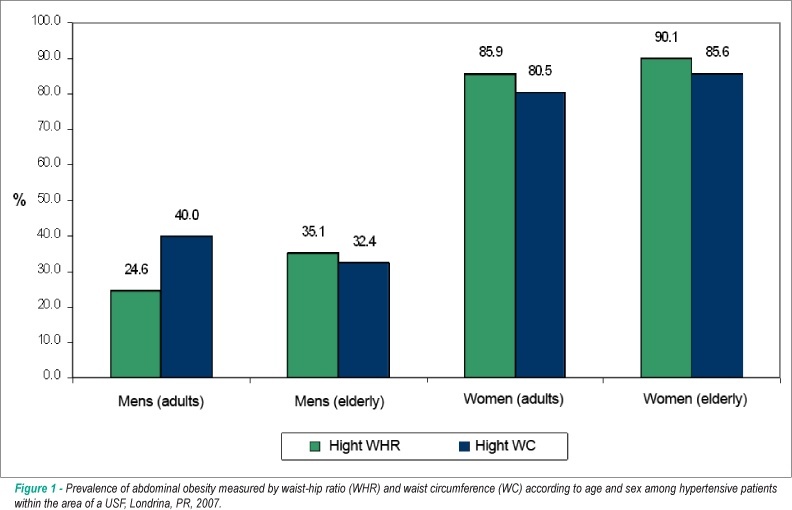
BACKGROUND: Abdominal obesity is an important cardiovascular risk factor and, along with dyslipidemia, impaired glucose tolerance and hypertension, it makes up the metabolic syndrome. OBJECTIVE: To investigate the prevalence of abdominal obesity and associated factors in hypertensive patients. METHODS: Cross-sectional study with hypertensive patients aged 20 to 79 registered in a Family Health Unit in the city of Londrina, Paraná. Abdominal obesity was found through waist-hip ratio (WHR) and waist circumference (WC) according to the cutoff points recommended by the World Health Organization (WHR > 1.0 and > WC 102 cm for men and WHR > WC 0.85 and > 88 cm for women). RESULTS: Among 378 respondents, the prevalence of abdominal obesity determined by WHR was 65.3% in adults and 68.1% in the elderly, and 87.9% in females and 30.2% in males (p <0.001). In women, WHR was associated with reports of high cholesterol, failure to perform regular physical activity, lack of paid work and low education. There was no association of WHR with any variables in males. High waist circumference was present in 66.8% of adults and 64.3% of elderly patients, also with differences between sexes (p <0.001). High waist circumference was associated, in women, to diabetes and to nonsmoking, and in men, to diabetes and to physical inactivity. CONCLUSION: These results show a high prevalence of abdominal obesity, especially among women, reinforcing the need for strategies to reduce abdominal obesity among hypertensive patients.

  • health centers
  • Hypertension
  • Obesity, Abdominal
  • Prevalence
Read Full Article
Creative Commons Attribution (CC BY) Creative Commons license
21/05/2010 DOI: 10.1590/S0066-782X2010005000049 Views 1

How to cite this article

EndNote RIS

Electronic Document Format (Vancouver)

Hoepfner C, Longo M, Coiradas AO, Teixeira LMR. Matricial Support and Arterial Hypertension Control. International Journal of Cardiovascular Sciences 2017;30(3):199-206.

Electronic Document Format (ABNT)

Hoepfner, Clóvis; Longo, Morgana; Coiradas, Andressa de Oliveira; Teixeira, Laíssa Mara Rodrigues. Matricial Support and Arterial Hypertension Control. International Journal of Cardiovascular Sciences, v. 30, n. 3, p. 199-206, Dec. 2016.

Electronic Document Format (APA)

Hoepfner, C., Longo, M., Coiradas, A. O., & Teixeira, L. M. R. (2017). Matricial Support and Arterial Hypertension Control. International Journal of Cardiovascular Sciences, 30(3), 199-206.

Electronic Document Format (ISO)

Hoepfner, Clóvis and Longo, Morgana and Coiradas, Andressa de Oliveira and Teixeira, Laíssa Mara Rodrigues. Matricial Support and Arterial Hypertension Control. International Journal of Cardiovascular Sciences [online]. 2017, vol. 30, n. 3, [cited 2026-10-14], pp. 199-206. Available from: <https://journals.cardiol.br/en/article/matricial-support-and-arterial-hypertension-control/>. ISSN 2359-4802

EndNote RIS

Electronic Document Format (Vancouver)

Hoepfner C, Franco SC. Therapeutic inertia and control of high blood pressure in primary health care units. Arquivos Brasileiros de Cardiologia 2010;95(2):223-9.

Electronic Document Format (ABNT)

Hoepfner, Clóvis; Franco, Selma Cristina. Therapeutic inertia and control of high blood pressure in primary health care units. Arquivos Brasileiros de Cardiologia, v. 95, n. 2, p. 223-229, Jul. 2010.

Electronic Document Format (APA)

Hoepfner, C., & Franco, S. C. (2010). Therapeutic inertia and control of high blood pressure in primary health care units. Arquivos Brasileiros de Cardiologia, 95(2), 223-229.

Electronic Document Format (ISO)

Hoepfner, Clóvis and Franco, Selma Cristina. Therapeutic inertia and control of high blood pressure in primary health care units. Arquivos Brasileiros de Cardiologia [online]. 2010, vol. 95, n. 2, [cited 2026-10-14], pp. 223-229. Available from: <https://journals.cardiol.br/en/article/therapeutic-inertia-and-control-of-high-blood-pressure-in-primary-health-care-units/>. ISSN 0066-782X

EndNote RIS

Electronic Document Format (Vancouver)

Girotto E, Andrade SM, Cabrera MAS. Prevalence of abdominal obesity in hypertensive patients registered in a Family Health Unit. Arquivos Brasileiros de Cardiologia 2010;94(6):754-62.

Electronic Document Format (ABNT)

Girotto, Edmarlon; Andrade, Selma Maffei de; Cabrera, Marcos Aparecido Sarriá. Prevalence of abdominal obesity in hypertensive patients registered in a Family Health Unit. Arquivos Brasileiros de Cardiologia, v. 94, n. 6, p. 754-762, May. 2010.

Electronic Document Format (APA)

Girotto, E., Andrade, S. M. , & Cabrera, M. A. S. (2010). Prevalence of abdominal obesity in hypertensive patients registered in a Family Health Unit. Arquivos Brasileiros de Cardiologia, 94(6), 754-762.

Electronic Document Format (ISO)

Girotto, Edmarlon and Andrade, Selma Maffei de and Cabrera, Marcos Aparecido Sarriá. Prevalence of abdominal obesity in hypertensive patients registered in a Family Health Unit. Arquivos Brasileiros de Cardiologia [online]. 2010, vol. 94, n. 6, [cited 2026-10-14], pp. 754-762. Available from: <https://journals.cardiol.br/en/article/prevalence-of-abdominal-obesity-in-hypertensive-patients-registered-in-a-family-health-unit/>. ISSN 0066-782X

  • About ABC Family
  • Internal Regulation
  • Editorial Board
  • Brazilian Society of Cardiology (SBC)

Issues

SBC Guidelines

  • Videos
  • Podcasts
  • News