ABC Family Arquivos Brasileiros de Cardiologia International Journal of Cardiovascular Sciences ABC Heart Failure & Cardiomyopathy ABC Imagem Cardiovascular
Português English
ABC Family
Português English
  • About
    • About ABC Family
    • Internal Regulation
    • Editorial Board
    • Brazilian Society of Cardiology (SBC)
  • Issues
  • SBC Guidelines
  • Content
    • Videos
    • Podcasts
    • News
  • About
    • About ABC Family
    • Internal Regulation
    • Editorial Board
    • Brazilian Society of Cardiology (SBC)
  • Issues
  • SBC Guidelines
  • Content
    • Videos
    • Podcasts
    • News

ABC Family

  • ABC Family
  • Arquivos Brasileiros de Cardiologia
  • International Journal of Cardiovascular Sciences
  • ABC Heart Failure & Cardiomyopathy
  • ABC Imagem Cardiovascular
Search in

No content found.

Journals
Ordering
Article types
Others

  1. Home
  2. Keyword: Ischemic Preconditioning Myocardial
Figure 1
ABC
Acute Coronary Syndrome

Protective Effect of Ischemic Preconditioning on Myocardium Against Remote Tissue Injury Following Transient Focal Cerebral Ischemia in Diabetic Rats

Meltem Kumas et al. Ozge Altintas Ersin Karatas Abdurrahim Kocyigit

Abstract

Background:

Remote ischemic preconditioning (IPreC) could provide tissue-protective effect at a remote site by anti-inflammatory, neuronal, and humoral signaling pathways.

Objectives:

The aim of the study was to investigate the possible protective effects of remote IPreC on myocardium after transient middle cerebral artery occlusion (MCAo) in streptozotocin- induced diabetic (STZ) and non-diabetic rats.

Methods:

48 male Spraque Dawley rats were divided into eight groups: Sham, STZ, IPreC, MCAo, IPreC+MCAo, STZ+IPreC, STZ+MCAo and STZ+IPreC+MCAo groups. We induced transient MCAo seven days after STZ-induced diabetes, and performed IPreC 72 hours before transient MCAo. Remote myocardial injury was investigated histopathologically. Bax, Bcl2 and caspase-3 protein levels were measured by Western blot analysis. Total antioxidant status (TAS), total oxidant status (TOS) of myocardial tissue were measured by colorimetric assay. Oxidative stress index(OSI) was calculated as TOS-to-TAS ratio. For all statistical analysis, p values < 0.05 were considered significant.

Results:

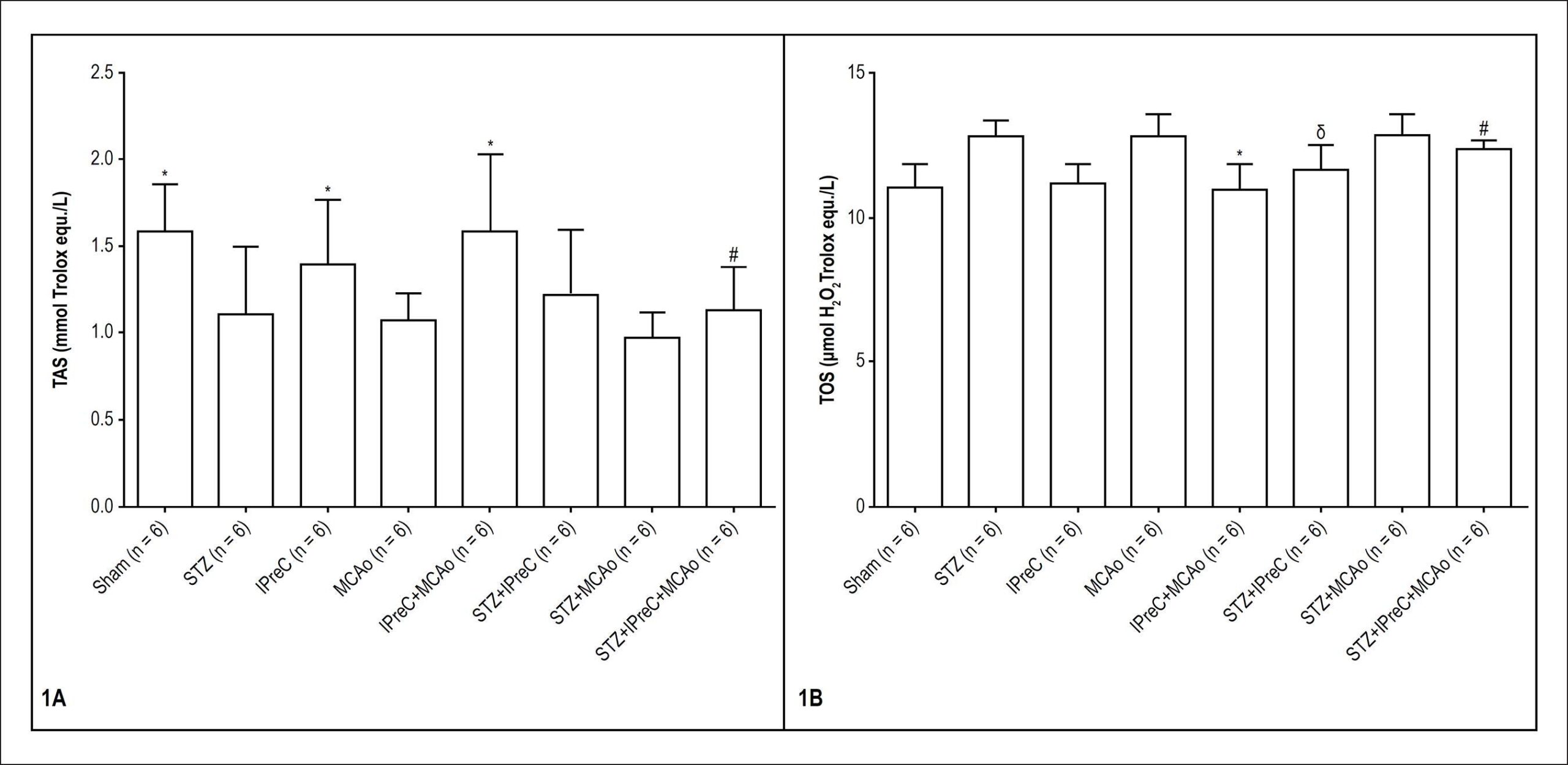
We observed serious damage including necrosis, congestion and mononuclear cell infiltration in myocardial tissue of the diabetic and ischemic groups. In these groups TOS and OSI levels were significantly higher; TAS levels were lower than those of IPreC related groups (p < 0.05). IPreC had markedly improved histopathological alterations and increased TAS levels in IPreC+MCAo and STZ+IPreC+MCAo compared to MCAo and STZ+MCAo groups (p < 0.05). In non-diabetic rats, MCAo activated apoptotic cell death via increasing Bax/Bcl2 ratio and caspase-3 levels. IPreC reduced apoptotic cell death by suppressing pro-apoptotic proteins. Diabetes markedly increased apoptotic protein levels and the effect did not reversed by IPreC.

Conclusions:

We could suggest that IPreC attenuates myocardial injury via ameliorating histological findings, activating antioxidant mechanisms, and inducing antiapoptotic activity in diabetic rats.
  • Diabetes Mellitus
  • Experimental
  • Ischemic Preconditioning Myocardial
  • Middle Cerebral Artery
  • Rats
Read Full Article
Creative Commons Attribution (CC BY) Creative Commons license
13/11/2017 DOI: 10.5935/abc.20170164 Views 1
Figure 1
ABC
Original Article

Is Local Nitric Oxide Availability Responsible for Myocardial Salvage after Remote Preconditioning?

Esbeidira Aranet Arroyo-Martínez et al. Alejandra Meaney Gabriela Gutiérrez-Salmeán Juan Miguel Rivera-Capello … Vidal González-Coronado Alejandro Alcocer-Chauvet Genaro Castillo Nayelli Nájera Guillermo Ceballos Eduardo Meaney

Abstract

Background:

Remote ischemic preconditioning (RIPC) represents an attractive therapy for myocardial protection, particularly when ischemic events can be anticipated. Although several hypothetic mechanisms have been proposed, no definite molecular pathways have been elucidated.

Objective:

We evaluated the effect of brachial circulation cuff occlusion on myocardial ischemic tolerance, necrosis, and nitric oxide (NO) in patients with ischemic heart disease undergoing elective percutaneous coronary interventions (PCI).

Methods:

46 patients were randomly allocated into two groups: control and RIPC before PCI procedures. Electrocardiographic analysis, serum concentrations of troponin I (cTn-I) were measured at baseline and 24 hours after PCI. A blood sample from the atherosclerotic plaque was drawn to determine nitrate and nitrites.

Results:

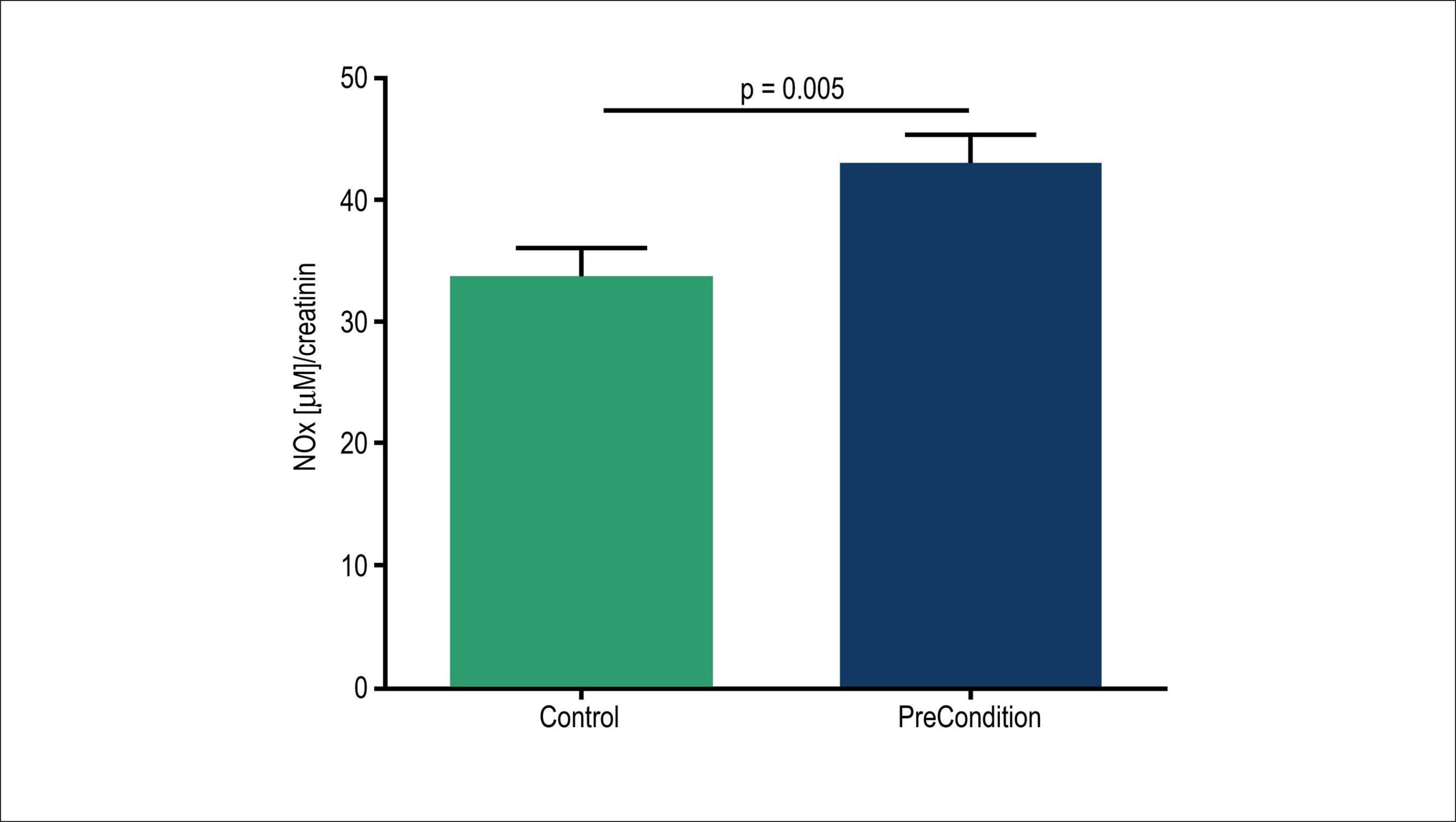
RIPC increased the availability of NO in the stented coronary artery. Control patients presented a small but significant increase in cTn-I, whilst it remained unchanged in preconditioned group. The preconditioning maneuver not only preserved but also enhanced the sum of R waves.

Conclusions:

RIPC induced an intracoronary increase of NO levels associated with a decrease in myocardial damage (measured as no increase in cTn-I) with electrocardiographic increases in the sum of R waves, suggesting an improved myocardium after elective PCI.

  • Ischemia
  • Ischemic Preconditioning Myocardial
  • Nitric Oxide
  • Reperfusion
Read Full Article
Creative Commons Attribution (CC BY) Creative Commons license
11/07/2016 DOI: 10.5935/abc.20160100 Views 1
Electrocardiographic score: application in exercise test for the assessment of ischemic preconditioning
ABC
Artigo Original

Electrocardiographic score: application in exercise test for the assessment of ischemic preconditioning

Augusto Uchida et al. Paulo Moffa Whady Hueb Luiz Antonio Machado Cesar … Beatriz Moreira Ayub Ferreira Jose Antonio Franchini Ramires

BACKGROUND: The time for 1.0 mm ST-segment depression (T-1.0mm) adopted to characterize ischemic preconditioning (IPC) in sequential exercise tests is consistent and reproducible; however, it has several limitations. OBJECTIVE: To apply an electrocardiographic score of myocardial ischemia in sequential exercise tests, comparing it to the conventional T-1.0 mm index. METHODS: Sixty one patients with mean age of 62.2 ± 7.5 years were evaluated; 86.9% were males. A total of 151 tests were analyzed, 116 of which were from patients who completed two assessment phases. The first phase comprised two sequential exercise tests for the documentation of IPC; the second phase, initiated one week later, comprised two more tests carried out under the effect of repaglinide. Two observers who were blind to the tests applied the score. RESULTS: Perfect inter and intraobserver agreement was found (Kendall tau-b = 0.96, p < 0.0001, and Kendall tau-b = 0.98, p < 0.0001, respectively). Values of sensitivity and specificity, negative predictive value, positive predictive value and accuracy were 72.41%, 89.29%, 75.8%, 87.5% and 81.0%, respectively. CONCLUSION: The ischemic score is a consistent and reproducible method for the documentation of IPC, and is a feasible alternative to T-1.0 mm.

  • Angina Pectoris
  • Ergometry
  • Ischemic Preconditioning Myocardial
  • Myocardial Infarction
Read Full Article
Creative Commons Attribution (CC BY) Creative Commons license
08/09/2010 DOI: 10.1590/S0066-782X2010005000122 Views 1

How to cite this article

EndNote RIS

Electronic Document Format (Vancouver)

Kumas M, Altintas O, Karatas E, Kocyigit A. Protective Effect of Ischemic Preconditioning on Myocardium Against Remote Tissue Injury Following Transient Focal Cerebral Ischemia in Diabetic Rats. Arquivos Brasileiros de Cardiologia 2017;109(6):516-2.

Electronic Document Format (ABNT)

Kumas, Meltem; Altintas, Ozge; Karatas, Ersin; Kocyigit, Abdurrahim. Protective Effect of Ischemic Preconditioning on Myocardium Against Remote Tissue Injury Following Transient Focal Cerebral Ischemia in Diabetic Rats. Arquivos Brasileiros de Cardiologia, v. 109, n. 6, p. 516-526, Nov. 2017.

Electronic Document Format (APA)

Kumas, M., Altintas, O., Karatas, E., & Kocyigit, A. (2017). Protective Effect of Ischemic Preconditioning on Myocardium Against Remote Tissue Injury Following Transient Focal Cerebral Ischemia in Diabetic Rats. Arquivos Brasileiros de Cardiologia, 109(6), 516-526.

Electronic Document Format (ISO)

Kumas, Meltem and Altintas, Ozge and Karatas, Ersin and Kocyigit, Abdurrahim. Protective Effect of Ischemic Preconditioning on Myocardium Against Remote Tissue Injury Following Transient Focal Cerebral Ischemia in Diabetic Rats. Arquivos Brasileiros de Cardiologia [online]. 2017, vol. 109, n. 6, [cited 2026-10-14], pp. 516-526. Available from: <https://journals.cardiol.br/en/article/protective-effect-of-ischemic-preconditioning-on-myocardium-against-remote-tissue-injury-following-transient-focal-cerebral-ischemia-in-diabetic-rats/>. ISSN 0066-782X

EndNote RIS

Electronic Document Format (Vancouver)

Arroyo-Martínez EA, Meaney A, Gutiérrez-Salmeán G, Rivera-Capello JM, González-Coronado V, Alcocer-Chauvet A, Castillo G, et al. Is Local Nitric Oxide Availability Responsible for Myocardial Salvage after Remote Preconditioning?. Arquivos Brasileiros de Cardiologia 2016;107(2):154-62.

Electronic Document Format (ABNT)

Arroyo-Martínez, Esbeidira Aranet; Meaney, Alejandra; Gutiérrez-Salmeán, Gabriela; Rivera-Capello, Juan Miguel; González-Coronado, Vidal; Alcocer-Chauvet, Alejandro; Castillo, Genaro; Nájera, Nayelli; Ceballos, Guillermo; Meaney, Eduardo. Is Local Nitric Oxide Availability Responsible for Myocardial Salvage after Remote Preconditioning?. Arquivos Brasileiros de Cardiologia, v. 107, n. 2, p. 154-162, Jul. 2016.

Electronic Document Format (APA)

Arroyo-Martínez, E. A., Meaney, A., Gutiérrez-Salmeán, G., Rivera-Capello, J. M., González-Coronado, V., Alcocer-Chauvet, A., Castillo, G., Nájera, N., Ceballos, G., & Meaney, E. (2016). Is Local Nitric Oxide Availability Responsible for Myocardial Salvage after Remote Preconditioning?. Arquivos Brasileiros de Cardiologia, 107(2), 154-162.

Electronic Document Format (ISO)

Arroyo-Martínez, Esbeidira Aranet and Meaney, Alejandra and Gutiérrez-Salmeán, Gabriela and Rivera-Capello, Juan Miguel and González-Coronado, Vidal and Alcocer-Chauvet, Alejandro and Castillo, Genaro and Nájera, Nayelli and Ceballos, Guillermo and Meaney, Eduardo. Is Local Nitric Oxide Availability Responsible for Myocardial Salvage after Remote Preconditioning?. Arquivos Brasileiros de Cardiologia [online]. 2016, vol. 107, n. 2, [cited 2026-10-14], pp. 154-162. Available from: <https://journals.cardiol.br/en/article/is-local-nitric-oxide-availability-responsible-for-myocardial-salvage-after-remote-preconditioning/>. ISSN 0066-782X

EndNote RIS

Electronic Document Format (Vancouver)

Uchida A, Moffa P, Hueb W, Cesar LAM, Ferreira BMA, Ramires JAF. Electrocardiographic score: application in exercise test for the assessment of ischemic preconditioning. Arquivos Brasileiros de Cardiologia 2010;95(4):486-92.

Electronic Document Format (ABNT)

Uchida, Augusto; Moffa, Paulo; Hueb, Whady; Cesar, Luiz Antonio Machado; Ferreira, Beatriz Moreira Ayub; Ramires, Jose Antonio Franchini. Electrocardiographic score: application in exercise test for the assessment of ischemic preconditioning. Arquivos Brasileiros de Cardiologia, v. 95, n. 4, p. 486-492, Sep. 2010.

Electronic Document Format (APA)

Uchida, A., Moffa, P., Hueb, W., Cesar, L. A. M., Ferreira, B. M. A., & Ramires, J. A. F. (2010). Electrocardiographic score: application in exercise test for the assessment of ischemic preconditioning. Arquivos Brasileiros de Cardiologia, 95(4), 486-492.

Electronic Document Format (ISO)

Uchida, Augusto and Moffa, Paulo and Hueb, Whady and Cesar, Luiz Antonio Machado and Ferreira, Beatriz Moreira Ayub and Ramires, Jose Antonio Franchini. Electrocardiographic score: application in exercise test for the assessment of ischemic preconditioning. Arquivos Brasileiros de Cardiologia [online]. 2010, vol. 95, n. 4, [cited 2026-10-14], pp. 486-492. Available from: <https://journals.cardiol.br/en/article/electrocardiographic-score-application-in-exercise-test-for-the-assessment-of-ischemic-preconditioning/>. ISSN 0066-782X

  • About ABC Family
  • Internal Regulation
  • Editorial Board
  • Brazilian Society of Cardiology (SBC)

Issues

SBC Guidelines

  • Videos
  • Podcasts
  • News