ABC Family Arquivos Brasileiros de Cardiologia International Journal of Cardiovascular Sciences ABC Heart Failure & Cardiomyopathy ABC Imagem Cardiovascular
Português English
ABC Family
Português English
  • About
    • About ABC Family
    • Internal Regulation
    • Editorial Board
    • Brazilian Society of Cardiology (SBC)
  • Issues
  • SBC Guidelines
  • Content
    • Videos
    • Podcasts
    • News
  • About
    • About ABC Family
    • Internal Regulation
    • Editorial Board
    • Brazilian Society of Cardiology (SBC)
  • Issues
  • SBC Guidelines
  • Content
    • Videos
    • Podcasts
    • News

ABC Family

  • ABC Family
  • Arquivos Brasileiros de Cardiologia
  • International Journal of Cardiovascular Sciences
  • ABC Heart Failure & Cardiomyopathy
  • ABC Imagem Cardiovascular
Search in

No content found.

Journals
Ordering
Article types
Others

  1. Home
  2. Keyword: heart disease
ABC
Review Article

Quality of Life and Congenital Heart Disease in Childhood and Adolescenc

Juliana Bertoletti et al. Giovana Caroline Marx Sérgio Pedro Hattge Júnior Lucia Campos Pellanda

Advances in cardiac surgery techniques and early diagnosis have enabled the increased survival of individuals with congenital heart disease. The investigation of the quality of life in children and adolescents with congenital heart disease provides complementary information to clinical data that can assist in decision making on the part of health professionals. Although many studies have been conducted to investigate the quality of life of children and adolescents with congenital heart disease, the results prove to be contradictory; while some studies show that congenital heart disease can impact the quality of life, others describe a better perception of quality of life among children and adolescents who suffer from the disease when compared with healthy control subjects. The purpose of this study is to review the literature on the assessment of health related quality of life in children and adolescents with congenital heart disease, in order to systematize the existing knowledge on this topic today. It is observed that research seeks to investigate aspects of personality in cardiac patients, their coping strategies used and perceived social support, aiming at better understanding the association of these variables with the level of quality of life in this population.
  • adolescence
  • Childhood
  • Congenital Abnormalities
  • heart disease
  • Quality of life
Read Full Article
Creative Commons Attribution (CC BY) Creative Commons license
21/12/2013 DOI: 10.5935/abc.20130244
Cardiac longitudinal study of children perinatally exposed to human immunodeficiency virus type 1
ABC
Artigo Original

Cardiac longitudinal study of children perinatally exposed to human immunodeficiency virus type 1

Maria Suely Bezerra Diógenes et al. Regina Célia de Menezes Succi Daisy M. Machado Valdir Ambrósio Moisés … Neil Ferreira Novo Antonio Carlos Carvalho

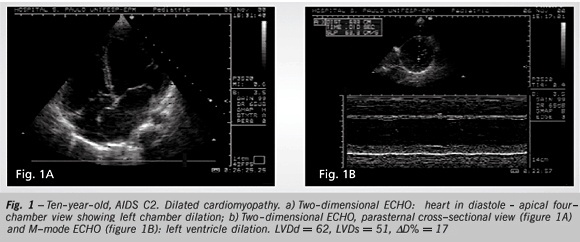
OBJECTIVE: To determine the frequency of cardiac abnormalities and its natural history in children perinatally exposed to HIV-1. METHODS: Eighty-four children exposed to HIV-1 were evaluated by serial clinical, electrocardiographic (ECG), and Doppler-echocardiographic (ECHO) examinations. RESULTS: Group I – (seroreversion) – 43 children (51.2%). Absence of clinical abnormalities. ECG: incomplete right bundle branch block (RBBB) 5 cases. ECHO: atrial septal defect (ASD) and ventricular septal defect (VSD) – 1 case each. Group II – 41 HIV-infected children (48.8%), of whom 51.2% were found to have cardiac abnormalities. Asymptomatic or mildly symptomatic children without immunosuppression: no clinical and echocardiographic abnormalities; ECG: incomplete right bundle branch block (RBBB) – (2 cases). Children with moderate and severe symptoms and immunological impairment: the following abnormalities were found: 1) clinical (31.7%)-isolated tachycardia (1 case), congestive heart failure (12 cases). 2) electrocardiographic (43.9%)- sinus tachycardia associated with other abnormalities (10 cases), incomplete right bundle branch block (5 cases), left anterior hemiblock (1 case), right anterior hemiblock (1 case), changes in ventricular repolarization (11 cases), right ventricular overload (2 cases), left ventricular overload (1 case), right QRS axis deviation (1 case), and arrhythmias (3 cases). 3) echocardiographic (26.8%)- dilated cardiomyopathy (5 cases), pericardial effusion with tamponade (2 cases), pulmonary hypertension (2 cases), and mitral valve prolapse (1 case). CONCLUSION: Cardiac involvement was a characteristic of the HIV-infected group. Higher prevalence of abnormalities was found among children belonging to the most advanced clinical and immunological category. The most commonly observed clinical, electrocardiographic and echocardiographic findings were congestive heart failure (CHF), changes in ventricular repolarization, and dilated cardiomyopathy, respectively. The latter was reversible in one case. Electrocardiogram changes were significantly more frequent than clinical and echocardiographic changes.

  • Echocardiogram
  • electrocardiogram
  • heart disease
  • HIV
  • vertical transmission
Read Full Article
Creative Commons Attribution (CC BY) Creative Commons license
07/11/2005 DOI: 10.1590/S0066-782X2005001700002 Views 1
ABC
Original Article

Assessment of functional capacity through oxygen consumption in patients with asymptomatic probable heart disease

Luiz Oswaldo Carneiro Rodrigues et al. Emerson Silami-Garcia Maria da Consolação Vieira Moreira Giane Amorim Ribeiro

PURPOSE: To compare peak exercise oxygen consumption (VO2peak) of healthy individuals with asymptomatic individuals with probable heart disease. METHODS: Ninety-eight men were evaluated. They were divided into two groups: 1) 39 healthy individuals (group N) with an age range of 50±4.6 years; and 2) 59 asymptomatic individuals with signs of atherosclerotic and/or hypertensive heart disease (group C) with an age range of 51.9±10.4 years. In regard to age, height, body surface area, percentage of fat, lean body mass, and daily physical activity, both groups were statistically similar. Environmental conditions during the ergometric test were also controlled. RESULTS: Maximal aerobic power (watts), VO2peak, maximal heart rate, and maximal pulmonary ventilation were lower in group C (p<0.01) than in group N; weight, however, was lower in group N (p=0.031) than in group C. Differences in the respiratory gas exchange index, heart rate at rest, and the maximal double product of the two groups were not statistically significant. CONCLUSION: Signs of probable heart disease, even though asymptomatic, may reduce the functional capacity, perhaps due to the lower maximal cardiac output and/or muscle metabolic changes.

  • functional capacity
  • heart disease
  • Oxygen Consumption
Read Full Article
Creative Commons Attribution (CC BY) Creative Commons license
24/10/2000 DOI: 10.1590/S0066-782X1999000700001

How to cite this article

EndNote RIS

Electronic Document Format (Vancouver)

Bertoletti J, Marx GC, Hattge Júnior SP, Pellanda LC. Quality of Life and Congenital Heart Disease in Childhood and Adolescenc. Arquivos Brasileiros de Cardiologia 2013;102(2):192-8.

Electronic Document Format (ABNT)

Bertoletti, Juliana; Marx, Giovana Caroline; Hattge Júnior, Sérgio Pedro; Pellanda, Lucia Campos. Quality of Life and Congenital Heart Disease in Childhood and Adolescenc. Arquivos Brasileiros de Cardiologia, v. 102, n. 2, p. 192-198, Dec. 2013.

Electronic Document Format (APA)

Bertoletti, J., Marx, G. C., Hattge Júnior, S. P., & Pellanda, L. C. (2013). Quality of Life and Congenital Heart Disease in Childhood and Adolescenc. Arquivos Brasileiros de Cardiologia, 102(2), 192-198.

Electronic Document Format (ISO)

Bertoletti, Juliana and Marx, Giovana Caroline and Hattge Júnior, Sérgio Pedro and Pellanda, Lucia Campos. Quality of Life and Congenital Heart Disease in Childhood and Adolescenc. Arquivos Brasileiros de Cardiologia [online]. 2013, vol. 102, n. 2, [cited 2026-10-14], pp. 192-198. Available from: <https://journals.cardiol.br/en/article/quality-of-life-and-congenital-heart-disease-in-childhood-and-adolescenc/>. ISSN 0066-782X

EndNote RIS

Electronic Document Format (Vancouver)

Diógenes MSB, Succi RCM, Machado DM, Moisés VA, Novo NF, Carvalho AC. Cardiac longitudinal study of children perinatally exposed to human immunodeficiency virus type 1. Arquivos Brasileiros de Cardiologia 2005;85(4):233-40.

Electronic Document Format (ABNT)

Diógenes, Maria Suely Bezerra; Succi, Regina Célia de Menezes; Machado, Daisy M.; Moisés, Valdir Ambrósio; Novo, Neil Ferreira; Carvalho, Antonio Carlos. Cardiac longitudinal study of children perinatally exposed to human immunodeficiency virus type 1. Arquivos Brasileiros de Cardiologia, v. 85, n. 4, p. 233-240, Nov. 2005.

Electronic Document Format (APA)

Diógenes, M. S. B., Succi, R. C. M., Machado, D. M., Moisés, V. A., Novo, N. F., & Carvalho, A. C. (2005). Cardiac longitudinal study of children perinatally exposed to human immunodeficiency virus type 1. Arquivos Brasileiros de Cardiologia, 85(4), 233-240.

Electronic Document Format (ISO)

Diógenes, Maria Suely Bezerra and Succi, Regina Célia de Menezes and Machado, Daisy M. and Moisés, Valdir Ambrósio and Novo, Neil Ferreira and Carvalho, Antonio Carlos. Cardiac longitudinal study of children perinatally exposed to human immunodeficiency virus type 1. Arquivos Brasileiros de Cardiologia [online]. 2005, vol. 85, n. 4, [cited 2026-10-14], pp. 233-240. Available from: <https://journals.cardiol.br/en/article/cardiac-longitudinal-study-of-children-perinatally-exposed-to-human-immunodeficiency-virus-type-1/>. ISSN 0066-782X

EndNote RIS

Electronic Document Format (Vancouver)

Rodrigues LOC, Silami-Garcia E, Moreira MCV, Ribeiro GA. Assessment of functional capacity through oxygen consumption in patients with asymptomatic probable heart disease. Arquivos Brasileiros de Cardiologia 2000;73(1):06-10.

Electronic Document Format (ABNT)

Rodrigues, Luiz Oswaldo Carneiro; Silami-Garcia, Emerson; Moreira, Maria da Consolação Vieira; Ribeiro, Giane Amorim. Assessment of functional capacity through oxygen consumption in patients with asymptomatic probable heart disease. Arquivos Brasileiros de Cardiologia, v. 73, n. 1, p. 06-10, Oct. 2000.

Electronic Document Format (APA)

Rodrigues, L. O. C., Silami-Garcia, E., Moreira, M. C. V., & Ribeiro, G. A. (2000). Assessment of functional capacity through oxygen consumption in patients with asymptomatic probable heart disease. Arquivos Brasileiros de Cardiologia, 73(1), 06-10.

Electronic Document Format (ISO)

Rodrigues, Luiz Oswaldo Carneiro and Silami-Garcia, Emerson and Moreira, Maria da Consolação Vieira and Ribeiro, Giane Amorim. Assessment of functional capacity through oxygen consumption in patients with asymptomatic probable heart disease. Arquivos Brasileiros de Cardiologia [online]. 2000, vol. 73, n. 1, [cited 2026-10-14], pp. 06-10. Available from: <https://journals.cardiol.br/en/article/assessment-of-functional-capacity-through-oxygen-consumption-in-patients-with-asymptomatic-probable-heart-disease/>. ISSN 0066-782X

  • About ABC Family
  • Internal Regulation
  • Editorial Board
  • Brazilian Society of Cardiology (SBC)

Issues

SBC Guidelines

  • Videos
  • Podcasts
  • News