ABC Family Arquivos Brasileiros de Cardiologia International Journal of Cardiovascular Sciences ABC Heart Failure & Cardiomyopathy ABC Imagem Cardiovascular
Português English
ABC Family
Português English
  • About
    • About ABC Family
    • Internal Regulation
    • Editorial Board
    • Brazilian Society of Cardiology (SBC)
  • Issues
  • SBC Guidelines
  • Content
    • Videos
    • Podcasts
    • News
  • About
    • About ABC Family
    • Internal Regulation
    • Editorial Board
    • Brazilian Society of Cardiology (SBC)
  • Issues
  • SBC Guidelines
  • Content
    • Videos
    • Podcasts
    • News

ABC Family

  • ABC Family
  • Arquivos Brasileiros de Cardiologia
  • International Journal of Cardiovascular Sciences
  • ABC Heart Failure & Cardiomyopathy
  • ABC Imagem Cardiovascular
Search in

No content found.

Journals
Ordering
Article types
Others

  1. Home
  2. Keyword: electrodes
Ablation of typical atrial flutter: a prospective randomized study of cooled-tip versus 8-mm-tip catheters
ABC
Artigo Original

Ablation of typical atrial flutter: a prospective randomized study of cooled-tip versus 8-mm-tip catheters

Sissy L. Melo et al. Mauricio I. Scanavacca Francisco C. C. Darrieux Denise T. Hachul Eduardo A. Sosa

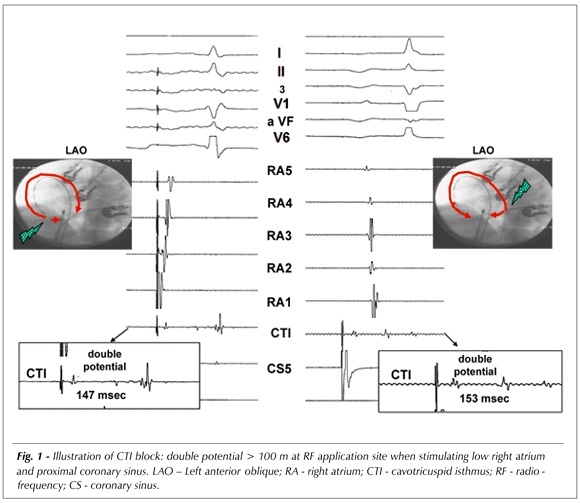
OBJECTIVES: Both ablation catheters with closed irrigated system and 8mm tip-catheters have been shown to be more effective for typical atrial flutter radiofrequency (RF) ablation when compared to conventional 4 mm tip catheter. Considering the differences in complexity and costs of both systems, a prospective study was designed to compare the efficacy and safety of cooled-tip and 8mm-tip catheters for atrial flutter ablation. METHODS: Fifty-two consecutive patients underwent RF ablation of cavotricupsid isthmus (CTI) for the treatment of typical atrial flutter, using catheter with closed irrigation system (n=26) or 8 mm-tip catheter (n=26). The RF pulses were applied point-by-point for 60 seconds, with power limited at 50 w for the irrigated catheter and by temperature control (60ºC / 70 w) for the 8mm catheter. RESULTS: The CTI block was successfully performed in 98.1%. Four patients in the irrigated group needed to switch to the other group. There was no significant difference with regard to ablation parameters, such as total time of RF ablation (591.1±309.0s vs 486.2±250.8s), total procedure duration (86.4±23.6 vs 78.1±22.5min) and time of fluoroscopy (17.0±6.7 vs 15.4±4.6min). During follow-up of 10.6 months in average, one patient in the irrigated group had recurrence of typical atrial flutter. CONCLUSION: Efficacy and safety of CTI ablation was comparable between both techniques (irrigated catheter and 8mm-tip catheter). The complexity of irrigated catheter makes it less competitive.
  • Atrial flutter
  • Catheter Ablation
  • Catheterization
  • electrodes
Read Full Article
Creative Commons Attribution (CC BY) Creative Commons license
21/05/2007 DOI: 10.1590/S0066-782X2007000300004 Views 1
Analysis of the effects of the continuous electrode paste band on precordial leads of the electrocardiogram
ABC
Original Article

Analysis of the effects of the continuous electrode paste band on precordial leads of the electrocardiogram

Carlos Henrique Purper Petterson et al. Nelson Rudi Koehler Ronaldo Passos Iuri Christmann

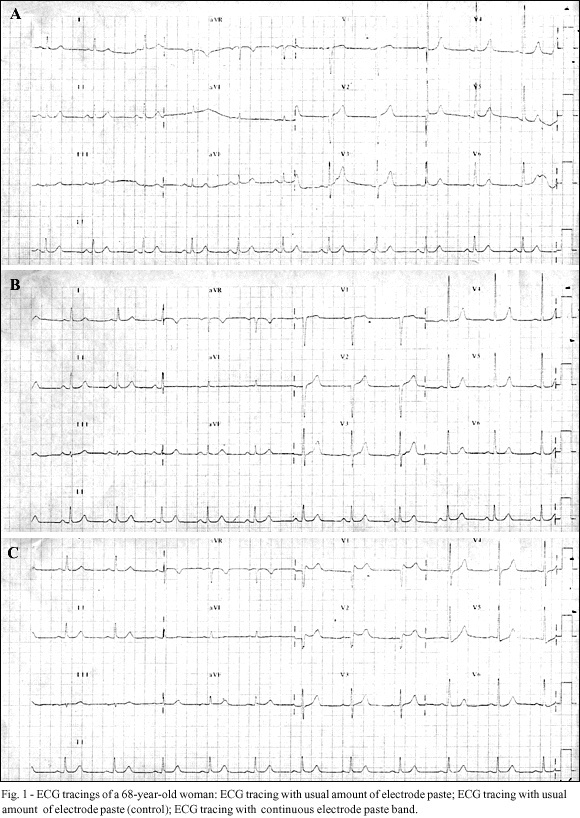
OBJECTIVE – To determine if the application of a continuous electrode paste band on precordial leads results in alteration of the electrocardiographic tracing as compared with an adequate amount of electrode paste, and if the former condition does not cause uniform morphologies from V1 to V6. METHODS – The amplitude and morphology of the electrocardiographic waves on the precordial leads in electrocardiographic tracings, which were performed with standard (control group) or excessive (continuous band) application of the electrode paste, were compared. RESULTS – None of the 106 patients studied showed uniformity of the QRS morphology from V1 to V6. The eletrocardiographic alterations identified in the tracings performed with a continuous electrode paste band that showed statistical significance in relation to the control group were the following: inversion of the P wave in V1; inversion of the T wave in V1, V2, and V3; appearance of R’ waves in V1 and V2; disappearance of S waves in V1; appearance of S waves in V5 and V6; alterations in the amplitude of almost all waves, in all leads. CONCLUSION – Application of a continuous electrode paste band in the precordial leads may cause significant alterations in the electrocardiographic tracing obtained.

  • electrocardiogram
  • electrocardiographic technique
  • electrode paste
  • electrodes
  • precordial leads
Read Full Article
Creative Commons Attribution (CC BY) Creative Commons license
08/01/2002 DOI: 10.1590/S0066-782X1999000900002

How to cite this article

EndNote RIS

Electronic Document Format (Vancouver)

Melo SL, Scanavacca MI, Darrieux FCC, Hachul DT, Sosa EA. Ablation of typical atrial flutter: a prospective randomized study of cooled-tip versus 8-mm-tip catheters. Arquivos Brasileiros de Cardiologia 2007;88(3):273-8.

Electronic Document Format (ABNT)

Melo, Sissy L.; Scanavacca, Mauricio I.; Darrieux, Francisco C. C.; Hachul, Denise T.; Sosa, Eduardo A.. Ablation of typical atrial flutter: a prospective randomized study of cooled-tip versus 8-mm-tip catheters. Arquivos Brasileiros de Cardiologia, v. 88, n. 3, p. 273-278, May. 2007.

Electronic Document Format (APA)

Melo, S. L., Scanavacca, M. I., Darrieux, F. C. C., Hachul, D. T., & Sosa, E. A. (2007). Ablation of typical atrial flutter: a prospective randomized study of cooled-tip versus 8-mm-tip catheters. Arquivos Brasileiros de Cardiologia, 88(3), 273-278.

Electronic Document Format (ISO)

Melo, Sissy L. and Scanavacca, Mauricio I. and Darrieux, Francisco C. C. and Hachul, Denise T. and Sosa, Eduardo A.. Ablation of typical atrial flutter: a prospective randomized study of cooled-tip versus 8-mm-tip catheters. Arquivos Brasileiros de Cardiologia [online]. 2007, vol. 88, n. 3, [cited 2026-10-14], pp. 273-278. Available from: <https://journals.cardiol.br/en/article/ablation-of-typical-atrial-flutter-a-prospective-randomized-study-of-cooled-tip-versus-8-mm-tip-catheters/>. ISSN 0066-782X

EndNote RIS

Electronic Document Format (Vancouver)

Petterson CHP, Koehler NR, Passos R, Christmann I. Analysis of the effects of the continuous electrode paste band on precordial leads of the electrocardiogram. Arquivos Brasileiros de Cardiologia 2002;73(3):266-72.

Electronic Document Format (ABNT)

Petterson, Carlos Henrique Purper; Koehler, Nelson Rudi; Passos, Ronaldo; Christmann, Iuri. Analysis of the effects of the continuous electrode paste band on precordial leads of the electrocardiogram. Arquivos Brasileiros de Cardiologia, v. 73, n. 3, p. 266-272, Jan. 2002.

Electronic Document Format (APA)

Petterson, C. H. P., Koehler, N. R., Passos, R., & Christmann, I. (2002). Analysis of the effects of the continuous electrode paste band on precordial leads of the electrocardiogram. Arquivos Brasileiros de Cardiologia, 73(3), 266-272.

Electronic Document Format (ISO)

Petterson, Carlos Henrique Purper and Koehler, Nelson Rudi and Passos, Ronaldo and Christmann, Iuri. Analysis of the effects of the continuous electrode paste band on precordial leads of the electrocardiogram. Arquivos Brasileiros de Cardiologia [online]. 2002, vol. 73, n. 3, [cited 2026-10-14], pp. 266-272. Available from: <https://journals.cardiol.br/en/article/analysis-of-the-effects-of-the-continuous-electrode-paste-band-on-precordial-leads-of-the-electrocardiogram/>. ISSN 0066-782X

  • About ABC Family
  • Internal Regulation
  • Editorial Board
  • Brazilian Society of Cardiology (SBC)

Issues

SBC Guidelines

  • Videos
  • Podcasts
  • News