ABC Family Arquivos Brasileiros de Cardiologia International Journal of Cardiovascular Sciences ABC Heart Failure & Cardiomyopathy ABC Imagem Cardiovascular
Português English
ABC Family
Português English
  • About
    • About ABC Family
    • Internal Regulation
    • Editorial Board
    • Brazilian Society of Cardiology (SBC)
  • Issues
  • SBC Guidelines
  • Content
    • Videos
    • Podcasts
    • News
  • About
    • About ABC Family
    • Internal Regulation
    • Editorial Board
    • Brazilian Society of Cardiology (SBC)
  • Issues
  • SBC Guidelines
  • Content
    • Videos
    • Podcasts
    • News

ABC Family

  • ABC Family
  • Arquivos Brasileiros de Cardiologia
  • International Journal of Cardiovascular Sciences
  • ABC Heart Failure & Cardiomyopathy
  • ABC Imagem Cardiovascular
Search in

No content found.

Journals
Ordering
Article types
Others

  1. Home
  2. Keyword: Calcium Signaling
Figure 1
ABC
Original Article

Coronary Calcium Score and Stratification of Coronary Artery Disease Risk in Patients with Atherosclerotic and Non-Atherosclerotic Ischemic Stroke

Edson Marcio Negrão et al. Maria Cristina Del Negro Barroso Freitas Patricia Beatriz Christino Marinho Thiago Falcão Hora … Vinicius Viana Abreu Montanaro Bernardo Jose Alves Ferreira Martins Sergio Henrique Rodolpho Ramalho

Abstract

Background

Ischemic Stroke (IS) and Coronary Artery Disease (CAD) frequently coexist and share atherosclerotic disease risk factors. According to the American Heart Association, IS subtypes may be considered CAD risk equivalents, but the evidence for non-atherosclerotic IS is uncertain. Additionally, the Coronary Calcium Score (CCS) is an accurate marker to address CAD risk; however, CCS distribution between IS subtypes is not well characterized.

Objectives

To compare the CCS between atherosclerotic and non-atherosclerotic IS groups; and to determine which covariates were associated with high CCS in IS.

Methods

This cross-sectional design included all patients with IS, 45 to 70 years of age at the time of the stroke, consecutively admitted to a rehabilitation hospital between August 2014 and December 2016, without prevalent CAD. All patients underwent CT scanning for CCS measurement. CCS≥100 was considered a high risk for CAD, with a significance level of p<0.05.

Results

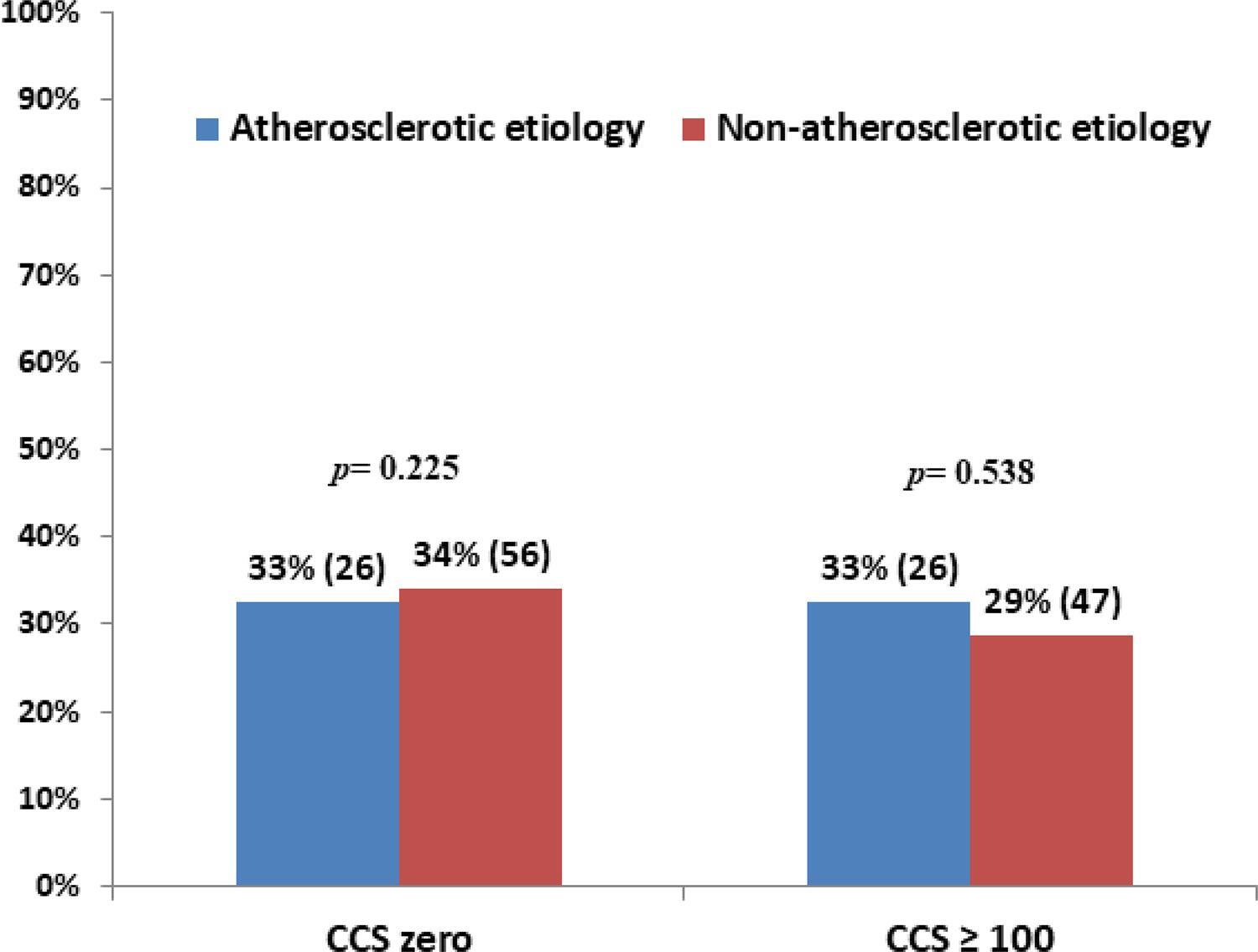
From the 244 studied patients (mean age 58.4±6.8 years; 49% female), 164 (67%) had non-atherosclerotic etiology. The proportions of CCS≥100 were similar between the atherosclerotic and the non-atherosclerotic groups (33% [n=26] x 29% [n=47]; p= 0.54). Among all IS patients, only age ≥60 years was independently associated with CCS≥100 (OR 3.5; 95%CI 1.7-7.1), accounting for hypertension, dyslipidemia, diabetes, sedentarism, and family history of CAD.

Conclusion

Atherosclerotic IS did not present a greater risk of CAD when compared to non-atherosclerotic IS according to CCS. Only age ≥60 years, but not etiology, was independently associated with CCS≥100.
  • Calcium Signaling
  • Coronary Artery Disease
  • Diabetes Mellitus
  • Dyslipidemias
  • Hypertension
  • Stroke
Read Full Article
Creative Commons Attribution (CC BY) Creative Commons license
18/01/2021 DOI: 10.36660/abc.20190616
Figure 1
ABC
Original Article

Physical Exercise and Regulation of Intracellular Calcium in Cardiomyocytes of Hypertensive Rats

Joel Alves Rodrigues et al. Thales Nicolau Prímola-Gomes Leôncio Lopes Soares Tiago Ferreira Leal … Clara Nóbrega Danillo Laviola Pedrosa Leonardo Mateus Teixeira Rezende Edilamar Menezes de Oliveira Antonio Jose Natali

Abstract

Background:

Regulation of intracellular calcium (Ca2+) in cardiomyocytes is altered by hypertension; and aerobic exercise brings benefits to hypertensive individuals.

Objective:

To verify the effects of aerobic exercise training on contractility and intracellular calcium (Ca2+) transients of cardiomyocytes and on the expression of microRNA 214 (miR-214) in the left ventricle of spontaneously hypertensive rats (SHR).

Methods:

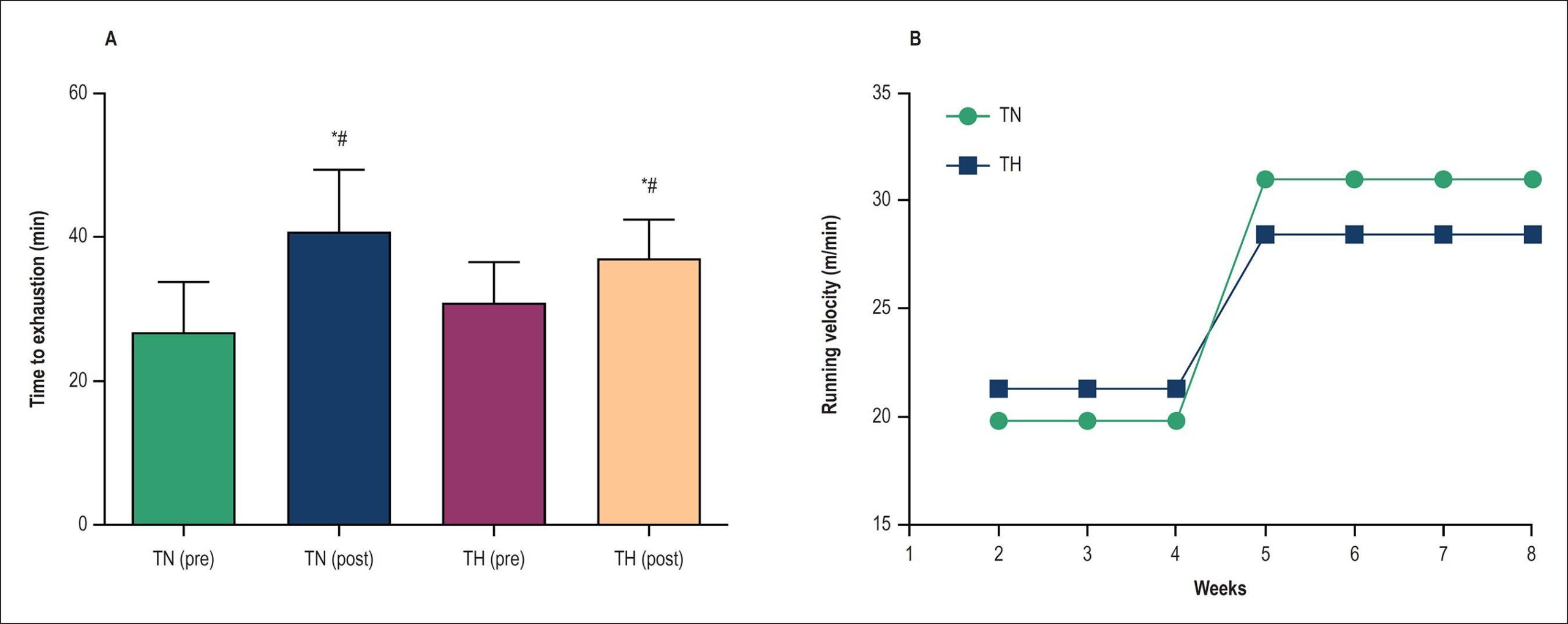
SHR and normotensive Wistar rats of 16 weeks were divided into 4 groups -sedentary hypertensive (SH); trained hypertensive (TH); sedentary normotensive (SN); and trained normotensive (TN). Animals of the TH and TN groups were subjected to treadmill running program, 5 days/week, 1 hour/day at 60-70% of maximum running velocity for 8 weeks. We adopted a p ≤ 0.05 as significance level for all comparisons.

Results:

Exercise training reduced systolic arterial pressure in hypertensive rats. In normotensive rats, exercise training reduced the time to 50% cell relaxation and the time to peak contraction and increased the time to 50% decay of the intracellular Ca2+ transients. In SHR, exercise increased the amplitude and reduced the time to 50% decay of Ca2+ transients. Exercise training increased the expression of miR-214 in hypertensive rats only.

Conclusion:

The aerobic training applied in this study increased the availability of intracellular Ca2+ and accelerated the sequestration of these ions in left ventricular myocytes of hypertensive rats, despite increased expression of miR-214 and maintenance of cell contractility.

  • Calcium Signaling
  • Exercise
  • Hypertension
  • Intracellular Calcium
  • Rats
  • Sensing Proteins
Read Full Article
Creative Commons Attribution (CC BY) Creative Commons license
02/07/2018 DOI: 10.5935/abc.20180113
Figure 1
ABC
Original Article

Atherosclerotic Plaque in Patients with Zero Calcium Score at Coronary Computed Tomography Angiography

Fabíola Santos Gabriel et al. Luiz Flávio Galvão Gonçalves Enaldo Vieira de Melo Antônio Carlos Sobral Sousa … Ibraim Masciarelli Francisco Pinto Sara Melo Macedo Santana Carlos José Oliveira de Matos Maria Júlia Silveira Souto Flávio Mateus do Sacramento Conceição Joselina Luzia Menezes Oliveira

Abstract

Background:

In view of the high mortality for cardiovascular diseases, it has become necessary to stratify the main risk factors and to choose the correct diagnostic modality. Studies have demonstrated that a zero calcium score (CS) is characteristic of a low risk for cardiovascular events. However, the prevalence of individuals with coronary atherosclerotic plaques and zero CS is conflicting in the specialized literature.

Objective:

To evaluate the frequency of patients with coronary atherosclerotic plaques, their degree of obstruction and associated factors in patients with zero CS and indication for coronary computed tomography angiography (CCTA).

Methods:

This is a cross-sectional, prospective study with 367 volunteers with zero CS at CCTA in four diagnostic imaging centers in the period from 2011 to 2016. A significance level of 5% and 95% confidence interval were adopted.

Results:

The frequency of atherosclerotic plaque in the coronary arteries in 367 patients with zero CS was 9.3% (34 individuals). In this subgroup, mean age was 52 ± 10 years, 18 (52.9%) were women and 16 (47%) had significant coronary obstructions (> 50%), with involvement of two or more segments in 4 (25%) patients. The frequency of non-obese individuals (90.6% vs 73.9%, p = 0.037) and alcohol drinkers (55.9% vs 34.8%, p = 0.015) was significantly higher in patients with atherosclerotic plaques, with an odds ratio of 3.4 for each of this variable.

Conclusions:

The frequency of atherosclerotic plaque with zero CS was relatively high, indicating that the absence of calcification does not exclude the presence of plaques, many of which obstructive, especially in non-obese subjects and alcohol drinkers.

  • Calcium Signaling
  • Cardiovascular Diseases, mortality
  • Coronary Artery Disease/diagnosis
  • Coronary, Angiotomography
  • Plaque, Atherosclerotic
  • Risk Factors
Read Full Article
Creative Commons Attribution (CC BY) Creative Commons license
03/05/2018 DOI: 10.5935/abc.20180063 Views 2
ABC
Letter to the Editor

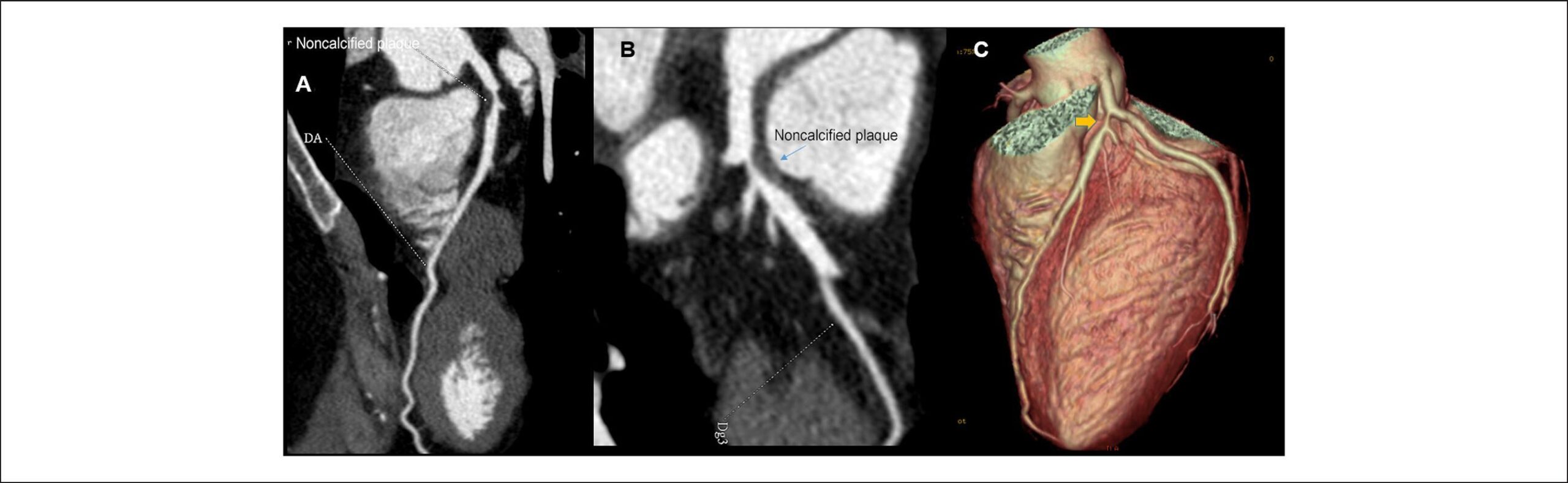
The Tip of The Iceberg: Non-Calcified Coronary Plague and Epicardial Adipose Tissue

Levent Cerit

To the Editor,

I have read with great interest the article entitled “Relationship between Calcium Score and Myocardial Scintigraphy in the Diagnosis of Coronary Disease” by Siqueira et al., recently published in Arquivos Brasileiros de Cardiologia 2016; 107:367-74. The investigators reported the possibility of removing extensive coronary artery disease (CAD) by means of a zero calcium score, or by indicating the presence of an extensive disease when it is severely increased, which justifies the use of this method in the initial or joint evaluation in asymptomatic patients with suspected CAD and in cardiovascular risk stratification. The evaluation of symptomatic low-risk patients, despite suggestive evidence, should be re-evaluated in upcoming guidelines.

[…]

  • Adipose Tissue / pathology
  • Biomarkers / analysis
  • Calcium Signaling
  • Coronary Artery Disease
  • Radionuclide Imaging
  • Tomography, Emission Computed
Read Full Article
Creative Commons Attribution (CC BY) Creative Commons license
01/04/2017 DOI: 10.5935/abc.20170046
Figure 1
ABC
Review Article

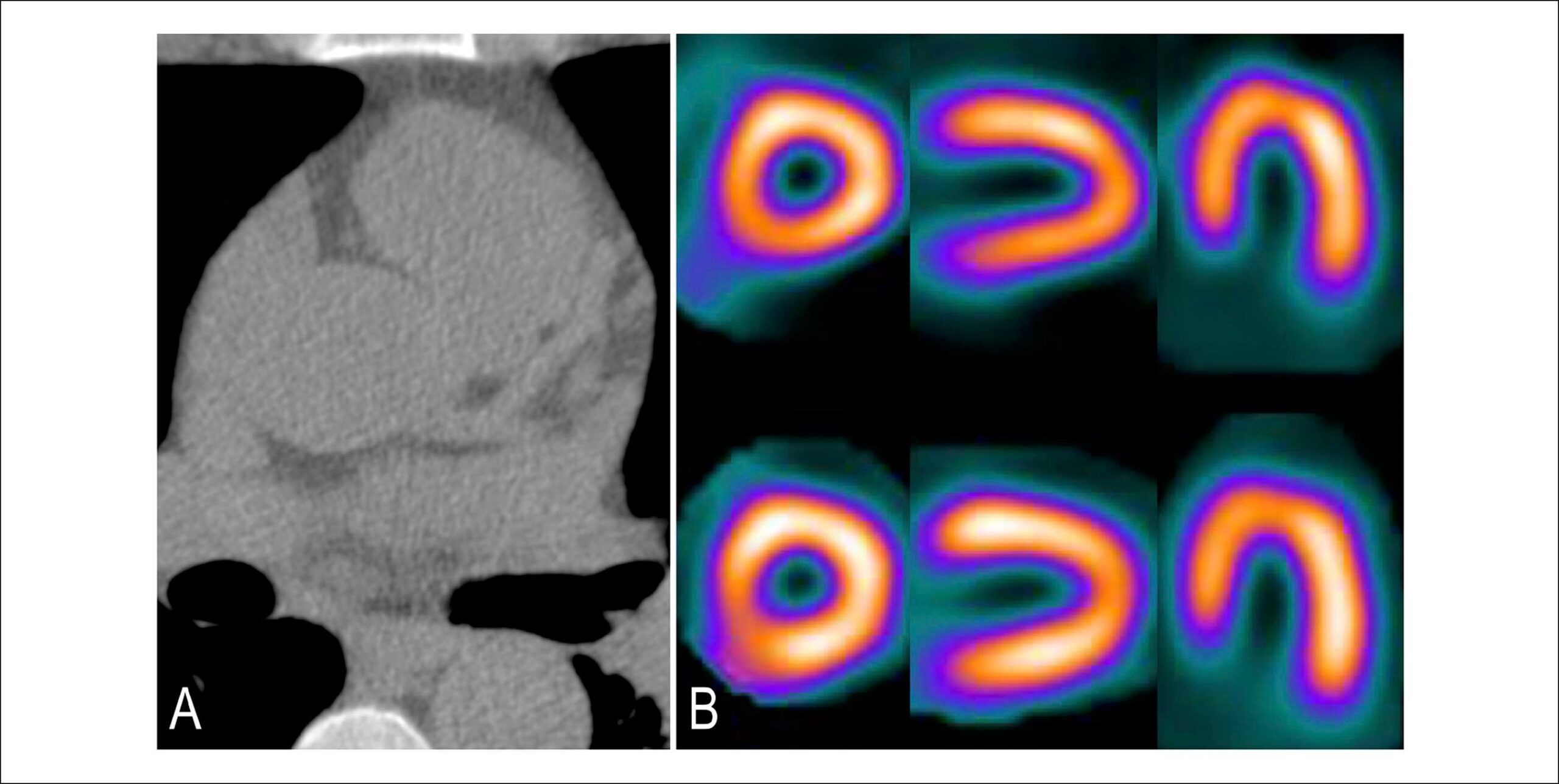
Relationship between Calcium Score and Myocardial Scintigraphy in the Diagnosis of Coronary Disease

Fabio Paiva Rossini Siqueira et al. Claudio Tinoco Mesquita Alair Augusto Sarmet M. Damas dos Santos Marcelo Souto Nacif

Abstract

Half the patients with coronary artery disease present with sudden death – or acute infarction as first symptom, making early diagnosis pivotal. Myocardial perfusion scintigraphy is frequently used in the assessment of these patients, but it does not detect the disease without flow restriction, exposes the patient to high levels of radiation and is costly. On the other hand, with less radiological exposure, calcium score is directly correlated to the presence and extension of coronary atherosclerosis, and also to the risk of cardiovascular events. Even though calcium score is a tried-and-true method for stratification of asymptomatic patients, its use is still reduced in this context, since current guidelines are contradictory to its use on symptomatic diseases. The aim of this review is to identify, on patients under investigation for coronary artery disease, the main evidence of the use of calcium score associated with functional evaluation and scintigraphy.

  • Calcium Signaling
  • Coronary Artery Disease / diagnoses
  • Scintigraphy
  • Tomography, Emission Computed
Read Full Article
Creative Commons Attribution (CC BY) Creative Commons license
18/07/2016 DOI: 10.5935/abc.20160104

How to cite this article

EndNote RIS

Electronic Document Format (Vancouver)

Negrão EM, Freitas MCDNB, Marinho PBC, Hora TF, Montanaro VVA, Martins BJAF, Ramalho SHR, et al. Coronary Calcium Score and Stratification of Coronary Artery Disease Risk in Patients with Atherosclerotic and Non-Atherosclerotic Ischemic Stroke. Arquivos Brasileiros de Cardiologia 2021;115(6):1144-51.

Electronic Document Format (ABNT)

Negrão, Edson Marcio; Freitas, Maria Cristina Del Negro Barroso; Marinho, Patricia Beatriz Christino; Hora, Thiago Falcão; Montanaro, Vinicius Viana Abreu; Martins, Bernardo Jose Alves Ferreira; Ramalho, Sergio Henrique Rodolpho. Coronary Calcium Score and Stratification of Coronary Artery Disease Risk in Patients with Atherosclerotic and Non-Atherosclerotic Ischemic Stroke. Arquivos Brasileiros de Cardiologia, v. 115, n. 6, p. 1144-1151, Jan. 2021.

Electronic Document Format (APA)

Negrão, E. M., Freitas, M. C. D. N. B., Marinho, P. B. C., Hora, T. F., Montanaro, V. V. A., Martins, B. J. A. F., & Ramalho, S. H. R. (2021). Coronary Calcium Score and Stratification of Coronary Artery Disease Risk in Patients with Atherosclerotic and Non-Atherosclerotic Ischemic Stroke. Arquivos Brasileiros de Cardiologia, 115(6), 1144-1151.

Electronic Document Format (ISO)

Negrão, Edson Marcio and Freitas, Maria Cristina Del Negro Barroso and Marinho, Patricia Beatriz Christino and Hora, Thiago Falcão and Montanaro, Vinicius Viana Abreu and Martins, Bernardo Jose Alves Ferreira and Ramalho, Sergio Henrique Rodolpho. Coronary Calcium Score and Stratification of Coronary Artery Disease Risk in Patients with Atherosclerotic and Non-Atherosclerotic Ischemic Stroke. Arquivos Brasileiros de Cardiologia [online]. 2021, vol. 115, n. 6, [cited 2026-10-14], pp. 1144-1151. Available from: <https://journals.cardiol.br/en/article/coronary-calcium-score-and-stratification-of-coronary-artery-disease-risk-in-patients-with-atherosclerotic-and-non-atherosclerotic-ischemic-stroke/>. ISSN 0066-782X

EndNote RIS

Electronic Document Format (Vancouver)

Rodrigues JA, Prímola-Gomes TN, Soares LL, Leal TF, Nóbrega C, Pedrosa DL, Rezende LMT, et al. Physical Exercise and Regulation of Intracellular Calcium in Cardiomyocytes of Hypertensive Rats. Arquivos Brasileiros de Cardiologia 2018;111(2):172-9.

Electronic Document Format (ABNT)

Rodrigues, Joel Alves; Prímola-Gomes, Thales Nicolau; Soares, Leôncio Lopes; Leal, Tiago Ferreira; Nóbrega, Clara; Pedrosa, Danillo Laviola; Rezende, Leonardo Mateus Teixeira; Oliveira, Edilamar Menezes de; Natali, Antonio Jose. Physical Exercise and Regulation of Intracellular Calcium in Cardiomyocytes of Hypertensive Rats. Arquivos Brasileiros de Cardiologia, v. 111, n. 2, p. 172-179, Jul. 2018.

Electronic Document Format (APA)

Rodrigues, J. A., Prímola-Gomes, T. N., Soares, L. L., Leal, T. F., Nóbrega, C., Pedrosa, D. L., Rezende, L. M. T., Oliveira, E. M. , & Natali, A. J. (2018). Physical Exercise and Regulation of Intracellular Calcium in Cardiomyocytes of Hypertensive Rats. Arquivos Brasileiros de Cardiologia, 111(2), 172-179.

Electronic Document Format (ISO)

Rodrigues, Joel Alves and Prímola-Gomes, Thales Nicolau and Soares, Leôncio Lopes and Leal, Tiago Ferreira and Nóbrega, Clara and Pedrosa, Danillo Laviola and Rezende, Leonardo Mateus Teixeira and Oliveira, Edilamar Menezes de and Natali, Antonio Jose. Physical Exercise and Regulation of Intracellular Calcium in Cardiomyocytes of Hypertensive Rats. Arquivos Brasileiros de Cardiologia [online]. 2018, vol. 111, n. 2, [cited 2026-10-14], pp. 172-179. Available from: <https://journals.cardiol.br/en/article/physical-exercise-and-regulation-of-intracellular-calcium-in-cardiomyocytes-of-hypertensive-rats/>. ISSN 0066-782X

EndNote RIS

Electronic Document Format (Vancouver)

Gabriel FS, Gonçalves LFG, Melo EV, Sousa ACS, Pinto IMF, Santana SMM, Matos CJO, et al. Atherosclerotic Plaque in Patients with Zero Calcium Score at Coronary Computed Tomography Angiography. Arquivos Brasileiros de Cardiologia 2018;110(5):420-7.

Electronic Document Format (ABNT)

Gabriel, Fabíola Santos; Gonçalves, Luiz Flávio Galvão; Melo, Enaldo Vieira de; Sousa, Antônio Carlos Sobral; Pinto, Ibraim Masciarelli Francisco; Santana, Sara Melo Macedo; Matos, Carlos José Oliveira de; Souto, Maria Júlia Silveira; Conceição, Flávio Mateus do Sacramento; Oliveira, Joselina Luzia Menezes. Atherosclerotic Plaque in Patients with Zero Calcium Score at Coronary Computed Tomography Angiography. Arquivos Brasileiros de Cardiologia, v. 110, n. 5, p. 420-427, May. 2018.

Electronic Document Format (APA)

Gabriel, F. S., Gonçalves, L. F. G., Melo, E. V. , Sousa, A. C. S., Pinto, I. M. F., Santana, S. M. M., Matos, C. J. O. , Souto, M. J. S., Conceição, F. M. S., & Oliveira, J. L. M. (2018). Atherosclerotic Plaque in Patients with Zero Calcium Score at Coronary Computed Tomography Angiography. Arquivos Brasileiros de Cardiologia, 110(5), 420-427.

Electronic Document Format (ISO)

Gabriel, Fabíola Santos and Gonçalves, Luiz Flávio Galvão and Melo, Enaldo Vieira de and Sousa, Antônio Carlos Sobral and Pinto, Ibraim Masciarelli Francisco and Santana, Sara Melo Macedo and Matos, Carlos José Oliveira de and Souto, Maria Júlia Silveira and Conceição, Flávio Mateus do Sacramento and Oliveira, Joselina Luzia Menezes. Atherosclerotic Plaque in Patients with Zero Calcium Score at Coronary Computed Tomography Angiography. Arquivos Brasileiros de Cardiologia [online]. 2018, vol. 110, n. 5, [cited 2026-10-14], pp. 420-427. Available from: <https://journals.cardiol.br/en/article/atherosclerotic-plaque-in-patients-with-zero-calcium-score-at-coronary-computed-tomography-angiography/>. ISSN 0066-782X

EndNote RIS

Electronic Document Format (Vancouver)

Cerit L. The Tip of The Iceberg: Non-Calcified Coronary Plague and Epicardial Adipose Tissue. Arquivos Brasileiros de Cardiologia 2017;108(4):383-5.

Electronic Document Format (ABNT)

Cerit, Levent. The Tip of The Iceberg: Non-Calcified Coronary Plague and Epicardial Adipose Tissue. Arquivos Brasileiros de Cardiologia, v. 108, n. 4, p. 383-385, Mar. 2017.

Electronic Document Format (APA)

Cerit, L. (2017). The Tip of The Iceberg: Non-Calcified Coronary Plague and Epicardial Adipose Tissue. Arquivos Brasileiros de Cardiologia, 108(4), 383-385.

Electronic Document Format (ISO)

Cerit, Levent. The Tip of The Iceberg: Non-Calcified Coronary Plague and Epicardial Adipose Tissue. Arquivos Brasileiros de Cardiologia [online]. 2017, vol. 108, n. 4, [cited 2026-10-14], pp. 383-385. Available from: <https://journals.cardiol.br/en/article/the-tip-of-the-iceberg-non-calcified-coronary-plague-and-epicardial-adipose-tissue/>. ISSN 0066-782X

EndNote RIS

Electronic Document Format (Vancouver)

Siqueira FPR, Mesquita CT, Santos AASMD, Nacif MS. Relationship between Calcium Score and Myocardial Scintigraphy in the Diagnosis of Coronary Disease. Arquivos Brasileiros de Cardiologia 2016;107(4):365-74.

Electronic Document Format (ABNT)

Siqueira, Fabio Paiva Rossini; Mesquita, Claudio Tinoco; Santos, Alair Augusto Sarmet M. Damas dos; Nacif, Marcelo Souto. Relationship between Calcium Score and Myocardial Scintigraphy in the Diagnosis of Coronary Disease. Arquivos Brasileiros de Cardiologia, v. 107, n. 4, p. 365-374, Jul. 2016.

Electronic Document Format (APA)

Siqueira, F. P. R., Mesquita, C. T., Santos, A. A. S. M. D. , & Nacif, M. S. (2016). Relationship between Calcium Score and Myocardial Scintigraphy in the Diagnosis of Coronary Disease. Arquivos Brasileiros de Cardiologia, 107(4), 365-374.

Electronic Document Format (ISO)

Siqueira, Fabio Paiva Rossini and Mesquita, Claudio Tinoco and Santos, Alair Augusto Sarmet M. Damas dos and Nacif, Marcelo Souto. Relationship between Calcium Score and Myocardial Scintigraphy in the Diagnosis of Coronary Disease. Arquivos Brasileiros de Cardiologia [online]. 2016, vol. 107, n. 4, [cited 2026-10-14], pp. 365-374. Available from: <https://journals.cardiol.br/en/article/relationship-between-calcium-score-and-myocardial-scintigraphy-in-the-diagnosis-of-coronary-disease/>. ISSN 0066-782X

  • About ABC Family
  • Internal Regulation
  • Editorial Board
  • Brazilian Society of Cardiology (SBC)

Issues

SBC Guidelines

  • Videos
  • Podcasts
  • News