ABC Family Arquivos Brasileiros de Cardiologia International Journal of Cardiovascular Sciences ABC Heart Failure & Cardiomyopathy ABC Imagem Cardiovascular
Português English
ABC Family
Português English
  • About
    • About ABC Family
    • Internal Regulation
    • Editorial Board
    • Brazilian Society of Cardiology (SBC)
  • Issues
  • SBC Guidelines
  • Content
    • Videos
    • Podcasts
    • News
  • About
    • About ABC Family
    • Internal Regulation
    • Editorial Board
    • Brazilian Society of Cardiology (SBC)
  • Issues
  • SBC Guidelines
  • Content
    • Videos
    • Podcasts
    • News

ABC Family

  • ABC Family
  • Arquivos Brasileiros de Cardiologia
  • International Journal of Cardiovascular Sciences
  • ABC Heart Failure & Cardiomyopathy
  • ABC Imagem Cardiovascular
Search in

No content found.

Journals
Ordering
Article types
Others

  1. Home
  2. Keyword: Brain Ischemia
ABCIC
Review Article

My Approach to Patent Foramen Ovale Closure

Fernando Melo Netto et al. Maria Estefânia Bosco Otto

Abstract

The patent foramen ovale (PFO), a relatively common and generally benign finding, has been associated with paradoxical embolisms. The closure of PFO, performed in patients with cryptogenic stroke, has been shown to reduce the recurrence rates of ischemic events, as evidenced by recent clinical trials. In this article, the authors synthesize the crucial role played by echocardiography in this context, from diagnosis and risk stratification to planning and monitoring of percutaneous intervention.

  • Brain Ischemia
  • Foramen Ovale
Read Full Article
Creative Commons Attribution (CC BY) Creative Commons license
28/02/2024 DOI: 10.36660/abcimg.20230103i
ABC
Original Article

Atrial High-Rate Episodes and Their Association with Cerebral Ischemic Events in Chagasic Patients

Emanoela Lima Freitas et al. Elieusa e Silva Sampaio Márcia Maria Carneiro Oliveira Lucas Hollanda Oliveira … Marcos Sergio da Silva Guimarães Jussara de Oliveira Pinheiro Luís Pereira de Magalhães Guisela Steffen Bonadie Albuquerque Cristiano Macedo Roque Aras

Abstract

Background

Atrial high-rate episodes (AHREs) are associated with an increased risk of cerebral ischemic events; however, there are no studies related to the presence of AHREs and cerebral ischemic events in Chagasic patients.

Objective

To investigate the association between the presence of AHREs ≥ 6 minutes and cerebral ischemic events in Chagasic patients.

Methods

Cohort study with Chagasic patients with implantable electronic cardiac devices (IECDs), followed at the Arrhythmia Outpatient Clinic of a University Hospital, in the city of Salvador, state of Bahia, Brazil, between May 2016 and June 2017.. Patients diagnosed with atrial flutter / atrial fibrillation, with unicameral IECD and using oral anticoagulation were excluded. AHREs with atrial frequency ≥ 190 beats per minute and duration ≥ 6 minutes (min) were considered, and cerebral ischemic events were identified by computed tomography (CT) of the skull.

Results

The 67 research participants (67.2% females, mean age 63.6 ± 9.2 years) were followed for 98 ± 28.8 days and 11.9% of the patients had AHREs ≥ 6 min. Skull CT showed silent cerebral ischemic events in 16.4% of the patients, 63.6% of whom had AHREs ≥ 6 min in the analysis of IECDs. Advanced age [OR 1.12 (95% CI 1.03-1.21; p=0.009] and the presence of AHREs ≥ 6 minutes [OR 96.2 (95% CI 9.4-987.4; p <0.001)] were independent predictors for ischemic events.

Conclusion

AHREs detected by IECDs were associated with the presence of silent cerebral ischemic events in Chagasic patients. (Arq Bras Cardiol. 2020; [online].ahead print, PP.0-0)

  • Atrial flutter
  • Brain Ischemia
  • Cerebral Infarction
  • Chagas Disease/complications
  • Pacemaker, Artificial
  • Tomography, Computed/methods
Read Full Article
Creative Commons Attribution (CC BY) Creative Commons license
11/09/2020 DOI: 10.36660/abc.20190647 Views 3
IJCS
Editorial

Challenges for Anticoagulation in Atrial Fibrillation

Ana Inês da Costa Bronchtein

Atrial fibrillation (AF) is the most prevalent arrhythmia in the world. It is considered a current epidemic and one of the main causes of ischemic stroke, usually with severe and debilitating conditions, and is responsible for systemic cardioembolic phenomena, increased number of cases of congestive heart failure (CHF), cognitive impairment related to silent embolic phenomena, and increased overall mortality in affected patients.

Vitamin K antagonists (VKA) represented in the vast majority of studies with warfarin have been widely used for many years; however, they have complex adherence due to several factors, including the need for frequent INR monitoring, regular dose adjustments for maintaining a suitable time in therapeutic range (TTR) (>= 70%) and interactions with a number of drugs and foods, which contributed to its ever decreasing use. Direct-acting anticoagulants (DACs), represented by dabigatran, rivaroxaban, apixaban and, more recently, edoxaban, offer an alternative to VKA, without the disadvantages presented by the latter.

[…]

  • Anticoagulants
  • Atrial Fibrillation
  • Brain Ischemia
  • Thromboembolism/prevention and control
  • Vitamin K
Read Full Article
Creative Commons Attribution (CC BY) Creative Commons license
17/02/2020 DOI: 10.36660/ijcs.20190003 Views 2
Chart 1
IJCS
Original Article

Trends and Predictors of Oral Anticoagulation in Patients with Atrial Fibrillation: A Serial Cross-Sectional Study from 2011 to 2016

Maria de Fátima de Araújo Geraldes et al. Eduardo Sahade Darze Paulo Novis Rocha

Abstract

Background:

Despite the efficacy of vitamin K antagonists against stroke in patients with atrial fibrillation (AF), the underuse of this therapy is well documented.

Objectives:

To evaluate trends and predictors of oral anticoagulants utilization in patients with AF.

Methods:

Observational, retrospective, serial cross-sectional study between 2011-2016. Comparisons between groups were performed using the Student t, Mann-Whitney and Chi-square tests. Logistic regression was used to identify independent predictors of anticoagulation. A p value < 0.05 was considered significant.

Results:

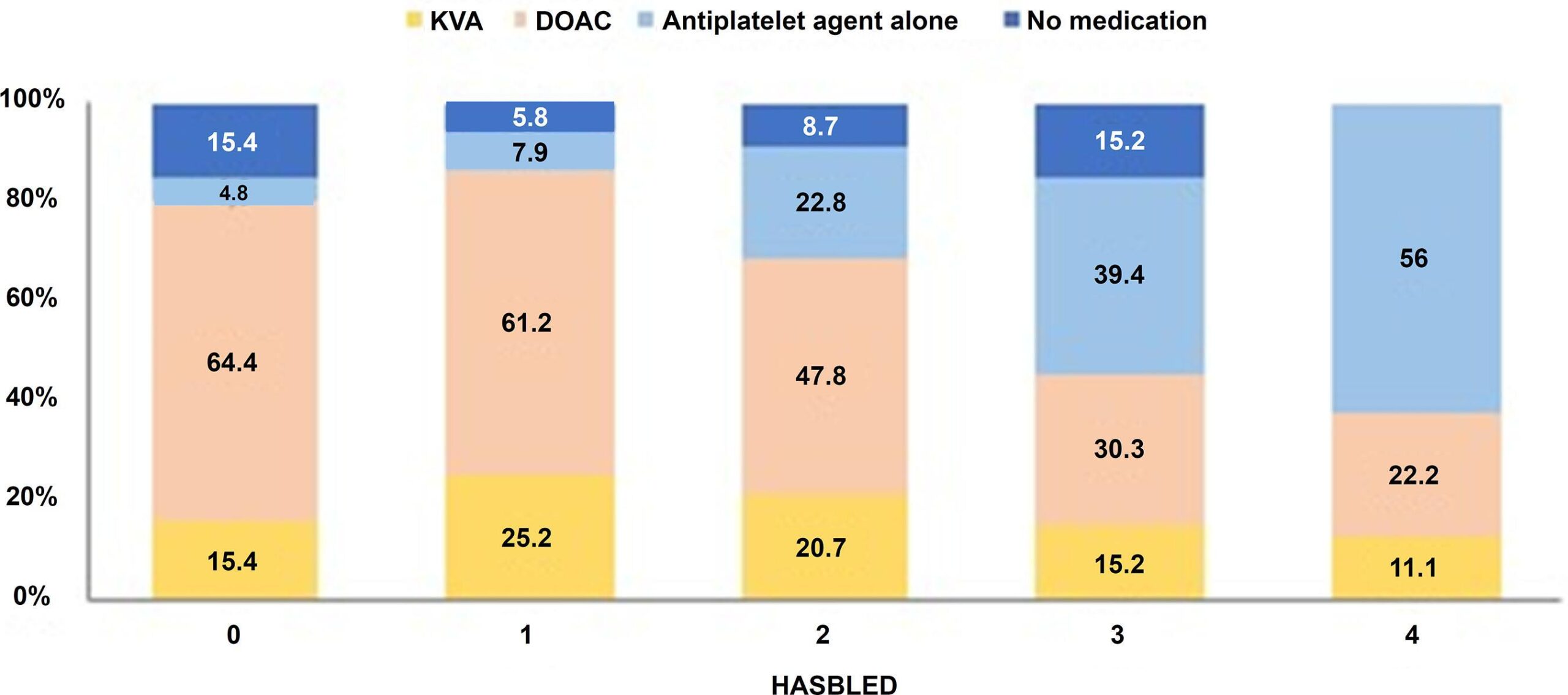
A total of 377 patients were analyzed. The mean age was 70 ± 15 years; 52% were male and 75% were anticoagulated (20% with VKA and 55% with DOAC). Over 5 years, the overall frequency of anticoagulation increased by 22.4%. The use of DOACs increased from 29% to 70%, whereas the use of VKA decreased from 36% to 17%. The use of antiplatelet agents alone also fell from 21% to 6%. The predictors of anticoagulation were previous episodes of AF (OR 3.1, p < 0.001), hypertension (OR 3.0, p < 0.001) and HASBLED score (OR 0.5, p < 0.001). The predictors of DOAC use were serum creatinine (OR 0.2, p = 0.002), left atrial size (OR 0.9, p = 0.003) and biological valve prosthesis (OR 0.1, p = 0.007). Of the 208 patients using DOACs, 63 (30%) received inadequate prescriptions: 5 with severe drug interactions and 58 with incorrect dosing.

Conclusions:

Between 2011 and 2016, DOACs were rapidly incorporated into clinical practice, replacing AVKs and antiplatelets, and contributing to greater use of anticoagulation in patients with AF.

  • Anticoagulants
  • Atrial Fibrillation
  • Brain Ischemia
  • Thromboembolism/ prevention & control
  • Vitamin K/antagonists & inhibitors
Read Full Article
Creative Commons Attribution (CC BY) Creative Commons license
24/10/2019 DOI: 10.5935/2359-4802.20190083 Views 1
Figure 1
ABC
Original Article

Trends in Mortality Rate from Cardiovascular Disease in Brazil, 1980-2012

Antonio de Padua Mansur et al. Desidério Favarato

Abstract

Background:

Studies have questioned the downward trend in mortality from cardiovascular diseases (CVD) in Brazil in recent years.

Objective:

to analyze recent trends in mortality from ischemic heart disease (IHD) and stroke in the Brazilian population.

Methods:

Mortality and population data were obtained from the Brazilian Institute of Geography and Statistics and the Ministry of Health. Risk of death was adjusted by the direct method, using as reference the world population of 2000. We analyzed trends in mortality from CVD, IHD and stroke in women and men in the periods of 1980-2006 and 2007-2012.

Results:

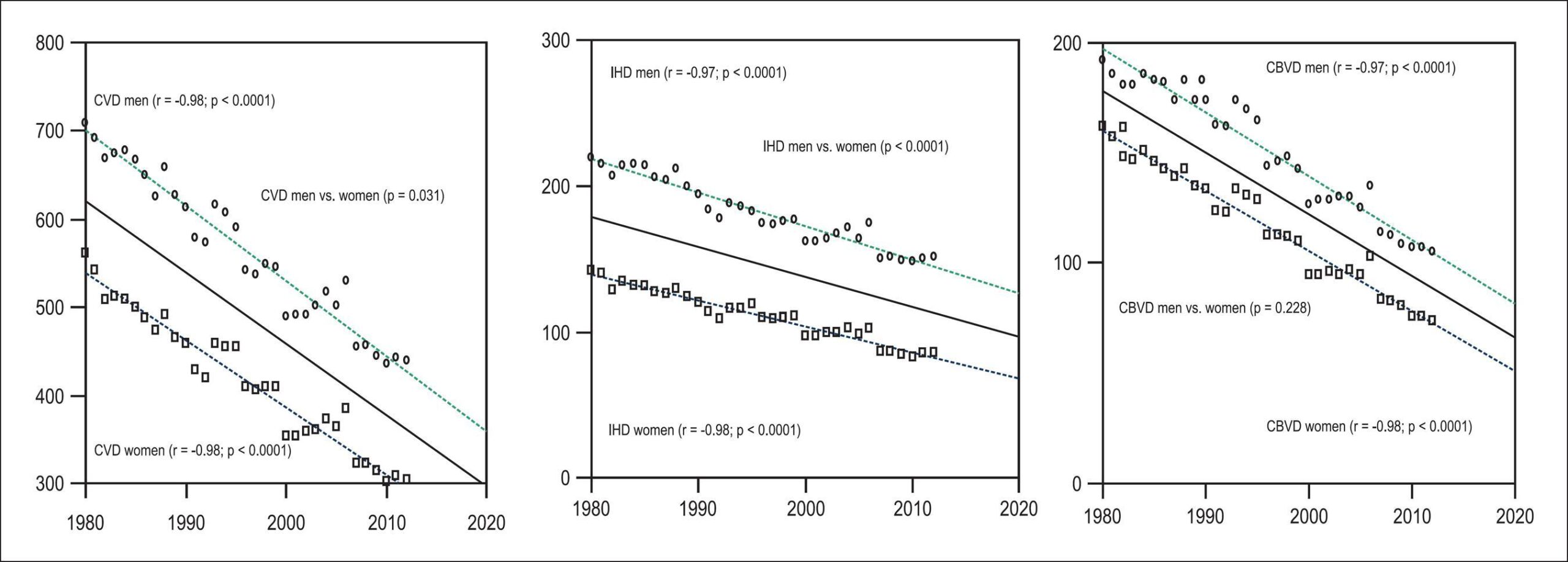
there was a decrease in CVD mortality and stroke in women and men for both periods (p < 0.001). Annual mortality variations for periods 1980-2006 and 2007-2012 were, respectively: CVD (total): -1.5% and -0.8%; CVD men: -1.4% and -0.6%; CVD women: -1.7% and -1.0%; DIC (men): -1.1% and 0.1%; stroke (men): -1.7% and -1.4%; DIC (women): -1.5% and 0.4%; stroke (women): -2.0% and -1.9%. From 1980 to 2006, there was a decrease in IHD mortality in men and women (p < 0.001), but from 2007 to 2012, changes in IHD mortality were not significant in men [y = 151 + 0.04 (R2 = 0.02; p = 0.779)] and women [y = 88-0.54 (R2 = 0.24; p = 0.320).

Conclusion:

Trend in mortality from IHD stopped falling in Brazil from 2007 to 2012.

  • Brain Ischemia
  • Cardiovascular Diseases / epidemiology
  • Mortality/trends
  • Myocardial Ischemia
Read Full Article
Creative Commons Attribution (CC BY) Creative Commons license
24/05/2016 DOI: 10.5935/abc.20160077 Views 1
ABC
Artigo Original

Epidemiologic transition in mortality rate from circulatory diseases in Brazil

Antonio de Padua Mansur et al. Adriano Ibrahim A. Lopes Desidério Favarato Solange Desirée Avakian … Luíz Antonio M. César José Antonio F. Ramires

BACKGROUND: Circulatory diseases (CD) are the major cause of death in Brazil, being cerebrovascular diseases (CVD) predominant. In developed countries ischemic heart diseases (IHD) predominate. OBJECTIVE: The objective of the present study was to investigate the ratio between cerebrovascular diseases/ischemic heart diseases (CVD/IHD) in males and females who were 30 years of age and older. METHODS: Population estimates and mortality data for CD, IHD and CVD were provided by the Ministry of Health for the period between 1980 and 2005. The risk of death from IHD and CVD per 100,000 Brazilians and CVD/IHD ratio were analyzed in 10-year age ranges as of 30 years of age. The risk of death was adjusted by direct method by using 1960 world population as the standard population. RESULTS: It was observed that the risk of death from IHD and CVD increased exponentially as age advanced. CVD was the major cause of death in Brazil until 1996, when IHD took the lead. In the period between 1980 and 2005 a 33.25% reduction in death risk from CD was observed in the Brazilian population. In that same period, the metropolitan area of the capital city of São Paulo reported a 45.44% reduction. The CVD/IHD ratio was shown to be higher among younger women – from 2.53 in 1980 down to 2.04 in 2005 in the Brazilian population, and from 2.76 in 1980 down to 1.96 in the metropolitan area of the capital city of São Paulo, with decreasing figures for subsequent age ranges. Among males, the CVD/IHD ratio was close to < 1 in all age ranges. CONCLUSION: A transition in death risk from CD could be observed in Brazil, with current predominance of IHD.

  • Brain Ischemia
  • Brazil
  • Mortality
  • Myocardial Ischemia
  • São Paulo
  • Urban Population
Read Full Article
Creative Commons Attribution (CC BY) Creative Commons license
06/01/2010 DOI: 10.1590/S0066-782X2009001100011 Views 1

How to cite this article

EndNote RIS

Electronic Document Format (Vancouver)

Netto FM, Otto MEB. My Approach to Patent Foramen Ovale Closure. ABC Imagem Cardiovascular 2024;37(1):e20230103.

Electronic Document Format (ABNT)

Netto, Fernando Melo; Otto, Maria Estefânia Bosco. My Approach to Patent Foramen Ovale Closure. ABC Imagem Cardiovascular, v. 37, n. 1, e20230103, Feb. 2024.

Electronic Document Format (APA)

Netto, F. M., & Otto, M. E. B. (2024). My Approach to Patent Foramen Ovale Closure. ABC Imagem Cardiovascular, 37(1), e20230103.

Electronic Document Format (ISO)

Netto, Fernando Melo and Otto, Maria Estefânia Bosco. My Approach to Patent Foramen Ovale Closure. ABC Imagem Cardiovascular [online]. 2024, vol. 37, n. 1, [cited 2026-10-14], e20230103. Available from: <https://journals.cardiol.br/en/article/my-approach-to-patent-foramen-ovale-closure/>. ISSN 2318-8219

EndNote RIS

Electronic Document Format (Vancouver)

Freitas EL, Sampaio ES, Oliveira MMC, Oliveira LH, Guimarães MSS, Pinheiro JO, Magalhães LP, et al. Atrial High-Rate Episodes and Their Association with Cerebral Ischemic Events in Chagasic Patients. Arquivos Brasileiros de Cardiologia 2020;115(6):1072-9.

Electronic Document Format (ABNT)

Freitas, Emanoela Lima; Sampaio, Elieusa e Silva; Oliveira, Márcia Maria Carneiro; Oliveira, Lucas Hollanda; Guimarães, Marcos Sergio da Silva; Pinheiro, Jussara de Oliveira; Magalhães, Luís Pereira de; Albuquerque, Guisela Steffen Bonadie; Macedo, Cristiano; Aras, Roque. Atrial High-Rate Episodes and Their Association with Cerebral Ischemic Events in Chagasic Patients. Arquivos Brasileiros de Cardiologia, v. 115, n. 6, p. 1072-1079, Sep. 2020.

Electronic Document Format (APA)

Freitas, E. L., Sampaio, E. S., Oliveira, M. M. C., Oliveira, L. H., Guimarães, M. S. S., Pinheiro, J. O., Magalhães, L. P. , Albuquerque, G. S. B., Macedo, C., & Aras, R. (2020). Atrial High-Rate Episodes and Their Association with Cerebral Ischemic Events in Chagasic Patients. Arquivos Brasileiros de Cardiologia, 115(6), 1072-1079.

Electronic Document Format (ISO)

Freitas, Emanoela Lima and Sampaio, Elieusa e Silva and Oliveira, Márcia Maria Carneiro and Oliveira, Lucas Hollanda and Guimarães, Marcos Sergio da Silva and Pinheiro, Jussara de Oliveira and Magalhães, Luís Pereira de and Albuquerque, Guisela Steffen Bonadie and Macedo, Cristiano and Aras, Roque. Atrial High-Rate Episodes and Their Association with Cerebral Ischemic Events in Chagasic Patients. Arquivos Brasileiros de Cardiologia [online]. 2020, vol. 115, n. 6, [cited 2026-10-14], pp. 1072-1079. Available from: <https://journals.cardiol.br/en/article/atrial-high-rate-episodes-and-their-association-with-cerebral-ischemic-events-in-chagasic-patients/>. ISSN 0066-782X

EndNote RIS

Electronic Document Format (Vancouver)

Bronchtein AIC. Challenges for Anticoagulation in Atrial Fibrillation. International Journal of Cardiovascular Sciences 2020;33(1):65-7.

Electronic Document Format (ABNT)

Bronchtein, Ana Inês da Costa. Challenges for Anticoagulation in Atrial Fibrillation. International Journal of Cardiovascular Sciences, v. 33, n. 1, p. 65-67, Feb. 2020.

Electronic Document Format (APA)

Bronchtein, A. I. C. (2020). Challenges for Anticoagulation in Atrial Fibrillation. International Journal of Cardiovascular Sciences, 33(1), 65-67.

Electronic Document Format (ISO)

Bronchtein, Ana Inês da Costa. Challenges for Anticoagulation in Atrial Fibrillation. International Journal of Cardiovascular Sciences [online]. 2020, vol. 33, n. 1, [cited 2026-10-14], pp. 65-67. Available from: <https://journals.cardiol.br/en/article/challenges-for-anticoagulation-in-atrial-fibrillation/>. ISSN 2359-4802

EndNote RIS

Electronic Document Format (Vancouver)

Geraldes MFA, Darze ES, Rocha PN. Trends and Predictors of Oral Anticoagulation in Patients with Atrial Fibrillation: A Serial Cross-Sectional Study from 2011 to 2016. International Journal of Cardiovascular Sciences 2019;33(1):68-7.

Electronic Document Format (ABNT)

Geraldes, Maria de Fátima de Araújo; Darze, Eduardo Sahade; Rocha, Paulo Novis. Trends and Predictors of Oral Anticoagulation in Patients with Atrial Fibrillation: A Serial Cross-Sectional Study from 2011 to 2016. International Journal of Cardiovascular Sciences, v. 33, n. 1, p. 68-78, Oct. 2019.

Electronic Document Format (APA)

Geraldes, M. F. A., Darze, E. S., & Rocha, P. N. (2019). Trends and Predictors of Oral Anticoagulation in Patients with Atrial Fibrillation: A Serial Cross-Sectional Study from 2011 to 2016. International Journal of Cardiovascular Sciences, 33(1), 68-78.

Electronic Document Format (ISO)

Geraldes, Maria de Fátima de Araújo and Darze, Eduardo Sahade and Rocha, Paulo Novis. Trends and Predictors of Oral Anticoagulation in Patients with Atrial Fibrillation: A Serial Cross-Sectional Study from 2011 to 2016. International Journal of Cardiovascular Sciences [online]. 2019, vol. 33, n. 1, [cited 2026-10-14], pp. 68-78. Available from: <https://journals.cardiol.br/en/article/trends-and-predictors-of-oral-anticoagulation-in-patients-with-atrial-fibrillation-a-serial-cross-sectional-study-from-2011-to-2016/>. ISSN 2359-4802

EndNote RIS

Electronic Document Format (Vancouver)

Mansur AP, Favarato D. Trends in Mortality Rate from Cardiovascular Disease in Brazil, 1980-2012. Arquivos Brasileiros de Cardiologia 2016;107(1):20-5.

Electronic Document Format (ABNT)

Mansur, Antonio de Padua; Favarato, Desidério. Trends in Mortality Rate from Cardiovascular Disease in Brazil, 1980-2012. Arquivos Brasileiros de Cardiologia, v. 107, n. 1, p. 20-25, May. 2016.

Electronic Document Format (APA)

Mansur, A. P., & Favarato, D. (2016). Trends in Mortality Rate from Cardiovascular Disease in Brazil, 1980-2012. Arquivos Brasileiros de Cardiologia, 107(1), 20-25.

Electronic Document Format (ISO)

Mansur, Antonio de Padua and Favarato, Desidério. Trends in Mortality Rate from Cardiovascular Disease in Brazil, 1980-2012. Arquivos Brasileiros de Cardiologia [online]. 2016, vol. 107, n. 1, [cited 2026-10-14], pp. 20-25. Available from: <https://journals.cardiol.br/en/article/trends-in-mortality-rate-from-cardiovascular-disease-in-brazil-1980-2012/>. ISSN 0066-782X

EndNote RIS

Electronic Document Format (Vancouver)

Mansur AP, Lopes AIA, Favarato D, Avakian SD, César LAM, Ramires JAF. Epidemiologic transition in mortality rate from circulatory diseases in Brazil. Arquivos Brasileiros de Cardiologia 2010;93(5):506-10.

Electronic Document Format (ABNT)

Mansur, Antonio de Padua; Lopes, Adriano Ibrahim A.; Favarato, Desidério; Avakian, Solange Desirée; César, Luíz Antonio M.; Ramires, José Antonio F.. Epidemiologic transition in mortality rate from circulatory diseases in Brazil. Arquivos Brasileiros de Cardiologia, v. 93, n. 5, p. 506-510, Jan. 2010.

Electronic Document Format (APA)

Mansur, A. P., Lopes, A. I. A., Favarato, D., Avakian, S. D., César, L. A. M., & Ramires, J. A. F. (2010). Epidemiologic transition in mortality rate from circulatory diseases in Brazil. Arquivos Brasileiros de Cardiologia, 93(5), 506-510.

Electronic Document Format (ISO)

Mansur, Antonio de Padua and Lopes, Adriano Ibrahim A. and Favarato, Desidério and Avakian, Solange Desirée and César, Luíz Antonio M. and Ramires, José Antonio F.. Epidemiologic transition in mortality rate from circulatory diseases in Brazil. Arquivos Brasileiros de Cardiologia [online]. 2010, vol. 93, n. 5, [cited 2026-10-14], pp. 506-510. Available from: <https://journals.cardiol.br/en/article/epidemiologic-transition-in-mortality-rate-from-circulatory-diseases-in-brazil/>. ISSN 0066-782X

  • About ABC Family
  • Internal Regulation
  • Editorial Board
  • Brazilian Society of Cardiology (SBC)

Issues

SBC Guidelines

  • Videos
  • Podcasts
  • News