ABC Family Arquivos Brasileiros de Cardiologia International Journal of Cardiovascular Sciences ABC Heart Failure & Cardiomyopathy ABC Imagem Cardiovascular
Português English
ABC Family
Português English
  • About
    • About ABC Family
    • Internal Regulation
    • Editorial Board
    • Brazilian Society of Cardiology (SBC)
  • Issues
  • SBC Guidelines
  • Content
    • Videos
    • Podcasts
    • News
  • About
    • About ABC Family
    • Internal Regulation
    • Editorial Board
    • Brazilian Society of Cardiology (SBC)
  • Issues
  • SBC Guidelines
  • Content
    • Videos
    • Podcasts
    • News

ABC Family

  • ABC Family
  • Arquivos Brasileiros de Cardiologia
  • International Journal of Cardiovascular Sciences
  • ABC Heart Failure & Cardiomyopathy
  • ABC Imagem Cardiovascular
Search in

No content found.

Journals
Ordering
Article types
Others

  1. Home
  2. Keyword: Mortality/trends
Figure 1
ABC
Viewpoint

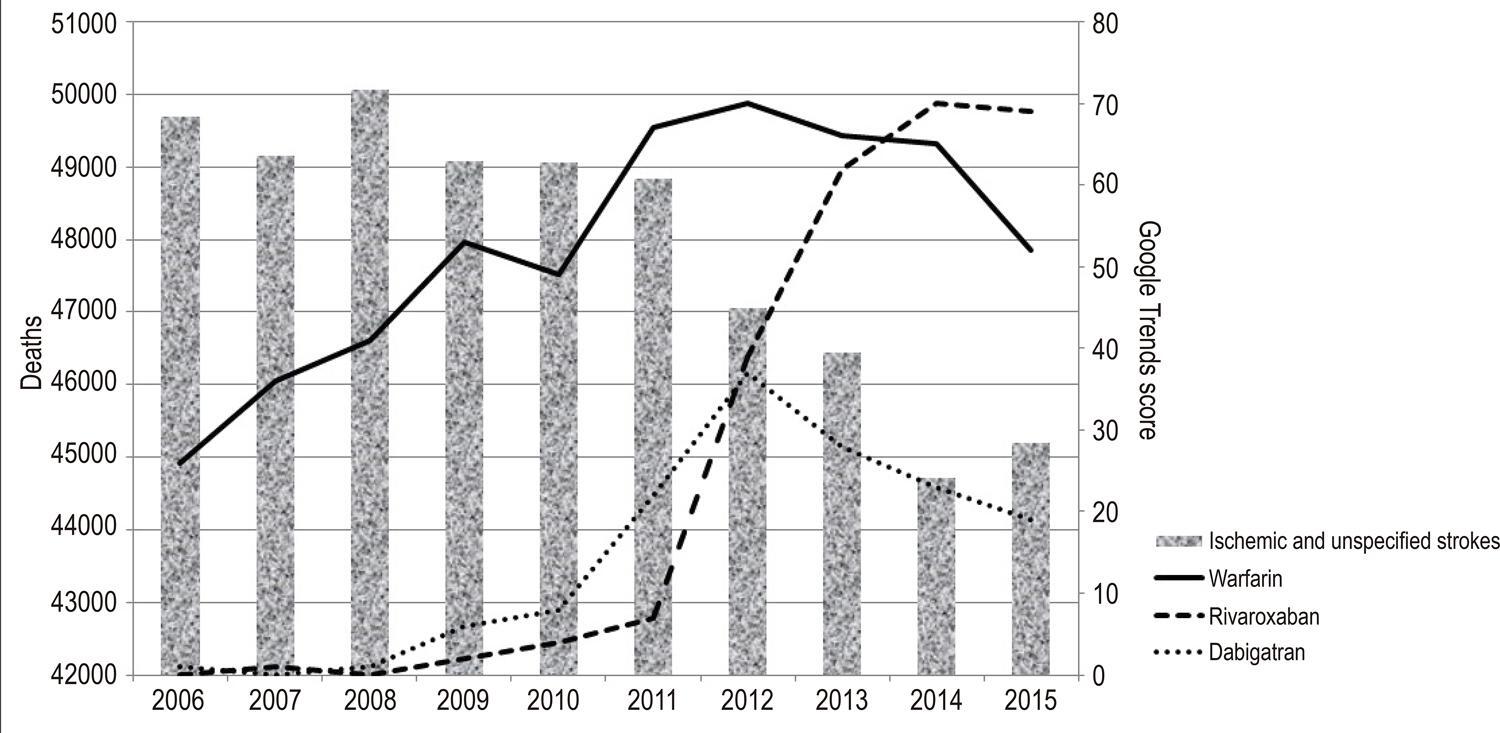
Internet Search Trends and Regional Mortality Tendencies: The Case of Oral Anticoagulants and Stroke

Roberto Muniz Ferreira et al. Ísis da Capela Pinheiro João Roquette Fleury da Rocha

Introduction

Multiple studies have found that up to 30% of ischemic strokes are associated with atrial fibrillation (AF), especially in the elderly population. , Although the embolic risk varies according to clinical characteristics and comorbidities, anticoagulant therapy has consistently shown to reduce stroke rates by approximately 70%. However, previous studies demonstrated that treatment rates with warfarin were low, even in patients at high risk for embolic events. Despite evidence from various publications demonstrating the effectiveness and safety of vitamin K antagonists, their complex pharmacokinetics and the need for continuous monitoring and frequent dose adjustments were the main explanations for low adherence.

Over the last 10 years, four direct oral anticoagulants (DOAC) have become available to prevent embolic events in patients with non-valvular AF: dabigatran, rivaroxaban, apixaban and edoxaban. In August 2011, dabigatran was the first DOAC approved in Brazil for stroke prevention, followed by rivaroxaban four months later. Two years later, apixaban was also introduced in the Brazilian market and only in February 2018 edoxaban became available. When compared to warfarin, multiple trials have suggested that DOACs are non-inferior in preventing ischemic strokes and possibly superior in reducing mortality, perhaps due to fewer intracranial hemorrhages. In addition to waive the need for laboratory monitoring, they have more predictable pharmacokinetics and a lower incidence of drug-to-drug interactions. Recent studies have demonstrated an increase in anticoagulation prescription rates among physicians since DOACs have become clinically available.

[…]
  • Anticoagulants / therapeutic use
  • Dabigatran
  • Mortality/trends
  • Myocardial Ischemia/prevention and control
  • Pharmaceutical Services, Online/trends
  • Rivaroxaban
  • Stroke/prevention and control
  • Varfarin
Read Full Article
Creative Commons Attribution (CC BY) Creative Commons license
29/05/2020 DOI: 10.36660/abc.20190768
Figure 1
ABC
Original Article

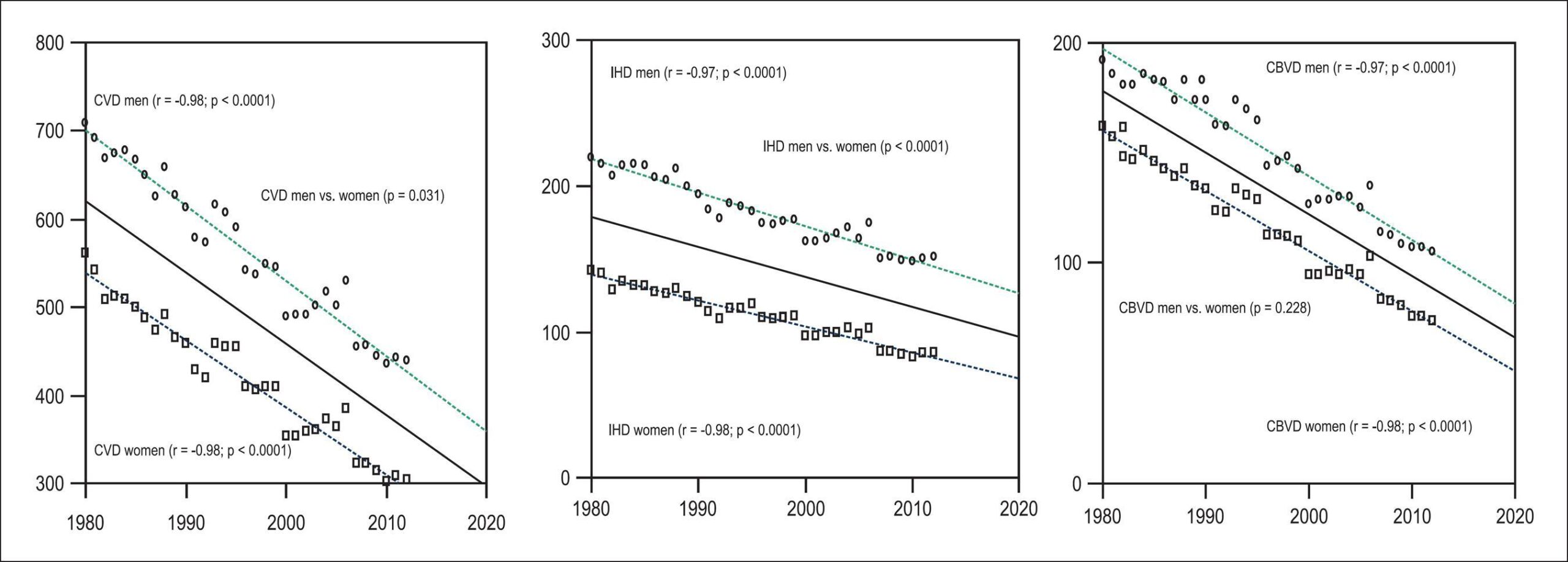
Trends in Mortality Rate from Cardiovascular Disease in Brazil, 1980-2012

Antonio de Padua Mansur et al. Desidério Favarato

Abstract

Background:

Studies have questioned the downward trend in mortality from cardiovascular diseases (CVD) in Brazil in recent years.

Objective:

to analyze recent trends in mortality from ischemic heart disease (IHD) and stroke in the Brazilian population.

Methods:

Mortality and population data were obtained from the Brazilian Institute of Geography and Statistics and the Ministry of Health. Risk of death was adjusted by the direct method, using as reference the world population of 2000. We analyzed trends in mortality from CVD, IHD and stroke in women and men in the periods of 1980-2006 and 2007-2012.

Results:

there was a decrease in CVD mortality and stroke in women and men for both periods (p < 0.001). Annual mortality variations for periods 1980-2006 and 2007-2012 were, respectively: CVD (total): -1.5% and -0.8%; CVD men: -1.4% and -0.6%; CVD women: -1.7% and -1.0%; DIC (men): -1.1% and 0.1%; stroke (men): -1.7% and -1.4%; DIC (women): -1.5% and 0.4%; stroke (women): -2.0% and -1.9%. From 1980 to 2006, there was a decrease in IHD mortality in men and women (p < 0.001), but from 2007 to 2012, changes in IHD mortality were not significant in men [y = 151 + 0.04 (R2 = 0.02; p = 0.779)] and women [y = 88-0.54 (R2 = 0.24; p = 0.320).

Conclusion:

Trend in mortality from IHD stopped falling in Brazil from 2007 to 2012.

  • Brain Ischemia
  • Cardiovascular Diseases / epidemiology
  • Mortality/trends
  • Myocardial Ischemia
Read Full Article
Creative Commons Attribution (CC BY) Creative Commons license
24/05/2016 DOI: 10.5935/abc.20160077 Views 1

How to cite this article

EndNote RIS

Electronic Document Format (Vancouver)

Ferreira RM, Pinheiro C, Rocha JRF. Internet Search Trends and Regional Mortality Tendencies: The Case of Oral Anticoagulants and Stroke. Arquivos Brasileiros de Cardiologia 2020;114(4):726-9.

Electronic Document Format (ABNT)

Ferreira, Roberto Muniz; Pinheiro, Ísis da Capela; Rocha, João Roquette Fleury da. Internet Search Trends and Regional Mortality Tendencies: The Case of Oral Anticoagulants and Stroke. Arquivos Brasileiros de Cardiologia, v. 114, n. 4, p. 726-729, May. 2020.

Electronic Document Format (APA)

Ferreira, R. M., Pinheiro, C., & Rocha, J. R. F. (2020). Internet Search Trends and Regional Mortality Tendencies: The Case of Oral Anticoagulants and Stroke. Arquivos Brasileiros de Cardiologia, 114(4), 726-729.

Electronic Document Format (ISO)

Ferreira, Roberto Muniz and Pinheiro, Ísis da Capela and Rocha, João Roquette Fleury da. Internet Search Trends and Regional Mortality Tendencies: The Case of Oral Anticoagulants and Stroke. Arquivos Brasileiros de Cardiologia [online]. 2020, vol. 114, n. 4, [cited 2026-10-14], pp. 726-729. Available from: <https://journals.cardiol.br/en/article/internet-search-trends-and-regional-mortality-tendencies-the-case-of-oral-anticoagulants-and-stroke/>. ISSN 0066-782X

EndNote RIS

Electronic Document Format (Vancouver)

Mansur AP, Favarato D. Trends in Mortality Rate from Cardiovascular Disease in Brazil, 1980-2012. Arquivos Brasileiros de Cardiologia 2016;107(1):20-5.

Electronic Document Format (ABNT)

Mansur, Antonio de Padua; Favarato, Desidério. Trends in Mortality Rate from Cardiovascular Disease in Brazil, 1980-2012. Arquivos Brasileiros de Cardiologia, v. 107, n. 1, p. 20-25, May. 2016.

Electronic Document Format (APA)

Mansur, A. P., & Favarato, D. (2016). Trends in Mortality Rate from Cardiovascular Disease in Brazil, 1980-2012. Arquivos Brasileiros de Cardiologia, 107(1), 20-25.

Electronic Document Format (ISO)

Mansur, Antonio de Padua and Favarato, Desidério. Trends in Mortality Rate from Cardiovascular Disease in Brazil, 1980-2012. Arquivos Brasileiros de Cardiologia [online]. 2016, vol. 107, n. 1, [cited 2026-10-14], pp. 20-25. Available from: <https://journals.cardiol.br/en/article/trends-in-mortality-rate-from-cardiovascular-disease-in-brazil-1980-2012/>. ISSN 0066-782X

  • About ABC Family
  • Internal Regulation
  • Editorial Board
  • Brazilian Society of Cardiology (SBC)

Issues

SBC Guidelines

  • Videos
  • Podcasts
  • News