ABC Family Arquivos Brasileiros de Cardiologia International Journal of Cardiovascular Sciences ABC Heart Failure & Cardiomyopathy ABC Imagem Cardiovascular
Português English
ABC Family
Português English
  • About
    • About ABC Family
    • Internal Regulation
    • Editorial Board
    • Brazilian Society of Cardiology (SBC)
  • Issues
  • SBC Guidelines
  • Content
    • Videos
    • Podcasts
    • News
  • About
    • About ABC Family
    • Internal Regulation
    • Editorial Board
    • Brazilian Society of Cardiology (SBC)
  • Issues
  • SBC Guidelines
  • Content
    • Videos
    • Podcasts
    • News

ABC Family

  • ABC Family
  • Arquivos Brasileiros de Cardiologia
  • International Journal of Cardiovascular Sciences
  • ABC Heart Failure & Cardiomyopathy
  • ABC Imagem Cardiovascular
Search in

No content found.

Journals
Ordering
Article types
Others

  1. Home
  2. Keyword: blood pressure determination
Figure 1
IJCS
Original Article

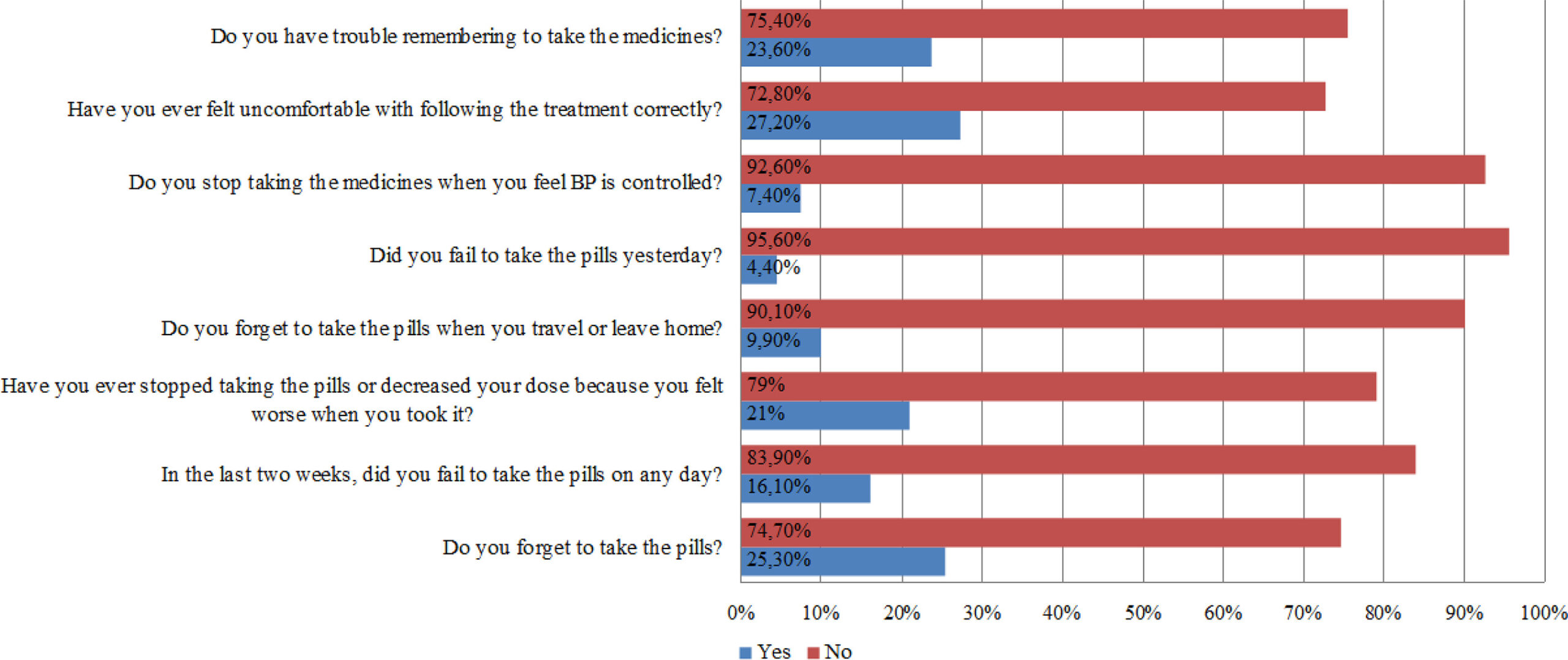
Association between Therapeutic Adherence and the Profile of Patients with Resistant Hypertension

Luciana Baltazar da Silveira de Araújo et al. Roque Aras Junior

Abstract

Background:

Resistant hypertension (RH) consists of increased blood pressure (BP) despite the use of 3 or more antihypertensives or BP control only when is use of 4 or more antihypertensives. It is fundamental to exclude pseudoresistance, which can be attributed to poor therapeutic adherence. Adherence evaluation, generally by the Morisky-Grenn test, is important because, when appropriate, it is associated with fewer cardiovascular complications and better BP control.

Objectives:

To evaluate the adherence of patients with RH and to investigate its relation with epidemiological, anthropometric and clinical characteristics, as well as to estimate the prevalence of pseudoresistance and to outline strategies to improve adherence.

Methods:

Retrospective observational cohort from an interview with patients followed at an outpatient clinic for RH. Therapeutic adherence, demographic, anthropometric data, cardiovascular risk factors, comorbidities, complementary exams and BP level were collected. One-way ANOVA and Student’s t-tests were used for normal variables, and the Kruskal-Wallis and Mann-Whitney tests were used for non-normal tests. Categorical variables were compared using the Chi-Square test. We considered a 5% significance level in all tests.

Results:

217 individuals were included. Of these, 17% had poor adherence. Epidemiological and clinical characteristics, complications, comorbidities, BP level or drugs used were statistically insignificant between groups. The poor adherence group used significantly more drugs (p = 0.0313) and 28% of pseudoresistance was estimated.

Conclusions:

Most of the individuals presented good therapeutic adherence by the Morisky test. Only the number of antihypertensive drugs had a statistically significant influence on adherence, while the epidemiological, anthropometric and clinical characteristics were statistically insignificant.
  • Antihypertensive Agents / pharmacology
  • Antihypertensive Agents/therapeutic use
  • blood pressure determination
  • drug resistance
  • Hypertension
  • Life Style
  • Prognosis
Read Full Article
Creative Commons Attribution (CC BY) Creative Commons license
24/10/2019 DOI: 10.5935/2359-4802.20190077 Views 1
IJCS
Editorial

The Accuracy of Blood Pressure Measurement

Claudio Tinoco Mesquita

The act of measuring a patient’s blood pressure with a stethoscope and a sphygmomanometer is among the most important because of the various clinical implications that may occur. Failure to detect elevated blood pressure levels may expose a patient to the risk of various complications such as stroke, heart failure, kidney failure, and premature atherosclerosis. Conversely, obtaining falsely elevated measures may lead to diagnostic investigations and use of costly and life-threatening drugs. The concern with the proper calibration and validation of blood pressure measurement devices is constant and fundamental for clinical practice. Turner et al., in a detailed computational study, demonstrated that the error resulting from the decalibrated sphygmomanometer accounts for 20% to 28% of cases of undetected systolic and diastolic hypertension and 15% and 31% of cases of falsely diagnosed systolic and diastolic hypertension, respectively.

[…]

  • blood pressure determination
  • Data Accuracy
  • Hypertension/complications
  • measurement equipment
  • Sphygmomanometers
Read Full Article
Creative Commons Attribution (CC BY) Creative Commons license
01/01/2017 DOI: 10.5935/2359-4802.20170041
Validity of a wrist digital monitor for blood pressure measurement in comparison to a mercury sphygmomanometer
ABC
Artigo Original

Validity of a wrist digital monitor for blood pressure measurement in comparison to a mercury sphygmomanometer

Ana M. B. Menezes et al. Samuel C. Dumith Ricardo B. Noal Ana Paula Nunes … Fernanda I. Mendonça Cora L. P. Araújo Marta A. Duval Paulo E. Caruso Pedro C. Hallal

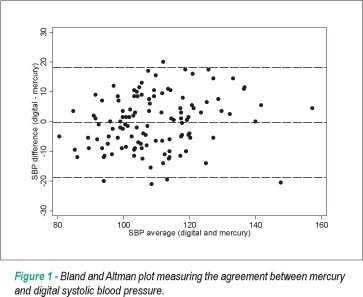
BACKGROUND: Valid measurements of blood pressure, both at clinical and community settings, are essential for monitoring this variable at the population level. OBJECTIVE: To evaluate the validity of a wrist digital monitor for measuring blood pressure among adolescents in comparison to a mercury sphygmomanometer. METHODS: A validation study was carried out in the city of Pelotas, Southern Brazil. Blood pressure was measured twice using two different sphygmomanometers; an OMRON wrist digital and a desktop BD mercury one. Half of the sample was measured first with the digital manometer and subsequently with the mercury one, whereas the remaining half was evaluated in the opposite order. Agreement between both measures was evaluated using the Bland and Altman method. RESULTS: 120 adolescents aged 14 to 15 years were included (50% of each sex). Mean systolic blood pressure among boys was 113.7 mmHg (SD 14.2) when using the mercury manometer and 115.5 mmHg (SD 15.2) when using the digital one. Equivalent values for diastolic blood pressure were 61.5 mmHg (SD 9.9) and 69.6 mmHg (10.2), respectively. Among girls, the mean systolic blood pressure was 104.7 mmHg (SD 10.1) when using the mercury manometer and 102.4 mmHg (SD 11.9) when using the digital device. Values for diastolic blood pressure were 60.0 mmHg (SD 10.4) and 65.7 mmHg (SD 7.7), respectively. CONCLUSIONS: The digital device showed a high level of agreement with the mercury manometer when measuring systolic blood pressure. The level of agreement was lower for diastolic blood pressure. The use of correction equations may be an alternative for studies using this wrist digital monitor in adolescent patients.

  • Adolescent
  • blood pressure determination
  • blood pressure monitors
  • Sphygmomanometers
  • Validation Studies
Read Full Article
Creative Commons Attribution (CC BY) Creative Commons license
28/04/2010 DOI: 10.1590/S0066-782X2010000300014 Views 1

How to cite this article

EndNote RIS

Electronic Document Format (Vancouver)

Araújo LBS, Aras Junior R. Association between Therapeutic Adherence and the Profile of Patients with Resistant Hypertension. International Journal of Cardiovascular Sciences 2019;33(2):121-30.

Electronic Document Format (ABNT)

Araújo, Luciana Baltazar da Silveira de; Aras Junior, Roque. Association between Therapeutic Adherence and the Profile of Patients with Resistant Hypertension. International Journal of Cardiovascular Sciences, v. 33, n. 2, p. 121-130, Oct. 2019.

Electronic Document Format (APA)

Araújo, L. B. S. , & Aras Junior, R. (2019). Association between Therapeutic Adherence and the Profile of Patients with Resistant Hypertension. International Journal of Cardiovascular Sciences, 33(2), 121-130.

Electronic Document Format (ISO)

Araújo, Luciana Baltazar da Silveira de and Aras Junior, Roque. Association between Therapeutic Adherence and the Profile of Patients with Resistant Hypertension. International Journal of Cardiovascular Sciences [online]. 2019, vol. 33, n. 2, [cited 2026-10-14], pp. 121-130. Available from: <https://journals.cardiol.br/en/article/association-between-therapeutic-adherence-and-the-profile-of-patients-with-resistant-hypertension/>. ISSN 2359-4802

EndNote RIS

Electronic Document Format (Vancouver)

Mesquita CT. The Accuracy of Blood Pressure Measurement. International Journal of Cardiovascular Sciences 2017;30(2):98-9.

Electronic Document Format (ABNT)

Mesquita, Claudio Tinoco. The Accuracy of Blood Pressure Measurement. International Journal of Cardiovascular Sciences, v. 30, n. 2, p. 98-99, Dec. 2016.

Electronic Document Format (APA)

Mesquita, C. T. (2017). The Accuracy of Blood Pressure Measurement. International Journal of Cardiovascular Sciences, 30(2), 98-99.

Electronic Document Format (ISO)

Mesquita, Claudio Tinoco. The Accuracy of Blood Pressure Measurement. International Journal of Cardiovascular Sciences [online]. 2017, vol. 30, n. 2, [cited 2026-10-14], pp. 98-99. Available from: <https://journals.cardiol.br/en/article/the-accuracy-of-blood-pressure-measurement/>. ISSN 2359-4802

EndNote RIS

Electronic Document Format (Vancouver)

Menezes AMB, Dumith SC, Noal RB, Nunes AP, Mendonça FI, Araújo CLP, Duval MA, et al. Validity of a wrist digital monitor for blood pressure measurement in comparison to a mercury sphygmomanometer. Arquivos Brasileiros de Cardiologia 2010;94(3):365-70.

Electronic Document Format (ABNT)

Menezes, Ana M. B.; Dumith, Samuel C.; Noal, Ricardo B.; Nunes, Ana Paula; Mendonça, Fernanda I.; Araújo, Cora L. P.; Duval, Marta A.; Caruso, Paulo E.; Hallal, Pedro C.. Validity of a wrist digital monitor for blood pressure measurement in comparison to a mercury sphygmomanometer. Arquivos Brasileiros de Cardiologia, v. 94, n. 3, p. 365-370, Apr. 2010.

Electronic Document Format (APA)

Menezes, A. M. B., Dumith, S. C., Noal, R. B., Nunes, A. P., Mendonça, F. I., Araújo, C. L. P., Duval, M. A., Caruso, P. E., & Hallal, P. C. (2010). Validity of a wrist digital monitor for blood pressure measurement in comparison to a mercury sphygmomanometer. Arquivos Brasileiros de Cardiologia, 94(3), 365-370.

Electronic Document Format (ISO)

Menezes, Ana M. B. and Dumith, Samuel C. and Noal, Ricardo B. and Nunes, Ana Paula and Mendonça, Fernanda I. and Araújo, Cora L. P. and Duval, Marta A. and Caruso, Paulo E. and Hallal, Pedro C.. Validity of a wrist digital monitor for blood pressure measurement in comparison to a mercury sphygmomanometer. Arquivos Brasileiros de Cardiologia [online]. 2010, vol. 94, n. 3, [cited 2026-10-14], pp. 365-370. Available from: <https://journals.cardiol.br/en/article/validity-of-a-wrist-digital-monitor-for-blood-pressure-measurement-in-comparison-to-a-mercury-sphygmomanometer/>. ISSN 0066-782X

  • About ABC Family
  • Internal Regulation
  • Editorial Board
  • Brazilian Society of Cardiology (SBC)

Issues

SBC Guidelines

  • Videos
  • Podcasts
  • News