ABC Family Arquivos Brasileiros de Cardiologia International Journal of Cardiovascular Sciences ABC Heart Failure & Cardiomyopathy ABC Imagem Cardiovascular
Português English
ABC Family
Português English
  • About
    • About ABC Family
    • Internal Regulation
    • Editorial Board
    • Brazilian Society of Cardiology (SBC)
  • Issues
  • SBC Guidelines
  • Content
    • Videos
    • Podcasts
    • News
  • About
    • About ABC Family
    • Internal Regulation
    • Editorial Board
    • Brazilian Society of Cardiology (SBC)
  • Issues
  • SBC Guidelines
  • Content
    • Videos
    • Podcasts
    • News

ABC Family

  • ABC Family
  • Arquivos Brasileiros de Cardiologia
  • International Journal of Cardiovascular Sciences
  • ABC Heart Failure & Cardiomyopathy
  • ABC Imagem Cardiovascular
Search in

No content found.

Journals
Ordering
Article types
Others

  1. Home
  2. Keyword: blood pressure monitors
ABC
Editorial

Blood Pressure Measurement: There’s More Than Meets the Arm

Rodrigo Bezerra et al. Audes D. M. Feitosa Wilson Nadruz

Hypertension is the most important risk factor for cardiovascular events in the population worldwide. – Therefore, the identification of this risk factor is crucial for the assessment of cardiovascular risk. Non-invasive evaluation of blood pressure (BP) using cuffs in the arms is the recommended method for diagnosing and managing hypertension. However, this evaluation must be done properly and accurately to avoid suboptimal BP measurement and inappropriate management decisions.

The selection of cuff size is a fundamental step in evaluating BP and depends on the arm circumference of the examined individual. A smaller-than-required cuff overestimates BP, while a larger-than-required cuff underestimates BP. Some studies have reported average differences in systolic BP of 6 mmHg when inappropriately sized cuffs are used, even though markedly greater discrepancies can be observed in some individuals. In the United States, approximately 51% of adults with hypertension need large or extra-large cuffs, including 84% of those with obesity and 65% of those aged 18-34. Because obesity is highly prevalent worldwide, these American figures highlight the importance of systematic evaluation of arm circumference for accurate BP measurement in clinical practice.

[…]
  • Adipose Tissue
  • Arms
  • blood pressure monitors
  • Hypertension
  • Obesity
  • Risk Factors
Read Full Article
Creative Commons Attribution (CC BY) Creative Commons license
16/06/2023 DOI: 10.36660/abc.20230274 Views 1
Validity of a wrist digital monitor for blood pressure measurement in comparison to a mercury sphygmomanometer
ABC
Artigo Original

Validity of a wrist digital monitor for blood pressure measurement in comparison to a mercury sphygmomanometer

Ana M. B. Menezes et al. Samuel C. Dumith Ricardo B. Noal Ana Paula Nunes … Fernanda I. Mendonça Cora L. P. Araújo Marta A. Duval Paulo E. Caruso Pedro C. Hallal

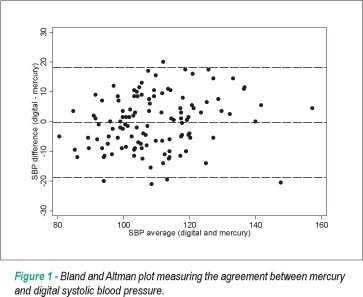
BACKGROUND: Valid measurements of blood pressure, both at clinical and community settings, are essential for monitoring this variable at the population level. OBJECTIVE: To evaluate the validity of a wrist digital monitor for measuring blood pressure among adolescents in comparison to a mercury sphygmomanometer. METHODS: A validation study was carried out in the city of Pelotas, Southern Brazil. Blood pressure was measured twice using two different sphygmomanometers; an OMRON wrist digital and a desktop BD mercury one. Half of the sample was measured first with the digital manometer and subsequently with the mercury one, whereas the remaining half was evaluated in the opposite order. Agreement between both measures was evaluated using the Bland and Altman method. RESULTS: 120 adolescents aged 14 to 15 years were included (50% of each sex). Mean systolic blood pressure among boys was 113.7 mmHg (SD 14.2) when using the mercury manometer and 115.5 mmHg (SD 15.2) when using the digital one. Equivalent values for diastolic blood pressure were 61.5 mmHg (SD 9.9) and 69.6 mmHg (10.2), respectively. Among girls, the mean systolic blood pressure was 104.7 mmHg (SD 10.1) when using the mercury manometer and 102.4 mmHg (SD 11.9) when using the digital device. Values for diastolic blood pressure were 60.0 mmHg (SD 10.4) and 65.7 mmHg (SD 7.7), respectively. CONCLUSIONS: The digital device showed a high level of agreement with the mercury manometer when measuring systolic blood pressure. The level of agreement was lower for diastolic blood pressure. The use of correction equations may be an alternative for studies using this wrist digital monitor in adolescent patients.

  • Adolescent
  • blood pressure determination
  • blood pressure monitors
  • Sphygmomanometers
  • Validation Studies
Read Full Article
Creative Commons Attribution (CC BY) Creative Commons license
28/04/2010 DOI: 10.1590/S0066-782X2010000300014 Views 1
Validation of the omron HEM 742 blood pressure monitoring device in adolescents
ABC
Artigo Original

Validation of the omron HEM 742 blood pressure monitoring device in adolescents

Diego Giulliano Destro Christofaro et al. Rômulo Araújo Fernandes Aline Mendes Gerage Marcelo José Alves … Marcos Doederlein Polito Arli Ramos de Oliveira

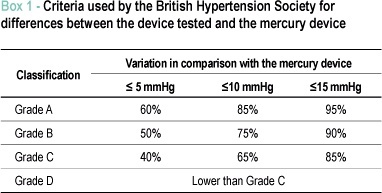
BACKGROUND: Accurate blood pressure measurement is fundamental for scientific investigation or clinical decision-making. In this sense, it is important to verify the values provided by electronic devices. OBJECTIVE: To validate the Omron HEM 742 blood pressure monitoring device in adolescents according to criteria suggested by the British Hypertension Society. METHODS: A total of 150 adolescents aged between 10 and 16 years participated in the study. The automated Omron HEM 742 monitor was connected in Y to the mercury column auscultatory device, then three simultaneous measurements were taken, and the differences between the readings of the two devices were calculated. The intraclass correlation coefficient and Bland-Altman plot (agreement) were used to verify the relationship between both devices. Specificity and sensitivity of the device were determined by using the ROC curve. RESULTS: The comparison between the measurements showed an equal to or lower than 5mmHg difference in 67.3% of the systolic values, and 69.3% of the diastolic values; an equal to or lower than 10mmHg difference occurred in 87.3% and 90.6% of the systolic and diastolic values, respectively; an equal to or lower than 15mmHg difference was found in 96.6% of the systolic values and 97.3% of the diastolic values. These findings are consistent with a grade A according to the British Hypertension Society protocol. A marked consonance was observed between the values obtained by the automated monitor and this device was proven to be capable of identifying the presence or absence of high blood pressure. CONCLUSION: The Omron HEM 742 monitor was proved valid for blood pressure measurement in adolescents according to the criteria suggested by the British Hypertension Society.

  • Adolescent
  • Blood Pressure
  • blood pressure monitors
Read Full Article
Creative Commons Attribution (CC BY) Creative Commons license
04/02/2009 DOI: 10.1590/S0066-782X2009000100003 Views 1

How to cite this article

EndNote RIS

Electronic Document Format (Vancouver)

Bezerra R, Feitosa ADM, Nadruz W. Blood Pressure Measurement: There’s More Than Meets the Arm. Arquivos Brasileiros de Cardiologia 2023;120(5):e20230274.

Electronic Document Format (ABNT)

Bezerra, Rodrigo; Feitosa, Audes D. M.; Nadruz, Wilson. Blood Pressure Measurement: There’s More Than Meets the Arm. Arquivos Brasileiros de Cardiologia, v. 120, n. 5, e20230274, Jun. 2023.

Electronic Document Format (APA)

Bezerra, R., Feitosa, A. D. M., & Nadruz, W. (2023). Blood Pressure Measurement: There’s More Than Meets the Arm. Arquivos Brasileiros de Cardiologia, 120(5), e20230274.

Electronic Document Format (ISO)

Bezerra, Rodrigo and Feitosa, Audes D. M. and Nadruz, Wilson. Blood Pressure Measurement: There’s More Than Meets the Arm. Arquivos Brasileiros de Cardiologia [online]. 2023, vol. 120, n. 5, [cited 2026-10-14], e20230274. Available from: <https://journals.cardiol.br/en/article/blood-pressure-measurement-theres-more-than-meets-the-arm/>. ISSN 0066-782X

EndNote RIS

Electronic Document Format (Vancouver)

Menezes AMB, Dumith SC, Noal RB, Nunes AP, Mendonça FI, Araújo CLP, Duval MA, et al. Validity of a wrist digital monitor for blood pressure measurement in comparison to a mercury sphygmomanometer. Arquivos Brasileiros de Cardiologia 2010;94(3):365-70.

Electronic Document Format (ABNT)

Menezes, Ana M. B.; Dumith, Samuel C.; Noal, Ricardo B.; Nunes, Ana Paula; Mendonça, Fernanda I.; Araújo, Cora L. P.; Duval, Marta A.; Caruso, Paulo E.; Hallal, Pedro C.. Validity of a wrist digital monitor for blood pressure measurement in comparison to a mercury sphygmomanometer. Arquivos Brasileiros de Cardiologia, v. 94, n. 3, p. 365-370, Apr. 2010.

Electronic Document Format (APA)

Menezes, A. M. B., Dumith, S. C., Noal, R. B., Nunes, A. P., Mendonça, F. I., Araújo, C. L. P., Duval, M. A., Caruso, P. E., & Hallal, P. C. (2010). Validity of a wrist digital monitor for blood pressure measurement in comparison to a mercury sphygmomanometer. Arquivos Brasileiros de Cardiologia, 94(3), 365-370.

Electronic Document Format (ISO)

Menezes, Ana M. B. and Dumith, Samuel C. and Noal, Ricardo B. and Nunes, Ana Paula and Mendonça, Fernanda I. and Araújo, Cora L. P. and Duval, Marta A. and Caruso, Paulo E. and Hallal, Pedro C.. Validity of a wrist digital monitor for blood pressure measurement in comparison to a mercury sphygmomanometer. Arquivos Brasileiros de Cardiologia [online]. 2010, vol. 94, n. 3, [cited 2026-10-14], pp. 365-370. Available from: <https://journals.cardiol.br/en/article/validity-of-a-wrist-digital-monitor-for-blood-pressure-measurement-in-comparison-to-a-mercury-sphygmomanometer/>. ISSN 0066-782X

EndNote RIS

Electronic Document Format (Vancouver)

Christofaro DGD, Fernandes RA, Gerage AM, Alves MJ, Polito MD, Oliveira AR. Validation of the omron HEM 742 blood pressure monitoring device in adolescents. Arquivos Brasileiros de Cardiologia 2009;92(1):10-5.

Electronic Document Format (ABNT)

Christofaro, Diego Giulliano Destro; Fernandes, Rômulo Araújo; Gerage, Aline Mendes; Alves, Marcelo José; Polito, Marcos Doederlein; Oliveira, Arli Ramos de. Validation of the omron HEM 742 blood pressure monitoring device in adolescents. Arquivos Brasileiros de Cardiologia, v. 92, n. 1, p. 10-15, Feb. 2009.

Electronic Document Format (APA)

Christofaro, D. G. D., Fernandes, R. A., Gerage, A. M., Alves, M. J., Polito, M. D., & Oliveira, A. R. (2009). Validation of the omron HEM 742 blood pressure monitoring device in adolescents. Arquivos Brasileiros de Cardiologia, 92(1), 10-15.

Electronic Document Format (ISO)

Christofaro, Diego Giulliano Destro and Fernandes, Rômulo Araújo and Gerage, Aline Mendes and Alves, Marcelo José and Polito, Marcos Doederlein and Oliveira, Arli Ramos de. Validation of the omron HEM 742 blood pressure monitoring device in adolescents. Arquivos Brasileiros de Cardiologia [online]. 2009, vol. 92, n. 1, [cited 2026-10-14], pp. 10-15. Available from: <https://journals.cardiol.br/en/article/validation-of-the-omron-hem-742-blood-pressure-monitoring-device-in-adolescents/>. ISSN 0066-782X

  • About ABC Family
  • Internal Regulation
  • Editorial Board
  • Brazilian Society of Cardiology (SBC)

Issues

SBC Guidelines

  • Videos
  • Podcasts
  • News