ABC Family Arquivos Brasileiros de Cardiologia International Journal of Cardiovascular Sciences ABC Heart Failure & Cardiomyopathy ABC Imagem Cardiovascular
Português English
ABC Family
Português English
  • About
    • About ABC Family
    • Internal Regulation
    • Editorial Board
    • Brazilian Society of Cardiology (SBC)
  • Issues
  • SBC Guidelines
  • Content
    • Videos
    • Podcasts
    • News
  • About
    • About ABC Family
    • Internal Regulation
    • Editorial Board
    • Brazilian Society of Cardiology (SBC)
  • Issues
  • SBC Guidelines
  • Content
    • Videos
    • Podcasts
    • News

ABC Family

  • ABC Family
  • Arquivos Brasileiros de Cardiologia
  • International Journal of Cardiovascular Sciences
  • ABC Heart Failure & Cardiomyopathy
  • ABC Imagem Cardiovascular
Search in

No content found.

Journals
Ordering
Article types
Others

  1. Home
  2. Keyword: anticholesteremic agents
ABC
Editorial

Achieving LDL-Cholesterol Goals: Can Implementation Science Save Us?

Fernando Yue Cesena

Atherosclerotic cardiovascular disease (ASCVD) is the leading cause of death worldwide,, and individuals who have already experienced an ASCVD event are at the highest risk of a new event. Achieving low levels of LDL-cholesterol (LDL-c) is a proven and safe strategy for preventing subsequent events. Current guidelines recommend LDL-c levels below 50 mg/dL or 55 mg/dL in secondary prevention., Available therapies, including statins, ezetimibe, anti-PCSK9 agents, and bempedoic acid, are sufficient for most patients to achieve LDL-c targets. Nevertheless, the widespread failure to attain these goals has been extensively reported globally.–

This issue of Arquivos Brasileiros de Cardiologia presents a study that investigated the prescription practices of 29 Brazilian cardiologists for LDL-c management in secondary prevention, estimating the number of patients potentially eligible for therapies beyond statins and ezetimibe. Physicians working in the Public Health System (PHS) or Supplementary Health System (SHS) completed a questionnaire regarding their clinical practices. The authors estimated that, among patients whose cardiologists aimed for LDL-c targets (92% of the total), 79% in the PHS and 86% in the SHS would achieve the desired LDL-c levels using statins and ezetimibe alone. By estimating the total number of individuals in secondary prevention in Brazil in 2024, the authors concluded that over one million individuals in the PHS and ~150.000 in the SHS would be potential candidates to lipid-lowering therapy beyond statins and ezetimibe. These results provide compelling support for improving access to modern lipid-lowering medications, such as anti-PCSK9 agents.

[…]

  • anticholesteremic agents
  • Cardiovascular Diseases
  • Implementation Science
  • Secondary Prevention
Read Full Article
Creative Commons Attribution (CC BY) Creative Commons license
03/10/2025 DOI: 10.36660/abc.20250516i
ABC
Editorial

Achievement of LDL-cholesterol Targets: Why do We Fail, and How Can We Improve?

Fernando Cesena

Atherosclerotic cardiovascular disease (ASCVD) remains the first cause of death in the world, and Brazil., Individuals with previous ASCVD are at the highest risk of subsequent events, and guidelines recommend aggressive lowering of low-density lipoprotein cholesterol (LDL-c) levels to prevent bad outcomes.,

However, several reports from around the world indicate a gap between guideline recommendations and clinical practice, and a large proportion of the population, especially in secondary prevention, lives with LDL-c levels above those considered reasonable to prevent events.– Indeed, lack of adherence to guideline-recommended therapies was independently associated with major cardiovascular events in a Brazilian population after acute coronary syndrome.

[…]

  • anticholesteremic agents
  • Cardiovascular Diseases
  • Hypercholesterolemia
  • Practice Guideline
  • Quality of Health Care
Read Full Article
Creative Commons Attribution (CC BY) Creative Commons license
10/06/2022 DOI: 10.36660/abc.20220288 Views 2
Rosuvastatin and ciprofibrate in the treatment of dyslipidemia in patients with HIV
ABC
Artigo Original

Rosuvastatin and ciprofibrate in the treatment of dyslipidemia in patients with HIV

Hamilton Domingos et al. Rivaldo Venâncio da Cunha Anamaria Mello Miranda Paniago Albert Schiaveto de Souza … Renata London Rodrigues João Américo Domingos

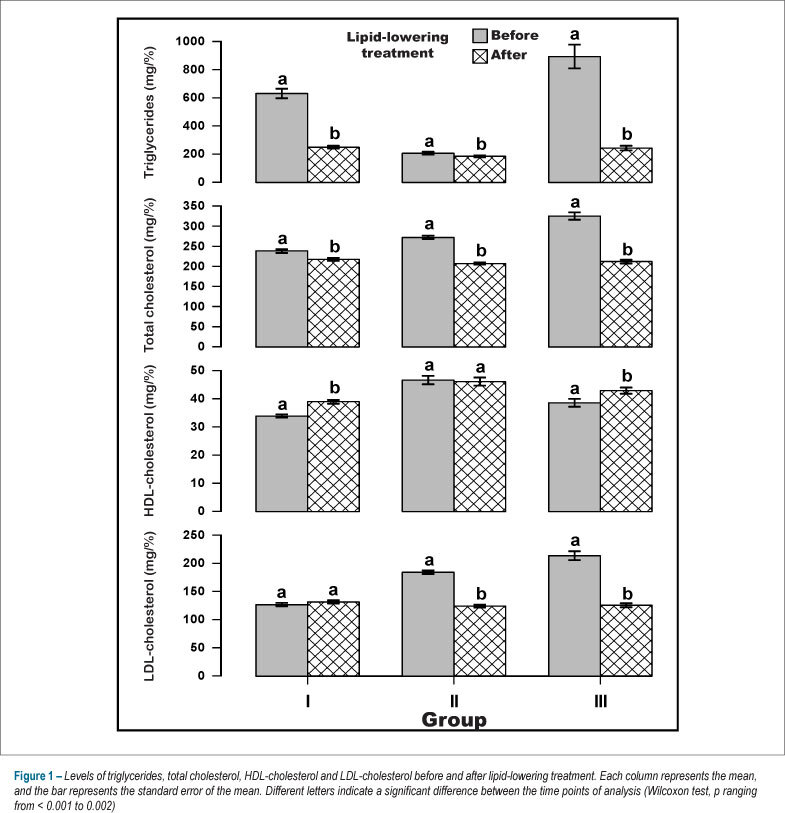
BACKGROUND: Dyslipidemia secondary to highly active antiretroviral therapy in patients with HIV is associated with a significant increase in cardiovascular morbidity and mortality due to atherosclerotic disease, requiring, thus, immediate and effective treatment. OBJECTIVE: To demonstrate the effectiveness and safety of rosuvastatin and ciprofibrate in the treatment of dyslipidemia associated with highly active antiretroviral therapy in patients with HIV. METHODS: Three hundred and forty-six patients with dyslipidemia underwent pharmacological treatment as follows: 200 patients with hypertriglyceridemia received ciprofibrate (Group I); 79 patients with hypercholesterolemia received rosuvastatin (Group II); and 67 patients with mixed dyslipidemia received ciprofibrate associated with rosuvastatin (Group III). The lipid profile was assessed before and after the lipid-lowering treatment, and the Wilcoxon test was used for statistical comparison. Liver transaminases and creatine phosphokinase were measured to assess liver and muscle toxicity. RESULTS: The serum concentrations of triglycerides and total cholesterol were significantly lower than those obtained before the lipid-lowering treatment in the three experimental groups (p < 0.002). A significant increase in HDL-cholesterol was observed in Groups I and III (p < 0.002). In Groups I and II, LDL-cholesterol was significantly lower (p < 0.001). None of the patients experienced elevations in transaminases or creatine phosphokinase to significantly toxic levels. CONCLUSION: The results of this study show that ciprofibrate and rosuvastatin or a combination of both can be considered an effective, safe and well-tolerated lipid-lowering treatment for patients with AIDS on highly active antiretroviral therapy.

  • anticholesteremic agents
  • Antiretroviral Therapy
  • Dyslipidemias
  • fibric acids
  • Highly Active
  • HIV
Read Full Article
Creative Commons Attribution (CC BY) Creative Commons license
30/10/2012 DOI: 10.1590/S0066-782X2012005000096

How to cite this article

EndNote RIS

Electronic Document Format (Vancouver)

Cesena FY. Achieving LDL-Cholesterol Goals: Can Implementation Science Save Us?. Arquivos Brasileiros de Cardiologia 2025;122(7):e20250516.

Electronic Document Format (ABNT)

Cesena, Fernando Yue. Achieving LDL-Cholesterol Goals: Can Implementation Science Save Us?. Arquivos Brasileiros de Cardiologia, v. 122, n. 7, e20250516, Oct. 2025.

Electronic Document Format (APA)

Cesena, F. Y. (2025). Achieving LDL-Cholesterol Goals: Can Implementation Science Save Us?. Arquivos Brasileiros de Cardiologia, 122(7), e20250516.

Electronic Document Format (ISO)

Cesena, Fernando Yue. Achieving LDL-Cholesterol Goals: Can Implementation Science Save Us?. Arquivos Brasileiros de Cardiologia [online]. 2025, vol. 122, n. 7, [cited 2026-10-14], e20250516. Available from: <https://journals.cardiol.br/en/article/achieving-ldl-cholesterol-goals-can-implementation-science-save-us/>. ISSN 0066-782X

EndNote RIS

Electronic Document Format (Vancouver)

Cesena F. Achievement of LDL-cholesterol Targets: Why do We Fail, and How Can We Improve?. Arquivos Brasileiros de Cardiologia 2022;118(6):1026-7.

Electronic Document Format (ABNT)

Cesena, Fernando. Achievement of LDL-cholesterol Targets: Why do We Fail, and How Can We Improve?. Arquivos Brasileiros de Cardiologia, v. 118, n. 6, p. 1026-1027, Jun. 2022.

Electronic Document Format (APA)

Cesena, F. (2022). Achievement of LDL-cholesterol Targets: Why do We Fail, and How Can We Improve?. Arquivos Brasileiros de Cardiologia, 118(6), 1026-1027.

Electronic Document Format (ISO)

Cesena, Fernando. Achievement of LDL-cholesterol Targets: Why do We Fail, and How Can We Improve?. Arquivos Brasileiros de Cardiologia [online]. 2022, vol. 118, n. 6, [cited 2026-10-14], pp. 1026-1027. Available from: <https://journals.cardiol.br/en/article/achievement-of-ldl-cholesterol-targets-why-do-we-fail-and-how-can-we-improve/>. ISSN 0066-782X

EndNote RIS

Electronic Document Format (Vancouver)

Domingos H, Cunha RV, Paniago AMM, Souza AS, Rodrigues RL, Domingos JA. Rosuvastatin and ciprofibrate in the treatment of dyslipidemia in patients with HIV. Arquivos Brasileiros de Cardiologia 2012;99(5):997-1007.

Electronic Document Format (ABNT)

Domingos, Hamilton; Cunha, Rivaldo Venâncio da; Paniago, Anamaria Mello Miranda; Souza, Albert Schiaveto de; Rodrigues, Renata London; Domingos, João Américo. Rosuvastatin and ciprofibrate in the treatment of dyslipidemia in patients with HIV. Arquivos Brasileiros de Cardiologia, v. 99, n. 5, p. 997-1007, Oct. 2012.

Electronic Document Format (APA)

Domingos, H., Cunha, R. V. , Paniago, A. M. M., Souza, A. S. , Rodrigues, R. L., & Domingos, J. A. (2012). Rosuvastatin and ciprofibrate in the treatment of dyslipidemia in patients with HIV. Arquivos Brasileiros de Cardiologia, 99(5), 997-1007.

Electronic Document Format (ISO)

Domingos, Hamilton and Cunha, Rivaldo Venâncio da and Paniago, Anamaria Mello Miranda and Souza, Albert Schiaveto de and Rodrigues, Renata London and Domingos, João Américo. Rosuvastatin and ciprofibrate in the treatment of dyslipidemia in patients with HIV. Arquivos Brasileiros de Cardiologia [online]. 2012, vol. 99, n. 5, [cited 2026-10-14], pp. 997-1007. Available from: <https://journals.cardiol.br/en/article/rosuvastatin-and-ciprofibrate-in-the-treatment-of-dyslipidemia-in-patients-with-hiv/>. ISSN 0066-782X

  • About ABC Family
  • Internal Regulation
  • Editorial Board
  • Brazilian Society of Cardiology (SBC)

Issues

SBC Guidelines

  • Videos
  • Podcasts
  • News