ABC Family Arquivos Brasileiros de Cardiologia International Journal of Cardiovascular Sciences ABC Heart Failure & Cardiomyopathy ABC Imagem Cardiovascular
Português English
ABC Family
Português English
  • About
    • About ABC Family
    • Internal Regulation
    • Editorial Board
    • Brazilian Society of Cardiology (SBC)
  • Issues
  • SBC Guidelines
  • Content
    • Videos
    • Podcasts
    • News
  • About
    • About ABC Family
    • Internal Regulation
    • Editorial Board
    • Brazilian Society of Cardiology (SBC)
  • Issues
  • SBC Guidelines
  • Content
    • Videos
    • Podcasts
    • News

ABC Family

  • ABC Family
  • Arquivos Brasileiros de Cardiologia
  • International Journal of Cardiovascular Sciences
  • ABC Heart Failure & Cardiomyopathy
  • ABC Imagem Cardiovascular
Search in

No content found.

Journals
Ordering
Article types
Others

  1. Home
  2. Keyword: Adropin
ABC
Editorial

Another Player in Increasing Collateral Circulation in the Heart – Another Potential Therapeutic Target in Cardiovascular Medicine?

Luis Henrique Wolff Gowdak

Richard Lower of Amsterdam first called attention to channels connecting the right and left coronary arteries in 1669. The Swiss anatomist Albrecht von Haller demonstrated these anastomoses by dissecting the coronary arteries. So, for centuries now, the presence of a well-developed collateral network providing blood supply to an underperfused myocardium has gained significant interest in physiology and physiopathology, and later, in therapeutics. Many questions kept scientists working restlessly to unravel the key players favoring the development of collateral vessels in the heart.

The coronary collateral circulation is a preformed network of immature anastomoses which connect the territory supplied by one epicardial coronary artery with that supplied by another. In 1959, Pitt et al. studied the prevalence of interarterial coronary anastomoses in seventy-five hearts obtained from an autopsy. Of the 15 normal hearts, only one (6%) was found to have such anastomoses. In those cases with occlusive coronary artery disease, myocardium fibrosis, or infarction, anastomoses were found in 75% to 100% of the cases. It was clear, from the beginning, that the presence of sustained periods of tissue ischemia was a pre-requisite to incite de establishment of collateral circulation.

[…]

  • Adropin
  • Collateral Circulation
  • Coronary Artery Disease
  • Myocardial Ischemia
  • Neovascularization, Physiologc
Read Full Article
Creative Commons Attribution (CC BY) Creative Commons license
05/09/2022 DOI: 10.36660/abc.20220558 Views 1
Figure 1
ABC
Original Article

Assessment of the Relationship Between the Adropin Levels and the Coronary Collateral Circulation in Patients wıth Chronic Coronary Syndrome

Hasan Akkaya et al. Ertuğrul Emre Güntürk Fulya Akkaya Uğur Karabıyık … İnayet Güntürk Samet Yılmaz

Abstract

Background

Coronary collateral circulation (CCC) provides an alternative blood flow to myocardial tissue exposed to ischemia and helps to preserve myocardial functions. Endothelial-derived nitric-oxide (NO) production and vascular endothelial growth factor (VEGF) have been suggested as the most important factors in the development of CCC. Adropin is a peptide hormone responsible for energy hemostasis, and is known for its positive effects on the endothelium through NO and VEGF.

Objective

The aim of this study is to investigate the association between adropin and the presence of CCC in patients with chronic coronary syndrome (CCS).

Methods

A total of 102 patients with CCS, who had complete occlusion of at least one major epicardial coronary artery, were included in the study and were divided into two groups: the group of patients (n:50) with poor CCC (Rentrop 0-1) and the group of patients (n:52) with good CCC (Rentrop 2-3). The level of significance adopted in the statistical analysis was 5%.

Results

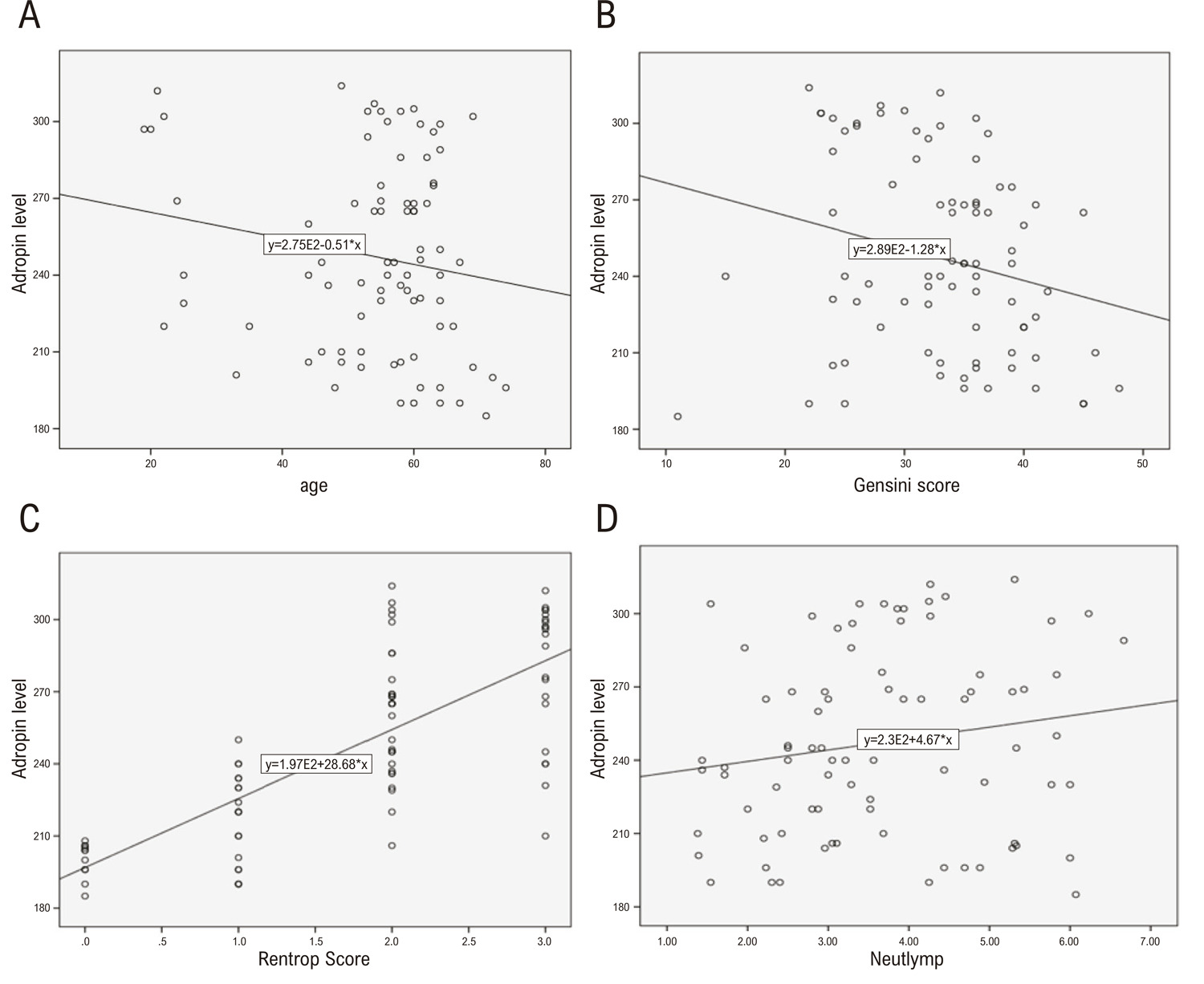
Mean adropine levels were found as 210.83±17.76 pg/mL and 268.25±28.94 pg/mL in the poor and good CCC groups, respectively (p<0.001). Adropin levels proved to be positively correlated with neutrophil-to-lymphocyte ratios (r:0.17, p:0.04) and the rentrop scores (r:0.76, p<0.001), and negatively correlated with age (r:-0.23, p:0.01) and Gensini scores (r:-0.19, p:0.02). Adropin level is a strong independent predictor of good CCC development (OR:1.12, 95% CI:(1.06–1.18), p<0.001).

Conclusion

This study suggests that adropin levels may be a possible factor associated with the presence of CCC in CCS patients.

  • Acute coronary syndrome
  • Adropin
  • Atherosclerosis
  • Coronary Angiography
  • Coronary Artery Diseases
  • Coronary Collateral Circulation
  • Diagnostic Imaging
  • Peptides
Read Full Article
Creative Commons Attribution (CC BY) Creative Commons license
27/06/2022 DOI: 10.36660/abc.20210573 Views 1
Figure 1
ABC
Original Article

Adropin and Irisin in Patients with Cardiac Cachexia

Ali Kemal Kalkan et al. Huseyin Altug Cakmak Mehmet Erturk Kübra Erol Kalkan … Fatih Uzun Omer Tasbulak Vesile Ornek Diker Suleyman Aydin Ahmet Celik

Abstract

Background:

Cardiac cachexia is an important predictive factor of the reduction in survival of patients with heart failure with reduced ejection fraction.

Objectives:

The aims of the present study were to evaluate adropin and irisin levels in cachectic and non-cachectic subjects and the relationships between the levels of these proteins and clinical and laboratory parameters in patients with HFrEF.

Methods:

The clinical records of patients who were admitted to the cardiology outpatient clinic for heart failure with reduced ejection fraction were screened. Cachectic patients were identified and assigned to the study group (n = 44, mean age, 65.4 ± 11.2 y; 61.4% men). Heart failure with reduced ejection fraction patients without weight loss were enrolled as the control group (n = 42, mean age, 61.0 ± 16.5 y; 64.3% men). The serum adropin and irisin levels of all patients were measured. A p-value < 0.05 was considered significant.

Results:

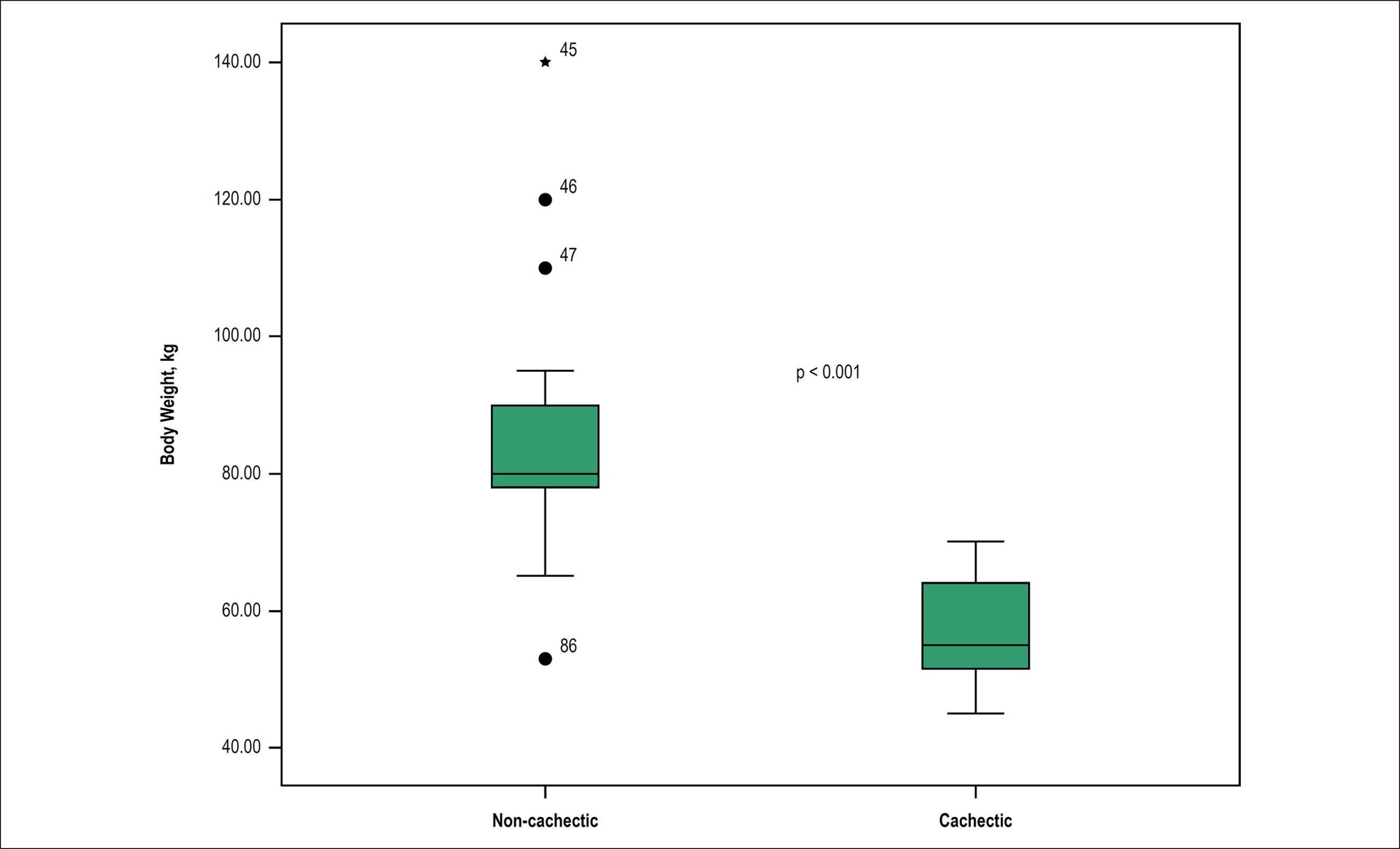
Serum adropin and irisin levels were significantly higher in the cachexia group than in the controls (Adropin (ng/L); 286.1 (231.3-404.0) vs 213.7 (203.1-251.3); p < 0.001, Irisin (µg/mL); 2.6 (2.2-4.4) vs 2.1 (1.8-2.4); p = 0.001). Serum adropin and irisin levels were positively correlated with brain natriuretic peptide (BNP) levels and New York Heart Association (NYHA) class and negatively correlated with body mass index (BMI) and serum albumin levels (all p values: < 0.001). In a multivariate analysis, adropin was the only independent predictor of cachexia in the heart failure with reduced ejection fraction patients (OR: 1.021; 95% CI: 1.004−1.038; p = 0.017).

Conclusions:

The results suggest that adropin and irisin may be novel markers of cardiac cachexia in heart failure with reduced ejection fraction patients. Adropin and irisin are related with the severity of heart failure.

  • Adropin
  • Cachexia / complications
  • Heart Failure / physiopathology, Hypertrophy, Left Ventricular
  • Hormones
  • Peptides
  • Ventricular Function, Left
Read Full Article
Creative Commons Attribution (CC BY) Creative Commons license
02/07/2018 DOI: 10.5935/abc.20180109

How to cite this article

EndNote RIS

Electronic Document Format (Vancouver)

Gowdak LHW. Another Player in Increasing Collateral Circulation in the Heart – Another Potential Therapeutic Target in Cardiovascular Medicine?. Arquivos Brasileiros de Cardiologia 2022;119(3):411-2.

Electronic Document Format (ABNT)

Gowdak, Luis Henrique Wolff. Another Player in Increasing Collateral Circulation in the Heart – Another Potential Therapeutic Target in Cardiovascular Medicine?. Arquivos Brasileiros de Cardiologia, v. 119, n. 3, p. 411-412, Sep. 2022.

Electronic Document Format (APA)

Gowdak, L. H. W. (2022). Another Player in Increasing Collateral Circulation in the Heart – Another Potential Therapeutic Target in Cardiovascular Medicine?. Arquivos Brasileiros de Cardiologia, 119(3), 411-412.

Electronic Document Format (ISO)

Gowdak, Luis Henrique Wolff. Another Player in Increasing Collateral Circulation in the Heart – Another Potential Therapeutic Target in Cardiovascular Medicine?. Arquivos Brasileiros de Cardiologia [online]. 2022, vol. 119, n. 3, [cited 2026-10-14], pp. 411-412. Available from: <https://journals.cardiol.br/en/article/another-player-in-increasing-collateral-circulation-in-the-heart-another-potential-therapeutic-target-in-cardiovascular-medicine/>. ISSN 0066-782X

EndNote RIS

Electronic Document Format (Vancouver)

Akkaya H, Güntürk EE, Akkaya F, Karabıyık U, Güntürk , Yılmaz S. Assessment of the Relationship Between the Adropin Levels and the Coronary Collateral Circulation in Patients wıth Chronic Coronary Syndrome. Arquivos Brasileiros de Cardiologia 2022;119(3):402-10.

Electronic Document Format (ABNT)

Akkaya, Hasan; Güntürk, Ertuğrul Emre; Akkaya, Fulya; Karabıyık, Uğur; Güntürk, İnayet; Yılmaz, Samet. Assessment of the Relationship Between the Adropin Levels and the Coronary Collateral Circulation in Patients wıth Chronic Coronary Syndrome. Arquivos Brasileiros de Cardiologia, v. 119, n. 3, p. 402-410, Jun. 2022.

Electronic Document Format (APA)

Akkaya, H., Güntürk, E. E., Akkaya, F., Karabıyık, U., Güntürk, , & Yılmaz, S. (2022). Assessment of the Relationship Between the Adropin Levels and the Coronary Collateral Circulation in Patients wıth Chronic Coronary Syndrome. Arquivos Brasileiros de Cardiologia, 119(3), 402-410.

Electronic Document Format (ISO)

Akkaya, Hasan and Güntürk, Ertuğrul Emre and Akkaya, Fulya and Karabıyık, Uğur and Güntürk, İnayet and Yılmaz, Samet. Assessment of the Relationship Between the Adropin Levels and the Coronary Collateral Circulation in Patients wıth Chronic Coronary Syndrome. Arquivos Brasileiros de Cardiologia [online]. 2022, vol. 119, n. 3, [cited 2026-10-14], pp. 402-410. Available from: <https://journals.cardiol.br/en/article/assessment-of-the-relationship-between-the-adropin-levels-and-the-coronary-collateral-circulation-in-patients-with-chronic-coronary-syndrome/>. ISSN 0066-782X

EndNote RIS

Electronic Document Format (Vancouver)

Kalkan AK, Cakmak HA, Erturk M, Kalkan KE, Uzun F, Tasbulak O, Diker VO, et al. Adropin and Irisin in Patients with Cardiac Cachexia. Arquivos Brasileiros de Cardiologia 2018;111(1):39-47.

Electronic Document Format (ABNT)

Kalkan, Ali Kemal; Cakmak, Huseyin Altug; Erturk, Mehmet; Kalkan, Kübra Erol; Uzun, Fatih; Tasbulak, Omer; Diker, Vesile Ornek; Aydin, Suleyman; Celik, Ahmet. Adropin and Irisin in Patients with Cardiac Cachexia. Arquivos Brasileiros de Cardiologia, v. 111, n. 1, p. 39-47, Jul. 2018.

Electronic Document Format (APA)

Kalkan, A. K., Cakmak, H. A., Erturk, M., Kalkan, K. E., Uzun, F., Tasbulak, O., Diker, V. O., Aydin, S., & Celik, A. (2018). Adropin and Irisin in Patients with Cardiac Cachexia. Arquivos Brasileiros de Cardiologia, 111(1), 39-47.

Electronic Document Format (ISO)

Kalkan, Ali Kemal and Cakmak, Huseyin Altug and Erturk, Mehmet and Kalkan, Kübra Erol and Uzun, Fatih and Tasbulak, Omer and Diker, Vesile Ornek and Aydin, Suleyman and Celik, Ahmet. Adropin and Irisin in Patients with Cardiac Cachexia. Arquivos Brasileiros de Cardiologia [online]. 2018, vol. 111, n. 1, [cited 2026-10-14], pp. 39-47. Available from: <https://journals.cardiol.br/en/article/adropin-and-irisin-in-patients-with-cardiac-cachexia-2/>. ISSN 0066-782X

  • About ABC Family
  • Internal Regulation
  • Editorial Board
  • Brazilian Society of Cardiology (SBC)

Issues

SBC Guidelines

  • Videos
  • Podcasts
  • News