ABC Family Arquivos Brasileiros de Cardiologia International Journal of Cardiovascular Sciences ABC Heart Failure & Cardiomyopathy ABC Imagem Cardiovascular
Português English
ABC Family
Português English
  • About
    • About ABC Family
    • Internal Regulation
    • Editorial Board
    • Brazilian Society of Cardiology (SBC)
  • Issues
  • SBC Guidelines
  • Content
    • Videos
    • Podcasts
    • News
  • About
    • About ABC Family
    • Internal Regulation
    • Editorial Board
    • Brazilian Society of Cardiology (SBC)
  • Issues
  • SBC Guidelines
  • Content
    • Videos
    • Podcasts
    • News

ABC Family

  • ABC Family
  • Arquivos Brasileiros de Cardiologia
  • International Journal of Cardiovascular Sciences
  • ABC Heart Failure & Cardiomyopathy
  • ABC Imagem Cardiovascular
Search in

No content found.

Journals
Ordering
Article types
Others

  1. Home
  2. Keyword: Ventricular Premature Complexes
QT Prolongation Following Premature Ventricular Contractions: A Potential Marker of Concealed Long QT Syndrome
IJCS
Original Article

QT Prolongation Following Premature Ventricular Contractions: A Potential Marker of Concealed Long QT Syndrome

Khatuna Jalabadze et al. Pavle Machavariani Bachuki Tsiklauri Natalia Garuchava … Ia Avaliani Maya Chigogidze

Abstract

Background:

Long QT syndrome (LQTS) predisposes individuals to malignant ventricular arrhythmias and sudden cardiac death; however, diagnosis remains challenging in patients with borderline corrected QT (QTc) values. Premature Ventricular Contractions (PVCs) may unmask concealed abnormalities of ventricular repolarization.

Aim:

To determine whether post-PVC QTc prolongation can differentiate patients with confirmed LQTS, healthy controls, and borderline index cases.

Methods:

In this retrospective study, 24-hour electrocardiography (ECG) recordings from 84 subjects were analyzed, including 10 patients with confirmed LQTS, 72 healthy controls, and 2 index patients with borderline baseline QTc values. QTc intervals before and after PVCs were measured manually and corrected using Bazett’s formula. Between-group differences were evaluated using analysis of covariance (ANCOVA) adjusted for baseline QTc, whereas within-group changes were assessed with paired t-tests. A two-tailed p < 0.05 was considered statistically significant.

Results:

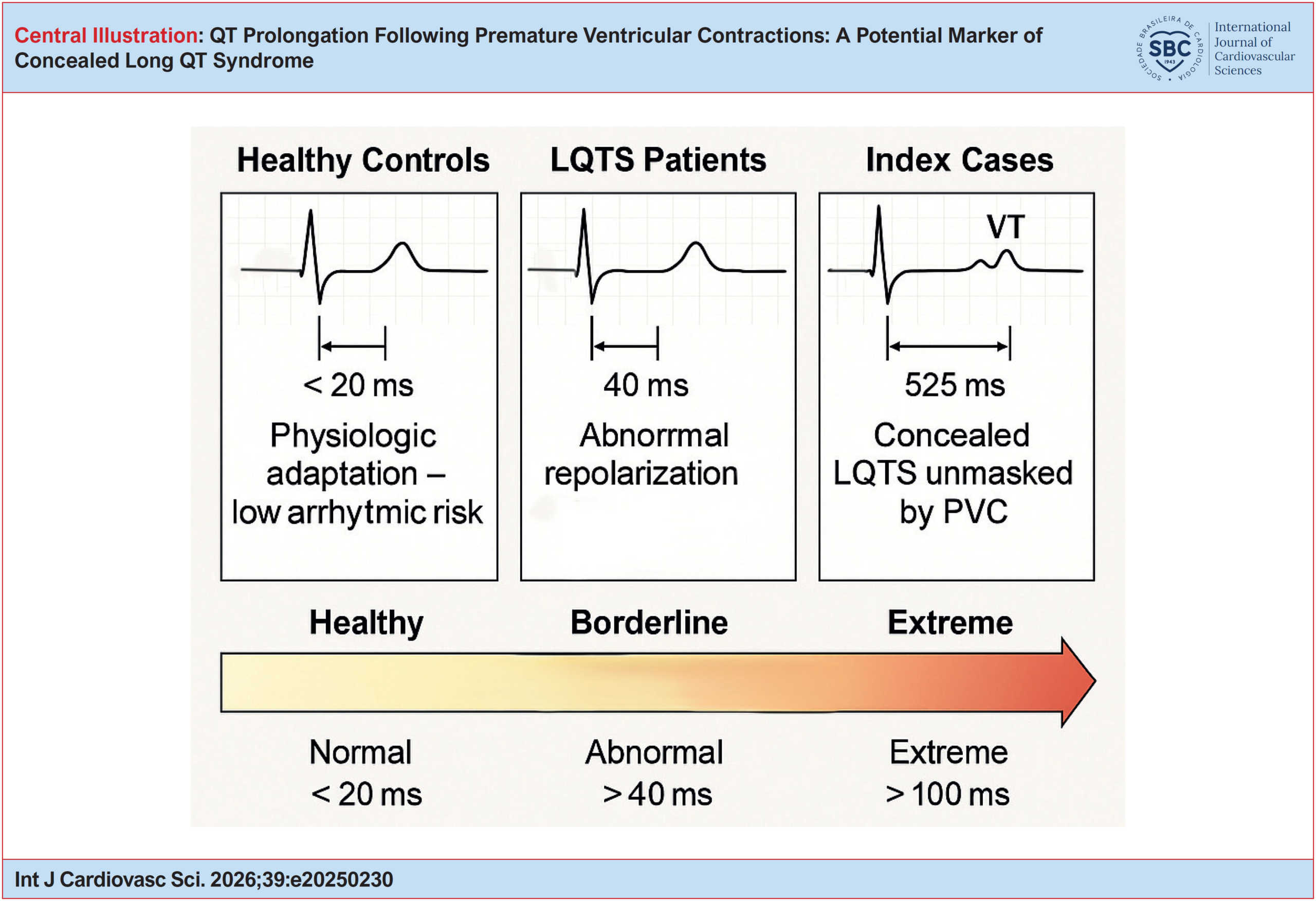
Post-PVC QTc intervals were longer in patients with LQTS than in healthy controls (488 ± 23 ms vs 391 ± 37 ms; adjusted p = 0.066). Overall, PVCs were associated with a mean QTc increase of +15.7 ms (95% CI 7.1–24.3; p = 0.0005), with larger increases observed in LQTS patients (+22.3 ms; p = 0.0019) compared with healthy controls (+10.0 ms; p = 0.0098). The two index patients exhibited marked QTc prolongation, rising from borderline baseline values (360–460 ms) to 540–600 ms (Δ≈165 ms).

Conclusion:

PVC-induced QTc prolongation may help distinguish healthy individuals from patients with overt or borderline LQTS. Whereas healthy controls demonstrated mild physiologic adaptation, patients with confirmed LQTS showed consistent QTc prolongation, and index patients exhibited marked post-PVC increases suggestive of concealed repolarization abnormalities. Assessment of QTc following PVCs may represent a simple bedside approach to improve diagnostic accuracy and risk stratification in LQTS; prospective studies in larger cohorts are warranted to confirm these findings.
  • Cardiac Arrhythmias
  • Long QT Syndrome
  • Ventricular Premature Complexes
Read Full Article
Creative Commons Attribution (CC BY) Creative Commons license
07/09/2026 DOI: 10.36660/ijcs.20250230 Views 3
Figure 1
ABC
Original Article

Is There any Relationship Between Myocardial Repolarization Parameters and the Frequency of Ventricular Premature Contractions?

Kayihan Karaman et al. Metin Karayakali Arif Arisoy Ilker Akar … Mustafa Ozturk Ahmet Yanik Samet Yilmaz Atac Celik

Abstract

Background:

Ventricular premature contractions (VPCs) may trigger lethal ventricular arrhythmias in patients with structural heart disease. However, this role of VPCs in healthy people remains controversial once that not enough clinical trials are available. Recently, some myocardial repolarization markers, such as Tp-e interval, Tp-e/QT, and Tp-e/QTc ratios, have been reported to be useful for predicting lethal ventricular arrhythmias in various clinical disorders without structural heart disease.

Objective:

In this study, we aimed to investigate the relation between VPC frequent and myocardial repolarization markers in individuals without structural heart disease.

Methods:

This study included 100 patients who had complaints of dizziness and palpitations. Twelve-lead electrocardiography and 24-hour ambulatory Holter recordings were obtained from all patients. VPC burden was calculated as the total number of VPCs divided by the number of all QRS complexes in the total recording time. P-values < 0.05 were considered significant.

Results:

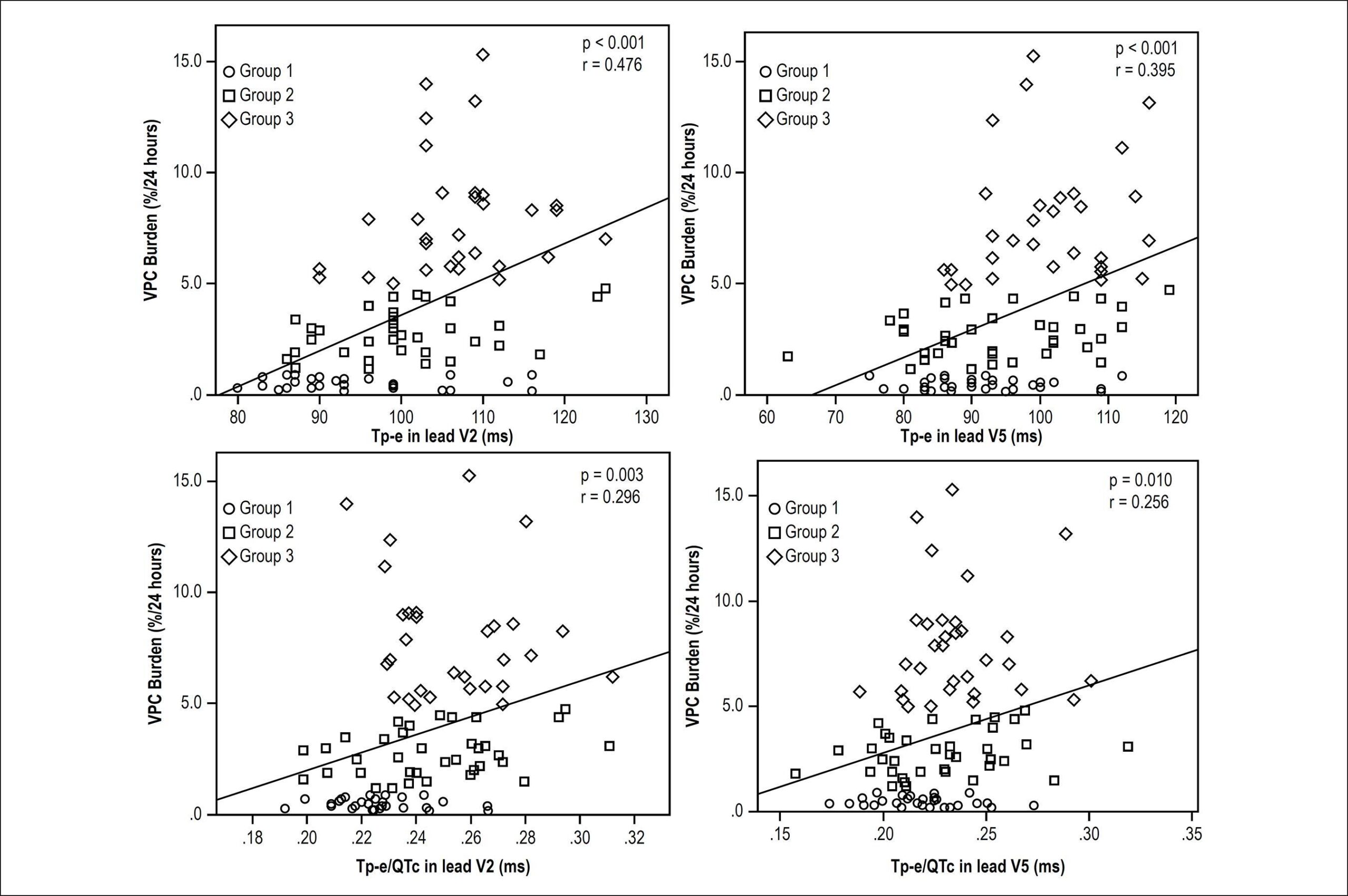
Tp-e interval and Tp-e/QTc ratio were significantly higher in patients with higher VPC burden than in patients with lower VPC burden, and a positive correlation was found between these markers and VPC burden. Tp-e (β = 1.318, p = 0.043) and Tp-e/QTc (β = -405.136, p = 0.024) in the lead V5 were identified as independent predictors of increased VPC burden.

Conclusions:

Tp-e interval and Tp-e/QTc ratio increased in patients with high VPC number. Our study showed that VPCs may have a negative effect on myocardial repolarization. This interaction may lead to an increased risk of malignant arrhythmias.

  • Arrhythmias Cardiac
  • Cardiovascular Diseases
  • Electrocardiography/methods
  • Obesity
  • Ventricular Dysfunction, Left
  • Ventricular Premature Complexes
Read Full Article
Creative Commons Attribution (CC BY) Creative Commons license
01/06/2018 DOI: 10.5935/abc.20180079
Figure 1
ABC
Original Article

Late Outcome of a Randomized Study on Oral Magnesium for Premature Complexes

Cristina Nádja M. Lima De Falco et al. Francisco Carlos da Costa Darrieux Cesar Grupi Luciana Sacilotto … Cristiano F. Pisani Sissy Lara José A. F. Ramires Eduardo Sosa Tan Chen Wu Denise Hachul Mauricio Scanavacca

Background:

Ventricular and supraventricular premature complexes (PC) are frequent and usually symptomatic. According to a previous study, magnesium pidolate (MgP) administration to symptomatic patients can improve the PC density and symptoms.

Objective:

To assess the late follow-up of that clinical intervention in patients treated with MgP or placebo.

Methods:

In the first phase of the study, 90 symptomatic and consecutive patients with PC were randomized (double-blind) to receive either MgP or placebo for 30 days. Monthly follow-up visits were conducted for 15 months to assess symptoms and control electrolytes. 24-hour Holter was performed twice, regardless of symptoms, or whenever symptoms were present. In the second phase of the study, relapsing patients, who had received MgP or placebo (crossing-over) in the first phase, were treated with MgP according to the same protocol.

Results:

Of the 45 patients initially treated with MgP, 17 (37.8%) relapsed during the 15-month follow-up, and the relapse time varied. Relapsing patients treated again had a statistically significant reduction in the PC density of 138.25/hour (p < 0.001). The crossing-over patients reduced it by 247/hour (p < 0.001). Patients who did not relapse, had a low PC frequency (3 PC/hour). Retreated patients had a 76.5% improvement in symptom, and crossing-over patients, 71.4%.

Conclusion:

Some patients on MgP had relapse of symptoms and PC, indicating that MgP is neither a definitive nor a curative treatment for late follow-up. However, improvement in the PC frequency and symptoms was observed in the second phase of treatment, similar to the response in the first phase of treatment.

  • Arrhythmias Cardiac
  • Magnesium
  • Ventricular Premature Complexes
Read Full Article
Creative Commons Attribution (CC BY) Creative Commons license
11/11/2014 DOI: 10.5935/abc.20140171 Views 1
Figure 1
ABC
Case Report

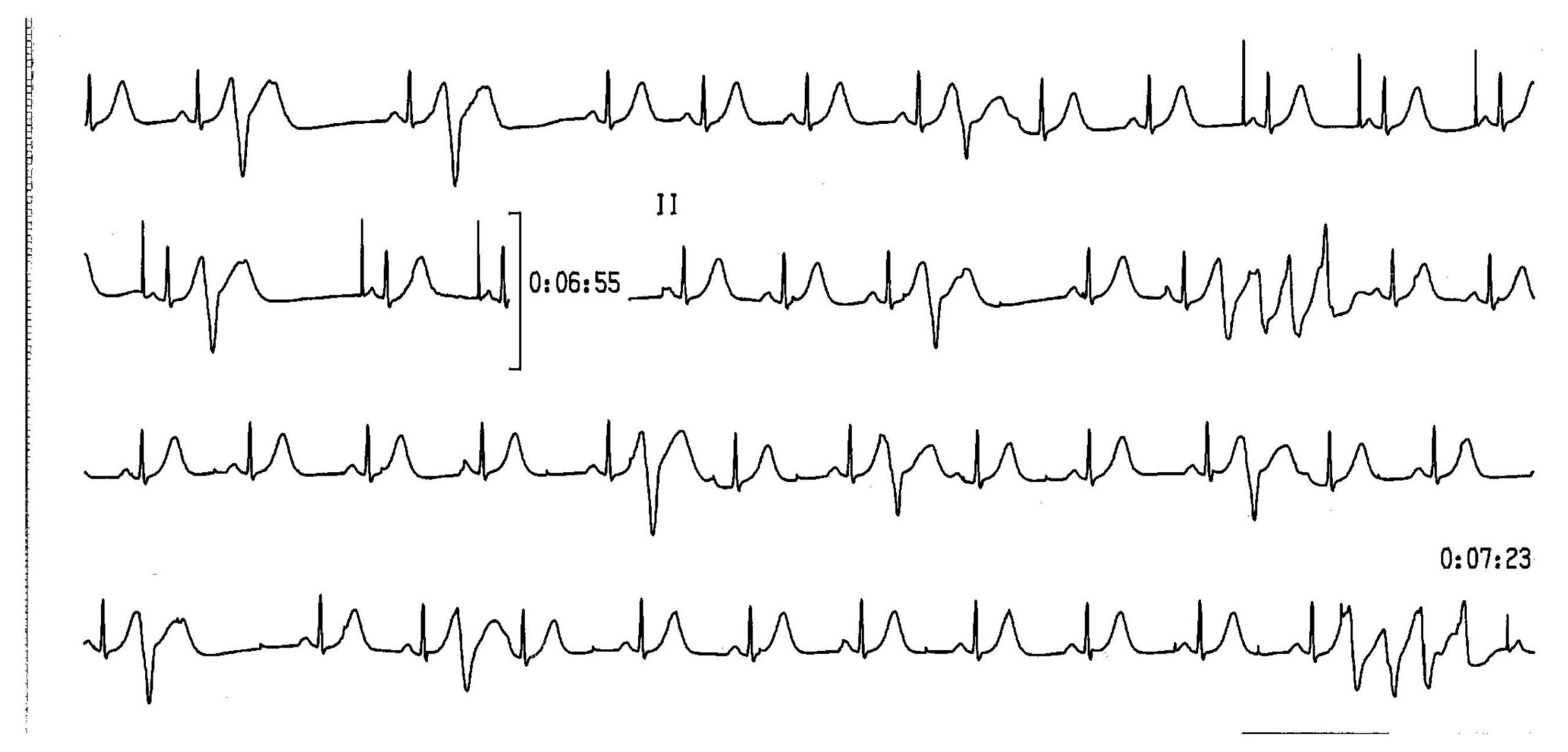
Short-Coupled Variant of "Torsades de Pointes" and Polymorphic Ventricular Tachycardia

Muhieddine Omar Chokr et al. Francisco Carlos da Costa Darrieux Carina Abigail Hardy Denise Tessariol Hachul … Allisson Valadão de Oliveira Britto Sissy Lara de Melo Cristiano Pisani Eduardo Argentino Sosa Martino Martinelli Filho Mauricio Ibrahim Scanavacca

Introduction

“Torsades de pointes” (TdP) ventricular tachycardias carry a high risk of sudden death, even when they occur in individuals with a structurally normal heart, in the absence of myocardial ischemia or prolonged QT interval. Leenhardt et al described a new syndrome with these characteristics in 1994 that showed a difference in which the TdP were triggered by ventricular extrasystoles (VE) with ultra-short coupling interval (< 300 ms).

Although this condition is easily diagnosed by the described characteristics, there is a lack of data on the clinical management of patients during the phase of electrical storm and during long-term clinical outcome. Over the past 20 years, three patients were identified in our institution with this clinical condition, as well as a family member with VE and short coupling interval, asymptomatic and without documented polymorphic ventricular tachycardia (VT).

[…]

  • Arrhythmias Cardiac
  • Excitation Contraction Coupling
  • Tachycardia, Ventricular / therapy
  • Ventricular Premature Complexes
Read Full Article
Creative Commons Attribution (CC BY) Creative Commons license
01/06/2014 DOI: 10.5935/abc.20140075 Views 1
Successful improvement of frequency and symptoms of premature complexes after oral magnesium administration
ABC
Artigo Original

Successful improvement of frequency and symptoms of premature complexes after oral magnesium administration

Cristina Nádja Muniz Lima De Falco et al. Cesar Grupi Eduardo Sosa Maurício Scanavacca … Denise Hachul Sissy Lara Luciana Sacilotto Cristiano F. Pisani José A. F. Ramires Francisco Darrieux

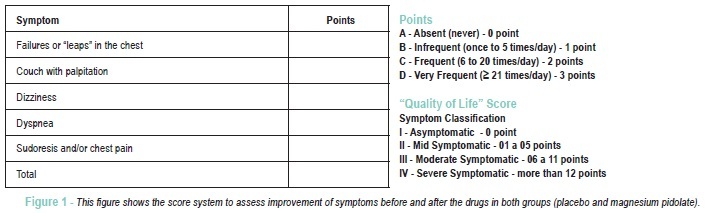
BACKGROUND: Premature ventricular and supraventricular complexes (PVC and PsVC) are frequent and often symptomatic. The magnesium (Mg) ion plays a role in the physiology of cell membranes and cardiac rhythm. OBJECTIVE: We evaluated whether the administration of Mg Pidolate (MgP) in patients with PVC and PsVC is superior to placebo (P) in improving symptoms and arrhythmia frequency. METHODS: Randomized double-blind study with 60 consecutive symptomatic patients with more than 240 PVC or PsVC on 24-hour Holter monitoring who were selected to receive placebo or MgP. To evaluate symptom improvement, a categorical and a specific questionnaire for symptoms related to PVC and PsVC was made. Improvement in premature complex density (PCD) per hour was considered significant if percentage reduction was >70% after treatment. The dose of MgP was 3.0 g/day for 30 days, equivalent to 260mg of Mg element. None of the patients had structural heart disease or renal failure. RESULTS: Of the 60 patients, 33 were female (55%). Ages ranged from 16 to 70 years old. In the MgP group, 76.6% of patients had a PCD reduction >70%, 10% of them >50% and only 13.4% <50%. In the P group, 40% showed slight improvement, <30%, in the premature complexes frequency (p < 0.001). Symptom improvement was achieved in 93.3% of patients in the MgP group, compared with only 16.7% in the P group (p < 0.001). CONCLUSION: Oral Mg supplementation decreases PCD, resulting in symptom improvement.

  • Arrhythmias
  • cardiac
  • ion channels
  • Magnesium
  • Ventricular Premature Complexes
Read Full Article
Creative Commons Attribution (CC BY) Creative Commons license
15/05/2012 DOI: 10.1590/S0066-782X2012005000043

How to cite this article

EndNote RIS

Electronic Document Format (Vancouver)

Jalabadze K, Machavariani P, Tsiklauri B, Garuchava N, Avaliani I, Chigogidze M. QT Prolongation Following Premature Ventricular Contractions: A Potential Marker of Concealed Long QT Syndrome. International Journal of Cardiovascular Sciences 2026;39:e20250230.

Electronic Document Format (ABNT)

Jalabadze, Khatuna; Machavariani, Pavle; Tsiklauri, Bachuki; Garuchava, Natalia; Avaliani, Ia; Chigogidze, Maya. QT Prolongation Following Premature Ventricular Contractions: A Potential Marker of Concealed Long QT Syndrome. International Journal of Cardiovascular Sciences, v. 39, e20250230, Sep. 2026.

Electronic Document Format (APA)

Jalabadze, K., Machavariani, P., Tsiklauri, B., Garuchava, N., Avaliani, I., & Chigogidze, M. (2026). QT Prolongation Following Premature Ventricular Contractions: A Potential Marker of Concealed Long QT Syndrome. International Journal of Cardiovascular Sciences, 39, e20250230.

Electronic Document Format (ISO)

Jalabadze, Khatuna and Machavariani, Pavle and Tsiklauri, Bachuki and Garuchava, Natalia and Avaliani, Ia and Chigogidze, Maya. QT Prolongation Following Premature Ventricular Contractions: A Potential Marker of Concealed Long QT Syndrome. International Journal of Cardiovascular Sciences [online]. 2026, vol. 39, [cited 2026-10-14], e20250230. Available from: <https://journals.cardiol.br/en/article/qt-prolongation-following-premature-ventricular-contractions-a-potential-marker-of-concealed-long-qt-syndrome/>. ISSN 2359-4802

EndNote RIS

Electronic Document Format (Vancouver)

Karaman K, Karayakali M, Arisoy A, Akar I, Ozturk M, Yanik A, Yilmaz S, et al. Is There any Relationship Between Myocardial Repolarization Parameters and the Frequency of Ventricular Premature Contractions?. Arquivos Brasileiros de Cardiologia 2018;110(6):534-41.

Electronic Document Format (ABNT)

Karaman, Kayihan; Karayakali, Metin; Arisoy, Arif; Akar, Ilker; Ozturk, Mustafa; Yanik, Ahmet; Yilmaz, Samet; Celik, Atac. Is There any Relationship Between Myocardial Repolarization Parameters and the Frequency of Ventricular Premature Contractions?. Arquivos Brasileiros de Cardiologia, v. 110, n. 6, p. 534-541, May. 2018.

Electronic Document Format (APA)

Karaman, K., Karayakali, M., Arisoy, A., Akar, I., Ozturk, M., Yanik, A., Yilmaz, S., & Celik, A. (2018). Is There any Relationship Between Myocardial Repolarization Parameters and the Frequency of Ventricular Premature Contractions?. Arquivos Brasileiros de Cardiologia, 110(6), 534-541.

Electronic Document Format (ISO)

Karaman, Kayihan and Karayakali, Metin and Arisoy, Arif and Akar, Ilker and Ozturk, Mustafa and Yanik, Ahmet and Yilmaz, Samet and Celik, Atac. Is There any Relationship Between Myocardial Repolarization Parameters and the Frequency of Ventricular Premature Contractions?. Arquivos Brasileiros de Cardiologia [online]. 2018, vol. 110, n. 6, [cited 2026-10-14], pp. 534-541. Available from: <https://journals.cardiol.br/en/article/is-there-any-relationship-between-myocardial-repolarization-parameters-and-the-frequency-of-ventricular-premature-contractions/>. ISSN 0066-782X

EndNote RIS

Electronic Document Format (Vancouver)

Falco CNMLD, Darrieux FCC, Grupi C, Sacilotto L, Pisani CF, Lara S, Ramires JAF, et al. Late Outcome of a Randomized Study on Oral Magnesium for Premature Complexes. Arquivos Brasileiros de Cardiologia 2014;103(6):468-75.

Electronic Document Format (ABNT)

Falco, Cristina Nádja M. Lima De; Darrieux, Francisco Carlos da Costa; Grupi, Cesar; Sacilotto, Luciana; Pisani, Cristiano F.; Lara, Sissy; Ramires, José A. F.; Sosa, Eduardo; Wu, Tan Chen; Hachul, Denise; Scanavacca, Mauricio. Late Outcome of a Randomized Study on Oral Magnesium for Premature Complexes. Arquivos Brasileiros de Cardiologia, v. 103, n. 6, p. 468-475, Nov. 2014.

Electronic Document Format (APA)

Falco, C. N. M. L. D., Darrieux, F. C. C., Grupi, C., Sacilotto, L., Pisani, C. F., Lara, S., Ramires, J. A. F., Sosa, E., Wu, T. C., Hachul, D., & Scanavacca, M. (2014). Late Outcome of a Randomized Study on Oral Magnesium for Premature Complexes. Arquivos Brasileiros de Cardiologia, 103(6), 468-475.

Electronic Document Format (ISO)

Falco, Cristina Nádja M. Lima De and Darrieux, Francisco Carlos da Costa and Grupi, Cesar and Sacilotto, Luciana and Pisani, Cristiano F. and Lara, Sissy and Ramires, José A. F. and Sosa, Eduardo and Wu, Tan Chen and Hachul, Denise and Scanavacca, Mauricio. Late Outcome of a Randomized Study on Oral Magnesium for Premature Complexes. Arquivos Brasileiros de Cardiologia [online]. 2014, vol. 103, n. 6, [cited 2026-10-14], pp. 468-475. Available from: <https://journals.cardiol.br/en/article/late-outcome-of-a-randomized-study-on-oral-magnesium-for-premature-complexes/>. ISSN 0066-782X

EndNote RIS

Electronic Document Format (Vancouver)

Chokr MO, Darrieux FCC, Hardy CA, Hachul DT, Britto AVO, Melo SL, Pisani C, et al. Short-Coupled Variant of “Torsades de Pointes” and Polymorphic Ventricular Tachycardia. Arquivos Brasileiros de Cardiologia 2014;102(6):e60.

Electronic Document Format (ABNT)

Chokr, Muhieddine Omar; Darrieux, Francisco Carlos da Costa; Hardy, Carina Abigail; Hachul, Denise Tessariol; Britto, Allisson Valadão de Oliveira; Melo, Sissy Lara de; Pisani, Cristiano; Sosa, Eduardo Argentino; Martinelli Filho, Martino; Scanavacca, Mauricio Ibrahim. Short-Coupled Variant of “Torsades de Pointes” and Polymorphic Ventricular Tachycardia. Arquivos Brasileiros de Cardiologia, v. 102, n. 6, e60, May. 2014.

Electronic Document Format (APA)

Chokr, M. O., Darrieux, F. C. C., Hardy, C. A., Hachul, D. T., Britto, A. V. O., Melo, S. L. , Pisani, C., Sosa, E. A., Martinelli Filho, M., & Scanavacca, M. I. (2014). Short-Coupled Variant of “Torsades de Pointes” and Polymorphic Ventricular Tachycardia. Arquivos Brasileiros de Cardiologia, 102(6), e60.

Electronic Document Format (ISO)

Chokr, Muhieddine Omar and Darrieux, Francisco Carlos da Costa and Hardy, Carina Abigail and Hachul, Denise Tessariol and Britto, Allisson Valadão de Oliveira and Melo, Sissy Lara de and Pisani, Cristiano and Sosa, Eduardo Argentino and Martinelli Filho, Martino and Scanavacca, Mauricio Ibrahim. Short-Coupled Variant of “Torsades de Pointes” and Polymorphic Ventricular Tachycardia. Arquivos Brasileiros de Cardiologia [online]. 2014, vol. 102, n. 6, [cited 2026-10-14], e60. Available from: <https://journals.cardiol.br/en/article/short-coupled-variant-of-torsades-de-pointes-and-polymorphic-ventricular-tachycardia/>. ISSN 0066-782X

EndNote RIS

Electronic Document Format (Vancouver)

Falco CNMLD, Grupi C, Sosa E, Scanavacca M, Hachul D, Lara S, Sacilotto L, et al. Successful improvement of frequency and symptoms of premature complexes after oral magnesium administration. Arquivos Brasileiros de Cardiologia 2012;98(6):480-7.

Electronic Document Format (ABNT)

Falco, Cristina Nádja Muniz Lima De; Grupi, Cesar; Sosa, Eduardo; Scanavacca, Maurício; Hachul, Denise; Lara, Sissy; Sacilotto, Luciana; Pisani, Cristiano F.; Ramires, José A. F.; Darrieux, Francisco. Successful improvement of frequency and symptoms of premature complexes after oral magnesium administration. Arquivos Brasileiros de Cardiologia, v. 98, n. 6, p. 480-487, May. 2012.

Electronic Document Format (APA)

Falco, C. N. M. L. D., Grupi, C., Sosa, E., Scanavacca, M., Hachul, D., Lara, S., Sacilotto, L., Pisani, C. F., Ramires, J. A. F., & Darrieux, F. (2012). Successful improvement of frequency and symptoms of premature complexes after oral magnesium administration. Arquivos Brasileiros de Cardiologia, 98(6), 480-487.

Electronic Document Format (ISO)

Falco, Cristina Nádja Muniz Lima De and Grupi, Cesar and Sosa, Eduardo and Scanavacca, Maurício and Hachul, Denise and Lara, Sissy and Sacilotto, Luciana and Pisani, Cristiano F. and Ramires, José A. F. and Darrieux, Francisco. Successful improvement of frequency and symptoms of premature complexes after oral magnesium administration. Arquivos Brasileiros de Cardiologia [online]. 2012, vol. 98, n. 6, [cited 2026-10-14], pp. 480-487. Available from: <https://journals.cardiol.br/en/article/successful-improvement-of-frequency-and-symptoms-of-premature-complexes-after-oral-magnesium-administration/>. ISSN 0066-782X

  • About ABC Family
  • Internal Regulation
  • Editorial Board
  • Brazilian Society of Cardiology (SBC)

Issues

SBC Guidelines

  • Videos
  • Podcasts
  • News