ABC Family Arquivos Brasileiros de Cardiologia International Journal of Cardiovascular Sciences ABC Heart Failure & Cardiomyopathy ABC Imagem Cardiovascular
Português English
ABC Family
Português English
  • About
    • About ABC Family
    • Internal Regulation
    • Editorial Board
    • Brazilian Society of Cardiology (SBC)
  • Issues
  • SBC Guidelines
  • Content
    • Videos
    • Podcasts
    • News
  • About
    • About ABC Family
    • Internal Regulation
    • Editorial Board
    • Brazilian Society of Cardiology (SBC)
  • Issues
  • SBC Guidelines
  • Content
    • Videos
    • Podcasts
    • News

ABC Family

  • ABC Family
  • Arquivos Brasileiros de Cardiologia
  • International Journal of Cardiovascular Sciences
  • ABC Heart Failure & Cardiomyopathy
  • ABC Imagem Cardiovascular
Search in

No content found.

Journals
Ordering
Article types
Others

  1. Home
  2. Keyword: Stroke/prevention and control
Figure 1
IJCS
Editorial

To Close or not to Close PFOs in Cryptogenic Stroke, an Evolving Question

Alex Felix et al. Monica Luiza de Alcantara

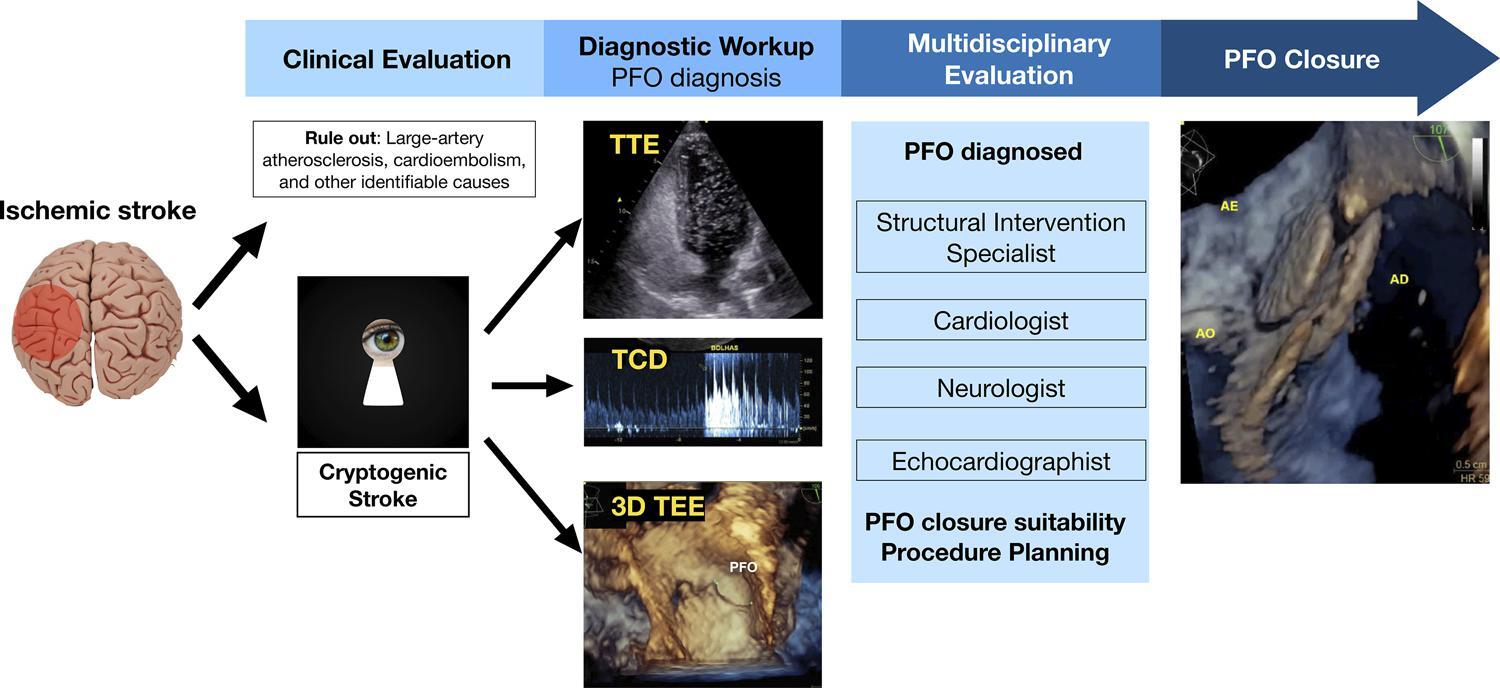
A matter of intense debate in the last decades, the ideal strategy for secondary prevention in patients with cryptogenic stroke and patent foramen ovale (PFO) is not yet clearly defined. PFOs are prevalent in the general population and can be found in up to 40% of patients with cryptogenic stroke. Although in some cases of cryptogenic stroke PFO might be just an innocent bystander, paradoxical embolism is a well-known potential causative mechanism, especially in patients with concomitant deep venous thrombosis, whereby PFO closure may represent an effective measure to avoid recurrences. Even among patients with PFO, phenotypical heterogeneity may also determine percutaneous treatment suitability and directly impact on results, whereas the presence of large shunts, atrial septal aneurysm or associated complex septal defects must also be taken into account.

In the past years, several evidence-based guidelines and expert consensus on the management of patients with PFO and prevention of recurrent stroke have been published by international scientific societies, including a position paper sponsored by the European Association of Percutaneous Cardiovascular Interventions (EAPCI), with the participation of eight European scientific societies. A recent guideline by the American Academy of Neurology (AAN) was published online last April.

[…]

  • Atrial Fibrillation
  • Patent Foramen Ovale
  • Risk Factors
  • Secondary Prevention
  • Stroke/prevention and control
Read Full Article
Creative Commons Attribution (CC BY) Creative Commons license
31/07/2020 DOI: 10.36660/ijcs.20200128 Views 1
Figure 1
ABC
Viewpoint

Internet Search Trends and Regional Mortality Tendencies: The Case of Oral Anticoagulants and Stroke

Roberto Muniz Ferreira et al. Ísis da Capela Pinheiro João Roquette Fleury da Rocha

Introduction

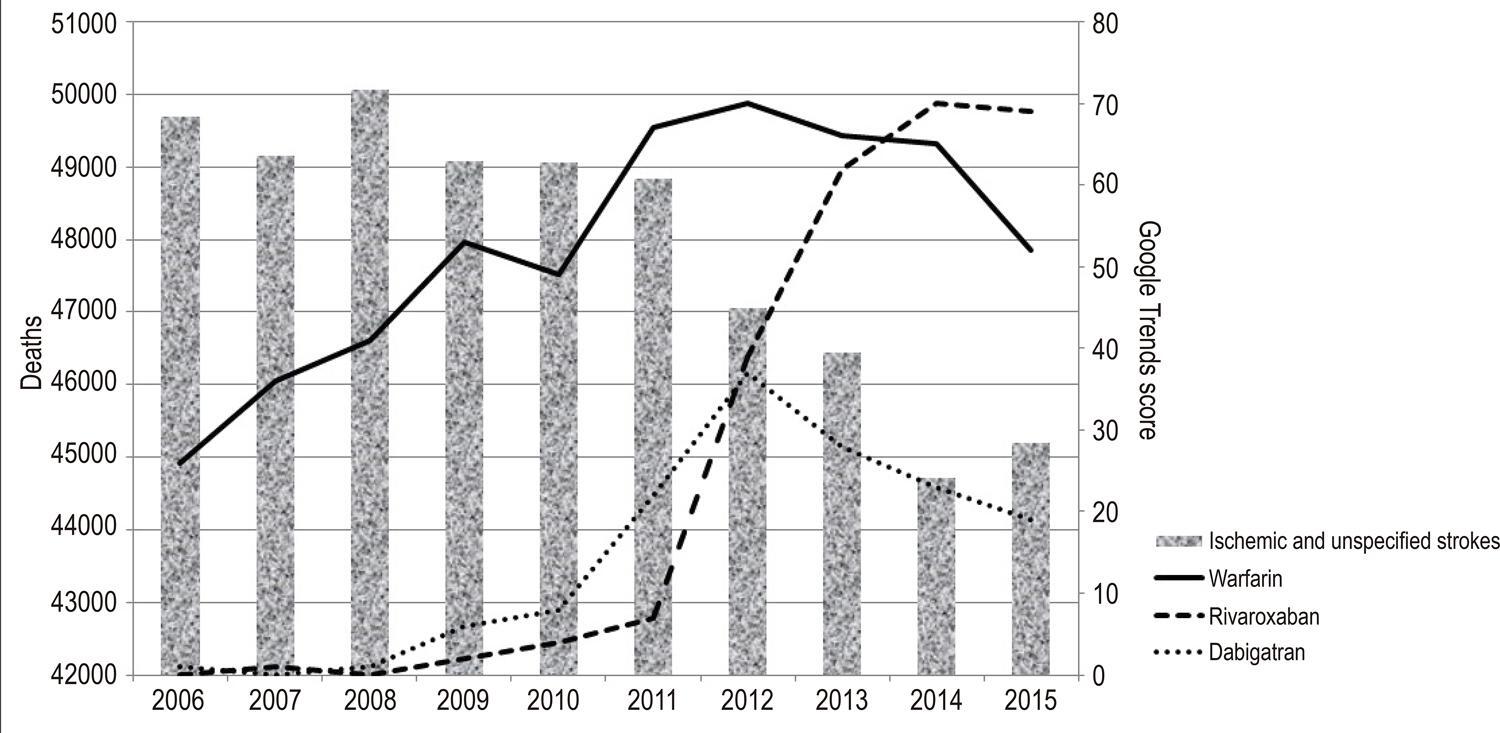
Multiple studies have found that up to 30% of ischemic strokes are associated with atrial fibrillation (AF), especially in the elderly population. , Although the embolic risk varies according to clinical characteristics and comorbidities, anticoagulant therapy has consistently shown to reduce stroke rates by approximately 70%. However, previous studies demonstrated that treatment rates with warfarin were low, even in patients at high risk for embolic events. Despite evidence from various publications demonstrating the effectiveness and safety of vitamin K antagonists, their complex pharmacokinetics and the need for continuous monitoring and frequent dose adjustments were the main explanations for low adherence.

Over the last 10 years, four direct oral anticoagulants (DOAC) have become available to prevent embolic events in patients with non-valvular AF: dabigatran, rivaroxaban, apixaban and edoxaban. In August 2011, dabigatran was the first DOAC approved in Brazil for stroke prevention, followed by rivaroxaban four months later. Two years later, apixaban was also introduced in the Brazilian market and only in February 2018 edoxaban became available. When compared to warfarin, multiple trials have suggested that DOACs are non-inferior in preventing ischemic strokes and possibly superior in reducing mortality, perhaps due to fewer intracranial hemorrhages. In addition to waive the need for laboratory monitoring, they have more predictable pharmacokinetics and a lower incidence of drug-to-drug interactions. Recent studies have demonstrated an increase in anticoagulation prescription rates among physicians since DOACs have become clinically available.

[…]

  • Anticoagulants / therapeutic use
  • Dabigatran
  • Mortality/trends
  • Myocardial Ischemia/prevention and control
  • Pharmaceutical Services, Online/trends
  • Rivaroxaban
  • Stroke/prevention and control
  • Varfarin
Read Full Article
Creative Commons Attribution (CC BY) Creative Commons license
29/05/2020 DOI: 10.36660/abc.20190768
ABC
Editorial

Are DOACs a Good Bang for Your Buck in Atrial Fibrillation Prevention in Real-Life?

Márcio Bittencourt

Mr. D., a 75-year-old retired university professor with a prior stroke, wakes up in the morning, drives to the hospital to have blood drawn to adjust his warfarin dosage and then goes to work. A couple of hours later, he gets a call from the nursing team telling him how to adjust the dose: “starting today you should take 7.5 mg of warfarin on Mondays, Wednesdays and Fridays. On the other days of the week you can keep up with the 5 mg pill you are used to. If you do not have a 7.5 mg pill you can cut the 5 mg in half and take one and a half pills on those days. It is not too complicated, is it? By the way, remember to go slow on that kale and spinach I know you like!”. Were it not for the fact the Mr. D. also takes enalapril and atenolol for his blood pressure and to control the heart rate of his atrial fibrillation (AF), a statin for secondary prevention since the stroke, and metformin for his diabetes; cutting pills in half and remembering on what day he should take which dosage should be too complicated.

Unfortunately, Mr. D. is about the average non-valvular AF patient seen in clinics in private practices in Brazil and places around the world, though patients from the Brazilian Unified Health System (Sistema Unico de Saúde, SUS) usually spend substantially more time at the hospital waiting for the results in person or coming back the next day to check them, due to more limited resources to contact patients over the phone.

[…]

  • Anticoagulants/administration and dosage
  • Atrial Fibrillation
  • Cost-Benefit Analysis
  • Stroke/prevention and control
  • Varfarin/economy
Read Full Article
Creative Commons Attribution (CC BY) Creative Commons license
06/04/2020 DOI: 10.36660/abc.20200120 Views 1
Figure 1
IJCS
Original Article

The Role of Patent Foramen Ovale Closure in the Secondary Prevention of Cryptogenic Stroke: a Meta-Analysis Report

Sónia P. Pinto Pereira et al. Alzira Nunes Cristina Santos Scott E Kasner José P. L Nunes

Abstract

Background:

Patent foramen ovale (PFO) closure has been compared to medical therapy for secondary prevention of recurrent cryptogenic stroke.

Objectives:

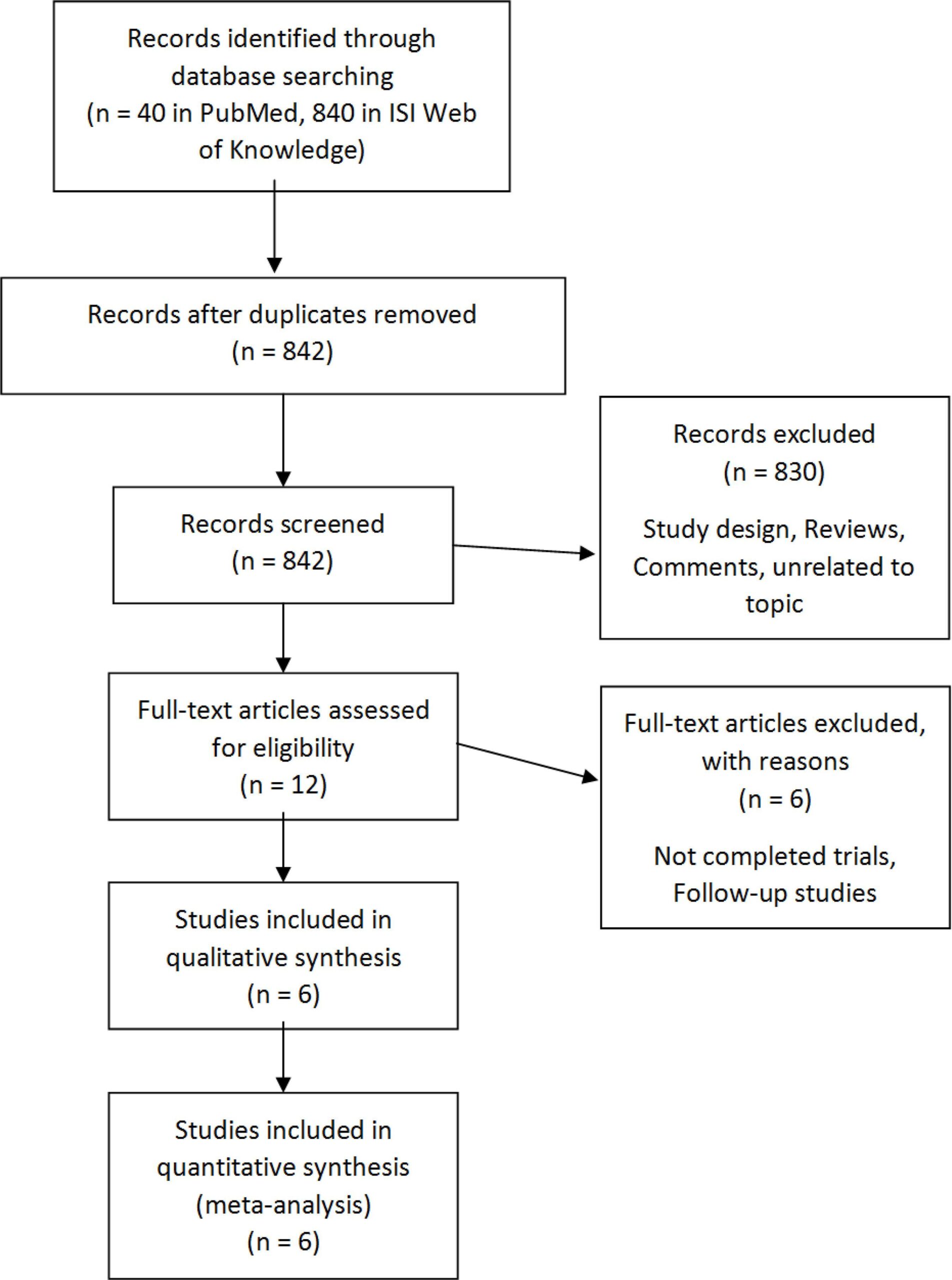
To produce an updated meta-analysis including only data from the primary analyses of clinical trials and to evaluate the role of PFO closure in the secondary prevention of recurrent stroke.

Methods:

Search in Medline (PubMed) and in ISI Web of Knowledge. Parameters under analysis and meta-analyses were: stroke, transient ischemic attack (TIA) and atrial fibrillation (AF). Comprehensive Meta-analysis Software V.2.0 (Biostat) was used. Random-effects analyses were carried out. A level of significance of 5% was used.

Results:

In this study six, randomized trials enrolling 3,750 patients were included. Unlike other published meta-analyses on the same topic, in this case, only clinical trial data, and not follow-up data, were used. PFO closure, as compared with medical therapy alone, demonstrated superiority in reducing the rate of recurrent stroke (risk ratio with PFO closure vs. medical therapy, 0.37; 95% confidence interval [CI], 0.17 to 0.78; p = 0.01). PFO closure did not offer a significant benefit in prevention of TIA (risk ratio with PFO closure vs. medical therapy, 0.96; 95% CI, 0.64 to 1.44; p = 0.85). Among patients assigned to closure group, an increased risk of atrial fibrillation was seen (risk ratio with PFO closure vs. medical therapy, 4.64; 95% CI, 2.38 to 9.01; p < 0.01).

Conclusions:

In patients with cryptogenic stroke who had a patent foramen ovale, a protective effect of closure was seen concerning the risk of recurrent stroke, but not regarding the prevention of TIA.

  • Atrial Fibrillation
  • Foramen Ovale Patent/Diagnosis
  • Isquemic Attack, Transient
  • Risk Factors
  • Stroke
  • Stroke/prevention and control
Read Full Article
Creative Commons Attribution (CC BY) Creative Commons license
03/02/2020 DOI: 10.36660/ijcs.20190075 Views 1
ABC
Editorial

Percutaneous Occlusion of Left Atrial Appendage: Growing Clinical Experience and Lack of Multicenter Randomized Clinical Trials

Cristiano F. Pisani et al. Mauricio Scanavacca

Left atrial appendage (LAA) closure as a prophylactic strategy for thromboembolic events in patients with atrial fibrillation (AF) has been performed for decades; initially during mitral valve repair surgeries and, more recently, in nonvalvular AF patients at high risk of embolism who do not tolerate the use of oral anticoagulants (OACs).

The idea of LAA occlusion as an alternative to chronic warfarin use emerged from observations of anatomopathological studies and during cardiac surgery that disclosed the LAA as the main site of thrombus formation in patients with nonvalvular atrial fibrillation.,

[…]

  • Atrial Appendage/diagnotic, imaging
  • Atrial Fibrillation / therapy
  • Prostheses and Implants/adverse effects
  • Stroke/prevention and control
Read Full Article
Creative Commons Attribution (CC BY) Creative Commons license
04/11/2019 DOI: 10.5935/abc.20190210 Views 2

How to cite this article

EndNote RIS

Electronic Document Format (Vancouver)

Felix A, Alcantara ML. To Close or not to Close PFOs in Cryptogenic Stroke, an Evolving Question. International Journal of Cardiovascular Sciences 2020;33(4):318-20.

Electronic Document Format (ABNT)

Felix, Alex; Alcantara, Monica Luiza de. To Close or not to Close PFOs in Cryptogenic Stroke, an Evolving Question. International Journal of Cardiovascular Sciences, v. 33, n. 4, p. 318-320, Jul. 2020.

Electronic Document Format (APA)

Felix, A., & Alcantara, M. L. (2020). To Close or not to Close PFOs in Cryptogenic Stroke, an Evolving Question. International Journal of Cardiovascular Sciences, 33(4), 318-320.

Electronic Document Format (ISO)

Felix, Alex and Alcantara, Monica Luiza de. To Close or not to Close PFOs in Cryptogenic Stroke, an Evolving Question. International Journal of Cardiovascular Sciences [online]. 2020, vol. 33, n. 4, [cited 2026-10-14], pp. 318-320. Available from: <https://journals.cardiol.br/en/article/to-close-or-not-to-close-pfos-in-cryptogenic-stroke-an-evolving-question/>. ISSN 2359-4802

EndNote RIS

Electronic Document Format (Vancouver)

Ferreira RM, Pinheiro C, Rocha JRF. Internet Search Trends and Regional Mortality Tendencies: The Case of Oral Anticoagulants and Stroke. Arquivos Brasileiros de Cardiologia 2020;114(4):726-9.

Electronic Document Format (ABNT)

Ferreira, Roberto Muniz; Pinheiro, Ísis da Capela; Rocha, João Roquette Fleury da. Internet Search Trends and Regional Mortality Tendencies: The Case of Oral Anticoagulants and Stroke. Arquivos Brasileiros de Cardiologia, v. 114, n. 4, p. 726-729, May. 2020.

Electronic Document Format (APA)

Ferreira, R. M., Pinheiro, C., & Rocha, J. R. F. (2020). Internet Search Trends and Regional Mortality Tendencies: The Case of Oral Anticoagulants and Stroke. Arquivos Brasileiros de Cardiologia, 114(4), 726-729.

Electronic Document Format (ISO)

Ferreira, Roberto Muniz and Pinheiro, Ísis da Capela and Rocha, João Roquette Fleury da. Internet Search Trends and Regional Mortality Tendencies: The Case of Oral Anticoagulants and Stroke. Arquivos Brasileiros de Cardiologia [online]. 2020, vol. 114, n. 4, [cited 2026-10-14], pp. 726-729. Available from: <https://journals.cardiol.br/en/article/internet-search-trends-and-regional-mortality-tendencies-the-case-of-oral-anticoagulants-and-stroke/>. ISSN 0066-782X

EndNote RIS

Electronic Document Format (Vancouver)

Bittencourt M. Are DOACs a Good Bang for Your Buck in Atrial Fibrillation Prevention in Real-Life?. Arquivos Brasileiros de Cardiologia 2020;114(3):467-8.

Electronic Document Format (ABNT)

Bittencourt, Márcio. Are DOACs a Good Bang for Your Buck in Atrial Fibrillation Prevention in Real-Life?. Arquivos Brasileiros de Cardiologia, v. 114, n. 3, p. 467-468, Apr. 2020.

Electronic Document Format (APA)

Bittencourt, M. (2020). Are DOACs a Good Bang for Your Buck in Atrial Fibrillation Prevention in Real-Life?. Arquivos Brasileiros de Cardiologia, 114(3), 467-468.

Electronic Document Format (ISO)

Bittencourt, Márcio. Are DOACs a Good Bang for Your Buck in Atrial Fibrillation Prevention in Real-Life?. Arquivos Brasileiros de Cardiologia [online]. 2020, vol. 114, n. 3, [cited 2026-10-14], pp. 467-468. Available from: <https://journals.cardiol.br/en/article/are-doacs-a-good-bang-for-your-buck-in-atrial-fibrillation-prevention-in-real-life/>. ISSN 0066-782X

EndNote RIS

Electronic Document Format (Vancouver)

Pereira SPP, Nunes A, Santos C, Kasner SE, Nunes JPL. The Role of Patent Foramen Ovale Closure in the Secondary Prevention of Cryptogenic Stroke: a Meta-Analysis Report. International Journal of Cardiovascular Sciences 2020;33(4):307-1.

Electronic Document Format (ABNT)

Pereira, Sónia P. Pinto; Nunes, Alzira; Santos, Cristina; Kasner, Scott E; Nunes, José P. L. The Role of Patent Foramen Ovale Closure in the Secondary Prevention of Cryptogenic Stroke: a Meta-Analysis Report. International Journal of Cardiovascular Sciences, v. 33, n. 4, p. 307-317, Feb. 2020.

Electronic Document Format (APA)

Pereira, S. P. P., Nunes, A., Santos, C., Kasner, S. E., & Nunes, J. P. L. (2020). The Role of Patent Foramen Ovale Closure in the Secondary Prevention of Cryptogenic Stroke: a Meta-Analysis Report. International Journal of Cardiovascular Sciences, 33(4), 307-317.

Electronic Document Format (ISO)

Pereira, Sónia P. Pinto and Nunes, Alzira and Santos, Cristina and Kasner, Scott E and Nunes, José P. L. The Role of Patent Foramen Ovale Closure in the Secondary Prevention of Cryptogenic Stroke: a Meta-Analysis Report. International Journal of Cardiovascular Sciences [online]. 2020, vol. 33, n. 4, [cited 2026-10-14], pp. 307-317. Available from: <https://journals.cardiol.br/en/article/the-role-of-patent-foramen-ovale-closure-in-the-secondary-prevention-of-cryptogenic-stroke-a-meta-analysis-report/>. ISSN 2359-4802

EndNote RIS

Electronic Document Format (Vancouver)

Pisani CF, Scanavacca M. Percutaneous Occlusion of Left Atrial Appendage: Growing Clinical Experience and Lack of Multicenter Randomized Clinical Trials. Arquivos Brasileiros de Cardiologia 2019;113(4):722-4.

Electronic Document Format (ABNT)

Pisani, Cristiano F.; Scanavacca, Mauricio. Percutaneous Occlusion of Left Atrial Appendage: Growing Clinical Experience and Lack of Multicenter Randomized Clinical Trials. Arquivos Brasileiros de Cardiologia, v. 113, n. 4, p. 722-724, Nov. 2019.

Electronic Document Format (APA)

Pisani, C. F., & Scanavacca, M. (2019). Percutaneous Occlusion of Left Atrial Appendage: Growing Clinical Experience and Lack of Multicenter Randomized Clinical Trials. Arquivos Brasileiros de Cardiologia, 113(4), 722-724.

Electronic Document Format (ISO)

Pisani, Cristiano F. and Scanavacca, Mauricio. Percutaneous Occlusion of Left Atrial Appendage: Growing Clinical Experience and Lack of Multicenter Randomized Clinical Trials. Arquivos Brasileiros de Cardiologia [online]. 2019, vol. 113, n. 4, [cited 2026-10-14], pp. 722-724. Available from: <https://journals.cardiol.br/en/article/percutaneous-occlusion-of-left-atrial-appendage-growing-clinical-experience-and-lack-of-multicenter-randomized-clinical-trials/>. ISSN 0066-782X

  • About ABC Family
  • Internal Regulation
  • Editorial Board
  • Brazilian Society of Cardiology (SBC)

Issues

SBC Guidelines

  • Videos
  • Podcasts
  • News