ABC Family Arquivos Brasileiros de Cardiologia International Journal of Cardiovascular Sciences ABC Heart Failure & Cardiomyopathy ABC Imagem Cardiovascular
Português English
ABC Family
Português English
  • About
    • About ABC Family
    • Internal Regulation
    • Editorial Board
    • Brazilian Society of Cardiology (SBC)
  • Issues
  • SBC Guidelines
  • Content
    • Videos
    • Podcasts
    • News
  • About
    • About ABC Family
    • Internal Regulation
    • Editorial Board
    • Brazilian Society of Cardiology (SBC)
  • Issues
  • SBC Guidelines
  • Content
    • Videos
    • Podcasts
    • News

ABC Family

  • ABC Family
  • Arquivos Brasileiros de Cardiologia
  • International Journal of Cardiovascular Sciences
  • ABC Heart Failure & Cardiomyopathy
  • ABC Imagem Cardiovascular
Search in

No content found.

Journals
Ordering
Article types
Others

  1. Home
  2. Keyword: Stress,Psychological
Figure 1
IJCS
Original Article

Validation of the Brazilian Version of the Screening Tool for Psychosocial Distress (Stop-D) for Cardiac Patients

Isabella Barros Rabelo Gontijo et al. Juciléia Rezende Souza Daniel Fernandes Barbosa Salvador Rassi

Abstract

Background:

Distress has a potentiating effect on complications of heart disease. Early identification of distress and psychosocial management could help patients to deal with the disease and improve their quality of life. However, in Brazil, there is no specific instrument for evaluation of distress in cardiac patients.

Objectives:

To describe the validation process of the Screening Tool for Psychosocial Distress (STOP-D) for the Brazilian population.

Methods:

Cross-sectional, observational study with a quantitative approach. A total of 144 patients (including outpatients and inpatients) were interviewed at the waiting room of the outpatient cardiology clinic or in cardiology wards. Sociodemographic and clinical data were collected, and distress was assessed using two instruments – the Brazilian version of the STOP-D and the Hospital Anxiety and Depression Scale (HADS). First, we performed an exploratory factor analysis and analysis of the accuracy of the STOP-D score by the receiver operating characteristic (ROC) curvet.

Results:

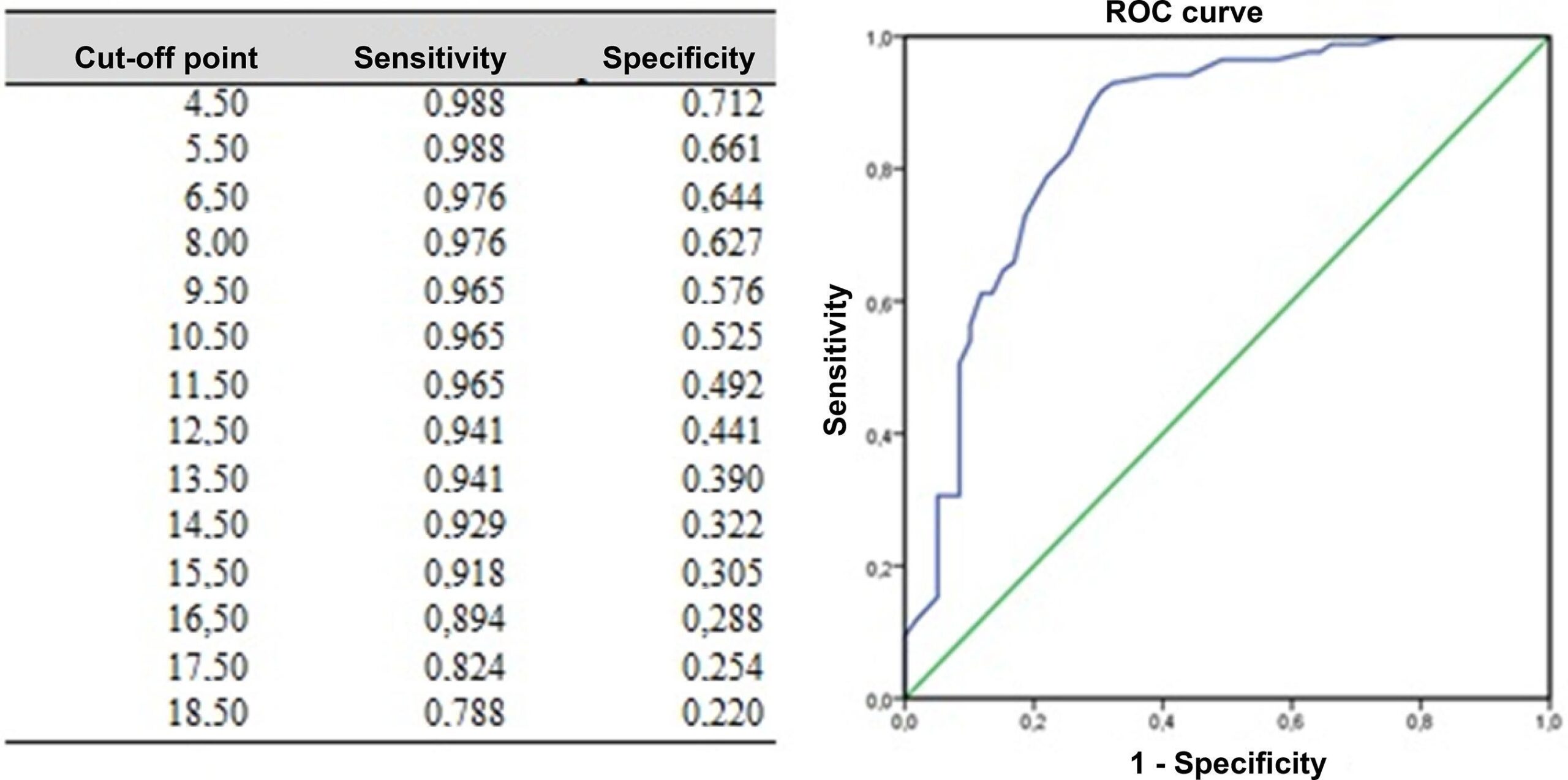
The factorability analysis of the correlation matrix did not detect any factor that made the factorial solution unfeasible. The instrument showed a single-factor nature, confirmed by the criterion of eigenvalues, with an 85% accuracy in predicting distress. A cut-off point of 15.5 was chosen for distress using the ROC curve.

Conclusions:

The Brazilian version of the STOP-D is an adequate instrument for the screening of heart disease patient for distress. It can be easily used by any health professional and would contribute to the promotion of a comprehensive support to cardiac patients.
  • Anxiety
  • Cardiovascular Diseases
  • Depression
  • Health Delivery
  • Quality of life
  • Social Conditions
  • Stress,Psychological
Read Full Article
Creative Commons Attribution (CC BY) Creative Commons license
15/04/2019 DOI: 10.5935/2359-4802.20190030 Views 1
Figure 1
ABC
Original Article

Ideal Cardiovascular Health and Job Strain: A Cross-Sectional Study from the Amazon Basin

Davi Dantas Muniz et al. Kamile Santos Siqueira Cristina Toledo Cornell Miguel Morita Fernandes-Silva … Pascoal Torres Muniz Odilson Marcos Silvestre

Abstract

Background:

Ideal Cardiovascular (CV) Health is characterized by four ideal lifestyle parameters and absence of cardiovascular risk factors. The prevalence of ideal CV health in the Amazon Basin and the influence of job strain on CV health in this setting are uncertain.

Objective:

To evaluate the prevalence of ideal CV health and its relationship with job strain in a secluded area from a developing country.

Methods:

Job strain was evaluated in 478 employees from an university in the Amazon Basin by a questionnaire that classified participants as passive, active, low or high strain, according to the demand-control model. CV health was evaluated using the American Heart Association 7 health factors (diet, physical activity, body mass index (BMI), smoking, hypertension, diabetes and hypercholesterolemia). Participants were classified as having ideal, intermediate or poor CV health. The level of significance was set at p < 0.05.

Results:

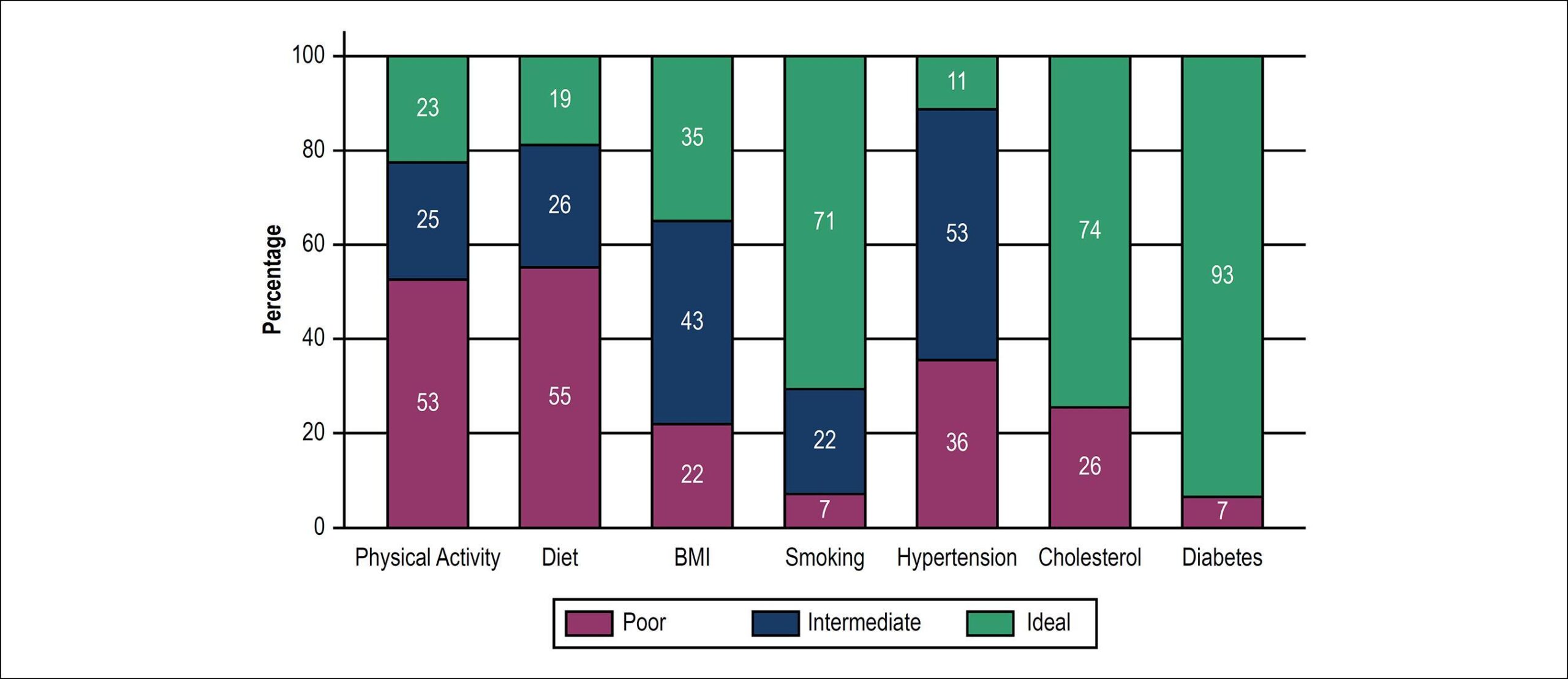
The mean age was 44.3 ± 12 years, 65% were men, and 35% were faculty. No participant fulfilled the criteria for ideal CV health. Intermediate CV health was found in 44 (9%) and poor in 434 (91%) individuals. Considering low strain as a reference group, individuals classified as high strain, active and passive had a non-significant (p > 0.05) increase in the chances of having poor CV health. When adjusting for possible confounders, high job strain was associated with poor BMI (> 30 kg/m2), (OR 2.11, 95%CI 1.06-4.22; p = 0.034) and poor diet (OR 2.31, 95% CI 1.29-4.13; p = 0.005).

Conclusion:

Job strain was not associated with cardiovascular health, but high job strain was related to obesity and poor diet. Given the high prevalence of poor CV health and lack of participants with ideal CV health, policies focusing on health education and lifestyle interventions are paramount to this population.

  • Amazonian Ecosystem
  • Cardiovascular Diseases / epidemiology
  • Eating Disorders
  • Obesity
  • Prevention and Control
  • Risk Factors
  • Stress,Psychological
Read Full Article
Creative Commons Attribution (CC BY) Creative Commons license
07/01/2019 DOI: 10.5935/abc.20190005
ABC
Editorial

Anger and Cardiovascular Disease: An Old and Complicated Relationship

Carlos Eduardo Lucena Montenegro et al. Sergio Tavares Montenegro

Negative feelings have long been related to health problems. Buddhism, for example, refers to anger as one of the three “poisons of the mind” (greed, anger and madness). In the first edition of Circulation, there was already an article suggesting the association between stress and cardiovascular disease.

In the last decades, several studies have tried to correlate psychosocial factors, such as anger, anxiety, depression and stress, with coronary artery disease (CAD), demonstrating the increase in the incidence of CAD in patients with a higher incidence of these psychic conditions, for example, with a marked increase in events of acute myocardial infarction (AMI) between 2008 and 2009, in the United States, when there was a stock market crash.– This relationship tends to be significantly more important in women, since factors such as low socioeconomic status and double working hours (conciliation of employment with maternity), among other factors, are more common in the female population. More recently, a longitudinal study of cohort was able to demonstrate the association between the activity of the cerebral amygdala (area involved with the emotions) and the increased risk of cardiovascular events.

[…]

  • Anger/physiology
  • Anxiety Disorders
  • Coronary Artery Disease
  • Depression
  • Stress,Psychological
Read Full Article
Creative Commons Attribution (CC BY) Creative Commons license
01/09/2018 DOI: 10.5935/abc.20180176 Views 1

How to cite this article

EndNote RIS

Electronic Document Format (Vancouver)

Gontijo IBR, Souza JR, Barbosa DF, Rassi S. Validation of the Brazilian Version of the Screening Tool for Psychosocial Distress (Stop-D) for Cardiac Patients. International Journal of Cardiovascular Sciences 2019;32(5):438-46.

Electronic Document Format (ABNT)

Gontijo, Isabella Barros Rabelo; Souza, Juciléia Rezende; Barbosa, Daniel Fernandes; Rassi, Salvador. Validation of the Brazilian Version of the Screening Tool for Psychosocial Distress (Stop-D) for Cardiac Patients. International Journal of Cardiovascular Sciences, v. 32, n. 5, p. 438-446, Apr. 2019.

Electronic Document Format (APA)

Gontijo, I. B. R., Souza, J. R., Barbosa, D. F., & Rassi, S. (2019). Validation of the Brazilian Version of the Screening Tool for Psychosocial Distress (Stop-D) for Cardiac Patients. International Journal of Cardiovascular Sciences, 32(5), 438-446.

Electronic Document Format (ISO)

Gontijo, Isabella Barros Rabelo and Souza, Juciléia Rezende and Barbosa, Daniel Fernandes and Rassi, Salvador. Validation of the Brazilian Version of the Screening Tool for Psychosocial Distress (Stop-D) for Cardiac Patients. International Journal of Cardiovascular Sciences [online]. 2019, vol. 32, n. 5, [cited 2026-10-14], pp. 438-446. Available from: <https://journals.cardiol.br/en/article/validation-of-the-brazilian-version-of-the-screening-tool-for-psychosocial-distress-stop-d-for-cardiac-patients/>. ISSN 2359-4802

EndNote RIS

Electronic Document Format (Vancouver)

Muniz DD, Siqueira KS, Cornell CT, Fernandes-Silva MM, Muniz PT, Silvestre OM. Ideal Cardiovascular Health and Job Strain: A Cross-Sectional Study from the Amazon Basin. Arquivos Brasileiros de Cardiologia 2019;112(3):260-8.

Electronic Document Format (ABNT)

Muniz, Davi Dantas; Siqueira, Kamile Santos; Cornell, Cristina Toledo; Fernandes-Silva, Miguel Morita; Muniz, Pascoal Torres; Silvestre, Odilson Marcos. Ideal Cardiovascular Health and Job Strain: A Cross-Sectional Study from the Amazon Basin. Arquivos Brasileiros de Cardiologia, v. 112, n. 3, p. 260-268, Jan. 2019.

Electronic Document Format (APA)

Muniz, D. D., Siqueira, K. S., Cornell, C. T., Fernandes-Silva, M. M., Muniz, P. T., & Silvestre, O. M. (2019). Ideal Cardiovascular Health and Job Strain: A Cross-Sectional Study from the Amazon Basin. Arquivos Brasileiros de Cardiologia, 112(3), 260-268.

Electronic Document Format (ISO)

Muniz, Davi Dantas and Siqueira, Kamile Santos and Cornell, Cristina Toledo and Fernandes-Silva, Miguel Morita and Muniz, Pascoal Torres and Silvestre, Odilson Marcos. Ideal Cardiovascular Health and Job Strain: A Cross-Sectional Study from the Amazon Basin. Arquivos Brasileiros de Cardiologia [online]. 2019, vol. 112, n. 3, [cited 2026-10-14], pp. 260-268. Available from: <https://journals.cardiol.br/en/article/ideal-cardiovascular-health-and-job-strain-a-cross-sectional-study-from-the-amazon-basin/>. ISSN 0066-782X

EndNote RIS

Electronic Document Format (Vancouver)

Montenegro CEL, Montenegro ST. Anger and Cardiovascular Disease: An Old and Complicated Relationship. Arquivos Brasileiros de Cardiologia 2018;111(3):417-8.

Electronic Document Format (ABNT)

Montenegro, Carlos Eduardo Lucena; Montenegro, Sergio Tavares. Anger and Cardiovascular Disease: An Old and Complicated Relationship. Arquivos Brasileiros de Cardiologia, v. 111, n. 3, p. 417-418, Aug. 2018.

Electronic Document Format (APA)

Montenegro, C. E. L., & Montenegro, S. T. (2018). Anger and Cardiovascular Disease: An Old and Complicated Relationship. Arquivos Brasileiros de Cardiologia, 111(3), 417-418.

Electronic Document Format (ISO)

Montenegro, Carlos Eduardo Lucena and Montenegro, Sergio Tavares. Anger and Cardiovascular Disease: An Old and Complicated Relationship. Arquivos Brasileiros de Cardiologia [online]. 2018, vol. 111, n. 3, [cited 2026-10-14], pp. 417-418. Available from: <https://journals.cardiol.br/en/article/anger-and-cardiovascular-disease-an-old-and-complicated-relationship/>. ISSN 0066-782X

  • About ABC Family
  • Internal Regulation
  • Editorial Board
  • Brazilian Society of Cardiology (SBC)

Issues

SBC Guidelines

  • Videos
  • Podcasts
  • News