ABC Family Arquivos Brasileiros de Cardiologia International Journal of Cardiovascular Sciences ABC Heart Failure & Cardiomyopathy ABC Imagem Cardiovascular
Português English
ABC Family
Português English
  • About
    • About ABC Family
    • Internal Regulation
    • Editorial Board
    • Brazilian Society of Cardiology (SBC)
  • Issues
  • SBC Guidelines
  • Content
    • Videos
    • Podcasts
    • News
  • About
    • About ABC Family
    • Internal Regulation
    • Editorial Board
    • Brazilian Society of Cardiology (SBC)
  • Issues
  • SBC Guidelines
  • Content
    • Videos
    • Podcasts
    • News

ABC Family

  • ABC Family
  • Arquivos Brasileiros de Cardiologia
  • International Journal of Cardiovascular Sciences
  • ABC Heart Failure & Cardiomyopathy
  • ABC Imagem Cardiovascular
Search in

No content found.

Journals
Ordering
Article types
Others

  1. Home
  2. Keyword: Rural Population
ABC
Statement

2019: Recommendations for Reducing Tobacco Consumption in Portuguese-Speaking Countries – Positioning of the Federation of Portuguese Language Cardiology Societies

Gláucia Maria Moraes de Oliveira et al. Miguel Mendes Oscar Pereira Dutra Aloysio Achutt … Mario Fernandes Vanda Azevedo Maria Beatriz Sena e Costa Santos Ferreira Armando Serra Coelho Miryan Bandeira dos Prazeres Cassandra Soares Mário Alberto Brito Lima Évora Mário Gomes Mariotto João Araujo Morais

Introduction

Depending on the epidemiological perspective of the observer and the extent of his concept of causality, tobacco consumption can be considered the second cause in the world of death attributed to classic cardiovascular risk factors, preceded only by hypertension, and the first cause of premature death and disabilities. When understood as an immediate cause without contextualization in the complex that determines and maintains population behavior, smoking was responsible in the world for about 8.10 (7.79-8.41) million deaths and 213.39 (201.16-226.66) million healthy life years lost (disability-adjusted life-years, DALYs). Although the number of daily smokers (individuals aged 15 years and older who smoke daily) has decreased, the total number of smokers continues to increase, imposing a major global challenge for healthcare systems.

Physicians, who generally deal directly and individually with the patient, tend to consider health/illness limited to the patient’s organic commitment and personal history and are less appreciative of the “causes of the causes” and the psychosocial determinants of the phenomena and behaviors, inseparable from the ecological context and interests. Environmental pollution (which has also a contribution from smoking and is progressively increasing) is currently considered to be the most important cause of morbidity and mortality in the world’s population, extending the spectrum beyond the traditionally valued risk factors. This perspective is very important for an understanding of the resistance to smoking control and planning of strategies that are more effective to approach this issue.

[…]
  • Rural Population
  • Smoking Prevention
  • Socioeconomic Factors
  • Tobacco Smoke Pollution
  • Tobacco Use Disorder/epidemiology
  • Tobacco Use Disorder/mortality
  • Urban Population
Read Full Article
Creative Commons Attribution (CC BY) Creative Commons license
15/04/2019 DOI: 10.5935/abc.20190071 Views 1
Figure 1
IJCS
Original Article

Prevalence of Peripheral Artery Disease and Associated Risk Factors in a Brazilian Rural Population: The Baependi Heart Study

Rafael de Oliveira Alvim et al. Fernando Augusto Lavezzo Dias Camila Maciel de Oliveira Andréa Roseli Vançan Russo Horimoto … Anderson Zampier Ulbrich José Eduardo Krieger Alexandre da Costa Pereira

Abstract

Background:

The identification of peripheral artery disease (PAD) can help prevent further progression of the disease and additional complications, considering that this condition is a risk factor for all-cause mortality and cardiovascular death.

Objective:

To assess the prevalence of PAD in the Baependi Heart Study and investigate associated risk factors in different age groups.

Methods:

A total of 1,627 individuals (of both genders and aged 18 – 102 years) residing in the municipality of Baependi (Minas Gerais, Brazil) were selected for this study. Anthropometric and biochemical parameters were evaluated by standard techniques. Physical activity level was determined by the International Physical Activity Questionnaire – Short Form (IPAQ-SF). The screening of PAD was performed by determination of the ankle-brachial index (ABI). The level of statistical significance was set at 5%.

Results:

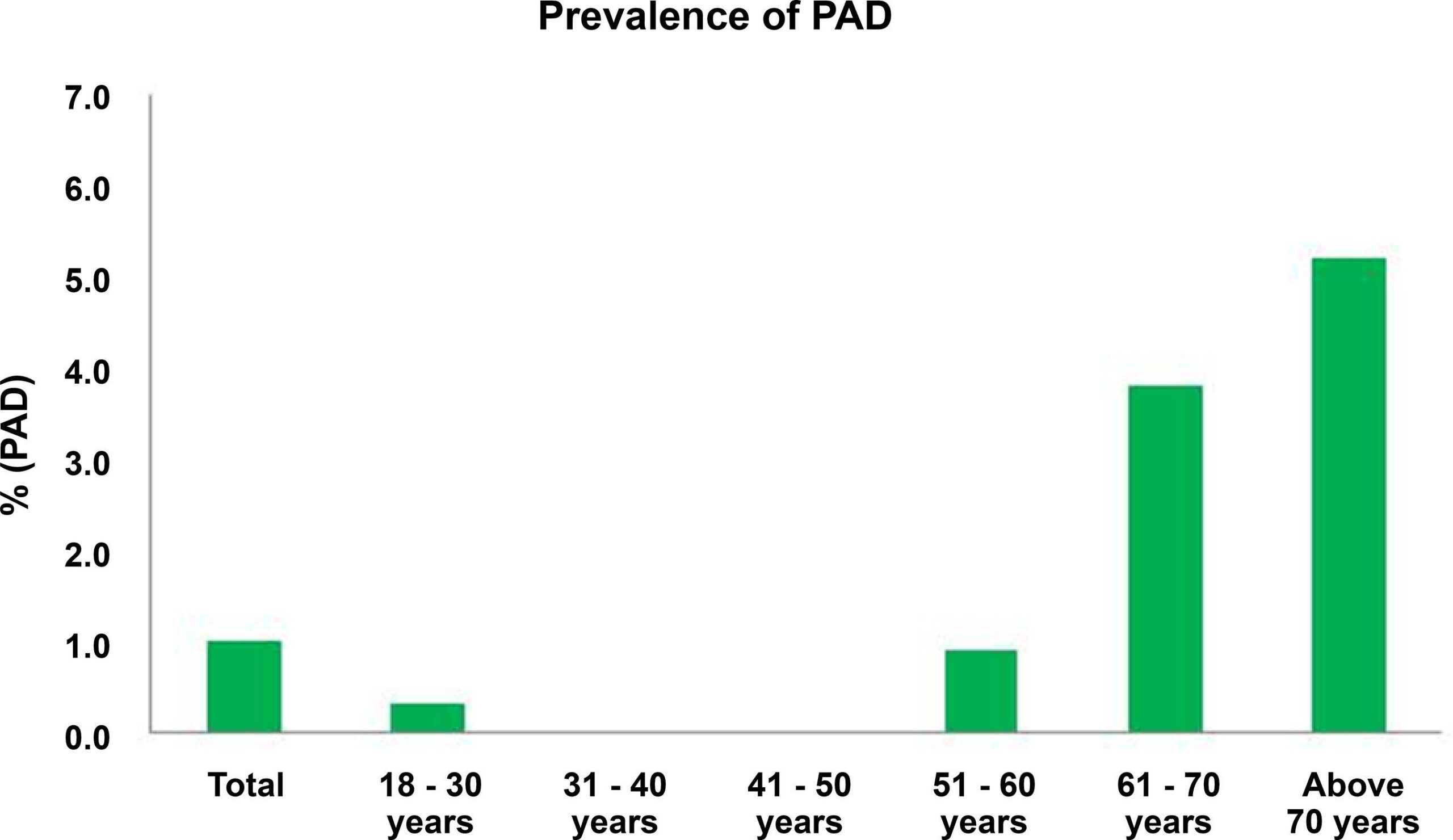
In the overall sample, the prevalence of PAD was 1.05%, and reached 5.2% after the age of 70 years. The frequency and intensity of smoking were higher in individuals with PAD. A prior history of myocardial infarction and a higher prevalence of hypertension, diabetes, obesity, and sedentary lifestyle were also associated with PAD. In addition, PAD was more frequent in blacks than whites. In multivariable analysis, age, diabetes, smoking, and physical inactivity remained independently associated with PAD.

Conclusion:

The prevalence of PAD was low and increased clearly with age in our sample from a Brazilian rural population. Furthermore, the main risk factors for PAD in the investigated sample were smoking, sedentary lifestyle, diabetes mellitus, and age. (Int J Cardiovasc Sci. 2018; [online].ahead print, PP.0-0)

  • Ankle Brachial Index
  • Peripheral Arterial Disease / prevalence
  • Risk Factors
  • Rural Population
  • Tobacco Use Disorder
Read Full Article
Creative Commons Attribution (CC BY) Creative Commons license
11/06/2018 DOI: 10.5935/2359-4802.20180031 Views 1
ABC
Artigo Original

Clinical and demographic profile and quality indicators for heart failure in a rural area

Henrique Miller Balieiro et al. Raphael Kasuo Osugue Samuel Pereira Rangel Raphael Brandão … Tatiana Leal Balieiro Sabrina Bernardez Evandro Tinoco Mesquita

BACKGROUND: data on heart failure (HF) in Brazil are ensued from tertiary centers. This information can not be extended to the rural population, for it reflects distinct social, economic and cultural characteristics. OBJECTIVE: To establish the clinical and demographic profile and quality indicators for HF in rural areas. METHODS: Transversal cohort study that included 166 patients from the rural area of Valença, Rio de Janeiro, Brazil. After the evaluation of clinical, laboratorial and echocardiograph data, chi-square and Fisher’s exact tests were used for analysis of proportion, as well as the Student’s t-test for numeric variables, in order to establish the population’s characteristics. RESULTS: Mean age was 61±14 years old, as 85 of them (51%) were men, 88 (53%) were afro-Brazilian and 85 (51%) had heart failure with reduced ejection fraction (HFREF). Systemic arterial hypertension (151 patients, 91%) and metabolic syndrome (103 patients, 62%) were prevalent comorbidities. The most common etiologies were: hypertensive (77 patients, 46%) and ischemic (62 patients, 37%). Quality indicators in HF were: 43 patients (26%) with previous echocardiogram, 102 patients (62%) were in use of beta-blockers, 147 patients (88%) received angiotensin converter enzyme inhibitor (ACEI) or angiotensin receptor blockers (ARB), and 22% of the patients with atrial fibrillation (AF) were under treatment with oral anticoagulation. For heart failure with normal ejection fraction (HFNEF), females (p=0.001; OD: 0.32; CI=0.17-0.60), metabolic syndrome (p=0.004; OD: 0.28; CI=1.31-4.78) and hypertensive etiology (p<0.0001; OD: 6.83; CI=3.45-13.5) were predominant. For CIREF, males (p=0.001; OD: 0.32; CI=0.170-0.605) and ischemic etiology (p<0.0001; OD: 0.16; CI=0.079-0.330) were predominant. CONCLUSION: In rural areas, HF shows similarity with regard to sex, ethnicity and classification. Hypertensive etiology was the most commonly present. HFNEF was prevalent among women and in the presence of metabolic syndrome, while HFREF was associated with males and ischemic etiology.

  • health care
  • Health Profile
  • Heart Failure
  • quality indictors
  • Rural Population
Read Full Article
Creative Commons Attribution (CC BY) Creative Commons license
05/05/2010 DOI: 10.1590/S0066-782X2009001200020
ABC
Artigo Original

Association between central obesity, triglycerides and hypertension in a rural area in Brazil

Adriano Marçal Pimenta et al. Gilberto Kac Andrea Gazzinelli Rodrigo Corrêa-Oliveira Gustavo Velásquez-Meléndez

BACKGROUND: Hypertension represents a serious public health problem and is one of the most frequent causes of morbidity around the world. OBJECTIVE: To estimate the prevalence of hypertension and its risk factors in a rural community located in the north-eastern state of Minas Gerais, Brazil. METHODS: A cross-sectional study was carried out in 2004 in the Virgem das Graças Village, a rural community located the Jequitinhonha Valley. The sample consisted of 287 males and females aged between 18 to 88 years. Hypertension was defined according to Joint National Committee criteria (systolic blood pressure > 140 mmHg and/or diastolic blood pressure > 90 mmHg): subjects already receiving anti-hypertensive treatment were considered to be hypertensive. Bivariate analysis was performed to test the relationship between the independent variables and hypertension. Logistic regression was used to adjust for confounding and to identify interactions. The strength of association was measured using Odds Ratio (OR) and its 95% confidence intervals [CI (95%)]. RESULTS: The crude prevalence of hypertension was 47.0% [CI (95%): 41.1 – 53.0], the age-standardized prevalence was 43.2% [CI (95%): 35.7 – 50.7], while the schooling-standardized prevalence was 44.1% [CI (95%): 43.9 – 44.3]. Age, triglycerides, waist circumference and sex were found to be independent risk factors for hypertension according to multivariate analysis. CONCLUSION: The findings provide important evidence concerning the hypertension as a public health problem and its association with dyslipidemia and abdominal obesity in the rural area of Minas Gerais.

  • Dyslipidemias
  • Epidemiology
  • Hypertension
  • Obesity
  • Rural Population
Read Full Article
Creative Commons Attribution (CC BY) Creative Commons license
25/06/2008 DOI: 10.1590/S0066-782X2008000600006

How to cite this article

EndNote RIS

Electronic Document Format (Vancouver)

Oliveira GMM, Mendes M, Dutra OP, Achutt A, Fernandes M, Azevedo V, Ferreira MBSCS, et al. 2019: Recommendations for Reducing Tobacco Consumption in Portuguese-Speaking Countries – Positioning of the Federation of Portuguese Language Cardiology Societies. Arquivos Brasileiros de Cardiologia 2019;112(4):477-86.

Electronic Document Format (ABNT)

Oliveira, Gláucia Maria Moraes de; Mendes, Miguel; Dutra, Oscar Pereira; Achutt, Aloysio; Fernandes, Mario; Azevedo, Vanda; Ferreira, Maria Beatriz Sena e Costa Santos; Coelho, Armando Serra; Soares, Miryan Bandeira dos Prazeres Cassandra; Évora, Mário Alberto Brito Lima; Mariotto, Mário Gomes; Morais, João Araujo. 2019: Recommendations for Reducing Tobacco Consumption in Portuguese-Speaking Countries – Positioning of the Federation of Portuguese Language Cardiology Societies. Arquivos Brasileiros de Cardiologia, v. 112, n. 4, p. 477-486, Apr. 2019.

Electronic Document Format (APA)

Oliveira, G. M. M. , Mendes, M., Dutra, O. P., Achutt, A., Fernandes, M., Azevedo, V., Ferreira, M. B. S. C. S., Coelho, A. S., Soares, M. B. P. C., Évora, M. A. B. L., Mariotto, M. G., & Morais, J. A. (2019). 2019: Recommendations for Reducing Tobacco Consumption in Portuguese-Speaking Countries – Positioning of the Federation of Portuguese Language Cardiology Societies. Arquivos Brasileiros de Cardiologia, 112(4), 477-486.

Electronic Document Format (ISO)

Oliveira, Gláucia Maria Moraes de and Mendes, Miguel and Dutra, Oscar Pereira and Achutt, Aloysio and Fernandes, Mario and Azevedo, Vanda and Ferreira, Maria Beatriz Sena e Costa Santos and Coelho, Armando Serra and Soares, Miryan Bandeira dos Prazeres Cassandra and Évora, Mário Alberto Brito Lima and Mariotto, Mário Gomes and Morais, João Araujo. 2019: Recommendations for Reducing Tobacco Consumption in Portuguese-Speaking Countries – Positioning of the Federation of Portuguese Language Cardiology Societies. Arquivos Brasileiros de Cardiologia [online]. 2019, vol. 112, n. 4, [cited 2026-10-14], pp. 477-486. Available from: <https://journals.cardiol.br/en/article/2019-recommendations-for-reducing-tobacco-consumption-in-portuguese-speaking-countries-positioning-of-the-federation-of-portuguese-language-cardiology-societies/>. ISSN 0066-782X

EndNote RIS

Electronic Document Format (Vancouver)

Alvim RO, Dias FAL, Oliveira CM, Horimoto ARVR, Ulbrich AZ, Krieger JE, Pereira AC, et al. Prevalence of Peripheral Artery Disease and Associated Risk Factors in a Brazilian Rural Population: The Baependi Heart Study. International Journal of Cardiovascular Sciences 2018;31(4):405-13.

Electronic Document Format (ABNT)

Alvim, Rafael de Oliveira; Dias, Fernando Augusto Lavezzo; Oliveira, Camila Maciel de; Horimoto, Andréa Roseli Vançan Russo; Ulbrich, Anderson Zampier; Krieger, José Eduardo; Pereira, Alexandre da Costa. Prevalence of Peripheral Artery Disease and Associated Risk Factors in a Brazilian Rural Population: The Baependi Heart Study. International Journal of Cardiovascular Sciences, v. 31, n. 4, p. 405-413, Jun. 2018.

Electronic Document Format (APA)

Alvim, R. O., Dias, F. A. L., Oliveira, C. M. , Horimoto, A. R. V. R., Ulbrich, A. Z., Krieger, J. E., & Pereira, A. C. (2018). Prevalence of Peripheral Artery Disease and Associated Risk Factors in a Brazilian Rural Population: The Baependi Heart Study. International Journal of Cardiovascular Sciences, 31(4), 405-413.

Electronic Document Format (ISO)

Alvim, Rafael de Oliveira and Dias, Fernando Augusto Lavezzo and Oliveira, Camila Maciel de and Horimoto, Andréa Roseli Vançan Russo and Ulbrich, Anderson Zampier and Krieger, José Eduardo and Pereira, Alexandre da Costa. Prevalence of Peripheral Artery Disease and Associated Risk Factors in a Brazilian Rural Population: The Baependi Heart Study. International Journal of Cardiovascular Sciences [online]. 2018, vol. 31, n. 4, [cited 2026-10-14], pp. 405-413. Available from: <https://journals.cardiol.br/en/article/prevalence-of-peripheral-artery-disease-and-associated-risk-factors-in-a-brazilian-rural-population-the-baependi-heart-study/>. ISSN 2359-4802

EndNote RIS

Electronic Document Format (Vancouver)

Balieiro HM, Osugue RK, Rangel SP, Brandão R, Balieiro TL, Bernardez S, Mesquita ET, et al. Clinical and demographic profile and quality indicators for heart failure in a rural area. Arquivos Brasileiros de Cardiologia 2010;93(6):687-91.

Electronic Document Format (ABNT)

Balieiro, Henrique Miller; Osugue, Raphael Kasuo; Rangel, Samuel Pereira; Brandão, Raphael; Balieiro, Tatiana Leal; Bernardez, Sabrina; Mesquita, Evandro Tinoco. Clinical and demographic profile and quality indicators for heart failure in a rural area. Arquivos Brasileiros de Cardiologia, v. 93, n. 6, p. 687-691, May. 2010.

Electronic Document Format (APA)

Balieiro, H. M., Osugue, R. K., Rangel, S. P., Brandão, R., Balieiro, T. L., Bernardez, S., & Mesquita, E. T. (2010). Clinical and demographic profile and quality indicators for heart failure in a rural area. Arquivos Brasileiros de Cardiologia, 93(6), 687-691.

Electronic Document Format (ISO)

Balieiro, Henrique Miller and Osugue, Raphael Kasuo and Rangel, Samuel Pereira and Brandão, Raphael and Balieiro, Tatiana Leal and Bernardez, Sabrina and Mesquita, Evandro Tinoco. Clinical and demographic profile and quality indicators for heart failure in a rural area. Arquivos Brasileiros de Cardiologia [online]. 2010, vol. 93, n. 6, [cited 2026-10-14], pp. 687-691. Available from: <https://journals.cardiol.br/en/article/clinical-and-demographic-profile-and-quality-indicators-for-heart-failure-in-a-rural-area/>. ISSN 0066-782X

EndNote RIS

Electronic Document Format (Vancouver)

Pimenta AM, Kac G, Gazzinelli A, Corrêa-Oliveira R, Velásquez-Meléndez G. Association between central obesity, triglycerides and hypertension in a rural area in Brazil. Arquivos Brasileiros de Cardiologia 2008;90(6):419-25.

Electronic Document Format (ABNT)

Pimenta, Adriano Marçal; Kac, Gilberto; Gazzinelli, Andrea; Corrêa-Oliveira, Rodrigo; Velásquez-Meléndez, Gustavo. Association between central obesity, triglycerides and hypertension in a rural area in Brazil. Arquivos Brasileiros de Cardiologia, v. 90, n. 6, p. 419-425, Jun. 2008.

Electronic Document Format (APA)

Pimenta, A. M., Kac, G., Gazzinelli, A., Corrêa-Oliveira, R., & Velásquez-Meléndez, G. (2008). Association between central obesity, triglycerides and hypertension in a rural area in Brazil. Arquivos Brasileiros de Cardiologia, 90(6), 419-425.

Electronic Document Format (ISO)

Pimenta, Adriano Marçal and Kac, Gilberto and Gazzinelli, Andrea and Corrêa-Oliveira, Rodrigo and Velásquez-Meléndez, Gustavo. Association between central obesity, triglycerides and hypertension in a rural area in Brazil. Arquivos Brasileiros de Cardiologia [online]. 2008, vol. 90, n. 6, [cited 2026-10-14], pp. 419-425. Available from: <https://journals.cardiol.br/en/article/association-between-central-obesity-triglycerides-and-hypertension-in-a-rural-area-in-brazil/>. ISSN 0066-782X

  • About ABC Family
  • Internal Regulation
  • Editorial Board
  • Brazilian Society of Cardiology (SBC)

Issues

SBC Guidelines

  • Videos
  • Podcasts
  • News