ABC Family Arquivos Brasileiros de Cardiologia International Journal of Cardiovascular Sciences ABC Heart Failure & Cardiomyopathy ABC Imagem Cardiovascular
Português English
ABC Family
Português English
  • About
    • About ABC Family
    • Internal Regulation
    • Editorial Board
    • Brazilian Society of Cardiology (SBC)
  • Issues
  • SBC Guidelines
  • Content
    • Videos
    • Podcasts
    • News
  • About
    • About ABC Family
    • Internal Regulation
    • Editorial Board
    • Brazilian Society of Cardiology (SBC)
  • Issues
  • SBC Guidelines
  • Content
    • Videos
    • Podcasts
    • News

ABC Family

  • ABC Family
  • Arquivos Brasileiros de Cardiologia
  • International Journal of Cardiovascular Sciences
  • ABC Heart Failure & Cardiomyopathy
  • ABC Imagem Cardiovascular
Search in

No content found.

Journals
Ordering
Article types
Others

  1. Home
  2. Keyword: Pulmonary Ventilation
ABC
Original Article

Maximal Oxygen Uptake and Ventilation Improvement Following Sacubitril-Valsartan Therapy

António Valentim Gonçalves et al. Tiago Pereira-da-Silva Ana Galrinho Pedro Rio … Rui Soares Joana Feliciano Rita Ilhão Moreira Sofia Silva Sandra Alves Eunice Capilé Rui Cruz Ferreira

Abstract

Background

Sacubitril/valsartan had its prognosis benefit confirmed in the PARADIGM-HF trial. However, data on cardiopulmonary exercise testing (CPET) changes with sacubitril-valsartan therapy are scarce.

Objective

This study aimed to compare CPET parameters before and after sacubitril-valsartan therapy.

Methods

Prospective evaluation of chronic heart failure (HF) patients with left ventricular ejection fraction ≤40% despite optimized standard of care therapy, who started sacubitril-valsartan therapy, expecting no additional HF treatment. CPET data were gathered in the week before and 6 months after sacubitril-valsartan therapy. Statistical differences with a p-value <0.05 were considered significant.

Results

Out of 42 patients, 35 (83.3%) completed the 6-month follow-up, since 2 (4.8%) patients died and 5 (11.9%) discontinued treatment for adverse events. Mean age was 58.6±11.1 years. New York Heart Association class improved in 26 (74.3%) patients. Maximal oxygen uptake (VO2max) (14.4 vs. 18.3 ml/kg/min, p<0.001), VE/VCO2slope (36.7 vs. 31.1, p<0.001), and exercise duration (487.8 vs. 640.3 sec, p<0.001) also improved with sacubitril-valsartan. Benefit was maintained even with the 24/26 mg dose (13.5 vs. 19.2 ml/kg/min, p=0.018) of sacubitril-valsartan, as long as this was the highest tolerated dose.

Conclusions

Sacubitril-valsartan therapy is associated with marked CPET improvement in VO2max, VE/VCO2slope, and exercise duration. (Arq Bras Cardiol. 2020; [online].ahead print, PP.0-0)
  • antihypertensive agents
  • Heart Failure
  • Hypertension
  • Oxygen Consumption
  • Pulmonary Ventilation
  • Sacubitril-Valsartan
  • Stroke Volume
Read Full Article
Creative Commons Attribution (CC BY) Creative Commons license
19/10/2020 DOI: 10.36660/abc.20190443 Views 1
Figure 1
ABC
Original Article

Minute-Ventilation Variability during Cardiopulmonary Exercise Test is Higher in Sedentary Men Than in Athletes

Renata Rodrigues Teixeira de Castro et al. Sabrina Pedrosa Lima Allan Robson Kluser Sales Antonio Claudio Lucas da Nóbrega

Abstract

Background:

The occurrence of minute-ventilation oscillations during exercise, named periodic breathing, exhibits important prognostic information in heart failure. Considering that exercise training could influence the fluctuation of ventilatory components during exercise, we hypothesized that ventilatory variability during exercise would be greater in sedentary men than athletes.

Objective:

To compare time-domain variability of ventilatory components of sedentary healthy men and athletes during a progressive maximal exercise test, evaluating their relationship to other variables usually obtained during a cardiopulmonary exercise test.

Methods:

Analysis of time-domain variability (SD/n and RMSSD/n) of minute-ventilation (Ve), respiratory rate (RR) and tidal volume (Vt) during a maximal cardiopulmonary exercise test of 9 athletes and 9 sedentary men was performed. Data was compared by two-tailed Student T test and Pearson´s correlations test.

Results:

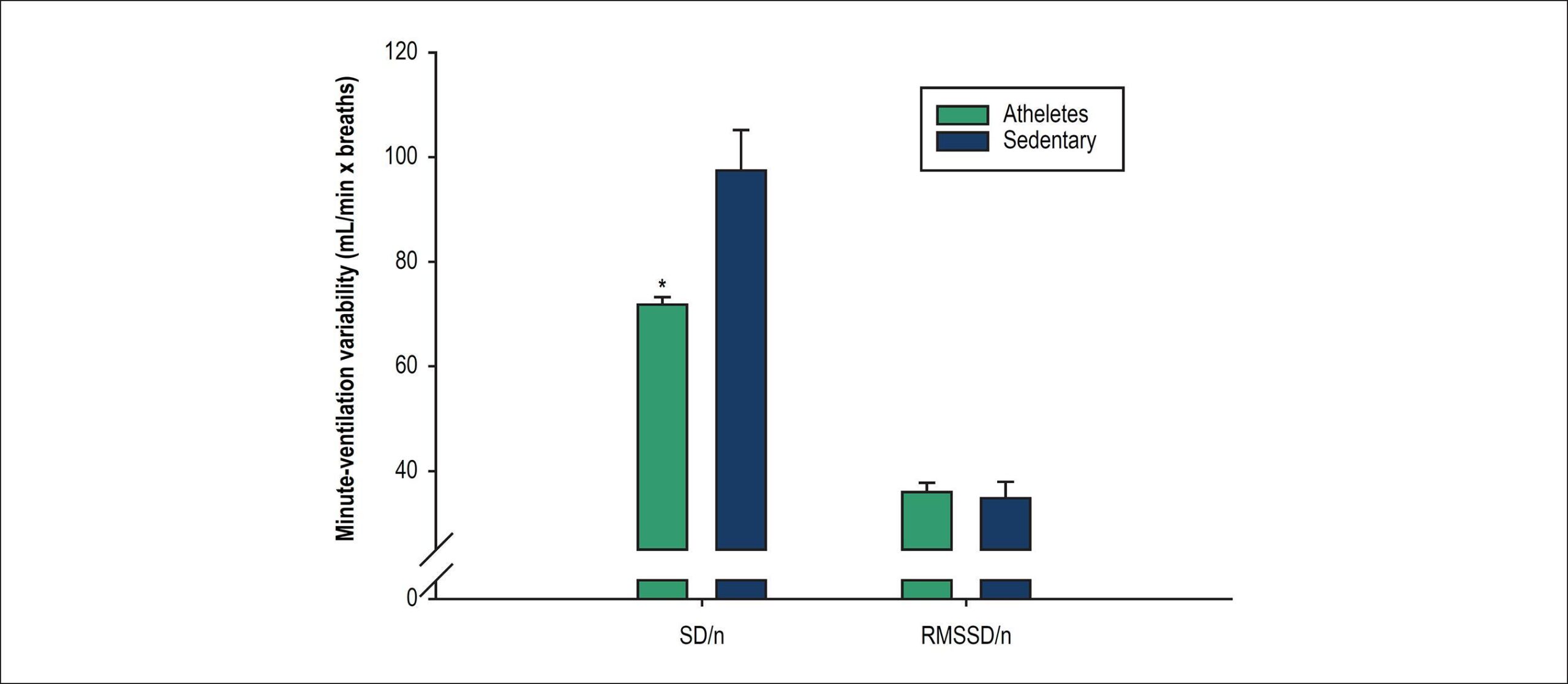
Sedentary men exhibited greater Vt (SD/n: 1.6 ± 0.3 vs. 0.9 ± 0.3 mL/breaths; p < 0.001) and Ve (SD/n: 97.5 ± 23.1 vs. 71.6 ± 4.8 mL/min x breaths; p = 0.038) variabilities than athletes. VE/VCO2 correlated to Vt variability (RMSSD/n) in both groups.

Conclusions:

Time-domain variability of Vt and Ve during exercise is greater in sedentary than athletes, with a positive relationship between VE/VCO2 pointing to a possible influence of ventilation-perfusion ratio on ventilatory variability during exercise in healthy volunteers.

  • Athletes
  • Breathing
  • Exercise
  • Pulmonary Ventilation
  • Respiratory Function Tests
  • Sedentary Lifestyle
Read Full Article
Creative Commons Attribution (CC BY) Creative Commons license
01/09/2017 DOI: 10.5935/abc.20170104 Views 2
Reference values for cardiopulmonary exercise testing for sedentary and active men and women
ABC
Artigo Original

Reference values for cardiopulmonary exercise testing for sedentary and active men and women

Artur Haddad Herdy et al. Dorian Uhlendorf

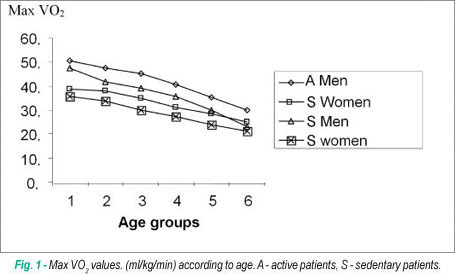
BACKGROUND: The reference values for cardiopulmonary exercise testing (CPET) available in Brazil were derived from a cycle ergometer in a sedentary and relatively small population. OBJECTIVE: Provide reference values for CPET in Brazilians of both sexes, either sedentary or active. METHODS: From 2006 to 2008, 3,992 CEPT of healthy individuals were selected from our laboratory. Athletes, smokers, patients with any known pathology, users of continuous medication and obese patients were excluded. Peak VO2 was considered max VO2. We also analyzed the anaerobic threshold VO2, maximum ventilation and oxygen pulse according to sex, age, sedentary and active patients. Age groups were divided as follows: G1 (15-24), G2 (25-34), G3 (35-44), G4 (45-54), G5 (55-64) and G6 (65-74). RESULTS: According to age groups, the mean values of VO2 in ml/kg/min with their standard deviations were: Active man: G1-50.6 ± 7.3, G2-47, 4 ± 7.4, G3-45, 4 ± 6.8, G4-40.5 ± 6.5; G5-35.3 ± 6.2; G6-30.0 ± 6.1. Active woman: G1-38.9 ± 5.7; G2-38.1 ± 6.6; G3-34.9 ± 5.9; G4-31.1 ± 5.4; G5-28.6 ± 6.1; G6-25.1 ± 4.4. Sedentary man: G1-47.4 ± 7.9; G2-41.9 ± 7.2; G3-39.0 ± 6.8; G4-35.6 ± 7.7; G5-30.0 ± 6.3; G6-23.1 ± 6.3. Sedentary woman: G1-35.6 ± 5.7; G2-34.0 ± 4.8; G3-30.0 ± 5.4; G4-27.2 ± 5.0; G5-23.9 ± 4.2; G6-21.2 ± 3.4. CONCLUSION: This article provides reference values of max VO2, among other parameters, in the Cardiopulmonary Exercise Testing performed on the treadmill in individuals of both sexes, either active and sedentary.

  • Exercise Test
  • Pulmonary Ventilation
  • Reference Values
  • Sedentary Lifestyle
Read Full Article
Creative Commons Attribution (CC BY) Creative Commons license
26/11/2010 DOI: 10.1590/S0066-782X2010005000155 Views 3

How to cite this article

EndNote RIS

Electronic Document Format (Vancouver)

Gonçalves AV, Pereira-da-Silva T, Galrinho A, Rio P, Soares R, Feliciano J, Moreira RI, et al. Maximal Oxygen Uptake and Ventilation Improvement Following Sacubitril-Valsartan Therapy. Arquivos Brasileiros de Cardiologia 2020;115(5):821-7.

Electronic Document Format (ABNT)

Gonçalves, António Valentim; Pereira-da-Silva, Tiago; Galrinho, Ana; Rio, Pedro; Soares, Rui; Feliciano, Joana; Moreira, Rita Ilhão; Silva, Sofia; Alves, Sandra; Capilé, Eunice; Ferreira, Rui Cruz. Maximal Oxygen Uptake and Ventilation Improvement Following Sacubitril-Valsartan Therapy. Arquivos Brasileiros de Cardiologia, v. 115, n. 5, p. 821-827, Oct. 2020.

Electronic Document Format (APA)

Gonçalves, A. V., Pereira-da-Silva, T., Galrinho, A., Rio, P., Soares, R., Feliciano, J., Moreira, R. I., Silva, S., Alves, S., Capilé, E., & Ferreira, R. C. (2020). Maximal Oxygen Uptake and Ventilation Improvement Following Sacubitril-Valsartan Therapy. Arquivos Brasileiros de Cardiologia, 115(5), 821-827.

Electronic Document Format (ISO)

Gonçalves, António Valentim and Pereira-da-Silva, Tiago and Galrinho, Ana and Rio, Pedro and Soares, Rui and Feliciano, Joana and Moreira, Rita Ilhão and Silva, Sofia and Alves, Sandra and Capilé, Eunice and Ferreira, Rui Cruz. Maximal Oxygen Uptake and Ventilation Improvement Following Sacubitril-Valsartan Therapy. Arquivos Brasileiros de Cardiologia [online]. 2020, vol. 115, n. 5, [cited 2026-10-14], pp. 821-827. Available from: <https://journals.cardiol.br/en/article/maximal-oxygen-uptake-and-ventilation-improvement-following-sacubitril-valsartan-therapy/>. ISSN 0066-782X

EndNote RIS

Electronic Document Format (Vancouver)

Castro RRT, Lima SP, Sales ARK, Nóbrega ACL. Minute-Ventilation Variability during Cardiopulmonary Exercise Test is Higher in Sedentary Men Than in Athletes. Arquivos Brasileiros de Cardiologia 2017;109(3):185-90.

Electronic Document Format (ABNT)

Castro, Renata Rodrigues Teixeira de; Lima, Sabrina Pedrosa; Sales, Allan Robson Kluser; Nóbrega, Antonio Claudio Lucas da. Minute-Ventilation Variability during Cardiopulmonary Exercise Test is Higher in Sedentary Men Than in Athletes. Arquivos Brasileiros de Cardiologia, v. 109, n. 3, p. 185-190, Aug. 2017.

Electronic Document Format (APA)

Castro, R. R. T. , Lima, S. P., Sales, A. R. K., & Nóbrega, A. C. L. (2017). Minute-Ventilation Variability during Cardiopulmonary Exercise Test is Higher in Sedentary Men Than in Athletes. Arquivos Brasileiros de Cardiologia, 109(3), 185-190.

Electronic Document Format (ISO)

Castro, Renata Rodrigues Teixeira de and Lima, Sabrina Pedrosa and Sales, Allan Robson Kluser and Nóbrega, Antonio Claudio Lucas da. Minute-Ventilation Variability during Cardiopulmonary Exercise Test is Higher in Sedentary Men Than in Athletes. Arquivos Brasileiros de Cardiologia [online]. 2017, vol. 109, n. 3, [cited 2026-10-14], pp. 185-190. Available from: <https://journals.cardiol.br/en/article/minute-ventilation-variability-during-cardiopulmonary-exercise-test-is-higher-in-sedentary-men-than-in-athletes/>. ISSN 0066-782X

EndNote RIS

Electronic Document Format (Vancouver)

Herdy AH, Uhlendorf D. Reference values for cardiopulmonary exercise testing for sedentary and active men and women. Arquivos Brasileiros de Cardiologia 2010;96(1):54-9.

Electronic Document Format (ABNT)

Herdy, Artur Haddad; Uhlendorf, Dorian. Reference values for cardiopulmonary exercise testing for sedentary and active men and women. Arquivos Brasileiros de Cardiologia, v. 96, n. 1, p. 54-59, Nov. 2010.

Electronic Document Format (APA)

Herdy, A. H., & Uhlendorf, D. (2010). Reference values for cardiopulmonary exercise testing for sedentary and active men and women. Arquivos Brasileiros de Cardiologia, 96(1), 54-59.

Electronic Document Format (ISO)

Herdy, Artur Haddad and Uhlendorf, Dorian. Reference values for cardiopulmonary exercise testing for sedentary and active men and women. Arquivos Brasileiros de Cardiologia [online]. 2010, vol. 96, n. 1, [cited 2026-10-14], pp. 54-59. Available from: <https://journals.cardiol.br/en/article/reference-values-for-cardiopulmonary-exercise-testing-for-sedentary-and-active-men-and-women/>. ISSN 0066-782X

  • About ABC Family
  • Internal Regulation
  • Editorial Board
  • Brazilian Society of Cardiology (SBC)

Issues

SBC Guidelines

  • Videos
  • Podcasts
  • News