ABC Family Arquivos Brasileiros de Cardiologia International Journal of Cardiovascular Sciences ABC Heart Failure & Cardiomyopathy ABC Imagem Cardiovascular
Português English
ABC Family
Português English
  • About
    • About ABC Family
    • Internal Regulation
    • Editorial Board
    • Brazilian Society of Cardiology (SBC)
  • Issues
  • SBC Guidelines
  • Content
    • Videos
    • Podcasts
    • News
  • About
    • About ABC Family
    • Internal Regulation
    • Editorial Board
    • Brazilian Society of Cardiology (SBC)
  • Issues
  • SBC Guidelines
  • Content
    • Videos
    • Podcasts
    • News

ABC Family

  • ABC Family
  • Arquivos Brasileiros de Cardiologia
  • International Journal of Cardiovascular Sciences
  • ABC Heart Failure & Cardiomyopathy
  • ABC Imagem Cardiovascular
Search in

No content found.

Journals
Ordering
Article types
Others

  1. Home
  2. Keyword: PRKAG2 Syndrome
ABC
Editorial

Focusing on the Right Ventricle in PRKAG2 Syndrome

Luís Rocha Lopes

The PRKAG2 gene encodes the adenosine monophosphate-activated protein kinase (AMPK) gamma 2 regulatory subunit. AMPK has a central role in cellular energy homeostasis. Pathogenic variation in PRKAG2 causes an autosomal dominant syndrome comprising ventricular hypertrophy, supraventricular arrhythmias, electrocardiographic pre-excitation and conduction system abnormalities.– The genetic background of this syndromic presentation was discovered in 2001.. Histologically there is myocyte glycogen accumulation, and the typical pattern of hypertrophy is usually described as biventricular and concentric, similar to other metabolic phenocopies of hypertrophic cardiomyopathy (HCM), with systolic dysfunction as another possible “red-flag” feature. The more frequent pathogenic variants are p.Arg302Gln and p.Asn488Ile. Due to the condition’s rarity, most publications consist of small case series or case reports, with few exceptions.. None of the previous publications specifically report right ventricular imaging findings in this condition.

Expanding on their previous work, where 3D echocardiography and strain imaging findings of the left ventricle were described in a cohort of 30 patients with PRKAG2 syndrome, Pena et al. provide a short report focusing on the right ventricle (RV), using the same cohort, in the current edition of this Journal.

[…]

  • Echocardiography/methods
  • Hypertrophy
  • Myocardial Deformability
  • PRKAG2 Syndrome
  • Right ventricle
  • Stroke Volume
Read Full Article
Creative Commons Attribution (CC BY) Creative Commons license
19/12/2022 DOI: 10.36660/abc.20220795 Views 1
Figure 1
ABC
Image

Non-Progressive Hepatic Form of Andersen Disease as a Mimic of Hypertrophic Cardiomyopathy

Fabio Mastrocola et al. William Santos de Oliveira Adalberto Atsushi Porto Roberto Moreno Mendonça Nestor Rodrigues de Oliveira Neto

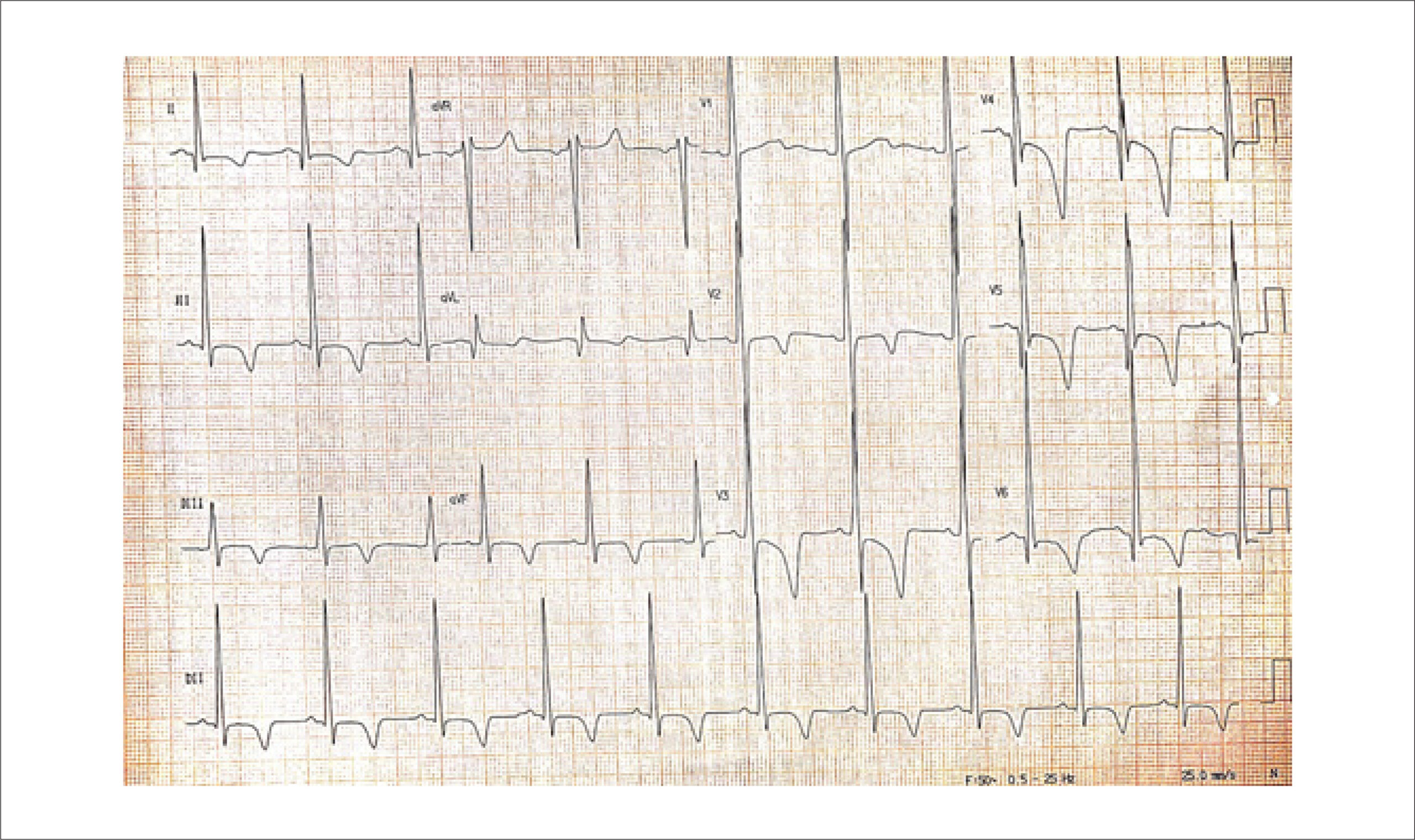
An 18-year-old male patient presented to our ambulatory services due to a 3-month course of progressive dyspnea and non-productive cough. Symptoms were present even at rest, and he exhibited severe limitation at physical activity. He had a diagnosis of glycogen storage disease (GSD) type IV attained by liver biopsy since three years of age, when he developed hepatomegaly and mild hepatic dysfunction. At the time, histopathological examination showed grade 2 fibrosis along with numerous intracytoplasmic PAS-positive deposits that were resistant to diastase. Thenceforth, his liver function remained stable, and he persisted otherwise asymptomatic. His physical examination was unremarkable, and routine laboratory evaluation was within the normal ranges. However, his basal ECG () showed signs of left ventricular hypertrophy. He was submitted to a cardiovascular magnetic resonance (CMR), which showed asymmetrical hypertrophy with predominance in the interventricular septum (). Late gadolinium enhancement (LGE) was present in a patchy, multifocal pattern (). Medical therapy for heart failure was initiated; the patient is now asymptomatic and maintains regular follow-up in our ambulatory.

Patients with classic GSD type IV have unrelenting liver disease with fast progression to cirrhosis during childhood; however, a small subset of affected individuals may present with milder hepatic dysfunction that does not advance to end-stage liver disease., Accordingly, our patient had the diagnosis of GSD type IV by three years of age, but did not develop cirrhosis afterwards.

[…]

  • Cardiomyopathy, Hypertrophic
  • Fibrosis
  • Glycogen Storage Disease Type IV
  • Heart Failure
  • Magnetic Resonance Spectroscopy/ methods
  • PRKAG2 Syndrome
  • Prognosis
Read Full Article
Creative Commons Attribution (CC BY) Creative Commons license
07/12/2020 DOI: 10.36660/abc.20200218

How to cite this article

EndNote RIS

Electronic Document Format (Vancouver)

Lopes LR. Focusing on the Right Ventricle in PRKAG2 Syndrome. Arquivos Brasileiros de Cardiologia 2022;119(6):910-1.

Electronic Document Format (ABNT)

Lopes, Luís Rocha. Focusing on the Right Ventricle in PRKAG2 Syndrome. Arquivos Brasileiros de Cardiologia, v. 119, n. 6, p. 910-911, Dec. 2022.

Electronic Document Format (APA)

Lopes, L. R. (2022). Focusing on the Right Ventricle in PRKAG2 Syndrome. Arquivos Brasileiros de Cardiologia, 119(6), 910-911.

Electronic Document Format (ISO)

Lopes, Luís Rocha. Focusing on the Right Ventricle in PRKAG2 Syndrome. Arquivos Brasileiros de Cardiologia [online]. 2022, vol. 119, n. 6, [cited 2026-10-14], pp. 910-911. Available from: <https://journals.cardiol.br/en/article/focusing-on-the-right-ventricle-in-prkag2-syndrome/>. ISSN 0066-782X

EndNote RIS

Electronic Document Format (Vancouver)

Mastrocola F, Oliveira WS, Porto AA, Mendonça RM, Oliveira Neto NR. Non-Progressive Hepatic Form of Andersen Disease as a Mimic of Hypertrophic Cardiomyopathy. Arquivos Brasileiros de Cardiologia 2020;115(5):964-6.

Electronic Document Format (ABNT)

Mastrocola, Fabio; Oliveira, William Santos de; Porto, Adalberto Atsushi; Mendonça, Roberto Moreno; Oliveira Neto, Nestor Rodrigues de. Non-Progressive Hepatic Form of Andersen Disease as a Mimic of Hypertrophic Cardiomyopathy. Arquivos Brasileiros de Cardiologia, v. 115, n. 5, p. 964-966, Dec. 2020.

Electronic Document Format (APA)

Mastrocola, F., Oliveira, W. S. , Porto, A. A., Mendonça, R. M., & Oliveira Neto, N. R. (2020). Non-Progressive Hepatic Form of Andersen Disease as a Mimic of Hypertrophic Cardiomyopathy. Arquivos Brasileiros de Cardiologia, 115(5), 964-966.

Electronic Document Format (ISO)

Mastrocola, Fabio and Oliveira, William Santos de and Porto, Adalberto Atsushi and Mendonça, Roberto Moreno and Oliveira Neto, Nestor Rodrigues de. Non-Progressive Hepatic Form of Andersen Disease as a Mimic of Hypertrophic Cardiomyopathy. Arquivos Brasileiros de Cardiologia [online]. 2020, vol. 115, n. 5, [cited 2026-10-14], pp. 964-966. Available from: <https://journals.cardiol.br/en/article/non-progressive-hepatic-form-of-andersen-disease-as-a-mimic-of-hypertrophic-cardiomyopathy/>. ISSN 0066-782X

  • About ABC Family
  • Internal Regulation
  • Editorial Board
  • Brazilian Society of Cardiology (SBC)

Issues

SBC Guidelines

  • Videos
  • Podcasts
  • News