ABC Family Arquivos Brasileiros de Cardiologia International Journal of Cardiovascular Sciences ABC Heart Failure & Cardiomyopathy ABC Imagem Cardiovascular
Português English
ABC Family
Português English
  • About
    • About ABC Family
    • Internal Regulation
    • Editorial Board
    • Brazilian Society of Cardiology (SBC)
  • Issues
  • SBC Guidelines
  • Content
    • Videos
    • Podcasts
    • News
  • About
    • About ABC Family
    • Internal Regulation
    • Editorial Board
    • Brazilian Society of Cardiology (SBC)
  • Issues
  • SBC Guidelines
  • Content
    • Videos
    • Podcasts
    • News

ABC Family

  • ABC Family
  • Arquivos Brasileiros de Cardiologia
  • International Journal of Cardiovascular Sciences
  • ABC Heart Failure & Cardiomyopathy
  • ABC Imagem Cardiovascular
Search in

No content found.

Journals
Ordering
Article types
Others

  1. Home
  2. Keyword: Mammary Arteries/surgery
ABC
Editorial

Multi-Arterial Grafting in Surgical Coronary Revascularization. The Renewed Quest for Enhanced Outcomes

Walter J. Gomes

With a large body of contemporary and historic evidence strengthening coronary artery bypass surgery (CABG) as the most effective procedure for treating advanced atherosclerotic coronary artery disease (CAD), the quest for enhanced outcomes and quality improvement is steadily underway.

Long-term graft patency is crucial for the benefits afforded by surgery, averting spontaneous myocardial infarction rate (MI) and increasing long-term survival, which is demonstrated with the employment of internal thoracic artery (ITA) conduits anastomosed to the left anterior descending coronary artery.

[…]

  • Coronary Artery Disease/surgery
  • Mammary Arteries/surgery
  • Myocardial Revascularization/transplant
  • Myocardial Revascularization/trends
  • Risk Factors/complications
Read Full Article
Creative Commons Attribution (CC BY) Creative Commons license
07/04/2023 DOI: 10.36660/abc.20230094
ABCIC
Original Article

Ligation of the Branches of the Anastomosed Internal Thoracic Artery in the Anterior Descending Coronary Artery and the Effect on Flow Velocities and Functional Status of the Graft

José Sebastião de Abreu et al. Tereza Cristina D Pinheiro José Acácio Feitosa Marilia Esther B Abreu … Ana Gardenia L. P Farias Marcia Maria Carneiro Sandra Nívea R Falcão

Summary

Introduction

Modification of internal thoracic artery flow occurs after its anastomosis in the left anterior descending coronary artery.

Objective

To evaluate the effect of ligation of the proximal branches of anastomosed internal thoracic artery flow on the left anterior descending in relation to velocities and coronary flow velocity reserve in patients with left ventricular ejection fraction preserved (> 50%).

Methods

Prospective study of patients with left ventricular ejection fraction > 50% and revascularized. Group I was composed of 25 patients with ligation of the major branches of the internal thoracic artery flow before its anastomosis in the left anterior descending coronary artery, and Group II was composed of 28 patients without ligation. Doppler was recorded at the proximal level of internal thoracic artery flow in the preoperative, early postoperative and 6 months later. The systolic peak velocity and diastolic, and systolic mean velocity and diastolic were measured. Coronary flow velocity reserve was obtained during dobutamine stress echocardiography in postoperative period 6 months later.

Results

In the postoperative, the systolic peak velocity and the systolic mean velocity decreased while increasing the diastolic peak velocity and the diastolic mean velocity in the groups (p < 0.05). From the postoperative to the postoperative period 6 months later, only the diastolic peak velocity modified, occurring its decrease in the groups (p < 0.05). During the dobutamine stress echocardiography, diastolic peak velocity and the diastolic mean velocity increased (p < 0.05) and groups did not differ, however, the systolic peak velocity and the systolic mean velocity increased only in Group II (p < 0.05). The coronary flow velocity reserve of the groups calculated by diastolic peak velocity (Group I = 2.17 ± 0.64 and Group II = 2.28 ± 0.63) and diastolic mean velocity (Group I = 2.27 ± 0.54 and Group II = 2.5 ± 0.79) did not differ.

Conclusion

In patients with preserved left ventricular ejection fraction, the ligation of the large branches of the anastomosed internal thoracic artery flow into the left anterior descending coronary artery does not compromise the coronary flow velocity reserve, but determines limitation in the increase of the systolic velocities. (Arq Bras Cardiol: Imagem cardiovasc. 2018;31(4):231-240)

  • Echocardiography, Doppler/methods
  • Fractional Flow Reserve
  • Internal Mammary-Coronary Artery Anastomosis
  • Mammary Arteries/surgery
  • Myocardial
  • Myocardial Revascularization
  • Stroke Volume
Read Full Article
Creative Commons Attribution (CC BY) Creative Commons license
04/02/2022 DOI: 10.5935/2318-8219.20180049 Views 2
Figure 1
ABC
Case Report

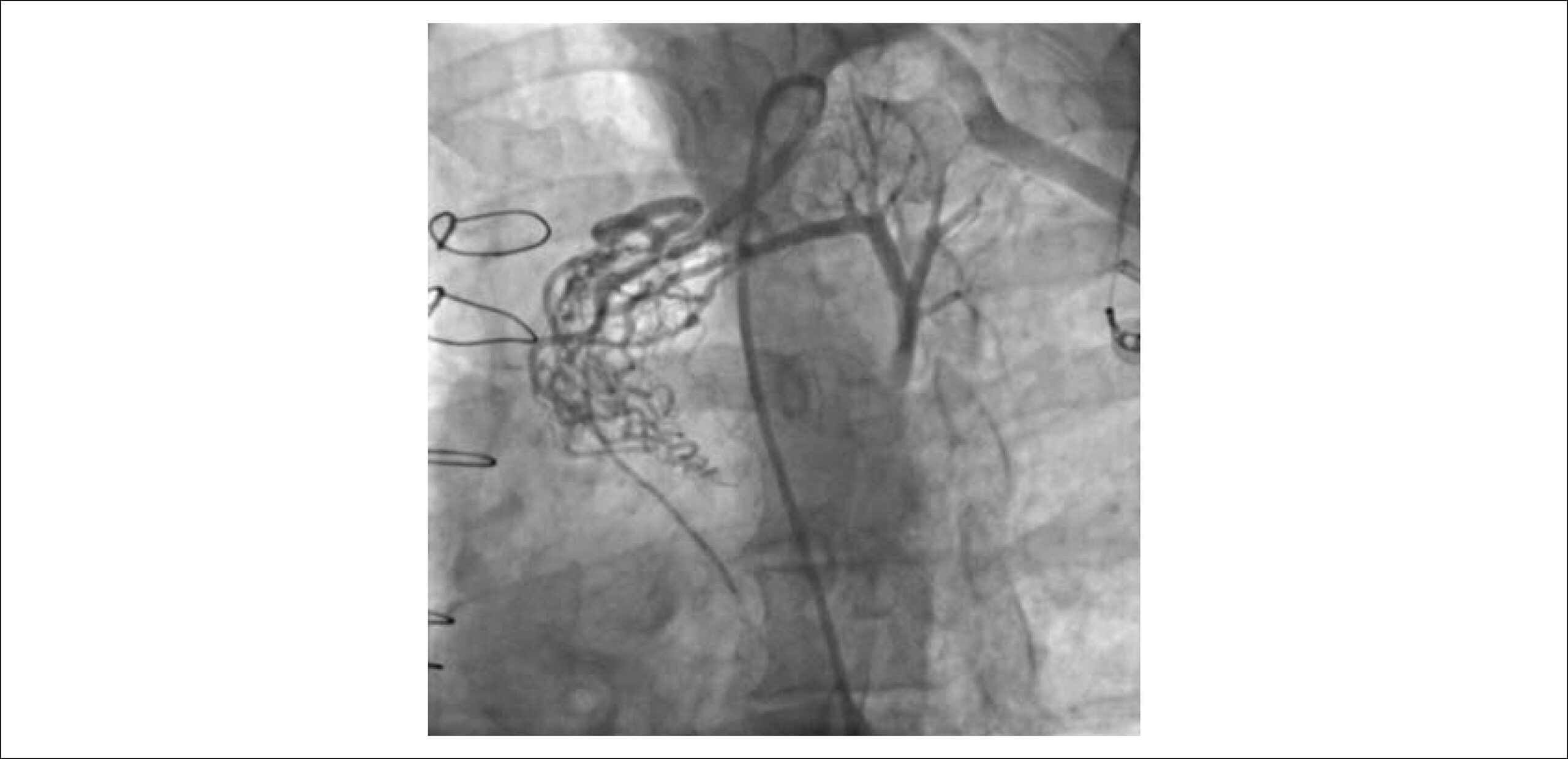
A Rare Cause of Angina After Coronary Bypass Grafting; Left İnternal Mammary Artery to Pulmonary Artery Fistula and Successful Treatment with Transcatheter Coil Embolization

Ali Nazmi Calik et al. Can Yücel Karabay Evliya Akdeniz Yiğit Çanga … Baris Gungor Omer Kozan

Abstract

Fistula from left internal mammary artery (LIMA) to pulmonary artery (PA) is rarely encountered in daily practice. In recent years, endovascular therapy options have emerged for the treatment of fistula formations and replaced with surgery.

A 53-year-old man admitted to our outpatient clinic with symptoms of typical angina and shortness of breath despite optimal medical therapy. In his relevant history, he had a coronary artery bypass graft (CABG) operation in 2009 in which his LIMA was anastomosed to left anterior descending (LAD) and ramus artery sequentially. Coronary angiography including selective imaging of LIMA demonstrated a fistula formation originating from the proximal portion of the LIMA and draining to PA. After successful closure of fistula with transcatheter coil embolization, the patient was discharged without any complication and symptom.

In conclusion, although LIMA to PA fistula is an infrequent clinical condition, it should be considered as a potential cause of persistent angina after CABG operation. Treatment options include conservative medical therapy, surgical ligation and endovascular interventions. The best therapy should be individualised for each patient in respect to patient’s symptoms, surgical compatibility and anatomy of fistula.

  • Arterio-Arterial Fistula
  • Cardiac Catheterization
  • Drug-Eluting Stents
  • Embolization, Therapeutic
  • Mammary Arteries/surgery
  • Pulmonary Artery
  • Self Expandable Metallic Stents
Read Full Article
Creative Commons Attribution (CC BY) Creative Commons license
02/12/2019 DOI: 10.5935/abc.20190196 Views 2

How to cite this article

EndNote RIS

Electronic Document Format (Vancouver)

Gomes WJ. Multi-Arterial Grafting in Surgical Coronary Revascularization. The Renewed Quest for Enhanced Outcomes. Arquivos Brasileiros de Cardiologia 2023;120(3):e20230094.

Electronic Document Format (ABNT)

Gomes, Walter J.. Multi-Arterial Grafting in Surgical Coronary Revascularization. The Renewed Quest for Enhanced Outcomes. Arquivos Brasileiros de Cardiologia, v. 120, n. 3, e20230094, Apr. 2023.

Electronic Document Format (APA)

Gomes, W. J. (2023). Multi-Arterial Grafting in Surgical Coronary Revascularization. The Renewed Quest for Enhanced Outcomes. Arquivos Brasileiros de Cardiologia, 120(3), e20230094.

Electronic Document Format (ISO)

Gomes, Walter J.. Multi-Arterial Grafting in Surgical Coronary Revascularization. The Renewed Quest for Enhanced Outcomes. Arquivos Brasileiros de Cardiologia [online]. 2023, vol. 120, n. 3, [cited 2026-10-14], e20230094. Available from: <https://journals.cardiol.br/en/article/multi-arterial-grafting-in-surgical-coronary-revascularization-the-renewed-quest-for-enhanced-outcomes/>. ISSN 0066-782X

EndNote RIS

Electronic Document Format (Vancouver)

Abreu JS, Pinheiro TCD, Feitosa JA, Abreu MEB, Farias AGLP, Carneiro MM, Falcão SNR, et al. Ligation of the Branches of the Anastomosed Internal Thoracic Artery in the Anterior Descending Coronary Artery and the Effect on Flow Velocities and Functional Status of the Graft. Arquivos Brasileiros de Cardiologia Imagem cardiovascular 2022;31(4):258-69.

Electronic Document Format (ABNT)

Abreu, José Sebastião de; Pinheiro, Tereza Cristina D; Feitosa, José Acácio; Abreu, Marilia Esther B; Farias, Ana Gardenia L. P; Carneiro, Marcia Maria; Falcão, Sandra Nívea R. Ligation of the Branches of the Anastomosed Internal Thoracic Artery in the Anterior Descending Coronary Artery and the Effect on Flow Velocities and Functional Status of the Graft. Arquivos Brasileiros de Cardiologia Imagem cardiovascular, v. 31, n. 4, p. 258-269, Feb. 2022.

Electronic Document Format (APA)

Abreu, J. S. , Pinheiro, T. C. D., Feitosa, J. A., Abreu, M. E. B., Farias, A. G. L. P., Carneiro, M. M., & Falcão, S. N. R. (2022). Ligation of the Branches of the Anastomosed Internal Thoracic Artery in the Anterior Descending Coronary Artery and the Effect on Flow Velocities and Functional Status of the Graft. Arquivos Brasileiros de Cardiologia Imagem cardiovascular, 31(4), 258-269.

Electronic Document Format (ISO)

Abreu, José Sebastião de and Pinheiro, Tereza Cristina D and Feitosa, José Acácio and Abreu, Marilia Esther B and Farias, Ana Gardenia L. P and Carneiro, Marcia Maria and Falcão, Sandra Nívea R. Ligation of the Branches of the Anastomosed Internal Thoracic Artery in the Anterior Descending Coronary Artery and the Effect on Flow Velocities and Functional Status of the Graft. Arquivos Brasileiros de Cardiologia Imagem cardiovascular [online]. 2022, vol. 31, n. 4, [cited 2026-10-14], pp. 258-269. Available from: <https://journals.cardiol.br/en/article/ligation-of-the-branches-of-the-anastomosed-internal-thoracic-artery-in-the-anterior-descending-coronary-artery-and-the-effect-on-flow-velocities-and-functional-status-of-the-graft/>. ISSN 2318-8219

EndNote RIS

Electronic Document Format (Vancouver)

Calik AN, Karabay CY, Akdeniz E, Çanga Y, Gungor B, Kozan O. A Rare Cause of Angina After Coronary Bypass Grafting; Left İnternal Mammary Artery to Pulmonary Artery Fistula and Successful Treatment with Transcatheter Coil Embolization. Arquivos Brasileiros de Cardiologia 2019;113(5):1002-5.

Electronic Document Format (ABNT)

Calik, Ali Nazmi; Karabay, Can Yücel; Akdeniz, Evliya; Çanga, Yiğit; Gungor, Baris; Kozan, Omer. A Rare Cause of Angina After Coronary Bypass Grafting; Left İnternal Mammary Artery to Pulmonary Artery Fistula and Successful Treatment with Transcatheter Coil Embolization. Arquivos Brasileiros de Cardiologia, v. 113, n. 5, p. 1002-1005, Dec. 2019.

Electronic Document Format (APA)

Calik, A. N., Karabay, C. Y., Akdeniz, E., Çanga, Y., Gungor, B., & Kozan, O. (2019). A Rare Cause of Angina After Coronary Bypass Grafting; Left İnternal Mammary Artery to Pulmonary Artery Fistula and Successful Treatment with Transcatheter Coil Embolization. Arquivos Brasileiros de Cardiologia, 113(5), 1002-1005.

Electronic Document Format (ISO)

Calik, Ali Nazmi and Karabay, Can Yücel and Akdeniz, Evliya and Çanga, Yiğit and Gungor, Baris and Kozan, Omer. A Rare Cause of Angina After Coronary Bypass Grafting; Left İnternal Mammary Artery to Pulmonary Artery Fistula and Successful Treatment with Transcatheter Coil Embolization. Arquivos Brasileiros de Cardiologia [online]. 2019, vol. 113, n. 5, [cited 2026-10-14], pp. 1002-1005. Available from: <https://journals.cardiol.br/en/article/a-rare-cause-of-angina-after-coronary-bypass-grafting-left-internal-mammary-artery-to-pulmonary-artery-fistula-and-successful-treatment-with-transcatheter-coil-embolization/>. ISSN 0066-782X

  • About ABC Family
  • Internal Regulation
  • Editorial Board
  • Brazilian Society of Cardiology (SBC)

Issues

SBC Guidelines

  • Videos
  • Podcasts
  • News