ABC Family Arquivos Brasileiros de Cardiologia International Journal of Cardiovascular Sciences ABC Heart Failure & Cardiomyopathy ABC Imagem Cardiovascular
Português English
ABC Family
Português English
  • About
    • About ABC Family
    • Internal Regulation
    • Editorial Board
    • Brazilian Society of Cardiology (SBC)
  • Issues
  • SBC Guidelines
  • Content
    • Videos
    • Podcasts
    • News
  • About
    • About ABC Family
    • Internal Regulation
    • Editorial Board
    • Brazilian Society of Cardiology (SBC)
  • Issues
  • SBC Guidelines
  • Content
    • Videos
    • Podcasts
    • News

ABC Family

  • ABC Family
  • Arquivos Brasileiros de Cardiologia
  • International Journal of Cardiovascular Sciences
  • ABC Heart Failure & Cardiomyopathy
  • ABC Imagem Cardiovascular
Search in

No content found.

Journals
Ordering
Article types
Others

  1. Home
  2. Keyword: Hydroxymethylglutaryl-CoA Reductase Inhibitors / therapeutic…
ABC
Viewpoint

Translational Medicine and Implementation Science: How to Transform What We Know Into What We Do

Protásio Lemos da Luz et al. Francisco Rafael Martins Laurindo

Basis of preventive medicine: a healthy lifestyle

When medical knowledge is to be applied to the general population, the concept of healthy lifestyle should be highlighted, especially in terms of preventive medicine.

Most cardiovascular events, such as myocardial infarction and death, are associated with risk factors such as dyslipidemia, smoking, hypertension and diabetes. Genetic factors are less representative. Another example is the Whitehall study, conducted with British civil servants, that showed that servants in lower grades of employments had a mortality rate three to four times higher than of those in the higher grades. The basis of preventive medicine is related to a healthy lifestyle, including a diet composed predominantly of fruit, vegetable and fish, and low intake of meat and carbohydrates. At least 150 minutes per week of aerobic and strength exercises are strongly recommended, including for protection of cognitive functions and Alzheimer prevention.

[…]
  • Atherosclerosis
  • Cardiovascular Diseases, mortality
  • Cholesterol
  • Exercises
  • Genome Human
  • Hydroxymethylglutaryl-CoA Reductase Inhibitors / therapeutic use
  • Preventive Medicine
  • Quality of life
  • Translational Medical Research
Read Full Article
Creative Commons Attribution (CC BY) Creative Commons license
05/08/2022 DOI: 10.36660/abc.20211029
Figure 1
ABC
Original Article

Cardiovascular Risk and Statin Eligibility in Primary Prevention: A Comparison between the Brazilian and the AHA/ACC Guidelines

Fernando H. Y. Cesena et al. Viviane A. Valente Raul D. Santos Márcio S. Bittencourt

Abstract

Background

Differences between the updated versions of the Brazilian Guideline on Dyslipidemias and the American Heart Association (AHA)/American College of Cardiology (ACC) Cholesterol Guideline regarding cardiovascular risk stratification and statin eligibility are unknown.

Objectives

To compare cardiovascular risk categorization and statin eligibility based on the Brazilian guideline with those based on the AHA/ACC guideline in primary prevention patients.

Methods

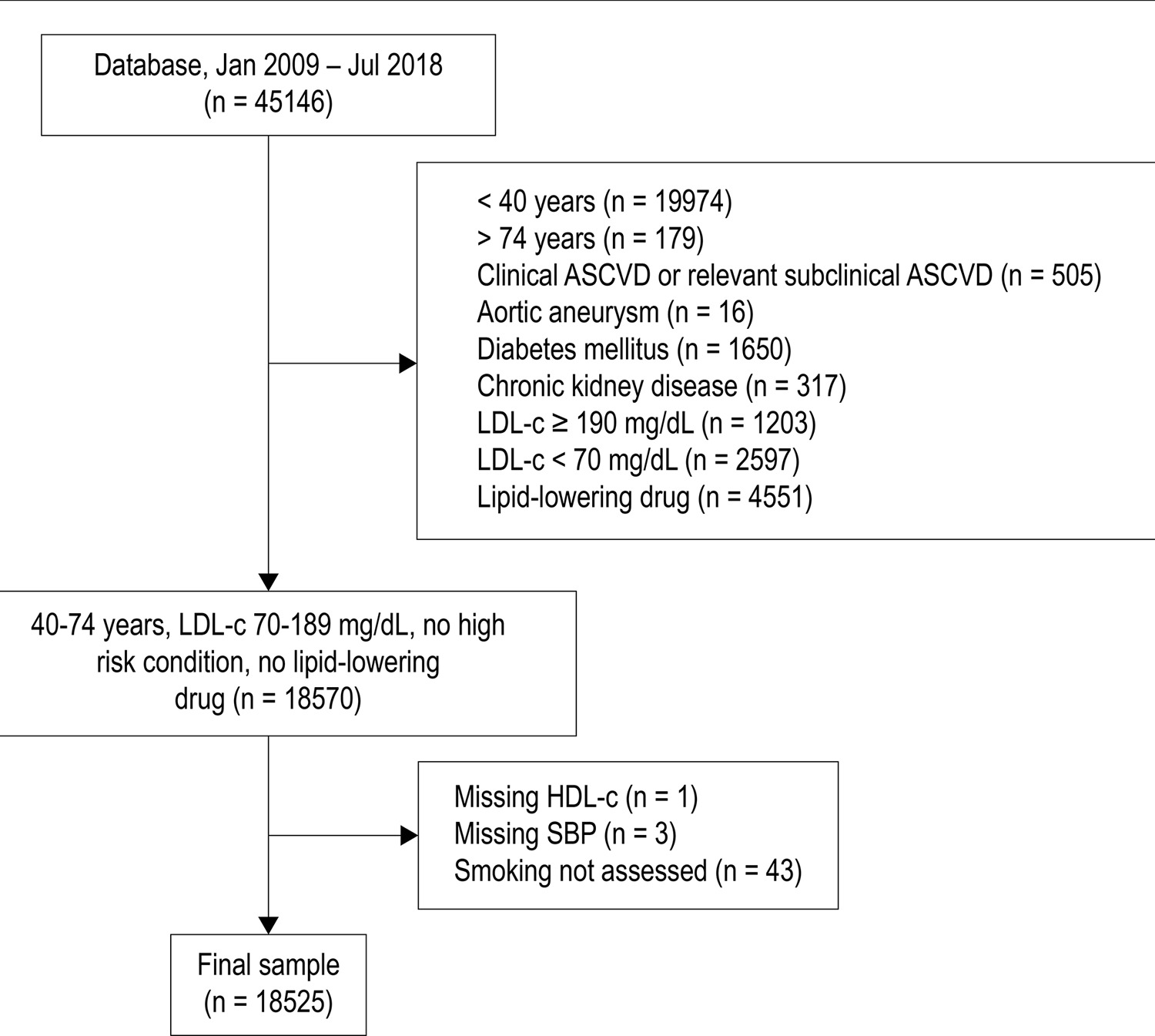
We retrospectively analyzed individuals aged 40-74 years without high-risk conditions, with LDL-c 70 to < 190 mg/dL, not on lipid-lowering drugs, who underwent routine clinical assessment. Cardiovascular risk was stratified according to the Brazilian and the AHA/ACC guidelines. Subjects were considered eligible for statin therapy if LDL-c was at least 30 mg/dL above the target for the cardiovascular risk (Brazilian guideline) or the 10-year atherosclerotic cardiovascular disease risk was ≥7.5% (AHA/ACC guideline). A p-value < 0.05 was considered statistically significant.

Results

The study sample consisted of 18,525 subjects (69% male, age 48 ± 6 years). Among subjects considered at intermediate or high risk by the Brazilian guideline, over 80% would be in a lower risk category by the AHA/ACC guideline. Among men, 45% and 16% would be statin eligible by the Brazilian and the AHA/ACC guidelines criteria, respectively (p < 0.001). Among women, the respective proportions would be 16% and 1% (p < 0.001). Eighty-two percent of women and 57% of men eligible for statins based on the Brazilian guideline criterion would not be eligible according to the AHA/ACC guideline criterion.

Conclusions

Compared with the AHA/ACC guideline, the Brazilian guideline classifies a larger proportion of primary prevention patients into higher-risk categories and substantially increases statin eligibility. (Arq Bras Cardiol. 2020; 115(3):440-449)

  • Atherosclerosis
  • Cardiovascular Diseases
  • Dyslipidemias
  • Hydroxymethylglutaryl-CoA Reductase Inhibitors / therapeutic use
  • Prevention and Control
  • Primary Prevention
  • Risk Factors
Read Full Article
Creative Commons Attribution (CC BY) Creative Commons license
28/09/2020 DOI: 10.36660/abc.20190519 Views 2
Figure 1
ABC
Original Article

Endothelial Effect of Statin Therapy at a High Dose Versus Low Dose Associated with Ezetimibe

Maristela Magnavita Oliveira Garcia et al. Carolina Garcez Varela Patricia Fontes Silva Paulo Roberto Passos Lima … Paulo Meira Góes Marilia Galeffi Rodrigues Maria de Lourdes Lima Souza e Silva Ana Marice Teixeira Ladeia Armênio Costa Guimarães Luis Claudio Lemos Correia

Abstract

Background:

The effect of statins on the endothelial function in humans remains under discussion. Particularly, it is still unclear if the improvement in endothelial function is due to a reduction in LDL-cholesterol or to an arterial pleiotropic effect.

Objective:

To test the hypothesis that modulation of the endothelial function promoted by statins is primarily mediated by the degree of reduction in LDL-cholesterol, independent of the dose of statin administered.

Methods:

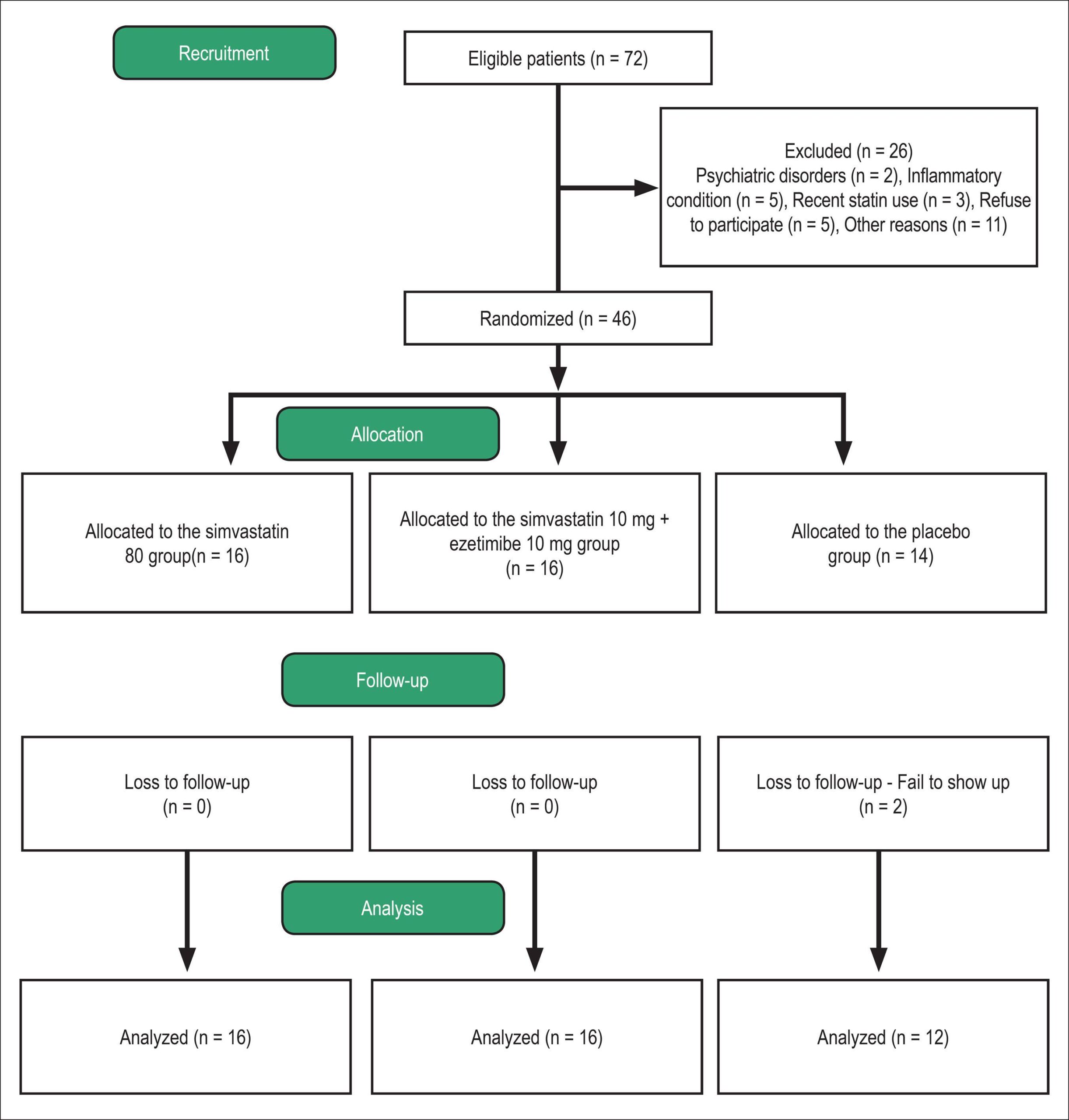
Randomized clinical trial with two groups of lipid-lowering treatment (16 patients/each) and one placebo group (14 patients). The two active groups were designed to promote a similar degree of reduction in LDL-cholesterol: the first used statin at a high dose (80 mg, simvastatin 80 group) and the second used statin at a low dose (10 mg) associated with ezetimibe (10 mg, simvastatin 10/ezetimibe group) to optimize the hypolipidemic effect. The endothelial function was assessed by flow-mediated vasodilation (FMV) before and 8 weeks after treatment.

Results:

The decrease in LDL-cholesterol was similar between the groups simvastatin 80 and simvastatin 10/ezetimibe (27% ± 31% and 30% ± 29%, respectively, p = 0.75). The simvastatin 80 group presented an increase in FMV from 8.4% ± 4.3% at baseline to 11% ± 4.2% after 8 weeks (p = 0.02). Similarly, the group simvastatin 10/ezetimibe showed improvement in FMV from 7.3% ± 3.9% to 12% ± 4.4% (p = 0.001). The placebo group showed no variation in LDL-cholesterol level or endothelial function.

Conclusion:

The improvement in endothelial function with statin seems to depend more on a reduction in LDL-cholesterol levels, independent of the dose of statin administered, than on pleiotropic mechanisms.

  • Anticholesterolemic Agents
  • Cholesterol
  • Endothelium / physiology
  • Ezetimibe
  • Hydroxymethylglutaryl-CoA Reductase Inhibitors / therapeutic use
Read Full Article
Creative Commons Attribution (CC BY) Creative Commons license
01/04/2016 DOI: 10.5935/abc.20160048 Views 1

How to cite this article

EndNote RIS

Electronic Document Format (Vancouver)

Luz PL, Laurindo FRM. Translational Medicine and Implementation Science: How to Transform What We Know Into What We Do. Arquivos Brasileiros de Cardiologia 2022;119(2):342-5.

Electronic Document Format (ABNT)

Luz, Protásio Lemos da; Laurindo, Francisco Rafael Martins. Translational Medicine and Implementation Science: How to Transform What We Know Into What We Do. Arquivos Brasileiros de Cardiologia, v. 119, n. 2, p. 342-345, Aug. 2022.

Electronic Document Format (APA)

Luz, P. L. , & Laurindo, F. R. M. (2022). Translational Medicine and Implementation Science: How to Transform What We Know Into What We Do. Arquivos Brasileiros de Cardiologia, 119(2), 342-345.

Electronic Document Format (ISO)

Luz, Protásio Lemos da and Laurindo, Francisco Rafael Martins. Translational Medicine and Implementation Science: How to Transform What We Know Into What We Do. Arquivos Brasileiros de Cardiologia [online]. 2022, vol. 119, n. 2, [cited 2026-10-14], pp. 342-345. Available from: <https://journals.cardiol.br/en/article/translational-medicine-and-implementation-science-how-to-transform-what-we-know-into-what-we-do/>. ISSN 0066-782X

EndNote RIS

Electronic Document Format (Vancouver)

Cesena FHY, Valente VA, Santos RD, Bittencourt MS. Cardiovascular Risk and Statin Eligibility in Primary Prevention: A Comparison between the Brazilian and the AHA/ACC Guidelines. Arquivos Brasileiros de Cardiologia 2020;115(3):440-9.

Electronic Document Format (ABNT)

Cesena, Fernando H. Y.; Valente, Viviane A.; Santos, Raul D.; Bittencourt, Márcio S.. Cardiovascular Risk and Statin Eligibility in Primary Prevention: A Comparison between the Brazilian and the AHA/ACC Guidelines. Arquivos Brasileiros de Cardiologia, v. 115, n. 3, p. 440-449, Sep. 2020.

Electronic Document Format (APA)

Cesena, F. H. Y., Valente, V. A., Santos, R. D., & Bittencourt, M. S. (2020). Cardiovascular Risk and Statin Eligibility in Primary Prevention: A Comparison between the Brazilian and the AHA/ACC Guidelines. Arquivos Brasileiros de Cardiologia, 115(3), 440-449.

Electronic Document Format (ISO)

Cesena, Fernando H. Y. and Valente, Viviane A. and Santos, Raul D. and Bittencourt, Márcio S.. Cardiovascular Risk and Statin Eligibility in Primary Prevention: A Comparison between the Brazilian and the AHA/ACC Guidelines. Arquivos Brasileiros de Cardiologia [online]. 2020, vol. 115, n. 3, [cited 2026-10-14], pp. 440-449. Available from: <https://journals.cardiol.br/en/article/cardiovascular-risk-and-statin-eligibility-in-primary-prevention-a-comparison-between-the-brazilian-and-the-aha-acc-guidelines/>. ISSN 0066-782X

EndNote RIS

Electronic Document Format (Vancouver)

Garcia MMO, Varela CG, Silva PF, Lima PRP, Góes PM, Rodrigues MG, Silva MLLS, et al. Endothelial Effect of Statin Therapy at a High Dose Versus Low Dose Associated with Ezetimibe. Arquivos Brasileiros de Cardiologia 2016;106(4):279-88.

Electronic Document Format (ABNT)

Garcia, Maristela Magnavita Oliveira; Varela, Carolina Garcez; Silva, Patricia Fontes; Lima, Paulo Roberto Passos; Góes, Paulo Meira; Rodrigues, Marilia Galeffi; Silva, Maria de Lourdes Lima Souza e; Ladeia, Ana Marice Teixeira; Guimarães, Armênio Costa; Correia, Luis Claudio Lemos. Endothelial Effect of Statin Therapy at a High Dose Versus Low Dose Associated with Ezetimibe. Arquivos Brasileiros de Cardiologia, v. 106, n. 4, p. 279-288, Mar. 2016.

Electronic Document Format (APA)

Garcia, M. M. O., Varela, C. G., Silva, P. F., Lima, P. R. P., Góes, P. M., Rodrigues, M. G., Silva, M. L. L. S. , Ladeia, A. M. T., Guimarães, A. C., & Correia, L. C. L. (2016). Endothelial Effect of Statin Therapy at a High Dose Versus Low Dose Associated with Ezetimibe. Arquivos Brasileiros de Cardiologia, 106(4), 279-288.

Electronic Document Format (ISO)

Garcia, Maristela Magnavita Oliveira and Varela, Carolina Garcez and Silva, Patricia Fontes and Lima, Paulo Roberto Passos and Góes, Paulo Meira and Rodrigues, Marilia Galeffi and Silva, Maria de Lourdes Lima Souza e and Ladeia, Ana Marice Teixeira and Guimarães, Armênio Costa and Correia, Luis Claudio Lemos. Endothelial Effect of Statin Therapy at a High Dose Versus Low Dose Associated with Ezetimibe. Arquivos Brasileiros de Cardiologia [online]. 2016, vol. 106, n. 4, [cited 2026-10-14], pp. 279-288. Available from: <https://journals.cardiol.br/en/article/endothelial-effect-of-statin-therapy-at-a-high-dose-versus-low-dose-associated-with-ezetimibe/>. ISSN 0066-782X

  • About ABC Family
  • Internal Regulation
  • Editorial Board
  • Brazilian Society of Cardiology (SBC)

Issues

SBC Guidelines

  • Videos
  • Podcasts
  • News