ABC Family Arquivos Brasileiros de Cardiologia International Journal of Cardiovascular Sciences ABC Heart Failure & Cardiomyopathy ABC Imagem Cardiovascular
Português English
ABC Family
Português English
  • About
    • About ABC Family
    • Internal Regulation
    • Editorial Board
    • Brazilian Society of Cardiology (SBC)
  • Issues
  • SBC Guidelines
  • Content
    • Videos
    • Podcasts
    • News
  • About
    • About ABC Family
    • Internal Regulation
    • Editorial Board
    • Brazilian Society of Cardiology (SBC)
  • Issues
  • SBC Guidelines
  • Content
    • Videos
    • Podcasts
    • News

ABC Family

  • ABC Family
  • Arquivos Brasileiros de Cardiologia
  • International Journal of Cardiovascular Sciences
  • ABC Heart Failure & Cardiomyopathy
  • ABC Imagem Cardiovascular
Search in

No content found.

Journals
Ordering
Article types
Others

  1. Home
  2. Keyword: hospital
IJCS
Editorial

What is the Future of the Hospital of the Future? The Seven Pillars

Erito Marques de Souza Filho et al. Sheila Mittelstaedt

In the current edition of the International Journal of Cardiovascular Sciences, Ribeiro et al. presented a controlled, multicenter, randomized, and blinded (regarding the outcome) study with a set of 340 patients. The authors proposed to assess whether a telemedicine strategy could be effective in reducing mortality and the number of hospitalizations in patients with heart failure. Studies like this reiterate the leading role of telemedicine and bring a broader thought: what is the future of the “hospital of the future”, and what experiences would be fundamental to make this a reality? Given the complexity of the issue, some elements seem to be indispensable; we listed them in the following paragraphs.

First pillar: the need for truly patient-centered care strategies, allowing patients to actively participate in decisions about their health. Salisbury et al. highlighted that this type of care includes a comprehensive review of patients’ problems, considering circumstances of each case, focusing on the quality of life and disease control. To this end, the authors point out the need to develop a personalized therapeutic strategy weighing the risks and benefits of the treatment, aiming to reduce their burdens, promote self-care and build an environment of shared decisions. In addition to patients, we must empower families to participate actively in their health care through collaboration with health professionals and the health system. Therefore, empathy and an effective doctor-patient relationship remain essential.

[…]

  • Future
  • hospital
  • Pillars
Read Full Article
Creative Commons Attribution (CC BY) Creative Commons license
12/09/2022 DOI: 10.36660/ijcs.20220124
Figure 1
IJCS
Original Article

Use of HAS-BLED Score in an Anticoagulation Outpatient Clinic of a Tertiary Hospital

Rafael Coimbra Ferreira Beltrame et al. Franciele Taís Bandeira Giasson André Luís Ferreira Azeredo da Silva Bruna Sessim Gomes … Luís Carlos Amon Marina Bergamini Blaya Rafael Selbach Scheffel Fernando Pivatto Júnior

Abstract

Background:

HAS-BLED score was developed to assess 1-year major bleeding risk in patients anticoagulated with vitamin K antagonists (VKA) due to atrial fibrillation (AF).

Objective:

Of this study was to assess the ability of HAS-BLED score and its components to predict major bleeding in patients treated in an anticoagulation outpatient clinic of a tertiary hospital.

Methods:

A retrospective cohort study on AF patients treated with VKA was conducted. Logistic regression analysis was performed to evaluate the ability of individual score components to predict major bleeding. The significance level adopted in all tests was 5%.

Results:

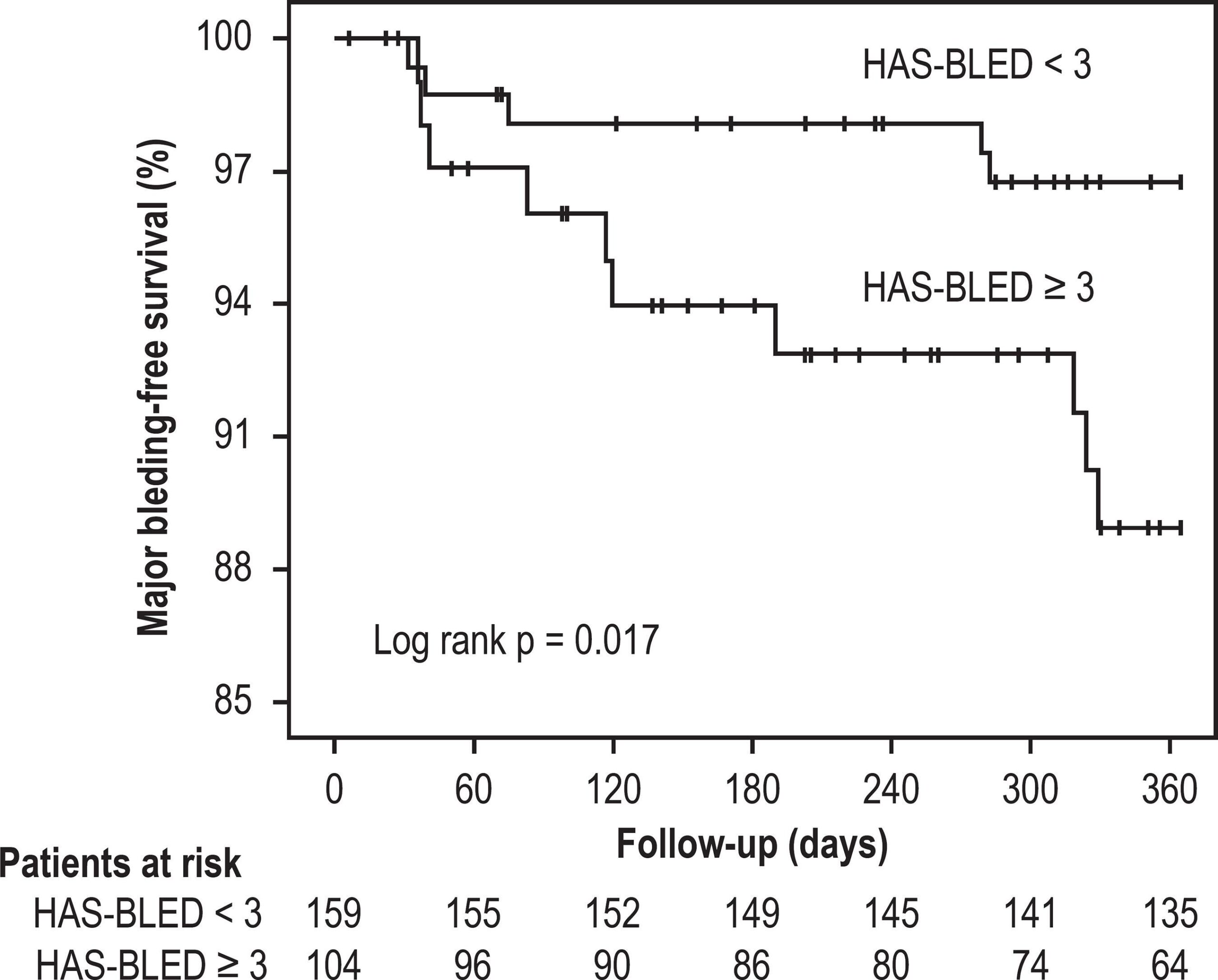
We studied 263 patients with a mean age of 71.1 ± 10.5 years over a period of 237.6 patients-year. Median HAS-BLED score was 2 (1-3). The overall incidence of major bleeding was 5.7%, and it was higher among high-risk HAS-BLED score patients than in low risk patients (9.6 vs. 3.1%; p = 0.052). Area under the ROC curve was 0.70 (p = 0.01). Cut-off point ≥ 3 showed sensibility of 66.7%, specificity of 62.1%, positive predictive value of 9.6% and negative predictive value of 96.9%. Major bleeding-free survival was lower in high-risk group (p = 0.017). In multivariate analysis, concurrent antiplatelet use was the only independent predictor of major bleeding among score components (OR 5.13, 95%CI: 1.55-17.0; p = 0.007).

Conclusion:

HAS-BLED score was able to predict major bleeding in this cohort of AF patients. Among score components, special attention should be given for concomitant antiplatelet use, which was independently associated to this outcome. Antiplatelets in AF patients under VKA anticoagulation should be used in selected patients with favorable risk-benefit assessment.

  • Atrial Fibrillation
  • Hemorrhage
  • hospital
  • outpatient clinics
Read Full Article
Creative Commons Attribution (CC BY) Creative Commons license
25/09/2017 DOI: 10.5935/2359-4802.20170081 Views 1
Coronary computed tomography angiography in the assessment of acute chest pain in the emergency room
ABC
Review Article

Coronary computed tomography angiography in the assessment of acute chest pain in the emergency room

Carlos Eduardo Elias dos Prazeres et al. Roberto Caldeira Cury Adriano Camargo de Castro Carneiro Carlos Eduardo Rochitte

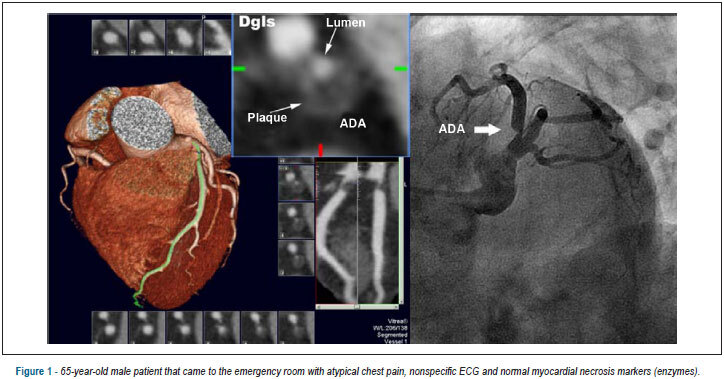
The coronary computed tomography angiography has recently emerged as an accurate diagnostic tool in the evaluation of coronary artery disease, providing diagnostic and prognostic data that correlate directly with the data provided by invasive coronary angiography. The association of recent technological developments has allowed improved temporal resolution and better spatial coverage of the cardiac volume with significant reduction in radiation dose, and with the crucial need for more effective protocols of risk stratification of patients with chest pain in the emergency room, recent evaluation of the computed tomography coronary angiography has been performed in the setting of acute chest pain, as about two thirds of invasive coronary angiographies show no significantly obstructive coronary artery disease. In daily practice, without the use of more efficient technologies, such as coronary angiography by computed tomography, safe and efficient stratification of patients with acute chest pain remains a challenge to the medical team in the emergency room. Recently, several studies, including three randomized trials, showed favorable results with the use of this technology in the emergency department for patients with low to intermediate likelihood of coronary artery disease. In this review, we show data resulting from coronary angiography by computed tomography in risk stratification of patients with chest pain in the emergency room, its diagnostic value, prognosis and cost-effectiveness and a critical analysis of recently published multicenter studies.

  • Chest Pain
  • Coronary Artery Disease
  • Emergency Service
  • hospital
  • Tomography
Read Full Article
Creative Commons Attribution (CC BY) Creative Commons license
22/10/2013 DOI: 10.5935/abc.20130208 Views 3
Anemia and heart failure in a community-based cohort: comparison with a specialized outpatient clinic
ABC
Artigo Original

Anemia and heart failure in a community-based cohort: comparison with a specialized outpatient clinic

Eduarda Barcellos dos Santos et al. Bolívar Saenz Tello Humberto Villacorta Ana Luisa Ferreira Sales … Christiane Wiefels Pedro Soares Teixeira Luis Costa Lima Filho Evandro Tinoco Mesquita

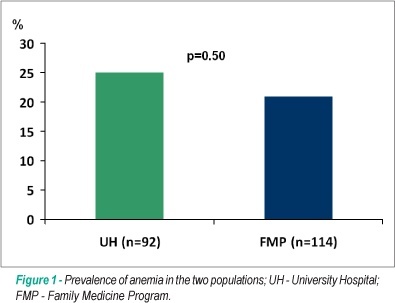
BACKGROUND: Anemia is common in patients with heart failure (HF). Its prevalence in patients with HF from a community-based cohort is unknown in our country. OBJECTIVE: evaluate the prevalence and characteristics of patients with anemia in a non-selected population with HF from a community-based cohort, comparing it with that of a HF population treated at a specialized outpatient clinic. METHODS: This was a transversal, prospective, observational study, carried out from January 2006 to March 2007. The patients with HF met the Boston criteria, with a score > 8. Anemia was defined through the criteria of the World Health Organization as hemoglobin levels < 13 g/dL for men and <12 g/dl for women. Patients treated at a primary care program in the community were randomly selected, as well as patients treated at a Heart Failure Outpatient Clinic in a university hospital. RESULTS: A total of 206 patients were assessed, with a mean age of 61.3±13.1 years, of which 53.4% were females. The prevalence of anemia in the community-based cohort (n=114) was 21% and at the outpatient clinic (n=92), of 25% (p=0.50). The patients from the community-based cohort presented a lower rate of kidney dysfunction (GFR<60 ml/min/1,73-5), predominance of HF with normal ejection fraction and female sex. Kidney function parameters (urea or creatinine) independently correlated with anemia in both populations. CONCLUSION: The prevalence of anemia was similar in the studied populations. Kidney function was the only factor that independently correlated with anemia in both populations.

  • Anemia
  • Comparative Study
  • Heart Failure
  • hospital
  • outpatient clinics
  • Prevalence
Read Full Article
Creative Commons Attribution (CC BY) Creative Commons license
22/09/2010 DOI: 10.1590/S0066-782X2010000100016 Views 2
ABC
Artigo Original

Use of digoxin in elderly patients admitted to a geriatric unit of a general hospital

Ulisses Gabriel de Vasconcelos Cunha et al. Maira Tonidandel Barbosa Emylucy Martins Paiva Paradela Flávio Gomes Carvalho

PURPOSE: To determine the prevalence of digoxin use as well as its indications in elderly patients at the time of admission to a geriatric unit of a general hospital. METHODS: One hundred and thirty elderly patients aged 65 and over (mean age = 80±9 years), 100 women and 30 men were consecutively investigated. Each patient was submitted to a thorough clinical investigation, laboratory work-up, chest X-ray, electrocardiogram and doppler echocardiogram. The use of digoxin was considered appropriate, questionable or inappropriate. RESULTS: At the time of admission to the geriatric unit 27.6% of the patients were receiving digoxin. The indication was considered appropriate in 36.1%, questionable in 11,1% and inappropriate in 52.7%. CONCLUSION: We found a high prevalence of digoxin use in elderly patients admitted to a geriatric unit of a general hospital. In most cases its indications were considered inappropriate or questionable. Due to the increased risk of digitalis intoxication in this age group the drug should be prescribed under more strict indications.

  • Digoxin
  • Elderly
  • hospital
Read Full Article
Creative Commons Attribution (CC BY) Creative Commons license
31/01/2007 DOI: 10.1590/S0066-782X1998001100009

How to cite this article

EndNote RIS

Electronic Document Format (Vancouver)

Souza Filho EM, Mittelstaedt S. What is the Future of the Hospital of the Future? The Seven Pillars. International Journal of Cardiovascular Sciences 2022;35(5):643-5.

Electronic Document Format (ABNT)

Souza Filho, Erito Marques de; Mittelstaedt, Sheila. What is the Future of the Hospital of the Future? The Seven Pillars. International Journal of Cardiovascular Sciences, v. 35, n. 5, p. 643-645, Sep. 2022.

Electronic Document Format (APA)

Souza Filho, E. M. , & Mittelstaedt, S. (2022). What is the Future of the Hospital of the Future? The Seven Pillars. International Journal of Cardiovascular Sciences, 35(5), 643-645.

Electronic Document Format (ISO)

Souza Filho, Erito Marques de and Mittelstaedt, Sheila. What is the Future of the Hospital of the Future? The Seven Pillars. International Journal of Cardiovascular Sciences [online]. 2022, vol. 35, n. 5, [cited 2026-10-14], pp. 643-645. Available from: <https://journals.cardiol.br/en/article/what-is-the-future-of-the-hospital-of-the-future-the-seven-pillars/>. ISSN 2359-4802

EndNote RIS

Electronic Document Format (Vancouver)

Beltrame RCF, Giasson FTB, Silva ALFA, Gomes BS, Amon LC, Blaya MB, Scheffel RS, et al. Use of HAS-BLED Score in an Anticoagulation Outpatient Clinic of a Tertiary Hospital. International Journal of Cardiovascular Sciences 2017;30(6):517-25.

Electronic Document Format (ABNT)

Beltrame, Rafael Coimbra Ferreira; Giasson, Franciele Taís Bandeira; Silva, André Luís Ferreira Azeredo da; Gomes, Bruna Sessim; Amon, Luís Carlos; Blaya, Marina Bergamini; Scheffel, Rafael Selbach; Pivatto Júnior, Fernando. Use of HAS-BLED Score in an Anticoagulation Outpatient Clinic of a Tertiary Hospital. International Journal of Cardiovascular Sciences, v. 30, n. 6, p. 517-525, Sep. 2017.

Electronic Document Format (APA)

Beltrame, R. C. F., Giasson, F. T. B., Silva, A. L. F. A. , Gomes, B. S., Amon, L. C., Blaya, M. B., Scheffel, R. S., & Pivatto Júnior, F. (2017). Use of HAS-BLED Score in an Anticoagulation Outpatient Clinic of a Tertiary Hospital. International Journal of Cardiovascular Sciences, 30(6), 517-525.

Electronic Document Format (ISO)

Beltrame, Rafael Coimbra Ferreira and Giasson, Franciele Taís Bandeira and Silva, André Luís Ferreira Azeredo da and Gomes, Bruna Sessim and Amon, Luís Carlos and Blaya, Marina Bergamini and Scheffel, Rafael Selbach and Pivatto Júnior, Fernando. Use of HAS-BLED Score in an Anticoagulation Outpatient Clinic of a Tertiary Hospital. International Journal of Cardiovascular Sciences [online]. 2017, vol. 30, n. 6, [cited 2026-10-14], pp. 517-525. Available from: <https://journals.cardiol.br/en/article/use-of-has-bled-score-in-an-anticoagulation-outpatient-clinic-of-a-tertiary-hospital/>. ISSN 2359-4802

EndNote RIS

Electronic Document Format (Vancouver)

Prazeres CEE, Cury RC, Carneiro ACC, Rochitte CE. Coronary computed tomography angiography in the assessment of acute chest pain in the emergency room. Arquivos Brasileiros de Cardiologia 2013;101(6):562-9.

Electronic Document Format (ABNT)

Prazeres, Carlos Eduardo Elias dos; Cury, Roberto Caldeira; Carneiro, Adriano Camargo de Castro; Rochitte, Carlos Eduardo. Coronary computed tomography angiography in the assessment of acute chest pain in the emergency room. Arquivos Brasileiros de Cardiologia, v. 101, n. 6, p. 562-569, Oct. 2013.

Electronic Document Format (APA)

Prazeres, C. E. E. , Cury, R. C., Carneiro, A. C. C., & Rochitte, C. E. (2013). Coronary computed tomography angiography in the assessment of acute chest pain in the emergency room. Arquivos Brasileiros de Cardiologia, 101(6), 562-569.

Electronic Document Format (ISO)

Prazeres, Carlos Eduardo Elias dos and Cury, Roberto Caldeira and Carneiro, Adriano Camargo de Castro and Rochitte, Carlos Eduardo. Coronary computed tomography angiography in the assessment of acute chest pain in the emergency room. Arquivos Brasileiros de Cardiologia [online]. 2013, vol. 101, n. 6, [cited 2026-10-14], pp. 562-569. Available from: <https://journals.cardiol.br/en/article/coronary-computed-tomography-angiography-in-the-assessment-of-acute-chest-pain-in-the-emergency-room/>. ISSN 0066-782X

EndNote RIS

Electronic Document Format (Vancouver)

Santos EB, Tello BS, Villacorta H, Sales ALF, Wiefels C, Teixeira PS, Lima Filho LC, et al. Anemia and heart failure in a community-based cohort: comparison with a specialized outpatient clinic. Arquivos Brasileiros de Cardiologia 2010;94(1):102-8.

Electronic Document Format (ABNT)

Santos, Eduarda Barcellos dos; Tello, Bolívar Saenz; Villacorta, Humberto; Sales, Ana Luisa Ferreira; Wiefels, Christiane; Teixeira, Pedro Soares; Lima Filho, Luis Costa; Mesquita, Evandro Tinoco. Anemia and heart failure in a community-based cohort: comparison with a specialized outpatient clinic. Arquivos Brasileiros de Cardiologia, v. 94, n. 1, p. 102-108, Sep. 2010.

Electronic Document Format (APA)

Santos, E. B. , Tello, B. S., Villacorta, H., Sales, A. L. F., Wiefels, C., Teixeira, P. S., Lima Filho, L. C., & Mesquita, E. T. (2010). Anemia and heart failure in a community-based cohort: comparison with a specialized outpatient clinic. Arquivos Brasileiros de Cardiologia, 94(1), 102-108.

Electronic Document Format (ISO)

Santos, Eduarda Barcellos dos and Tello, Bolívar Saenz and Villacorta, Humberto and Sales, Ana Luisa Ferreira and Wiefels, Christiane and Teixeira, Pedro Soares and Lima Filho, Luis Costa and Mesquita, Evandro Tinoco. Anemia and heart failure in a community-based cohort: comparison with a specialized outpatient clinic. Arquivos Brasileiros de Cardiologia [online]. 2010, vol. 94, n. 1, [cited 2026-10-14], pp. 102-108. Available from: <https://journals.cardiol.br/en/article/anemia-and-heart-failure-in-a-community-based-cohort-comparison-with-a-specialized-outpatient-clinic/>. ISSN 0066-782X

EndNote RIS

Electronic Document Format (Vancouver)

Cunha UGV, Barbosa MT, Paradela EMP, Carvalho FG. Use of digoxin in elderly patients admitted to a geriatric unit of a general hospital. Arquivos Brasileiros de Cardiologia 2007;71(5):695-8.

Electronic Document Format (ABNT)

Cunha, Ulisses Gabriel de Vasconcelos; Barbosa, Maira Tonidandel; Paradela, Emylucy Martins Paiva; Carvalho, Flávio Gomes. Use of digoxin in elderly patients admitted to a geriatric unit of a general hospital. Arquivos Brasileiros de Cardiologia, v. 71, n. 5, p. 695-698, Jan. 2007.

Electronic Document Format (APA)

Cunha, U. G. V., Barbosa, M. T., Paradela, E. M. P., & Carvalho, F. G. (2007). Use of digoxin in elderly patients admitted to a geriatric unit of a general hospital. Arquivos Brasileiros de Cardiologia, 71(5), 695-698.

Electronic Document Format (ISO)

Cunha, Ulisses Gabriel de Vasconcelos and Barbosa, Maira Tonidandel and Paradela, Emylucy Martins Paiva and Carvalho, Flávio Gomes. Use of digoxin in elderly patients admitted to a geriatric unit of a general hospital. Arquivos Brasileiros de Cardiologia [online]. 2007, vol. 71, n. 5, [cited 2026-10-14], pp. 695-698. Available from: <https://journals.cardiol.br/en/article/use-of-digoxin-in-elderly-patients-admitted-to-a-geriatric-unit-of-a-general-hospital/>. ISSN 0066-782X

  • About ABC Family
  • Internal Regulation
  • Editorial Board
  • Brazilian Society of Cardiology (SBC)

Issues

SBC Guidelines

  • Videos
  • Podcasts
  • News