Anemia and heart failure in a community-based cohort: comparison with a specialized outpatient clinic
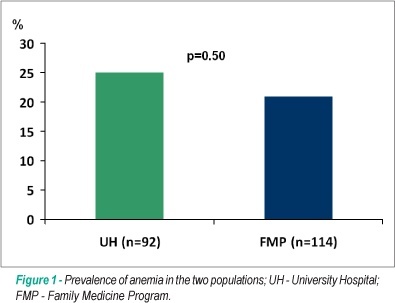
BACKGROUND: Anemia is common in patients with heart failure (HF). Its prevalence in patients with HF from a community-based cohort is unknown in our country. OBJECTIVE: evaluate the prevalence and characteristics of patients with anemia in a non-selected population with HF from a community-based cohort, comparing it with that of a HF population treated at a specialized outpatient clinic. METHODS: This was a transversal, prospective, observational study, carried out from January 2006 to March 2007. The patients with HF met the Boston criteria, with a score > 8. Anemia was defined through the criteria of the World Health Organization as hemoglobin levels < 13 g/dL for men and <12 g/dl for women. Patients treated at a primary care program in the community were randomly selected, as well as patients treated at a Heart Failure Outpatient Clinic in a university hospital. RESULTS: A total of 206 patients were assessed, with a mean age of 61.3±13.1 years, of which 53.4% were females. The prevalence of anemia in the community-based cohort (n=114) was 21% and at the outpatient clinic (n=92), of 25% (p=0.50). The patients from the community-based cohort presented a lower rate of kidney dysfunction (GFR<60 ml/min/1,73-5), predominance of HF with normal ejection fraction and female sex. Kidney function parameters (urea or creatinine) independently correlated with anemia in both populations. CONCLUSION: The prevalence of anemia was similar in the studied populations. Kidney function was the only factor that independently correlated with anemia in both populations.
Images
Image gallery fullscreen viewer
Comments are moderated by the editorial team before publication. Discussions should be evidence-based and use scientific language. Conflicts of interest should be declared.