
ABC Family Arquivos Brasileiros de Cardiologia International Journal of Cardiovascular Sciences ABC Heart Failure & Cardiomyopathy ABC Imagem Cardiovascular
Português English
ABC Family
Português English
  • About
    • About ABC Family
    • Internal Regulation
    • Editorial Board
    • Brazilian Society of Cardiology (SBC)
  • Issues
  • SBC Guidelines
  • Content
    • Videos
    • Podcasts
    • News
  • About
    • About ABC Family
    • Internal Regulation
    • Editorial Board
    • Brazilian Society of Cardiology (SBC)
  • Issues
  • SBC Guidelines
  • Content
    • Videos
    • Podcasts
    • News

ABC Family

  • ABC Family
  • Arquivos Brasileiros de Cardiologia
  • International Journal of Cardiovascular Sciences
  • ABC Heart Failure & Cardiomyopathy
  • ABC Imagem Cardiovascular
Search in

No content found.

Journals
Ordering
Article types
Others

  1. Home
  2. Keyword: Heart Failure/epidemiology
ABC
Editorial

Prognosis of Heart Failure with Mid-Range Ejection Fraction: A Story or a Version?

Adriana Lopes Latado

The category “heart failure (HF) with mid-range ejection fraction” (HFmrEF), i.e., with left ventricular ejection fraction (LVEF) between 40-49%, was first described in 2016 in the European Society of Cardiology Guidelines on the syndrome. After that, much of the worldwide cardiology community has adopted HF’s classification into three categories of LVEF (reduced, mid-range and preserved), including the Brazilian Society of Cardiology (2018), despite existing uncertainties about the real meaning of the new classification and, more importantly, what the identification of HFmrEF subgroup would impact on clinical practice. Unlike most, the American Heart Association and the American College of Cardiology (2013) has used ‘borderline’ HF with preserved LVEF (HFpEF) to define patients with LVEF between 41 and 49%, which was not updated in the document of 2017.,

In this context, in 2021, different international cardiological societies published a report proposing a universal definition and classification of HF. Regarding the classification by LVEF, although attractive from a clinical and epidemiological point of view, authors reviewed the limitations of its use from different aspects and proposed HF categories in which therapeutic strategy would be different. HFmrEF became synonymous with “lightly reduced” LVEF HF, now including LVEF between 41-49%, which was also adopted by Brazilian HF Guidelines update, 2021.,

[…]

  • Atrial Fibrillation
  • Cardiovascular Diseases/physiopathology
  • Heart Failure/epidemiology
  • Heart Failure/physiopathology
  • Mortality
  • Prognosis
  • Stroke
Read Full Article
Creative Commons Attribution (CC BY) Creative Commons license
29/04/2022 DOI: 10.36660/abc.20220170
ABC
Editorial

Heart Failure Trends in Paraíba: Earlier Diagnosis or Better Treatment? – That is One of the Questions

Ana Teresa Timóteo

Heart Failure (HF) is a clinical syndrome with high prevalence, morbidity and mortality worldwide.– It is also one of the main causes for hospital admissions with elevated direct and indirect costs.– The prevalence of HF is expected to increase due to the increase in cardiovascular risk factors in the general population and to the increase in life expectancy. Elderly patients are more prone to the development of HF, as well as of admissions for HF. For that reason, an increase in the economic burden of HF is expected in the next decades.–

Previously published data showed, however, some epidemiological differences according to the world region, when comparing developing and developed countries. Recently published data from the European Society of cardiology Heart Failure Long-term Registry, a registry that included a wide spectrum of countries with very different socio-economic backgrounds, from Southern, Western, Northern and Eastern Europe, as well as Middle East and Northern Africa, showed significant between-region differences in baseline characteristics, clinical characteristics and also treatment and outcomes in patients with acute and chronic HF.

[…]

  • Comorbidity
  • Health Care Costs
  • Heart Failure / mortality
  • Heart Failure/epidemiology
  • Heart Failure/physiopathology
  • Heart Failure/trends
  • Hospitalization
Read Full Article
Creative Commons Attribution (CC BY) Creative Commons license
20/03/2020 DOI: 10.36660/abc.20190898 Views 1
Figure 1
ABC
Original Article

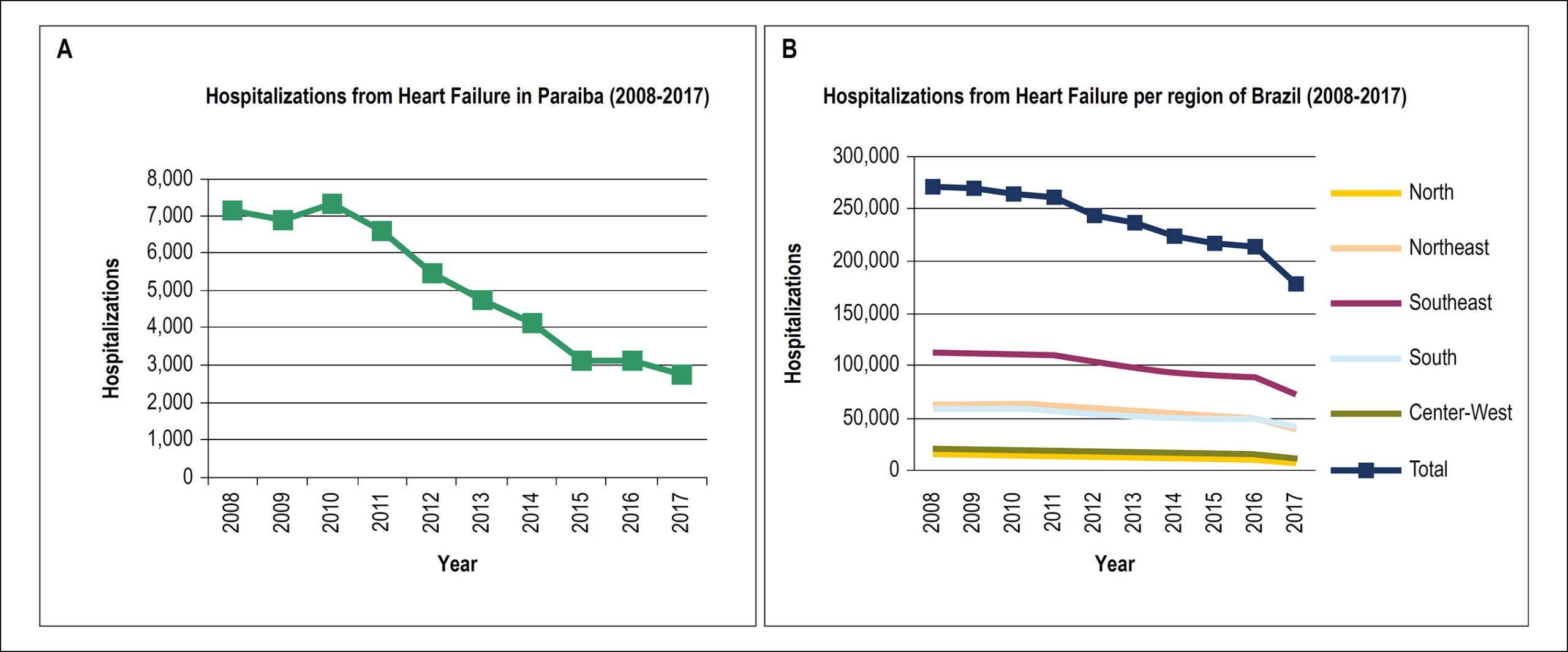
A 10-Year Trend Analysis of Heart Failure in the Less Developed Brazil

Amanda D. F. Fernandes et al. Gilson C. Fernandes Manuel Rivera Mazza Leonardo M. Knijnik … Gustavo Soares Fernandes Andre Telis de Vilela Amit Badiye Sandra V. Chaparro

Abstract

Background:

Data on heart failure (HF) epidemiology in less developed areas of Brazil are scarce.

Objective:

Our aim was to determine the HF morbidity and mortality in Paraiba and Brazil and its 10-year trends.

Methods:

A retrospective search was conducted from 2008 to 2017 using the DATASUS database and included patients ≥ 15 years old with a primary diagnosis of HF. Data on in-hospital and population morbidity and mortality were collected and stratified by year, gender and age. Pearson correlation and linear-by-linear association test for trends were calculated, with a level of significance of 5%.

Results:

From 2008 to 2017, HF admissions decreased 62% (p = 0.004) in Paraiba and 34% (p = 0.004) in Brazil. The in-hospital mortality rate increased in Paraiba and Brazil [65.1% (p = 0.006) and 30.1% (p = 0.003), respectively], but the absolute in-hospital mortality had a significant decrease only in Paraiba [37.5% (p = 0.013)], which was maintained after age stratification, except for groups 15-19, 60-69 and > 80 years. It was observed an increase in the hospital stay [44% (p = 0.004) in Paraiba and 12.3% (p = 0.004) in Brazil]. From 2008 to 2015, mortality rate for HF in the population decreased 10.7% (p = 0.047) in Paraiba and 7.7% (p = 0.017) in Brazil.

Conclusions:

Although HF mortality rate has been decreasing in Paraiba and Brazil, an increase in the in-hospital mortality rate and length of stay for HF has been observed. Hospital-based clinical studies should be performed to identify the causes for these trends of increase.

  • Comorbidity
  • Heart Failure / mortality
  • Heart Failure/epidemiology
  • Heart Failure/physiopathology
  • Heart Failure/trends
  • Hospitalization
Read Full Article
Creative Commons Attribution (CC BY) Creative Commons license
20/03/2020 DOI: 10.36660/abc.20180321
Figure 1
ABC
Editorial

Heart Failure Awareness Day: A Tribute to the Genius Carlos Chagas

Evandro Tinoco Mesquita et al. Aurea Lucia Alves de Azevedo Grippa de Souza Salvador Rassi

The purpose of the Brazilian Society of Cardiology (SBC) is to expand and disseminate knowledge on Cardiovascular Science and to make each cardiologist aware of the activities intended to promote cardiovascular health in Brazilian society. Since its foundation, SBC has been stimulating research and dissemination, among civil society, of epidemiological and preventive matters related to the treatment of cardiovascular diseases, including heart failure (HF). HF has been identified as a cardiovascular epidemic throughout the world and involves important aspects on morbidity, mortality and healthcare costs, being little recognized among individuals, members of our society, healthcare managers and policy makers. The increasing prevalence of HF is due to population aging and the growth of risk factors, such as obesity, systemic arterial hypertension and diabetes mellitus, as well as increased survival of patients with heart diseases, such as congenital heart disease and ischemic heart disease. Worldwide, about 26 million adults have HF and forecasts indicate that the prevalence tends to increase by 25% by 2030.

Within the scenario, it should be underscored that HF with preserved ejection fraction (HFPEF) needs greater recognition and prevention strategies by general practitioners, geriatricians and cardiologists. The syndrome presents asymptomatic stages and a symptomatic form, and preventive and therapeutic measures are able to reduce the progression of the disease and morbimortality. Outbreaks of acute HF and decompensation promote recurrence in emergency rooms and hospital admissions that promote worsening of the condition, where the outcome can be abrupt due to pump failure or sudden death. In this decade, initiatives in different countries, led by cardiology associations and societies, have promoted activities to warn the population and health professionals regarding early detection, complementary tests and access to medications and treatment based on scientific evidence.

[…]

  • Chagas Cardiomyopathy/physiopathology
  • Chagas Disease/epidemiology
  • Heart Failure /prevention and control
  • Heart Failure/epidemiology
  • Risk Factors
Read Full Article
Creative Commons Attribution (CC BY) Creative Commons license
08/08/2019 DOI: 10.5935/abc.20190137

How to cite this article

EndNote RIS

Electronic Document Format (Vancouver)

Latado AL. Prognosis of Heart Failure with Mid-Range Ejection Fraction: A Story or a Version?. Arquivos Brasileiros de Cardiologia 2022;118(4):701-2.

Electronic Document Format (ABNT)

Latado, Adriana Lopes. Prognosis of Heart Failure with Mid-Range Ejection Fraction: A Story or a Version?. Arquivos Brasileiros de Cardiologia, v. 118, n. 4, p. 701-702, Apr. 2022.

Electronic Document Format (APA)

Latado, A. L. (2022). Prognosis of Heart Failure with Mid-Range Ejection Fraction: A Story or a Version?. Arquivos Brasileiros de Cardiologia, 118(4), 701-702.

Electronic Document Format (ISO)

Latado, Adriana Lopes. Prognosis of Heart Failure with Mid-Range Ejection Fraction: A Story or a Version?. Arquivos Brasileiros de Cardiologia [online]. 2022, vol. 118, n. 4, [cited 2026-10-14], pp. 701-702. Available from: <https://journals.cardiol.br/en/article/prognosis-of-heart-failure-with-mid-range-ejection-fraction-a-story-or-a-version/>. ISSN 0066-782X

EndNote RIS

Electronic Document Format (Vancouver)

Timóteo AT. Heart Failure Trends in Paraíba: Earlier Diagnosis or Better Treatment? – That is One of the Questions. Arquivos Brasileiros de Cardiologia 2020;114(2):232-3.

Electronic Document Format (ABNT)

Timóteo, Ana Teresa. Heart Failure Trends in Paraíba: Earlier Diagnosis or Better Treatment? – That is One of the Questions. Arquivos Brasileiros de Cardiologia, v. 114, n. 2, p. 232-233, Mar. 2020.

Electronic Document Format (APA)

Timóteo, A. T. (2020). Heart Failure Trends in Paraíba: Earlier Diagnosis or Better Treatment? – That is One of the Questions. Arquivos Brasileiros de Cardiologia, 114(2), 232-233.

Electronic Document Format (ISO)

Timóteo, Ana Teresa. Heart Failure Trends in Paraíba: Earlier Diagnosis or Better Treatment? – That is One of the Questions. Arquivos Brasileiros de Cardiologia [online]. 2020, vol. 114, n. 2, [cited 2026-10-14], pp. 232-233. Available from: <https://journals.cardiol.br/en/article/heart-failure-trends-in-paraiba-earlier-diagnosis-or-better-treatment-that-is-one-of-the-questions/>. ISSN 0066-782X

EndNote RIS

Electronic Document Format (Vancouver)

Fernandes ADF, Fernandes GC, Mazza MR, Knijnik LM, Fernandes GS, Vilela AT, Badiye A, et al. A 10-Year Trend Analysis of Heart Failure in the Less Developed Brazil. Arquivos Brasileiros de Cardiologia 2020;114(2):222-31.

Electronic Document Format (ABNT)

Fernandes, Amanda D. F.; Fernandes, Gilson C.; Mazza, Manuel Rivera; Knijnik, Leonardo M.; Fernandes, Gustavo Soares; Vilela, Andre Telis de; Badiye, Amit; Chaparro, Sandra V.. A 10-Year Trend Analysis of Heart Failure in the Less Developed Brazil. Arquivos Brasileiros de Cardiologia, v. 114, n. 2, p. 222-231, Mar. 2020.

Electronic Document Format (APA)

Fernandes, A. D. F., Fernandes, G. C., Mazza, M. R., Knijnik, L. M., Fernandes, G. S., Vilela, A. T. , Badiye, A., & Chaparro, S. V. (2020). A 10-Year Trend Analysis of Heart Failure in the Less Developed Brazil. Arquivos Brasileiros de Cardiologia, 114(2), 222-231.

Electronic Document Format (ISO)

Fernandes, Amanda D. F. and Fernandes, Gilson C. and Mazza, Manuel Rivera and Knijnik, Leonardo M. and Fernandes, Gustavo Soares and Vilela, Andre Telis de and Badiye, Amit and Chaparro, Sandra V.. A 10-Year Trend Analysis of Heart Failure in the Less Developed Brazil. Arquivos Brasileiros de Cardiologia [online]. 2020, vol. 114, n. 2, [cited 2026-10-14], pp. 222-231. Available from: <https://journals.cardiol.br/en/article/a-10-year-trend-analysis-of-heart-failure-in-the-less-developed-brazil/>. ISSN 0066-782X

EndNote RIS

Electronic Document Format (Vancouver)

Mesquita ET, Souza ALAAG, Rassi S. Heart Failure Awareness Day: A Tribute to the Genius Carlos Chagas. Arquivos Brasileiros de Cardiologia 2019;113(1):05-8.

Electronic Document Format (ABNT)

Mesquita, Evandro Tinoco; Souza, Aurea Lucia Alves de Azevedo Grippa de; Rassi, Salvador. Heart Failure Awareness Day: A Tribute to the Genius Carlos Chagas. Arquivos Brasileiros de Cardiologia, v. 113, n. 1, p. 05-08, Aug. 2019.

Electronic Document Format (APA)

Mesquita, E. T., Souza, A. L. A. A. G. , & Rassi, S. (2019). Heart Failure Awareness Day: A Tribute to the Genius Carlos Chagas. Arquivos Brasileiros de Cardiologia, 113(1), 05-08.

Electronic Document Format (ISO)

Mesquita, Evandro Tinoco and Souza, Aurea Lucia Alves de Azevedo Grippa de and Rassi, Salvador. Heart Failure Awareness Day: A Tribute to the Genius Carlos Chagas. Arquivos Brasileiros de Cardiologia [online]. 2019, vol. 113, n. 1, [cited 2026-10-14], pp. 05-08. Available from: <https://journals.cardiol.br/en/article/heart-failure-awareness-day-a-tribute-to-the-genius-carlos-chagas/>. ISSN 0066-782X

  • About ABC Family
  • Internal Regulation
  • Editorial Board
  • Brazilian Society of Cardiology (SBC)

Issues

SBC Guidelines

  • Videos
  • Podcasts
  • News