ABC Family Arquivos Brasileiros de Cardiologia International Journal of Cardiovascular Sciences ABC Heart Failure & Cardiomyopathy ABC Imagem Cardiovascular
Português English
ABC Family
Português English
  • About
    • About ABC Family
    • Internal Regulation
    • Editorial Board
    • Brazilian Society of Cardiology (SBC)
  • Issues
  • SBC Guidelines
  • Content
    • Videos
    • Podcasts
    • News
  • About
    • About ABC Family
    • Internal Regulation
    • Editorial Board
    • Brazilian Society of Cardiology (SBC)
  • Issues
  • SBC Guidelines
  • Content
    • Videos
    • Podcasts
    • News

ABC Family

  • ABC Family
  • Arquivos Brasileiros de Cardiologia
  • International Journal of Cardiovascular Sciences
  • ABC Heart Failure & Cardiomyopathy
  • ABC Imagem Cardiovascular
Search in

No content found.

Journals
Ordering
Article types
Others

  1. Home
  2. Keyword: Cystatin C
ABC
Editorial

Cystatin C as a Candidate Biomarker of Cardiovascular Outcomes: Too Near, but too Far from Reality

Luiz Sérgio F. de Carvalho et al. Thiago Quinaglia AC Silva Otávio Rizzi Coelho-Filho

While the development of novel risk factors for cardiovascular risk assessment is necessary to improve risk stratification, proving its clinical value on top of traditional risk factors is routinely challenging.– Besides all the innovative and straightforward biomarker research published in the last decades, only very few markers of cardiovascular risk have shown clinical significance., Among many of them, cystatin C has emerged some years ago as a candidate for improving cardiovascular risk stratification.

In the Cardiovascular Health Study (CHS), a community-based and longitudinal study with over 4,600 elderly individuals, cystatin C has shown to predict cardiovascular outcomes. As compared with the lowest quintile, the highest quintile of cystatin C was associated with a significantly increased risk of death from cardiovascular causes (hazard ratio [HR] 2.27 [1.73 to 2.97]), myocardial infarction (HR 1.48 [1.08 to 2.02]), and stroke (HR 1.47 [1.09 to 1.96]) after multivariate adjustment. However, cystatin C is typically known as a marker of renal function, being roughly correlated with glomerular filtration rate in early stages of kidney diseases., Reasonably, since glomerular function is a strong surrogate marker of cardiovascular disease, it suggests an obvious association between cystatin C and cardiovascular outcomes. A mechanism to avoid the impact of this inexorable bias was to study only individuals with normal kidney function. Yet, additional studies have shown inconsistent magnitudes of effect between cystatin C and cardiovascular outcomes.

[…]
  • Atherosclerosis
  • Biomarkers
  • Cardiovascular Diseases
  • Cystatin C
  • Glomerular Filtration Rate
Read Full Article
Creative Commons Attribution (CC BY) Creative Commons license
01/12/2018 DOI: 10.5935/abc.20180226
Figure 1
ABC
Original Article

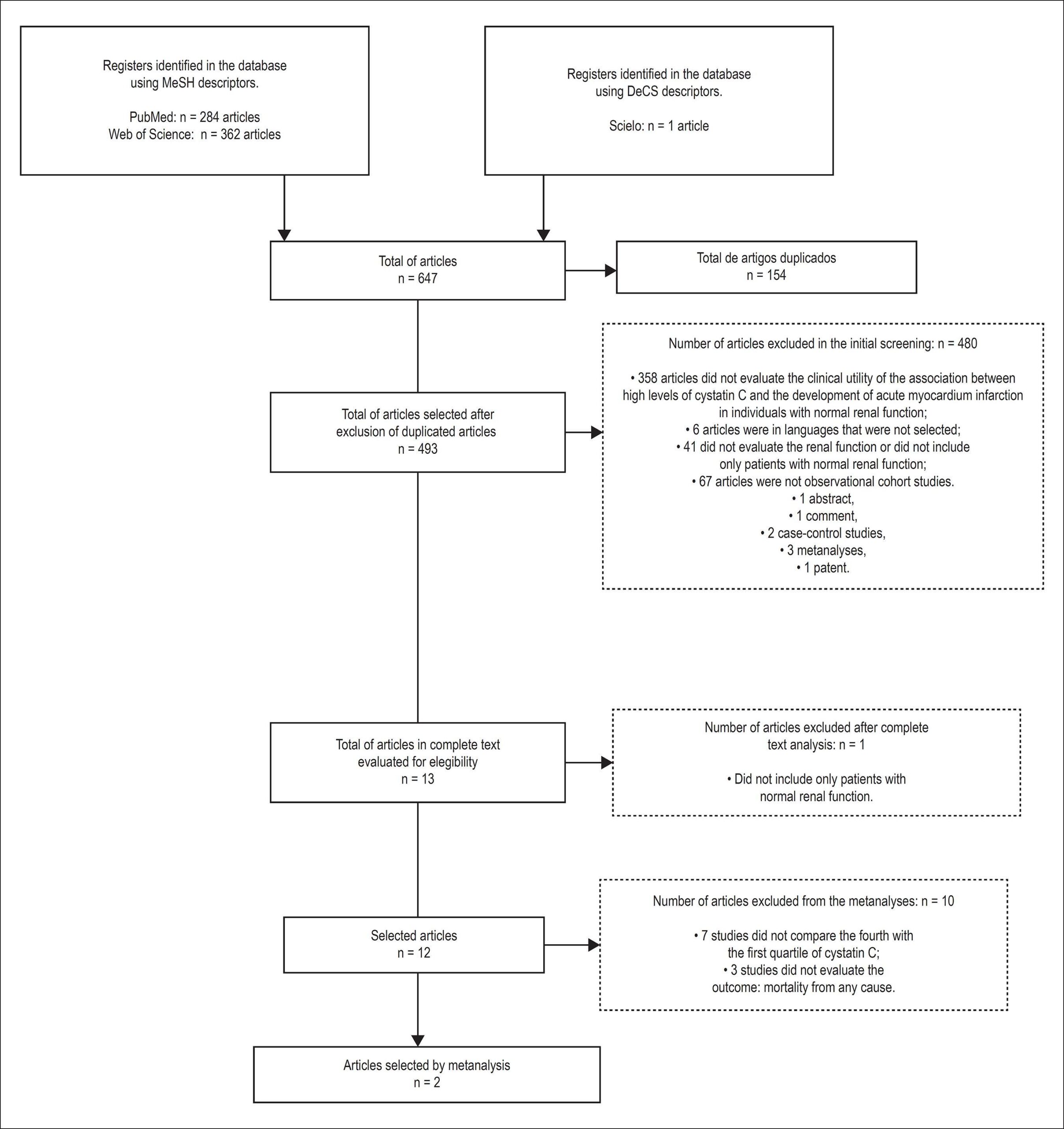
Association Between Increased Levels of Cystatin C and the Development of Cardiovascular Events or Mortality: A Systematic Review and Meta-Analysis

Caroline Fuchs Einwoegerer et al. Caroline Pereira Domingueti

Abstract

Background:

Cystatin C seems promising for evaluating the risk of cardiovascular events and mortality.

Objective:

To evaluate the association between high levels of cystatin C and the development of cardiovascular events or mortality.

Methods:

The articles were selected in the Medline/PubMed, Web of Science, and Scielo databases. The eligibility criteria were prospective cohort observational trials that assessed the association of high serum levels of cystatin C with the development of cardiovascular events or mortality in individuals with normal renal function. Only studies that evaluated the mortality outcome compared the fourth with the first quartile of cystatin C and performed multivariate Cox’s proportional hazard regression analysis were included in the meta-analysis. A p value < 0,05 was considered significant.

Results:

Among the 647 articles found, 12 were included in the systematic review and two in the meta-analysis. The risk of development of adverse outcomes was assessed by eight studies using the hazard ratio. Among them, six studies found an increased risk of cardiovascular events or mortality. The multivariate regression analysis was performed by six studies, and the risk of developing adverse outcomes remained significant after the analysis in four of these studies. The result of the meta-analysis [HR = 2.28 (1.70-3.05), p < 0.001] indicated that there is a significant association between high levels of cystatin C and the risk of mortality in individuals with normal renal function.

Conclusion:

There is a significant association between high levels of cystatin C and the development of cardiovascular events or mortality in individuals with normal renal function.

  • Cardiovascular Diseases, mortality
  • Coronary Artery Disease
  • Cystatin C
  • Meta-Analysis as Topic
  • Myocardial Infarction
  • Renal Insufficiency, Chronic
Read Full Article
Creative Commons Attribution (CC BY) Creative Commons license
21/09/2018 DOI: 10.5935/abc.20180171 Views 1
Figure 1
IJCS
Review Article

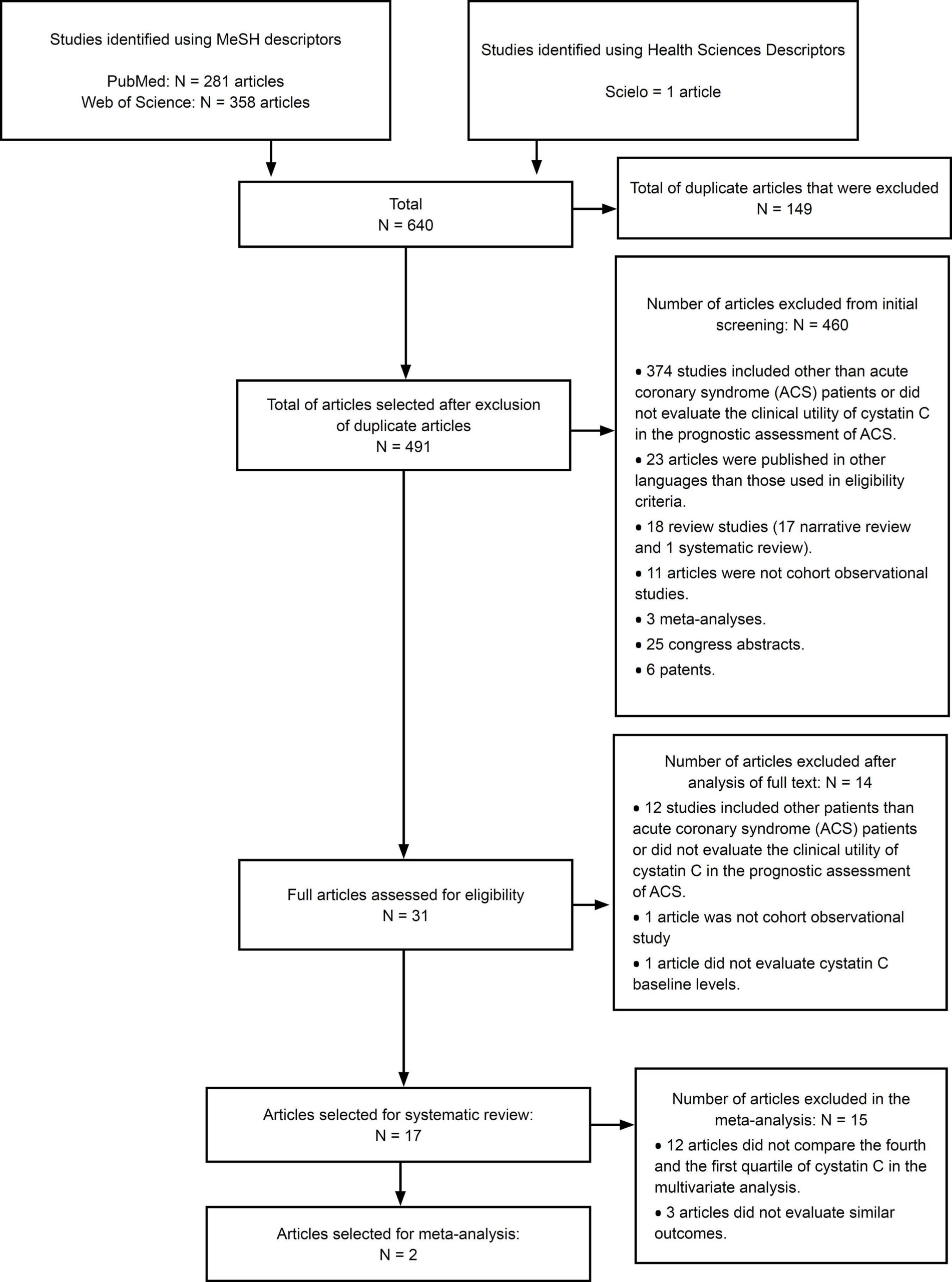
Clinical Usefulness of Cystatin C to Assess the Prognosis of Acute Coronary Syndromes: A Systematic Review and Meta-Analysis

Karine Farnese Costa Martucheli et al. Caroline Pereira Domingueti

Abstract

Cystatin C is used as a marker of renal function and has been shown to be promising for evaluating the prognosis of acute coronary syndromes (ACSs). To evaluate the prognostic value of cystatin C in patients with ACSs. The articles were searched using PubMed, Web of Science and Scielo databases. Observational cohort studies that evaluated the association between increased cystatin C and the development of cardiovascular events and mortality in patients with ACSs were included. Only studies that evaluated similar outcomes, studies that compared the highest with the lowest quartiles of cystatin C, and studies that performed multivariate analysis that included glomerular filtration rate or serum creatinine, were included in the meta-analysis. Methodological quality of the articles was assessed using the Newcastle-Ottawa Scale questionnaire for cohort studies. After applying the eligibility criteria, 17 studies were included in the systematic review. All included studies reported a significant association between higher levels of cystatin C and outcomes. The meta-analysis demonstrated that elevated levels of cystatin C are associated with increased risk of cardiovascular mortality or non-fatal myocardial infarction in patients with ACSs, and such association is independent of renal function [OR = 1.65 (1.464 – 1.861), p < 0.001]. Among the studies included, 4 have good quality and 13 have excellent methodological quality.The systematic review and meta-analysis demonstrated that there is a significant association between increased cystatin C levels and the development of cardiovascular events and mortality in patients with ACSs.

  • Acute Coronary Syndrome/physiopathology
  • Biomarkers
  • Cystatin C
  • Prognosis
Read Full Article
Creative Commons Attribution (CC BY) Creative Commons license
01/01/2018 DOI: 10.5935/2359-4802.20180010 Views 1
ABC
Artigo Original

Correlation between serum cystatin C and markers of subclinical atherosclerosis in hypertensive patients

Francisco das Chagas Monteiro Junior et al. Pedro Antônio Muniz Ferreira José Aldemir Teixeira Nunes Cacionor Pereira da Cunha Júnior … Ronald Lopes Brito João Henrique Almeida Costa José Ribamar Oliveira Lima Joyce Santos Lages Natalino Salgado Filho Valter Correia de Lima

BACKGROUND: Serum cystatin C (s-CC), an endogenous marker of kidney function, has also been proposed as a cardiovascular risk marker. However, it is unknown whether it is a direct marker of atherosclerosis, independently of kidney function. OBJECTIVE: The aim of this study was to correlate s-CC with two surrogate markers of subclinical atherosclerosis. METHODS: This is a cross-sectional study involving 103 middle-aged (57.49 ± 11.7 years) hypertensive outpatients, being 60 female (58.25%), most with preserved kidney function. S-CC was correlated with carotid intima media thickness (IMT) and flow-mediated dilation of brachial artery (FMD), both assessed by ultrasound, as well as with measured creatinine clearance and established cardiovascular risk factors. RESULTS: S-CC was neither significantly correlated with IMT (r = -0.024; p = 0.84) nor with FMD (r = -0.050 and p = 0.687) and no significant association was observed with conventional risk factors and inflammatory markers. In univariate analysis, s-CC was correlated with measured creatinine clearance (r = -0,498; p < 0,001), age (r = 0,408; p < 0,001), microalbuminuria (r = 0,291; p = 0,014), uric acid (r = 0,391; p < 0,001), ratio E/e' (r = 0,242; p = 0,049) and Framingham score (r = 0,359; p = 0,001). However, after multiple regression analysis, only the association with measured creatinine clearance remained significant (r = -0,491; p < 0,001). CONCLUSION: In middle-aged hypertensive outpatients, s-CC correlated with measured creatinine clearance, as expected, but no association was observed with markers of atherosclerosis neither with established cardiovascular risk factors.

  • Creatinine
  • Cystatin C
  • Hypertension
  • Subclinical atherosclerosis
Read Full Article
Creative Commons Attribution (CC BY) Creative Commons license
04/09/2012 DOI: 10.1590/S0066-782X2012005000083 Views 1

How to cite this article

EndNote RIS

Electronic Document Format (Vancouver)

Carvalho LSF, Silva TQA, Coelho-Filho OR. Cystatin C as a Candidate Biomarker of Cardiovascular Outcomes: Too Near, but too Far from Reality. Arquivos Brasileiros de Cardiologia 2018;111(6):808-9.

Electronic Document Format (ABNT)

Carvalho, Luiz Sérgio F. de; Silva, Thiago Quinaglia AC; Coelho-Filho, Otávio Rizzi. Cystatin C as a Candidate Biomarker of Cardiovascular Outcomes: Too Near, but too Far from Reality. Arquivos Brasileiros de Cardiologia, v. 111, n. 6, p. 808-809, Nov. 2018.

Electronic Document Format (APA)

Carvalho, L. S. F. , Silva, T. Q. A., & Coelho-Filho, O. R. (2018). Cystatin C as a Candidate Biomarker of Cardiovascular Outcomes: Too Near, but too Far from Reality. Arquivos Brasileiros de Cardiologia, 111(6), 808-809.

Electronic Document Format (ISO)

Carvalho, Luiz Sérgio F. de and Silva, Thiago Quinaglia AC and Coelho-Filho, Otávio Rizzi. Cystatin C as a Candidate Biomarker of Cardiovascular Outcomes: Too Near, but too Far from Reality. Arquivos Brasileiros de Cardiologia [online]. 2018, vol. 111, n. 6, [cited 2026-10-14], pp. 808-809. Available from: <https://journals.cardiol.br/en/article/cystatin-c-as-a-candidate-biomarker-of-cardiovascular-outcomes-too-near-but-too-far-from-reality/>. ISSN 0066-782X

EndNote RIS

Electronic Document Format (Vancouver)

Einwoegerer CF, Domingueti CP. Association Between Increased Levels of Cystatin C and the Development of Cardiovascular Events or Mortality: A Systematic Review and Meta-Analysis. Arquivos Brasileiros de Cardiologia 2018;111(6):796-807.

Electronic Document Format (ABNT)

Einwoegerer, Caroline Fuchs; Domingueti, Caroline Pereira. Association Between Increased Levels of Cystatin C and the Development of Cardiovascular Events or Mortality: A Systematic Review and Meta-Analysis. Arquivos Brasileiros de Cardiologia, v. 111, n. 6, p. 796-807, Sep. 2018.

Electronic Document Format (APA)

Einwoegerer, C. F., & Domingueti, C. P. (2018). Association Between Increased Levels of Cystatin C and the Development of Cardiovascular Events or Mortality: A Systematic Review and Meta-Analysis. Arquivos Brasileiros de Cardiologia, 111(6), 796-807.

Electronic Document Format (ISO)

Einwoegerer, Caroline Fuchs and Domingueti, Caroline Pereira. Association Between Increased Levels of Cystatin C and the Development of Cardiovascular Events or Mortality: A Systematic Review and Meta-Analysis. Arquivos Brasileiros de Cardiologia [online]. 2018, vol. 111, n. 6, [cited 2026-10-14], pp. 796-807. Available from: <https://journals.cardiol.br/en/article/association-between-increased-levels-of-cystatin-c-and-the-development-of-cardiovascular-events-or-mortality-a-systematic-review-and-meta-analysis/>. ISSN 0066-782X

EndNote RIS

Electronic Document Format (Vancouver)

Martucheli KFC, Domingueti CP. Clinical Usefulness of Cystatin C to Assess the Prognosis of Acute Coronary Syndromes: A Systematic Review and Meta-Analysis. International Journal of Cardiovascular Sciences 2018;31(3):290-307.

Electronic Document Format (ABNT)

Martucheli, Karine Farnese Costa; Domingueti, Caroline Pereira. Clinical Usefulness of Cystatin C to Assess the Prognosis of Acute Coronary Syndromes: A Systematic Review and Meta-Analysis. International Journal of Cardiovascular Sciences, v. 31, n. 3, p. 290-307, Dec. 2017.

Electronic Document Format (APA)

Martucheli, K. F. C., & Domingueti, C. P. (2018). Clinical Usefulness of Cystatin C to Assess the Prognosis of Acute Coronary Syndromes: A Systematic Review and Meta-Analysis. International Journal of Cardiovascular Sciences, 31(3), 290-307.

Electronic Document Format (ISO)

Martucheli, Karine Farnese Costa and Domingueti, Caroline Pereira. Clinical Usefulness of Cystatin C to Assess the Prognosis of Acute Coronary Syndromes: A Systematic Review and Meta-Analysis. International Journal of Cardiovascular Sciences [online]. 2018, vol. 31, n. 3, [cited 2026-10-14], pp. 290-307. Available from: <https://journals.cardiol.br/en/article/clinical-usefulness-of-cystatin-c-to-assess-the-prognosis-of-acute-coronary-syndromes-a-systematic-review-and-meta-analysis/>. ISSN 2359-4802

EndNote RIS

Electronic Document Format (Vancouver)

Monteiro Junior FC, Ferreira PAM, Nunes JAT, Cunha Júnior CP, Brito RL, Costa JHA, Lima JRO, et al. Correlation between serum cystatin C and markers of subclinical atherosclerosis in hypertensive patients. Arquivos Brasileiros de Cardiologia 2012;99(4):899-906.

Electronic Document Format (ABNT)

Monteiro Junior, Francisco das Chagas; Ferreira, Pedro Antônio Muniz; Nunes, José Aldemir Teixeira; Cunha Júnior, Cacionor Pereira da; Brito, Ronald Lopes; Costa, João Henrique Almeida; Lima, José Ribamar Oliveira; Lages, Joyce Santos; Salgado Filho, Natalino; Lima, Valter Correia de. Correlation between serum cystatin C and markers of subclinical atherosclerosis in hypertensive patients. Arquivos Brasileiros de Cardiologia, v. 99, n. 4, p. 899-906, Sep. 2012.

Electronic Document Format (APA)

Monteiro Junior, F. C., Ferreira, P. A. M., Nunes, J. A. T., Cunha Júnior, C. P. , Brito, R. L., Costa, J. H. A., Lima, J. R. O., Lages, J. S., Salgado Filho, N., & Lima, V. C. (2012). Correlation between serum cystatin C and markers of subclinical atherosclerosis in hypertensive patients. Arquivos Brasileiros de Cardiologia, 99(4), 899-906.

Electronic Document Format (ISO)

Monteiro Junior, Francisco das Chagas and Ferreira, Pedro Antônio Muniz and Nunes, José Aldemir Teixeira and Cunha Júnior, Cacionor Pereira da and Brito, Ronald Lopes and Costa, João Henrique Almeida and Lima, José Ribamar Oliveira and Lages, Joyce Santos and Salgado Filho, Natalino and Lima, Valter Correia de. Correlation between serum cystatin C and markers of subclinical atherosclerosis in hypertensive patients. Arquivos Brasileiros de Cardiologia [online]. 2012, vol. 99, n. 4, [cited 2026-10-14], pp. 899-906. Available from: <https://journals.cardiol.br/en/article/correlation-between-serum-cystatin-c-and-markers-of-subclinical-atherosclerosis-in-hypertensive-patients/>. ISSN 0066-782X

  • About ABC Family
  • Internal Regulation
  • Editorial Board
  • Brazilian Society of Cardiology (SBC)

Issues

SBC Guidelines

  • Videos
  • Podcasts
  • News