ABC Family Arquivos Brasileiros de Cardiologia International Journal of Cardiovascular Sciences ABC Heart Failure & Cardiomyopathy ABC Imagem Cardiovascular
Português English
ABC Family
Português English
  • About
    • About ABC Family
    • Internal Regulation
    • Editorial Board
    • Brazilian Society of Cardiology (SBC)
  • Issues
  • SBC Guidelines
  • Content
    • Videos
    • Podcasts
    • News
  • About
    • About ABC Family
    • Internal Regulation
    • Editorial Board
    • Brazilian Society of Cardiology (SBC)
  • Issues
  • SBC Guidelines
  • Content
    • Videos
    • Podcasts
    • News

ABC Family

  • ABC Family
  • Arquivos Brasileiros de Cardiologia
  • International Journal of Cardiovascular Sciences
  • ABC Heart Failure & Cardiomyopathy
  • ABC Imagem Cardiovascular
Search in

No content found.

Journals
Ordering
Article types
Others

  1. Home
  2. Keyword: Continuity of Patient Care
Comparison between Five Risk Scores in Patients with Acute Coronary Syndromes Undergoing Surgical Revascularization during the Index Hospitalization
ABC
Original Article

Comparison between Five Risk Scores in Patients with Acute Coronary Syndromes Undergoing Surgical Revascularization during the Index Hospitalization

José C. Nicolau et al. Roberto R. C. V. Giraldez Fabio B. Jatene Luís A. O. Dallan … Luiz A. Lisboa Omar A. V. Mejia Jorge L. M. Ribera Adriadne J. Bertolin Luciano M. Baracioli Felipe G. Lima Maria C. D. Andrade Santiago A. C. Vintimilla Leonardo Salis Fabiane L. de Freitas Maxim Goncharov Lucas C. Godoy Remo H. de M. Furtado Michael E. Farkouh

Abstract

Background

Risk scores (RS) for patients with acute coronary syndromes (ACS) and coronary artery bypass grafting (CABG) have been tested previously, but little is known about their value in ACS patients undergoing CABG during the index hospitalization.

Objectives

To compare five different RS in ACS patients undergoing CABG during the index hospitalization.

Methods

The analyzed RS were GRACE, TIMI-non-ST-elevation ACS (TIMI-NSTEACS), TIMI-ST-elevation acute myocardial infarction (TIMI-STEMI), ACUITY/HORIZONS (A-H) bleeding, and EuroSCORE II. The RS were evaluated regarding their performance during the in-hospital phase and the long-term follow-up after discharge; a p-value <0.05 was considered significant.

Results

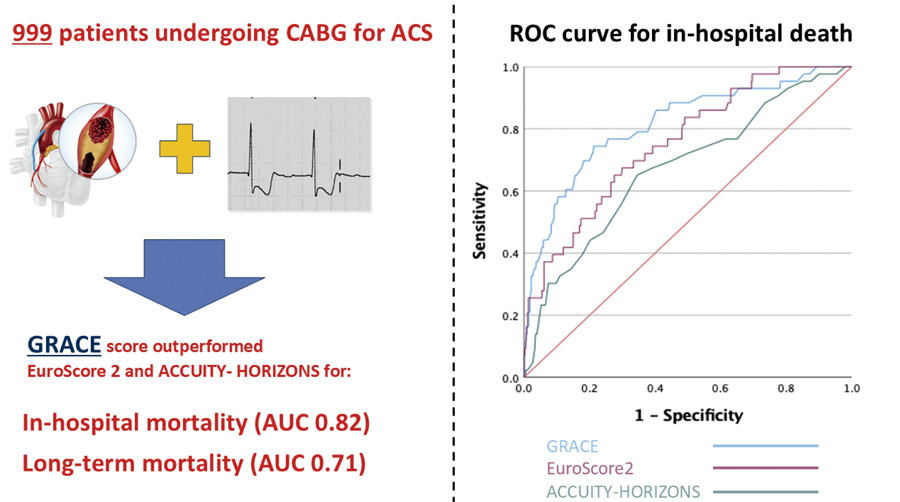
A total of 999 patients were included between 1998 and 2022. The mean time from symptom onset to CABG was 6.3 ± 5.5 days. The areas under the ROC curves were 0.82 (95% CI 0.74 – 0.89, p<0.001) for GRACE, 0.78 (95% CI 0.62-0.93, P=0.004) for TIMI-STEMI, 0.75 (95% CI 0.61-0.83, p<0.001) for EuroSCORE II, 0.67 (95% CI 0.59-0.76, P<0.001) for A-H bleeding, and 0.58 (95% CI 0.49-0.67, p=0.131) for TIMI-NSTEACS. Excluding in-hospital deaths, only GRACE and TIMI-STEMI were significantly associated with long-term mortality (mean follow-up of 5.5 ± 4 years). In the multivariable analyses, the GRACE score was the only RS significantly associated with in-hospital and long-term mortality in all adjusted models.

Conclusion

In patients with ACS who underwent CABG during the index hospitalization, the GRACE score was the only risk score that remained independently associated with both in-hospital and long-term mortality across all developed models, after adjustment for potential confounders. Moreover, the GRACE score performed better than others in predicting in-hospital deaths. These findings may influence the clinical decision-making process in this high-risk population.
  • Acute coronary syndrome
  • Continuity of Patient Care
  • Mortality
  • Myocardial Revascularization
Read Full Article
Creative Commons Attribution (CC BY) Creative Commons license
09/01/2026 DOI: 10.36660/abc.20250320i Views 1
IJCS
Editorial

Breathing and Cardiovascular Patterns: What can we Learn from Respiratory Exercises?

Gabriel Dias Rodrigues

In the current issue of the International Journal of Cardiovascular Sciences, Fetter and colleagues found that respiratory movements of the abdominal cavity and rib cage, evaluated by circumferences measurements, were higher in Yoga practitioners than in an age-matched sedentary group. Also, the study confirmed that Yoga practitioners showed higher maximal expiratory strength and lower heart rate at rest than non-practitioners.

Yoga has been recommended as a non-pharmacological therapy to control cardiovascular risk factors. Respiratory exercises are part of the Yoga program that includes abdominal and rib cage expansion by rhythmic movements. – It was demonstrated that four months of Yoga respiratory training improved inspiratory and expiratory muscle strength, forced vital capacity and quality of life in healthy elderly. Another study demostrated that Yoga influenced cardiorespiratory control, affecting the resting sympatho-vagal balance, with a shift from vagal to sympathetic predominance, reflecting a sympathetic withdrawal. Several disease subsets are marked by autonomic dysfunction characterized by sympathetic overactivity at rest, and in this context, respiratory exercises such as Yoga may be a potential countermeasure.

[…]

  • Breathing
  • Breathing Exercises
  • Cardiovascular Diseases
  • Continuity of Patient Care
  • physical therapy modalities
  • Yoga
Read Full Article
Creative Commons Attribution (CC BY) Creative Commons license
10/03/2023 DOI: 10.36660/ijcs.20210191 Views 1
Figure 1
ABCHF
Editorial

The Role of the Heart Failure Specialist: Benefits for Both the Patient and the Cardiology Community

Livia A. Goldraich et al. Jefferson L. Vieira Nadine Clausell

In recent decades, the advancement of knowledge of cardiovascular diseases has been remarkable. Heart failure (HF) has a prominent role among the conditions of greatest epidemiological relevance for the population, given its high prevalence and incidence worldwide, including Brazil.– Thus, mastery of this condition is key to cardiologist training. However, the understanding of the complexity of the different diseases and pathophysiological mechanisms potentially involved in the development, progression, and prognosis of HF has advanced, and a broad and intricate spectrum of therapeutic options has emerged, especially in the past two decades. These advances allowed a significant improvement in the clinical outcomes of HF patients; however, as knowledge and consequent therapeutic challenges became more complex, it was clear that a new type of training and expertise in the field of Cardiology was needed.

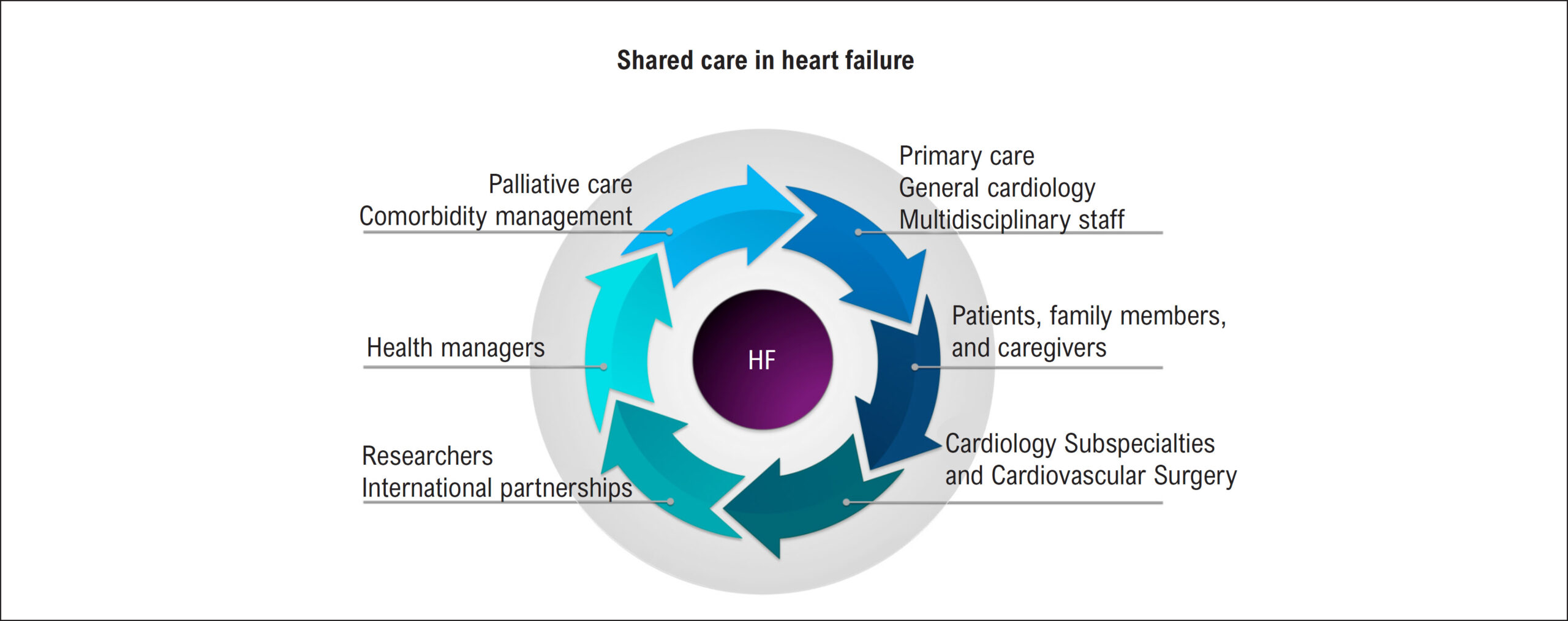
The American Heart Association (AHA) and the European Society of Cardiology (ESC) were the first to encourage the growth and strengthening of the HF specialty, with the creation of study groups, departments, and journals focused on this condition.– Several specific HF congresses have been organized and brought together a growing number of participants for about 20 years. Concomitantly, several cardiology centers of worldwide relevance have developed fellowship programs in HF and heart transplantation, many of which more recently also cover mechanical circulatory support. Finally, certification examinations for HF specialist by the American Board of Internal Medicine (ABIM) and the ESC Heart Failure Association were created in 2013 and 2014, respectively., In 2020, an expert consensus of the American College of Cardiology (ACC) together with the Heart Failure Society of America (HFSA) and the International Society for Heart and Lung Transplantation (ISHLT) introduced a list of requirements for HF specialist training, based on the core competencies of the Accreditation Council for Graduate Medical Education (ACGME). This document outlines, in particular, the expectations for physicians who treat advanced HF patients or heart transplant recipients, and recommends specific skills in mechanical circulatory support, cardiac resynchronization therapy, heart transplantation, and pulmonary hypertension. The authors also recommend that there be a maintenance of certification process based on participation in continuing medical education programs and collaboration with national databases and registries. exemplifies and adapts the HF training model used at Brigham and Women’s Hospital, Harvard University, Boston, United States.

[…]

  • Continuity of Patient Care
  • Cross-Sectional Studies
  • Epidemiology
  • Heart failure/prevalence
  • Learning
  • Specialization
Read Full Article
Creative Commons Attribution (CC BY) Creative Commons license
06/07/2021 DOI: 10.36660/abchf.20210002 Views 1

How to cite this article

EndNote RIS

Electronic Document Format (Vancouver)

Nicolau JC, Giraldez RRCV, Jatene FB, Dallan LAO, Lisboa LA, Mejia OAV, Ribera JLM, et al. Comparison between Five Risk Scores in Patients with Acute Coronary Syndromes Undergoing Surgical Revascularization during the Index Hospitalization. Arquivos Brasileiros de Cardiologia 2026;122(11):e20250320.

Electronic Document Format (ABNT)

Nicolau, José C.; Giraldez, Roberto R. C. V.; Jatene, Fabio B.; Dallan, Luís A. O.; Lisboa, Luiz A.; Mejia, Omar A. V.; Ribera, Jorge L. M.; Bertolin, Adriadne J.; Baracioli, Luciano M.; Lima, Felipe G.; Andrade, Maria C. D.; Vintimilla, Santiago A. C.; Salis, Leonardo; Freitas, Fabiane L. de; Goncharov, Maxim; Godoy, Lucas C.; Furtado, Remo H. de M.; Farkouh, Michael E.. Comparison between Five Risk Scores in Patients with Acute Coronary Syndromes Undergoing Surgical Revascularization during the Index Hospitalization. Arquivos Brasileiros de Cardiologia, v. 122, n. 11, e20250320, Jan. 2026.

Electronic Document Format (APA)

Nicolau, J. C., Giraldez, R. R. C. V., Jatene, F. B., Dallan, L. A. O., Lisboa, L. A., Mejia, O. A. V., Ribera, J. L. M., Bertolin, A. J., Baracioli, L. M., Lima, F. G., Andrade, M. C. D., Vintimilla, S. A. C., Salis, L., Freitas, F. L. , Goncharov, M., Godoy, L. C., Furtado, R. H. M., & Farkouh, M. E. (2026). Comparison between Five Risk Scores in Patients with Acute Coronary Syndromes Undergoing Surgical Revascularization during the Index Hospitalization. Arquivos Brasileiros de Cardiologia, 122(11), e20250320.

Electronic Document Format (ISO)

Nicolau, José C. and Giraldez, Roberto R. C. V. and Jatene, Fabio B. and Dallan, Luís A. O. and Lisboa, Luiz A. and Mejia, Omar A. V. and Ribera, Jorge L. M. and Bertolin, Adriadne J. and Baracioli, Luciano M. and Lima, Felipe G. and Andrade, Maria C. D. and Vintimilla, Santiago A. C. and Salis, Leonardo and Freitas, Fabiane L. de and Goncharov, Maxim and Godoy, Lucas C. and Furtado, Remo H. de M. and Farkouh, Michael E.. Comparison between Five Risk Scores in Patients with Acute Coronary Syndromes Undergoing Surgical Revascularization during the Index Hospitalization. Arquivos Brasileiros de Cardiologia [online]. 2026, vol. 122, n. 11, [cited 2026-10-14], e20250320. Available from: <https://journals.cardiol.br/en/article/comparison-between-five-risk-scores-in-patients-with-acute-coronary-syndromes-undergoing-surgical-revascularization-during-the-index-hospitalization/>. ISSN 0066-782X

EndNote RIS

Electronic Document Format (Vancouver)

Rodrigues GD. Breathing and Cardiovascular Patterns: What can we Learn from Respiratory Exercises?. International Journal of Cardiovascular Sciences 2023;34(6):732-3.

Electronic Document Format (ABNT)

Rodrigues, Gabriel Dias. Breathing and Cardiovascular Patterns: What can we Learn from Respiratory Exercises?. International Journal of Cardiovascular Sciences, v. 34, n. 6, p. 732-733, Mar. 2023.

Electronic Document Format (APA)

Rodrigues, G. D. (2023). Breathing and Cardiovascular Patterns: What can we Learn from Respiratory Exercises?. International Journal of Cardiovascular Sciences, 34(6), 732-733.

Electronic Document Format (ISO)

Rodrigues, Gabriel Dias. Breathing and Cardiovascular Patterns: What can we Learn from Respiratory Exercises?. International Journal of Cardiovascular Sciences [online]. 2023, vol. 34, n. 6, [cited 2026-10-14], pp. 732-733. Available from: <https://journals.cardiol.br/en/article/breathing-and-cardiovascular-patterns-what-can-we-learn-from-respiratory-exercises/>. ISSN 2359-4802

EndNote RIS

Electronic Document Format (Vancouver)

Goldraich LA, Vieira JL, Clausell N. The Role of the Heart Failure Specialist: Benefits for Both the Patient and the Cardiology Community. ABC: Heart Failure & Cardiomyopathy 2021;1(1):11-4.

Electronic Document Format (ABNT)

Goldraich, Livia A.; Vieira, Jefferson L.; Clausell, Nadine. The Role of the Heart Failure Specialist: Benefits for Both the Patient and the Cardiology Community. ABC: Heart Failure & Cardiomyopathy, v. 1, n. 1, p. 11-14, Jul. 2021.

Electronic Document Format (APA)

Goldraich, L. A., Vieira, J. L., & Clausell, N. (2021). The Role of the Heart Failure Specialist: Benefits for Both the Patient and the Cardiology Community. ABC: Heart Failure & Cardiomyopathy, 1(1), 11-14.

Electronic Document Format (ISO)

Goldraich, Livia A. and Vieira, Jefferson L. and Clausell, Nadine. The Role of the Heart Failure Specialist: Benefits for Both the Patient and the Cardiology Community. ABC: Heart Failure & Cardiomyopathy [online]. 2021, vol. 1, n. 1, [cited 2026-10-14], pp. 11-14. Available from: <https://journals.cardiol.br/en/article/the-role-of-the-heart-failure-specialist-benefits-for-both-the-patient-and-the-cardiology-community/>

  • About ABC Family
  • Internal Regulation
  • Editorial Board
  • Brazilian Society of Cardiology (SBC)

Issues

SBC Guidelines

  • Videos
  • Podcasts
  • News