Comparison between Five Risk Scores in Patients with Acute Coronary Syndromes Undergoing Surgical Revascularization during the Index Hospitalization
Abstract
Background
Risk scores (RS) for patients with acute coronary syndromes (ACS) and coronary artery bypass grafting (CABG) have been tested previously, but little is known about their value in ACS patients undergoing CABG during the index hospitalization.
Objectives
To compare five different RS in ACS patients undergoing CABG during the index hospitalization.
Methods
The analyzed RS were GRACE, TIMI-non-ST-elevation ACS (TIMI-NSTEACS), TIMI-ST-elevation acute myocardial infarction (TIMI-STEMI), ACUITY/HORIZONS (A-H) bleeding, and EuroSCORE II. The RS were evaluated regarding their performance during the in-hospital phase and the long-term follow-up after discharge; a p-value <0.05 was considered significant.
Results
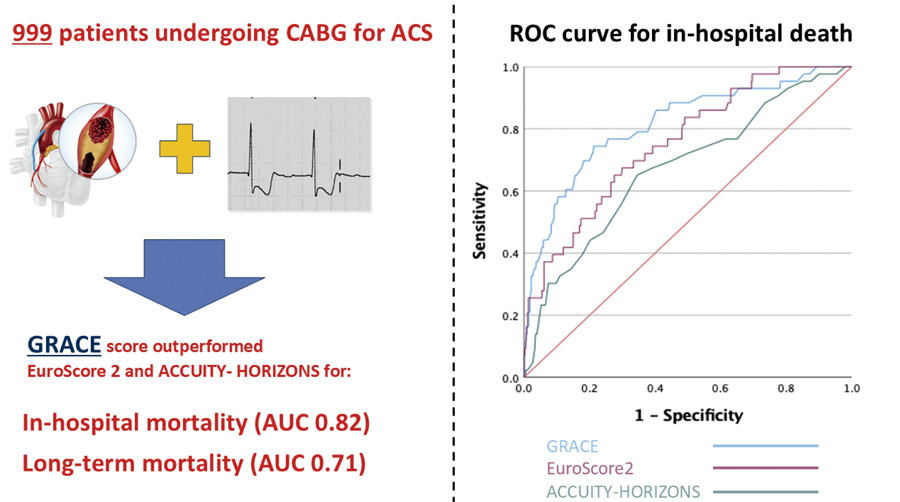
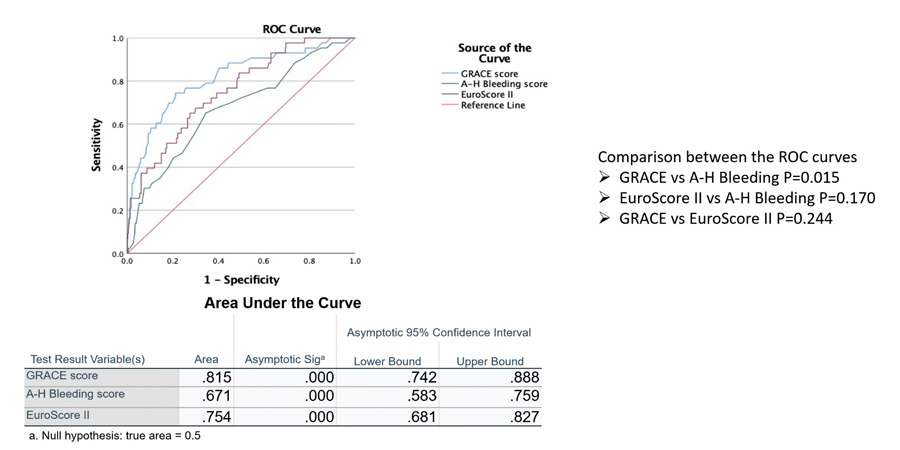
A total of 999 patients were included between 1998 and 2022. The mean time from symptom onset to CABG was 6.3 ± 5.5 days. The areas under the ROC curves were 0.82 (95% CI 0.74 – 0.89, p<0.001) for GRACE, 0.78 (95% CI 0.62-0.93, P=0.004) for TIMI-STEMI, 0.75 (95% CI 0.61-0.83, p<0.001) for EuroSCORE II, 0.67 (95% CI 0.59-0.76, P<0.001) for A-H bleeding, and 0.58 (95% CI 0.49-0.67, p=0.131) for TIMI-NSTEACS. Excluding in-hospital deaths, only GRACE and TIMI-STEMI were significantly associated with long-term mortality (mean follow-up of 5.5 ± 4 years). In the multivariable analyses, the GRACE score was the only RS significantly associated with in-hospital and long-term mortality in all adjusted models.
Conclusion
In patients with ACS who underwent CABG during the index hospitalization, the GRACE score was the only risk score that remained independently associated with both in-hospital and long-term mortality across all developed models, after adjustment for potential confounders. Moreover, the GRACE score performed better than others in predicting in-hospital deaths. These findings may influence the clinical decision-making process in this high-risk population.
Images
Image gallery fullscreen viewer
Comments are moderated by the editorial team before publication. Discussions should be evidence-based and use scientific language. Conflicts of interest should be declared.