ABC Family Arquivos Brasileiros de Cardiologia International Journal of Cardiovascular Sciences ABC Heart Failure & Cardiomyopathy ABC Imagem Cardiovascular
Português English
ABC Family
Português English
  • About
    • About ABC Family
    • Internal Regulation
    • Editorial Board
    • Brazilian Society of Cardiology (SBC)
  • Issues
  • SBC Guidelines
  • Content
    • Videos
    • Podcasts
    • News
  • About
    • About ABC Family
    • Internal Regulation
    • Editorial Board
    • Brazilian Society of Cardiology (SBC)
  • Issues
  • SBC Guidelines
  • Content
    • Videos
    • Podcasts
    • News

ABC Family

  • ABC Family
  • Arquivos Brasileiros de Cardiologia
  • International Journal of Cardiovascular Sciences
  • ABC Heart Failure & Cardiomyopathy
  • ABC Imagem Cardiovascular
Search in

No content found.

Journals
Ordering
Article types
Others

  1. Home
  2. Keyword: Cardiac pacing
Figure 1
ABC
Research Letter

A Hybrid Approach of Simultaneous Extraction and Leadless Pacemaker Implantation in a Transvenous Lead Endocarditis Case

Helder Santos et al. André Grazina Mariana Santos Paulo Osório … Guilherme Portugal Ana Lousinha Bruno Valente Pedro Silva Cunha Mário Oliveira

Introduction

Symptomatic bradycardia treatment is based on the transvenous method of endocardial pacing. However, cardiac electronic implantable devices (CEID) are associated with a potential risk of complications, including infections, with an estimated rate of 0.5% with primary implants and 1–7 % with secondary interventions. CIED infections are associated with longer hospital length of stay, higher clinical costs and mortality rates. , According to guidelines, infective endocarditis related to CIED implicates complete removal of the system, followed by a period without intravascular therapy. – Nevertheless, most of the patients require CIED reimplantation, which is known to be associated with a risk of reinfection between 2 and 11%, particularly in cases with only partial removal of the initial device.

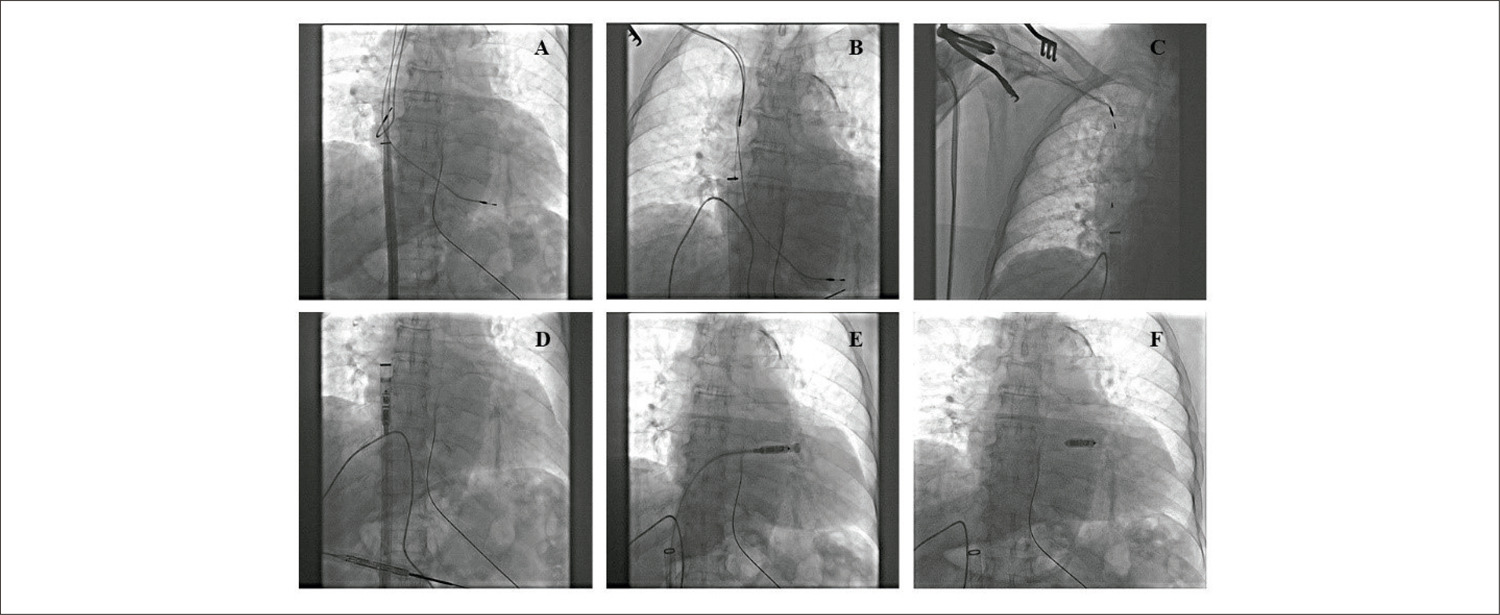
The PISA technique is a percutaneous procedure used with success in lead extraction of the CIED. This technique starts with the identification of the proximal portion of the lead. Then, a debridement is performed along the lead to achieve the site of venous insertion. Subsequently, a polypropylene dilator sheath is inserted and advanced externally up to the lead in rotational movements, while maintaining a light traction. Such movements will cause the release of adhesions around the lead, allowing, after the full advancement of the sheath, the entire lead removal.

[…]
  • Artificial/adverse effects
  • Artificial/methods
  • Bradycardia/complications
  • Cardiac pacing
  • Equipment and Supplies/instrumentation
  • Leadless Pacemaker
  • Method PISA
  • Pacemaker
  • Replantation
Read Full Article
Creative Commons Attribution (CC BY) Creative Commons license
27/02/2023 DOI: 10.36660/abc.20220091 Views 1
Cardiac pacing in hypertrophic cardiomyopathy: a cohort with 24 years of follow-up
ABC
Artigo Original

Cardiac pacing in hypertrophic cardiomyopathy: a cohort with 24 years of follow-up

Lenine Angelo Alves Silva et al. Edmundo Arteaga Fernández Martino Martinelli Filho Roberto Costa … Sérgio Siqueira Barbara Maria Ianni Charles Mady

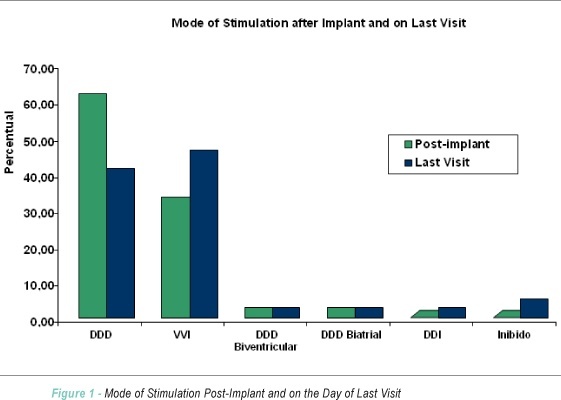
BACKGROUND: The benefits of heart stimulation in hypertrophic cardiomyopathy (HCM) patients have been questioned. Research work available in Brazil on those benefits is scarce. OBJECTIVE: To describe the indication, clinical response, complications and survival time related to pacemaker implant in HCM patients. METHODS: Thirty-nine hypertrophic cardiomyopathy patients were studied (41% males) and submitted to pacemaker implant from May, 1980 through November, 2003. RESULTS: Twenty-seven patients presented obstructive hypertrophic cardiomyopathy, and 12, non-obstructive. Mean age was 46.4 years of age (range 14 – 77), with follow-up of 6.4 ± 4.1 years. Major indications for implant were: spontaneous or induced atrioventricular block (54%), refractoriness to therapeutic conduct associated to high gradient (33%), support for drug therapy to treat bradychardia (8%), and atrial fibrillation prevention (5%). Functional class was shown to improve from 2.41±0.87 to 1.97±0.92 (p = 0.008), and symptoms referred were reduced. No change was made in drug therapy administration. No procedure-related deaths were reported. Although shown to be safe, the procedure was not free from complications (6 patients – 15.4%). Three deaths occurred in the follow-up period – the three of them were atrial fibrillation female patients, with evidence of functional deterioration. A close association was observed between clinical condition worsening and the onset of atrial fibrillation or flutter. CONCLUSION: Cardiac pacing in HCM patients was successful, with evidence of symptoms relief in obstructive HCM patients. No functional improvement was observed in non-obstructive patients.

  • Artificial
  • Cardiac pacing
  • cardiomyopathy
  • Cohort Studies
  • hypertrophic
  • outcome assessment
Read Full Article
Creative Commons Attribution (CC BY) Creative Commons license
11/11/2008 DOI: 10.1590/S0066-782X2008001600011
Influence of external temporary biatrial pacing on the prevention of atrial fibrillation after coronary artery bypass without extracorporeal circulation
ABC
Artigo Original

Influence of external temporary biatrial pacing on the prevention of atrial fibrillation after coronary artery bypass without extracorporeal circulation

Francisco Maia da Silva et al. Rodrigo Milani Dalton Précoma Maximiliano Guimarães … Jose Augusto Moutinho Laura Barboza Alexandre Sartori Paulo Brofman

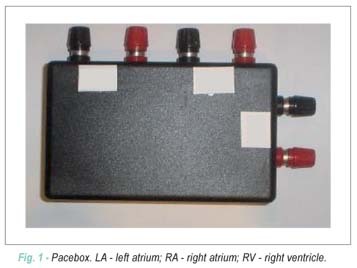
BACKGROUND: Atrial fibrillation is the most common complication after myocardial revascularization, and it increases morbidity/mortality. OBJECTIVE: The purpose of this prospective randomized study was to test the hypothesis that temporary biatrial pacing is effective in reducing the incidence of postoperative atrial fibrillation after myocardial revascularization. METHODS: Ninety-eight non-consecutive patients who had undergone off-pump myocardial revascularization received two temporary electrodes attached to the right and left atria, which were connected to either pair of atrial pacemaker electrodes, in addition to the leads implanted in the right ventricle. Two groups of patients were randomized (control: 49 patients with no biatrial pacing; therapeutic: 49 patients with biatrial pacing). The variables of interest were atrial fibrillation (present or absent) and length of hospital stay. RESULTS: The incidence of atrial fibrillation was 36.73% in the control group and 14.29% in the therapeutic group (p=0.0194). Length of hospital stay was 7.00 ± 2.82 days for patients with no atrial fibrillation (n=73) and 9.20 ± 2.87 days for patients with atrial fibrillation (n=25) (p=0.0001). Age was an important predictor of arrhythmia and ranged between 62.34 ± 9.00 years in the group with no atrial fibrillation and 67.20 ± 7.42 years in the group with atrial fibrillation (p=0.0170). CONCLUSION: Compared to controls, prophylactic temporary biatrial pacing is effective in preventing atrial fibrillation. Hospital stay was longer for patients who developed postoperative atrial fibrillation, and age was an important predictor for the development of arrhythmia.

  • Artificial
  • Atrial Fibrillation
  • Cardiac pacing
  • Myocardial Revascularization
Read Full Article
Creative Commons Attribution (CC BY) Creative Commons license
28/04/2008 DOI: 10.1590/S0066-782X2008000200003
Functional behavior of patients with conventional pacemakers undergoing cardiac resynchronization
ABC
Artigo Original

Functional behavior of patients with conventional pacemakers undergoing cardiac resynchronization

Rodrigo Tavares Silva et al. Martino Martinelli Filho Carlos Eduardo Batista de Lima Daniela Garcia Moreno Cabral Martins … Silvana Angelina Dorio Nishióka Anísio Alexandre Pedrosa Elizabeth Sartori Crevelari Roberto Costa Eduardo Argentino Sosa José Antonio Franchini Ramires

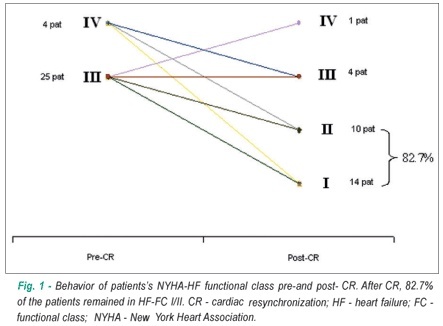
BACKGROUND: Cardiac resynchronization therapy (CRT) is an efficient treatment for patients with heart failure (HF), severe ventricular dysfunction and intraventricular block. Conventional pacemakers (CPM) implanted in the right ventricular apical area cause alterations in the normal sequence of cardiac activation similar to those induced by LBBB (left bundle-branch block). Therefore, patients with CPM and advanced HF could be candidates to undergo CRT, but as only small numbers of patients have been evaluated so far, definitive conclusions are lacking. OBJECTIVE: To assess the clinical and functional outcome of cardiac resynchronization therapy (CRT) in patients with conventional pacemakers. METHODS: Patients with CPM, who were in NYHA HF functional class III/IV class refractory to drug therapy, and left ventricular ejection fraction (LVEF) ) <35% underwent CRT. Patients’ clinical-functional behavior was assessed prospectively six months after the procedure. The improvement of one HF-functional class was set as an effective response to the procedure. The following was assessed: QRS duration (ECG), diastolic diameter (LVDd), left ventricular systolic diameter (LVSd) and LVEF seen on the echocardiogram. For the statistical analysis, Student’s paired t test and Spearman’s correlation were used. RESULTS: Twenty-nine patients (mean age 61.5) were evaluated. Of these, six were females, and chagasic cardiomyopathy was predominant. During the clinical follow-up of 22.7±13 months, 86.2% of the patients benefited from CRT. Within this group, the mean LVEF increased by 18% (p=0.013), QRS duration dropped by 11.8% (p=0.002) and no significant reduction in left ventricular intracavitary diameters was observed. CONCLUSION: CRT is effective for patients with CPM and advanced HF as it yields a high rate of response (86.2%), significantly improves LVEF and reduces QRS duration.

  • Artificial
  • Bundle Branch Block
  • Cardiac pacing
  • congestive
  • Heart Failure
  • Pacemaker
Read Full Article
Creative Commons Attribution (CC BY) Creative Commons license
28/04/2008 DOI: 10.1590/S0066-782X2008000200012 Views 1

How to cite this article

EndNote RIS

Electronic Document Format (Vancouver)

Santos H, Grazina A, Santos M, Osório P, Portugal G, Lousinha A, Valente B, et al. A Hybrid Approach of Simultaneous Extraction and Leadless Pacemaker Implantation in a Transvenous Lead Endocarditis Case. Arquivos Brasileiros de Cardiologia 2023;120(2):e20220091.

Electronic Document Format (ABNT)

Santos, Helder; Grazina, André; Santos, Mariana; Osório, Paulo; Portugal, Guilherme; Lousinha, Ana; Valente, Bruno; Cunha, Pedro Silva; Oliveira, Mário. A Hybrid Approach of Simultaneous Extraction and Leadless Pacemaker Implantation in a Transvenous Lead Endocarditis Case. Arquivos Brasileiros de Cardiologia, v. 120, n. 2, e20220091, Feb. 2023.

Electronic Document Format (APA)

Santos, H., Grazina, A., Santos, M., Osório, P., Portugal, G., Lousinha, A., Valente, B., Cunha, P. S., & Oliveira, M. (2023). A Hybrid Approach of Simultaneous Extraction and Leadless Pacemaker Implantation in a Transvenous Lead Endocarditis Case. Arquivos Brasileiros de Cardiologia, 120(2), e20220091.

Electronic Document Format (ISO)

Santos, Helder and Grazina, André and Santos, Mariana and Osório, Paulo and Portugal, Guilherme and Lousinha, Ana and Valente, Bruno and Cunha, Pedro Silva and Oliveira, Mário. A Hybrid Approach of Simultaneous Extraction and Leadless Pacemaker Implantation in a Transvenous Lead Endocarditis Case. Arquivos Brasileiros de Cardiologia [online]. 2023, vol. 120, n. 2, [cited 2026-10-14], e20220091. Available from: <https://journals.cardiol.br/en/article/a-hybrid-approach-of-simultaneous-extraction-and-leadless-pacemaker-implantation-in-a-transvenous-lead-endocarditis-case/>. ISSN 0066-782X

EndNote RIS

Electronic Document Format (Vancouver)

Silva LAA, Fernández EA, Martinelli Filho M, Costa R, Siqueira S, Ianni BM, Mady C, et al. Cardiac pacing in hypertrophic cardiomyopathy: a cohort with 24 years of follow-up. Arquivos Brasileiros de Cardiologia 2008;91(4):274-80.

Electronic Document Format (ABNT)

Silva, Lenine Angelo Alves; Fernández, Edmundo Arteaga; Martinelli Filho, Martino; Costa, Roberto; Siqueira, Sérgio; Ianni, Barbara Maria; Mady, Charles. Cardiac pacing in hypertrophic cardiomyopathy: a cohort with 24 years of follow-up. Arquivos Brasileiros de Cardiologia, v. 91, n. 4, p. 274-280, Nov. 2008.

Electronic Document Format (APA)

Silva, L. A. A., Fernández, E. A., Martinelli Filho, M., Costa, R., Siqueira, S., Ianni, B. M., & Mady, C. (2008). Cardiac pacing in hypertrophic cardiomyopathy: a cohort with 24 years of follow-up. Arquivos Brasileiros de Cardiologia, 91(4), 274-280.

Electronic Document Format (ISO)

Silva, Lenine Angelo Alves and Fernández, Edmundo Arteaga and Martinelli Filho, Martino and Costa, Roberto and Siqueira, Sérgio and Ianni, Barbara Maria and Mady, Charles. Cardiac pacing in hypertrophic cardiomyopathy: a cohort with 24 years of follow-up. Arquivos Brasileiros de Cardiologia [online]. 2008, vol. 91, n. 4, [cited 2026-10-14], pp. 274-280. Available from: <https://journals.cardiol.br/en/article/cardiac-pacing-in-hypertrophic-cardiomyopathy-a-cohort-with-24-years-of-follow-up/>. ISSN 0066-782X

EndNote RIS

Electronic Document Format (Vancouver)

Silva FM, Milani R, Précoma D, Guimarães M, Moutinho JA, Barboza L, Sartori A, et al. Influence of external temporary biatrial pacing on the prevention of atrial fibrillation after coronary artery bypass without extracorporeal circulation. Arquivos Brasileiros de Cardiologia 2008;90(2):87-93.

Electronic Document Format (ABNT)

Silva, Francisco Maia da; Milani, Rodrigo; Précoma, Dalton; Guimarães, Maximiliano; Moutinho, Jose Augusto; Barboza, Laura; Sartori, Alexandre; Brofman, Paulo. Influence of external temporary biatrial pacing on the prevention of atrial fibrillation after coronary artery bypass without extracorporeal circulation. Arquivos Brasileiros de Cardiologia, v. 90, n. 2, p. 87-93, Apr. 2008.

Electronic Document Format (APA)

Silva, F. M. , Milani, R., Précoma, D., Guimarães, M., Moutinho, J. A., Barboza, L., Sartori, A., & Brofman, P. (2008). Influence of external temporary biatrial pacing on the prevention of atrial fibrillation after coronary artery bypass without extracorporeal circulation. Arquivos Brasileiros de Cardiologia, 90(2), 87-93.

Electronic Document Format (ISO)

Silva, Francisco Maia da and Milani, Rodrigo and Précoma, Dalton and Guimarães, Maximiliano and Moutinho, Jose Augusto and Barboza, Laura and Sartori, Alexandre and Brofman, Paulo. Influence of external temporary biatrial pacing on the prevention of atrial fibrillation after coronary artery bypass without extracorporeal circulation. Arquivos Brasileiros de Cardiologia [online]. 2008, vol. 90, n. 2, [cited 2026-10-14], pp. 87-93. Available from: <https://journals.cardiol.br/en/article/influence-of-external-temporary-biatrial-pacing-on-the-prevention-of-atrial-fibrillation-after-coronary-artery-bypass-without-extracorporeal-circulation/>. ISSN 0066-782X

EndNote RIS

Electronic Document Format (Vancouver)

Silva RT, Martinelli Filho M, Lima CEB, Martins DGMC, Nishióka SAD, Pedrosa AA, Crevelari ES, et al. Functional behavior of patients with conventional pacemakers undergoing cardiac resynchronization. Arquivos Brasileiros de Cardiologia 2008;90(2):151-6.

Electronic Document Format (ABNT)

Silva, Rodrigo Tavares; Martinelli Filho, Martino; Lima, Carlos Eduardo Batista de; Martins, Daniela Garcia Moreno Cabral; Nishióka, Silvana Angelina Dorio; Pedrosa, Anísio Alexandre; Crevelari, Elizabeth Sartori; Costa, Roberto; Sosa, Eduardo Argentino; Ramires, José Antonio Franchini. Functional behavior of patients with conventional pacemakers undergoing cardiac resynchronization. Arquivos Brasileiros de Cardiologia, v. 90, n. 2, p. 151-156, Apr. 2008.

Electronic Document Format (APA)

Silva, R. T., Martinelli Filho, M., Lima, C. E. B. , Martins, D. G. M. C., Nishióka, S. A. D., Pedrosa, A. A., Crevelari, E. S., Costa, R., Sosa, E. A., & Ramires, J. A. F. (2008). Functional behavior of patients with conventional pacemakers undergoing cardiac resynchronization. Arquivos Brasileiros de Cardiologia, 90(2), 151-156.

Electronic Document Format (ISO)

Silva, Rodrigo Tavares and Martinelli Filho, Martino and Lima, Carlos Eduardo Batista de and Martins, Daniela Garcia Moreno Cabral and Nishióka, Silvana Angelina Dorio and Pedrosa, Anísio Alexandre and Crevelari, Elizabeth Sartori and Costa, Roberto and Sosa, Eduardo Argentino and Ramires, José Antonio Franchini. Functional behavior of patients with conventional pacemakers undergoing cardiac resynchronization. Arquivos Brasileiros de Cardiologia [online]. 2008, vol. 90, n. 2, [cited 2026-10-14], pp. 151-156. Available from: <https://journals.cardiol.br/en/article/functional-behavior-of-patients-with-conventional-pacemakers-undergoing-cardiac-resynchronization/>. ISSN 0066-782X

  • About ABC Family
  • Internal Regulation
  • Editorial Board
  • Brazilian Society of Cardiology (SBC)

Issues

SBC Guidelines

  • Videos
  • Podcasts
  • News