ABC Family Arquivos Brasileiros de Cardiologia International Journal of Cardiovascular Sciences ABC Heart Failure & Cardiomyopathy ABC Imagem Cardiovascular
Português English
ABC Family
Português English
  • About
    • About ABC Family
    • Internal Regulation
    • Editorial Board
    • Brazilian Society of Cardiology (SBC)
  • Issues
  • SBC Guidelines
  • Content
    • Videos
    • Podcasts
    • News
  • About
    • About ABC Family
    • Internal Regulation
    • Editorial Board
    • Brazilian Society of Cardiology (SBC)
  • Issues
  • SBC Guidelines
  • Content
    • Videos
    • Podcasts
    • News

ABC Family

  • ABC Family
  • Arquivos Brasileiros de Cardiologia
  • International Journal of Cardiovascular Sciences
  • ABC Heart Failure & Cardiomyopathy
  • ABC Imagem Cardiovascular
Search in

No content found.

Journals
Ordering
Article types
Others

  1. Home
  2. Keyword: congestive
Functional behavior of patients with conventional pacemakers undergoing cardiac resynchronization
ABC
Artigo Original

Functional behavior of patients with conventional pacemakers undergoing cardiac resynchronization

Rodrigo Tavares Silva et al. Martino Martinelli Filho Carlos Eduardo Batista de Lima Daniela Garcia Moreno Cabral Martins … Silvana Angelina Dorio Nishióka Anísio Alexandre Pedrosa Elizabeth Sartori Crevelari Roberto Costa Eduardo Argentino Sosa José Antonio Franchini Ramires

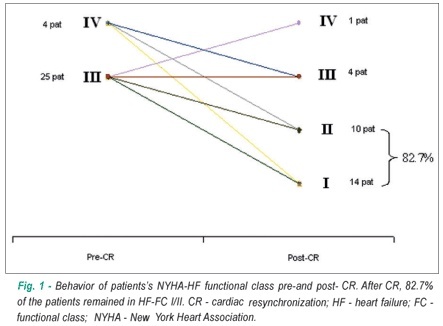
BACKGROUND: Cardiac resynchronization therapy (CRT) is an efficient treatment for patients with heart failure (HF), severe ventricular dysfunction and intraventricular block. Conventional pacemakers (CPM) implanted in the right ventricular apical area cause alterations in the normal sequence of cardiac activation similar to those induced by LBBB (left bundle-branch block). Therefore, patients with CPM and advanced HF could be candidates to undergo CRT, but as only small numbers of patients have been evaluated so far, definitive conclusions are lacking. OBJECTIVE: To assess the clinical and functional outcome of cardiac resynchronization therapy (CRT) in patients with conventional pacemakers. METHODS: Patients with CPM, who were in NYHA HF functional class III/IV class refractory to drug therapy, and left ventricular ejection fraction (LVEF) ) <35% underwent CRT. Patients’ clinical-functional behavior was assessed prospectively six months after the procedure. The improvement of one HF-functional class was set as an effective response to the procedure. The following was assessed: QRS duration (ECG), diastolic diameter (LVDd), left ventricular systolic diameter (LVSd) and LVEF seen on the echocardiogram. For the statistical analysis, Student’s paired t test and Spearman’s correlation were used. RESULTS: Twenty-nine patients (mean age 61.5) were evaluated. Of these, six were females, and chagasic cardiomyopathy was predominant. During the clinical follow-up of 22.7±13 months, 86.2% of the patients benefited from CRT. Within this group, the mean LVEF increased by 18% (p=0.013), QRS duration dropped by 11.8% (p=0.002) and no significant reduction in left ventricular intracavitary diameters was observed. CONCLUSION: CRT is effective for patients with CPM and advanced HF as it yields a high rate of response (86.2%), significantly improves LVEF and reduces QRS duration.
  • Artificial
  • Bundle Branch Block
  • Cardiac pacing
  • congestive
  • Heart Failure
  • Pacemaker
Read Full Article
Creative Commons Attribution (CC BY) Creative Commons license
28/04/2008 DOI: 10.1590/S0066-782X2008000200012 Views 1
Myocardial revascularization and ventricular restoration through pacopexy
ABC
Artigo Original

Myocardial revascularization and ventricular restoration through pacopexy

João Roberto Breda et al. Luciano Figueiredo Aguiar João Nelson Rodrigues Branco Roberto Catani … Ibraim Pinto Edson Nakano Enio Buffolo

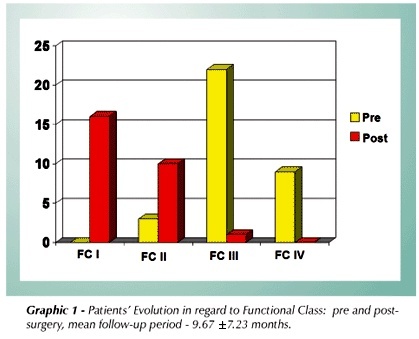
OBJECTIVE: To analyze left ventricle performance after myocardial revascularization associated to ventricular geometrics restoration by “pacopexy” in schemic myocardiopathy patients with significant ventricular dysfunction in whom ventricular restoration was obtained through special technique. METHODS: Myocardial revascularization associated to ventricular geometrics restoration through special technique, with no use of prosthesis or other synthetic materials. RESULTS: Patients’ functional class was shown to have improved 93.10% after surgical procedure. Pre- and post-surgical comparison showed significant increase in left ventricle ejection fraction as well as decrease in left ventricle systolic diameter. No significant change was observed in left ventricle diastolic diameter or systolic volume. Post-surgical follow-up time length ranged from 1 month to 3 years and 4 months. CONCLUSION: Ventricular dysfunction restoration technique through pacopexy showed to be effective for the management of severe ventricular dysfunction from schemic causes. Major impact was observed in the functional class of patients under study.

  • congestive
  • Heart Failure
  • left
  • Myocardial Revascularization
  • Ventricular Function
Read Full Article
Creative Commons Attribution (CC BY) Creative Commons license
20/03/2007 DOI: 10.1590/S0066-782X2007000200007
Subjective global assessment of nutritional status in cardiac patients
ABC
Artigo Original

Subjective global assessment of nutritional status in cardiac patients

Aurea Kaoru Yamauti et al. Marcelo Eidi Ochiai Paula Sofia Bifulco Moab Alves de Araújo … Rosiris Roco Alonso Regina Helena Cunha Ribeiro Antonio Carlos Pereira-Barretto

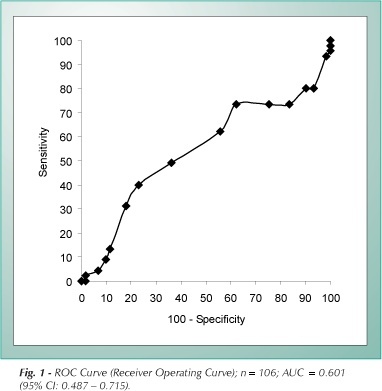
OBJECTIVE: To analyze the performance of Subjective Global Assessment of Nutritional Status (SGA) in diagnosing malnutrition in patients with heart disease. METHODS: One hundred and six hospitalized patients (53 with heart failure) completed an SGA questionnaire on their nutritional history (changes in body weight, dietary intake, gastrointestinal symptoms, functional capacity, and diagnosis) and underwent physical examination. Then, anthropometric measurements were obtained (body weight, mid-arm circumference, triceps skinfold thickness, and arm muscle circumference). Serum albumin, total lymphocyte count and anthropometric measurements were determined for the objective assessment of patients with congestive heart failure. An ROC curve was used to analyze sensitivity, specificity and accuracy of SGA compared to the objective assessment. RESULTS: Patients’ age was 57.7 ± 15.7, and the majority was male (67.9%). The ROC curve showed score 16 as SGA cut-off point with the highest sensitivity (62.2%) and specificity (55.7%). The area under the curve was 0.601 (95% CI: 0.487 – 0.715). Anthropometric assessment showed malnutrition prevalence at 51.9% by SGA and 42.5% by, with accuracy of 65.3% in men and 44.1% in women. In patients with congestive heart failure, SGA assessed malnutrition prevalence was 60.4%, while objective assessment was 32.1% with accuracy of 67.6% in men and 31.3% in women. CONCLUSION: SGA detected a greater number of malnourished patients than the objective evaluation. Its performance in identifying malnutrition was better in men. It also detected cardiac patients at nutritional risk.

  • congestive
  • Heart Diseases
  • Heart Failure
  • Nutrition Assessment
  • protein malnutrition
Read Full Article
Creative Commons Attribution (CC BY) Creative Commons license
18/01/2007 DOI: 10.1590/S0066-782X2006001900014 Views 1

How to cite this article

EndNote RIS

Electronic Document Format (Vancouver)

Silva RT, Martinelli Filho M, Lima CEB, Martins DGMC, Nishióka SAD, Pedrosa AA, Crevelari ES, et al. Functional behavior of patients with conventional pacemakers undergoing cardiac resynchronization. Arquivos Brasileiros de Cardiologia 2008;90(2):151-6.

Electronic Document Format (ABNT)

Silva, Rodrigo Tavares; Martinelli Filho, Martino; Lima, Carlos Eduardo Batista de; Martins, Daniela Garcia Moreno Cabral; Nishióka, Silvana Angelina Dorio; Pedrosa, Anísio Alexandre; Crevelari, Elizabeth Sartori; Costa, Roberto; Sosa, Eduardo Argentino; Ramires, José Antonio Franchini. Functional behavior of patients with conventional pacemakers undergoing cardiac resynchronization. Arquivos Brasileiros de Cardiologia, v. 90, n. 2, p. 151-156, Apr. 2008.

Electronic Document Format (APA)

Silva, R. T., Martinelli Filho, M., Lima, C. E. B. , Martins, D. G. M. C., Nishióka, S. A. D., Pedrosa, A. A., Crevelari, E. S., Costa, R., Sosa, E. A., & Ramires, J. A. F. (2008). Functional behavior of patients with conventional pacemakers undergoing cardiac resynchronization. Arquivos Brasileiros de Cardiologia, 90(2), 151-156.

Electronic Document Format (ISO)

Silva, Rodrigo Tavares and Martinelli Filho, Martino and Lima, Carlos Eduardo Batista de and Martins, Daniela Garcia Moreno Cabral and Nishióka, Silvana Angelina Dorio and Pedrosa, Anísio Alexandre and Crevelari, Elizabeth Sartori and Costa, Roberto and Sosa, Eduardo Argentino and Ramires, José Antonio Franchini. Functional behavior of patients with conventional pacemakers undergoing cardiac resynchronization. Arquivos Brasileiros de Cardiologia [online]. 2008, vol. 90, n. 2, [cited 2026-10-14], pp. 151-156. Available from: <https://journals.cardiol.br/en/article/functional-behavior-of-patients-with-conventional-pacemakers-undergoing-cardiac-resynchronization/>. ISSN 0066-782X

EndNote RIS

Electronic Document Format (Vancouver)

Breda JR, Aguiar LF, Branco JNR, Catani R, Pinto I, Nakano E, Buffolo E, et al. Myocardial revascularization and ventricular restoration through pacopexy. Arquivos Brasileiros de Cardiologia 2007;88(2):173-8.

Electronic Document Format (ABNT)

Breda, João Roberto; Aguiar, Luciano Figueiredo; Branco, João Nelson Rodrigues; Catani, Roberto; Pinto, Ibraim; Nakano, Edson; Buffolo, Enio. Myocardial revascularization and ventricular restoration through pacopexy. Arquivos Brasileiros de Cardiologia, v. 88, n. 2, p. 173-178, Mar. 2007.

Electronic Document Format (APA)

Breda, J. R., Aguiar, L. F., Branco, J. N. R., Catani, R., Pinto, I., Nakano, E., & Buffolo, E. (2007). Myocardial revascularization and ventricular restoration through pacopexy. Arquivos Brasileiros de Cardiologia, 88(2), 173-178.

Electronic Document Format (ISO)

Breda, João Roberto and Aguiar, Luciano Figueiredo and Branco, João Nelson Rodrigues and Catani, Roberto and Pinto, Ibraim and Nakano, Edson and Buffolo, Enio. Myocardial revascularization and ventricular restoration through pacopexy. Arquivos Brasileiros de Cardiologia [online]. 2007, vol. 88, n. 2, [cited 2026-10-14], pp. 173-178. Available from: <https://journals.cardiol.br/en/article/myocardial-revascularization-and-ventricular-restoration-through-pacopexy/>. ISSN 0066-782X

EndNote RIS

Electronic Document Format (Vancouver)

Yamauti AK, Ochiai ME, Bifulco PS, Araújo MA, Alonso RR, Ribeiro RHC, Pereira-Barretto AC, et al. Subjective global assessment of nutritional status in cardiac patients. Arquivos Brasileiros de Cardiologia 2007;87(6):772-7.

Electronic Document Format (ABNT)

Yamauti, Aurea Kaoru; Ochiai, Marcelo Eidi; Bifulco, Paula Sofia; Araújo, Moab Alves de; Alonso, Rosiris Roco; Ribeiro, Regina Helena Cunha; Pereira-Barretto, Antonio Carlos. Subjective global assessment of nutritional status in cardiac patients. Arquivos Brasileiros de Cardiologia, v. 87, n. 6, p. 772-777, Jan. 2007.

Electronic Document Format (APA)

Yamauti, A. K., Ochiai, M. E., Bifulco, P. S., Araújo, M. A. , Alonso, R. R., Ribeiro, R. H. C., & Pereira-Barretto, A. C. (2007). Subjective global assessment of nutritional status in cardiac patients. Arquivos Brasileiros de Cardiologia, 87(6), 772-777.

Electronic Document Format (ISO)

Yamauti, Aurea Kaoru and Ochiai, Marcelo Eidi and Bifulco, Paula Sofia and Araújo, Moab Alves de and Alonso, Rosiris Roco and Ribeiro, Regina Helena Cunha and Pereira-Barretto, Antonio Carlos. Subjective global assessment of nutritional status in cardiac patients. Arquivos Brasileiros de Cardiologia [online]. 2007, vol. 87, n. 6, [cited 2026-10-14], pp. 772-777. Available from: <https://journals.cardiol.br/article/subjective-global-assessment-of-nutritional-status-in-cardiac-patients/>. ISSN 0066-782X

  • About ABC Family
  • Internal Regulation
  • Editorial Board
  • Brazilian Society of Cardiology (SBC)

Issues

SBC Guidelines

  • Videos
  • Podcasts
  • News