ABC Family Arquivos Brasileiros de Cardiologia International Journal of Cardiovascular Sciences ABC Heart Failure & Cardiomyopathy ABC Imagem Cardiovascular
Português English
ABC Family
Português English
  • About
    • About ABC Family
    • Internal Regulation
    • Editorial Board
    • Brazilian Society of Cardiology (SBC)
  • Issues
  • SBC Guidelines
  • Content
    • Videos
    • Podcasts
    • News
  • About
    • About ABC Family
    • Internal Regulation
    • Editorial Board
    • Brazilian Society of Cardiology (SBC)
  • Issues
  • SBC Guidelines
  • Content
    • Videos
    • Podcasts
    • News

ABC Family

  • ABC Family
  • Arquivos Brasileiros de Cardiologia
  • International Journal of Cardiovascular Sciences
  • ABC Heart Failure & Cardiomyopathy
  • ABC Imagem Cardiovascular
Search in

No content found.

Journals
Ordering
Article types
Others

  1. Home
  2. Keyword: angina
Safety and Efficacy of Exercise-based Cardiac Rehabilitation in Patients with Refractory Angina
ABC
Original Article

Safety and Efficacy of Exercise-based Cardiac Rehabilitation in Patients with Refractory Angina

Luciana Oliveira Cascaes Dourado et al. Camila Paixão Jordão Marcelo Luiz Campos Vieira Luis Henrique Wolff Gowdak … Carlos Eduardo Negrão Luiz Antonio Machado Cesar Luciana Diniz Nagem Janot de Matos

Abstract

Background

Evidence on the safety and anti-ischemic effects of exercise-based cardiac rehabilitation (ECR) in patients with refractory angina (RA) remains limited.

Objective

To evaluate the safety and efficacy of a 12-week ECR program in patients with RA, focusing on improvements in symptoms, functional capacity, and ischemic burden assessed by exercise stress echocardiography (ESE).

Methods

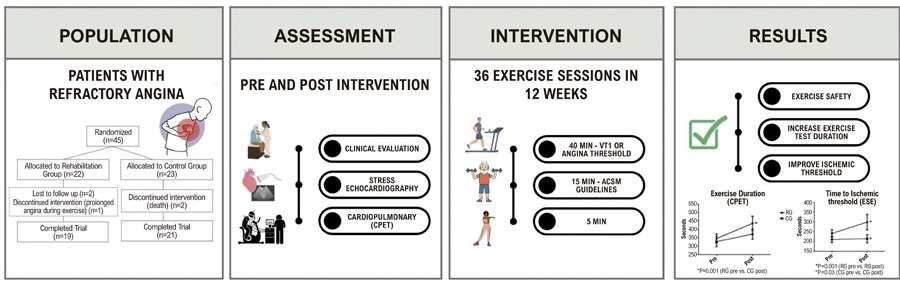
This was a prospective, single-center, randomized controlled trial evaluating a 12-week ECR program in patients with RA. Forty-five patients were randomized to either the rehabilitation group (RG), receiving ECR, or the control group (CG), receiving medical treatment (MT) alone. Outcomes included mortality, cardiovascular events, anginal symptoms, and parameters from ESE and cardiopulmonary exercise testing (CPET). Statistical significance was set at p < 0.05.

Results

In ESE, exercise duration was significantly greater in RGpost (after ECR) compared to RGpre (before ECR) (∆ = 63.24 ± 19.87 s; p < 0.01). Angina quantification was lower in RGpost than in RGpre, CGpost (after MT alone), and CGpre (before MT alone) (∆ = –1.64 ± 0.48 n, p < 0.01; –3.10 ± 0.97 n, p < 0.01; and –2.73 ± 0.92 n, p = 0.01, respectively). The angina threshold was higher in RGpost than in RGpre and CGpost (∆ = 89.66 ± 33.16 s, p = 0.04; and 111.76 ± 42.25 s, p = 0.04, respectively). Improvement in ischemic burden on ESE was demonstrated by increased time to ischemic threshold in RGpost compared to RGpre, CGpost, and CGpre (∆ = 83.23 ± 21.84 s, p < 0.01; 98.44 ± 35.11 s, p = 0.03; and 109.34 ± 34.00 s, p < 0.01, respectively). In CPET, RGpost showed increased exercise duration (∆ = 104.54 ± 28.09 s, p < 0.01) and distance covered (∆ = 131.23 ± 30.48 m, p < 0.01) compared to RGpre. No significant differences in VO2 were observed between groups. Two patients in the CG group died. One patient in the RG group experienced prolonged angina during training. No significant differences in major cardiovascular events were observed between groups.

Conclusion

The 12-week ECR-program was safe and effective in improving exercise duration, distance covered and ischemic burden on ESE in patients with RA.
  • angina
  • Cardiac Rehabilitation
  • Myocardial Ischemia
Read Full Article
Creative Commons Attribution (CC BY) Creative Commons license
02/02/2026 DOI: 10.36660/abc.20250331i Views 4
Figure 1
ABC
Original Article

Adjusting RFR by Predictors of Disagreement, “The Adjusted RFR”: An Alternative Methodology to Improve the Diagnostic Capacity of Coronary Indices

Diego Fernández-Rodríguez et al. Juan Casanova-Sandoval Ignacio Barriuso Kristian Rivera … Imanol Otaegui Bruno García del Blanco Teresa Gil Jiménez Manuel López-Pérez Marcos Rodríguez-Esteban Francisco Torres-Saura Víctor Jiménez Díaz Raymundo Ocaranza-Sánchez Vicente Peral Disdier Guillermo Sánchez Elvira Fernando Worner

Abstract

Background

Cutoff thresholds for the “resting full-cycle ratio” (RFR) oscillate in different series, suggesting that population characteristics may influence them. Likewise, predictors of discordance between the RFR and fractional flow reserve (FFR) have been documented. The RECOPA Study showed that diagnostic capacity is reduced in the RFR “grey zone”, requiring the performance of FFR to rule out or confirm ischemia.

Objectives

To determine predictors of discordance, integrate the information they provide in a clinical-physiological index, the “Adjusted RFR”, and compare its agreement with the FFR.

Methods

Using data from the RECOPA Study, predictors of discordance with respect to FFR were determined in the RFR “grey zone” (0.86 to 0.92) to construct an index (“Adjusted RFR”) that would weigh RFR together with predictors of discordance and evaluate its agreement with FFR.

Results

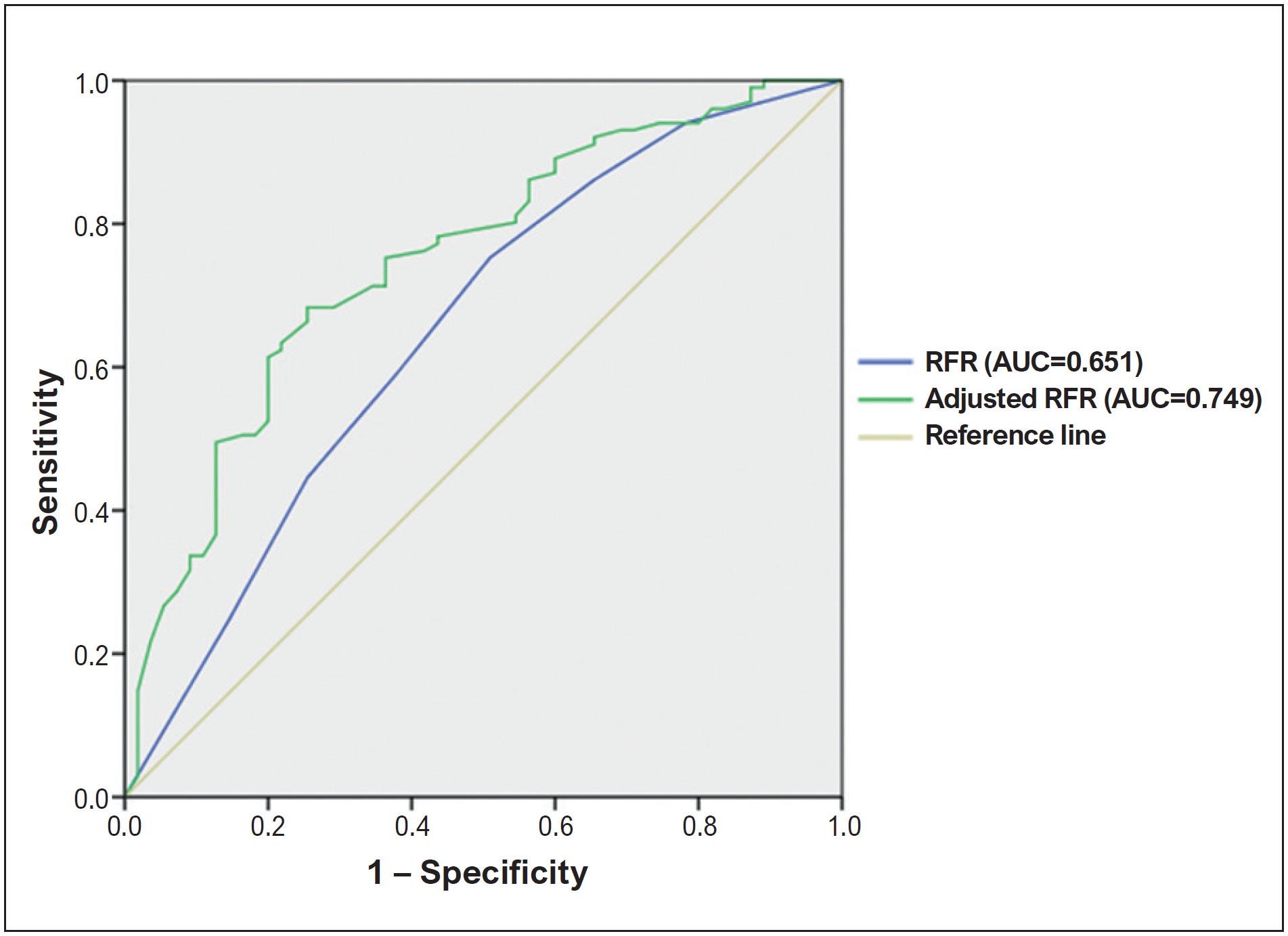
A total of 156 lesions were evaluated in 141 patients. Predictors of discordance were: chronic kidney disease, previous ischemic heart disease, lesions not involving the anterior descending artery, and acute coronary syndrome. Though limited, the “Adjusted RFR” improved the diagnostic capacity compared to the RFR in the “grey zone” (AUC-RFR = 0.651 versus AUC-“Adjusted RFR” = 0.749), also showing an improvement in all diagnostic indices when optimal cutoff thresholds were established (sensitivity: 59% to 68%; specificity: 62% to 75%; diagnostic accuracy: 60% to 71%; positive likelihood ratio: 1.51 to 2.34; negative likelihood ratio: 0.64 to 0.37).

Conclusions

Adjusting the RFR by integrating the information provided by predictors of discordance to obtain the “Adjusted RFR” improved the diagnostic capacity in our population. Further studies are required to evaluate whether clinical-physiological indices improve the diagnostic capacity of RFR or other coronary indices.

  • angina
  • Fractional Flow Reserve
  • Resting Full-cycle Ratio
  • Sensitivity
  • Specificity
Read Full Article
Creative Commons Attribution (CC BY) Creative Commons license
25/11/2022 DOI: 10.36660/abc.20220176
Wellens syndrome
ABC
Case Report

Wellens syndrome

Marcelo Campos Appel-da-Silva et al. Gabriel Zago Aníbal Pereira Abelin Walter Otávio Pin … Oscar Pereira Dutra Renato Vaz

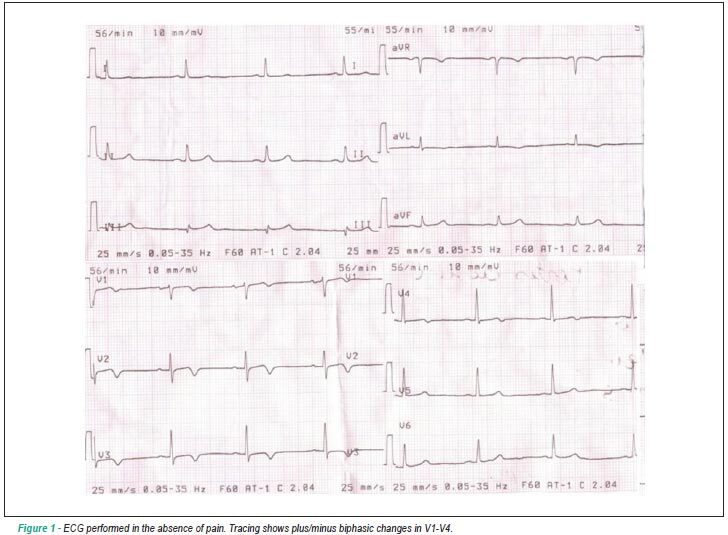
The assessment of chest pain is a routine in emergency health services. Although this is a common complaint with a broad differential diagnosis. the major concern is the possibility of acute coronary syndrome (ACS). Electrocardiography and cardiac enzyme levels are important tools in the investigation of these patients; however. negative results may actually be overlooking the identification of some conditions. We report the case of a female patient with angina. whose baseline tests in the emergency room were negative for changes suggestive of ischemic heart disease. The Wellens syndrome. a recently described disease. is a variant of unstable angina which. if not identified. may result in significant morbidity and mortality.

  • Acute coronary syndrome
  • angina
  • Electrocardiography
  • Myocardial Ischemia
  • unstable
Read Full Article
Creative Commons Attribution (CC BY) Creative Commons license
22/09/2010 DOI: 10.1590/S0066-782X2010000400026 Views 1
Prevalence of angina pectoris in Pelotas, south of Brazil
ABC
Artigo Original

Prevalence of angina pectoris in Pelotas, south of Brazil

Leonardo Alves et al. Juraci A. Cesar Bernardo L. Horta

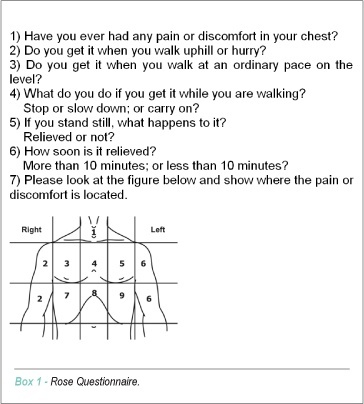
BACKGROUND: Ischemic heart disease is the leading cause of death in the world and angina is its cardinal manifestation. OBJECTIVE: To determine the prevalence of angina and possible angina and its distribution by main demographic and socioeconomic characteristics among adults 40 years of age or older. METHODS: This is a population-based, cross-sectional study featuring residents of the urban area in Pelotas, a city located in the south of Brazil, from October through December 2007. A two-stage cluster sampling – census tracts and households – was used. The prevalence of angina and possible angina was defined according to the Rose questionnaire. These conditions were assessed by demographic and socioeconomic characteristics: age, sex, skin color, economic status, and schooling. Data were collected using standardized questionnaires in interviews with the individuals in their homes. The non-respondent rate was 6.8%. RESULTS: The prevalence of angina among the 1,680 individuals taking part in the study was 8.2% (95% CI: 6.7 – 9.6), while that of possible angina came to 12.3% (95% CI: 10.6 – 14.0). The prevalence of angina and possible angina was higher among women, black/brown-skinned individuals, low economic class individuals and subjects with the low schooling. The prevalence of angina was higher among older individuals, while possible angina was found not to be associated with age. CONCLUSION: The prevalence of angina and possible angina was found to be high, affecting approximately 20% of the population in Pelotas.

  • angina
  • Cross-Sectional Studies
  • population
  • Prevalence
Read Full Article
Creative Commons Attribution (CC BY) Creative Commons license
25/06/2010 DOI: 10.1590/S0066-782X2010005000075 Views 1

How to cite this article

EndNote RIS

Electronic Document Format (Vancouver)

Dourado LOC, Jordão CP, Vieira MLC, Gowdak LHW, Negrão CE, Cesar LAM, Matos LDNJ, et al. Safety and Efficacy of Exercise-based Cardiac Rehabilitation in Patients with Refractory Angina. Arquivos Brasileiros de Cardiologia 2026;122(12):e20250331.

Electronic Document Format (ABNT)

Dourado, Luciana Oliveira Cascaes; Jordão, Camila Paixão; Vieira, Marcelo Luiz Campos; Gowdak, Luis Henrique Wolff; Negrão, Carlos Eduardo; Cesar, Luiz Antonio Machado; Matos, Luciana Diniz Nagem Janot de. Safety and Efficacy of Exercise-based Cardiac Rehabilitation in Patients with Refractory Angina. Arquivos Brasileiros de Cardiologia, v. 122, n. 12, e20250331, Feb. 2026.

Electronic Document Format (APA)

Dourado, L. O. C., Jordão, C. P., Vieira, M. L. C., Gowdak, L. H. W., Negrão, C. E., Cesar, L. A. M., & Matos, L. D. N. J. (2026). Safety and Efficacy of Exercise-based Cardiac Rehabilitation in Patients with Refractory Angina. Arquivos Brasileiros de Cardiologia, 122(12), e20250331.

Electronic Document Format (ISO)

Dourado, Luciana Oliveira Cascaes and Jordão, Camila Paixão and Vieira, Marcelo Luiz Campos and Gowdak, Luis Henrique Wolff and Negrão, Carlos Eduardo and Cesar, Luiz Antonio Machado and Matos, Luciana Diniz Nagem Janot de. Safety and Efficacy of Exercise-based Cardiac Rehabilitation in Patients with Refractory Angina. Arquivos Brasileiros de Cardiologia [online]. 2026, vol. 122, n. 12, [cited 2026-10-14], e20250331. Available from: <https://journals.cardiol.br/en/article/safety-and-efficacy-of-exercise-based-cardiac-rehabilitation-in-patients-with-refractory-angina/>. ISSN 0066-782X

EndNote RIS

Electronic Document Format (Vancouver)

Fernández-Rodríguez D, Casanova-Sandoval J, Barriuso I, Rivera K, Otaegui I, Blanco BG, Jiménez TG, et al. Adjusting RFR by Predictors of Disagreement, “The Adjusted RFR”: An Alternative Methodology to Improve the Diagnostic Capacity of Coronary Indices. Arquivos Brasileiros de Cardiologia 2022;119(5):705-13.

Electronic Document Format (ABNT)

Fernández-Rodríguez, Diego; Casanova-Sandoval, Juan; Barriuso, Ignacio; Rivera, Kristian; Otaegui, Imanol; Blanco, Bruno García del; Jiménez, Teresa Gil; López-Pérez, Manuel; Rodríguez-Esteban, Marcos; Torres-Saura, Francisco; Díaz, Víctor Jiménez; Ocaranza-Sánchez, Raymundo; Disdier, Vicente Peral; Elvira, Guillermo Sánchez; Worner, Fernando. Adjusting RFR by Predictors of Disagreement, “The Adjusted RFR”: An Alternative Methodology to Improve the Diagnostic Capacity of Coronary Indices. Arquivos Brasileiros de Cardiologia, v. 119, n. 5, p. 705-713, Nov. 2022.

Electronic Document Format (APA)

Fernández-Rodríguez, D., Casanova-Sandoval, J., Barriuso, I., Rivera, K., Otaegui, I., Blanco, B. G. , Jiménez, T. G., López-Pérez, M., Rodríguez-Esteban, M., Torres-Saura, F., Díaz, V. J., Ocaranza-Sánchez, R., Disdier, V. P., Elvira, G. S., & Worner, F. (2022). Adjusting RFR by Predictors of Disagreement, “The Adjusted RFR”: An Alternative Methodology to Improve the Diagnostic Capacity of Coronary Indices. Arquivos Brasileiros de Cardiologia, 119(5), 705-713.

Electronic Document Format (ISO)

Fernández-Rodríguez, Diego and Casanova-Sandoval, Juan and Barriuso, Ignacio and Rivera, Kristian and Otaegui, Imanol and Blanco, Bruno García del and Jiménez, Teresa Gil and López-Pérez, Manuel and Rodríguez-Esteban, Marcos and Torres-Saura, Francisco and Díaz, Víctor Jiménez and Ocaranza-Sánchez, Raymundo and Disdier, Vicente Peral and Elvira, Guillermo Sánchez and Worner, Fernando. Adjusting RFR by Predictors of Disagreement, “The Adjusted RFR”: An Alternative Methodology to Improve the Diagnostic Capacity of Coronary Indices. Arquivos Brasileiros de Cardiologia [online]. 2022, vol. 119, n. 5, [cited 2026-10-14], pp. 705-713. Available from: <https://journals.cardiol.br/en/article/adjusting-rfr-by-predictors-of-disagreement-the-adjusted-rfr-an-alternative-methodology-to-improve-the-diagnostic-capacity-of-coronary-indices/>. ISSN 0066-782X

EndNote RIS

Electronic Document Format (Vancouver)

Appel-da-Silva MC, Zago G, Abelin AP, Pin WO, Dutra OP, Vaz R. Wellens syndrome. Arquivos Brasileiros de Cardiologia 2010;94(4):e116-9.

Electronic Document Format (ABNT)

Appel-da-Silva, Marcelo Campos; Zago, Gabriel; Abelin, Aníbal Pereira; Pin, Walter Otávio; Dutra, Oscar Pereira; Vaz, Renato. Wellens syndrome. Arquivos Brasileiros de Cardiologia, v. 94, n. 4, p. e116-e119, Sep. 2010.

Electronic Document Format (APA)

Appel-da-Silva, M. C., Zago, G., Abelin, A. P., Pin, W. O., Dutra, O. P., & Vaz, R. (2010). Wellens syndrome. Arquivos Brasileiros de Cardiologia, 94(4), e116-e119.

Electronic Document Format (ISO)

Appel-da-Silva, Marcelo Campos and Zago, Gabriel and Abelin, Aníbal Pereira and Pin, Walter Otávio and Dutra, Oscar Pereira and Vaz, Renato. Wellens syndrome. Arquivos Brasileiros de Cardiologia [online]. 2010, vol. 94, n. 4, [cited 2026-10-14], pp. e116-e119. Available from: <https://journals.cardiol.br/en/article/wellens-syndrome/>. ISSN 0066-782X

EndNote RIS

Electronic Document Format (Vancouver)

Alves L, Cesar JA, Horta BL. Prevalence of angina pectoris in Pelotas, south of Brazil. Arquivos Brasileiros de Cardiologia 2010;95(2):179-85.

Electronic Document Format (ABNT)

Alves, Leonardo; Cesar, Juraci A.; Horta, Bernardo L.. Prevalence of angina pectoris in Pelotas, south of Brazil. Arquivos Brasileiros de Cardiologia, v. 95, n. 2, p. 179-185, Jun. 2010.

Electronic Document Format (APA)

Alves, L., Cesar, J. A., & Horta, B. L. (2010). Prevalence of angina pectoris in Pelotas, south of Brazil. Arquivos Brasileiros de Cardiologia, 95(2), 179-185.

Electronic Document Format (ISO)

Alves, Leonardo and Cesar, Juraci A. and Horta, Bernardo L.. Prevalence of angina pectoris in Pelotas, south of Brazil. Arquivos Brasileiros de Cardiologia [online]. 2010, vol. 95, n. 2, [cited 2026-10-14], pp. 179-185. Available from: <https://journals.cardiol.br/en/article/prevalence-of-angina-pectoris-in-pelotas-south-of-brazil/>. ISSN 0066-782X

  • About ABC Family
  • Internal Regulation
  • Editorial Board
  • Brazilian Society of Cardiology (SBC)

Issues

SBC Guidelines

  • Videos
  • Podcasts
  • News