Safety and Efficacy of Exercise-based Cardiac Rehabilitation in Patients with Refractory Angina
Abstract
Background
Evidence on the safety and anti-ischemic effects of exercise-based cardiac rehabilitation (ECR) in patients with refractory angina (RA) remains limited.
Objective
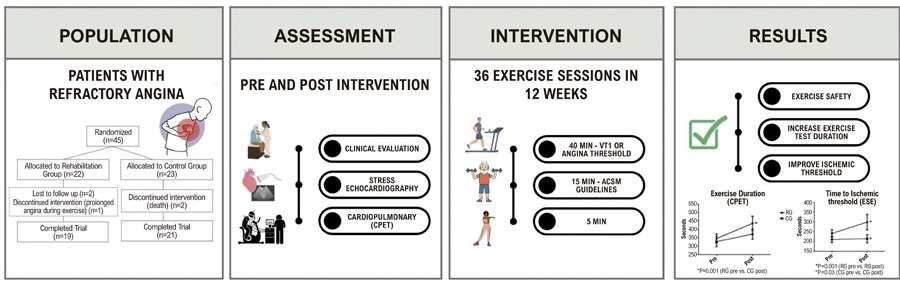
To evaluate the safety and efficacy of a 12-week ECR program in patients with RA, focusing on improvements in symptoms, functional capacity, and ischemic burden assessed by exercise stress echocardiography (ESE).
Methods
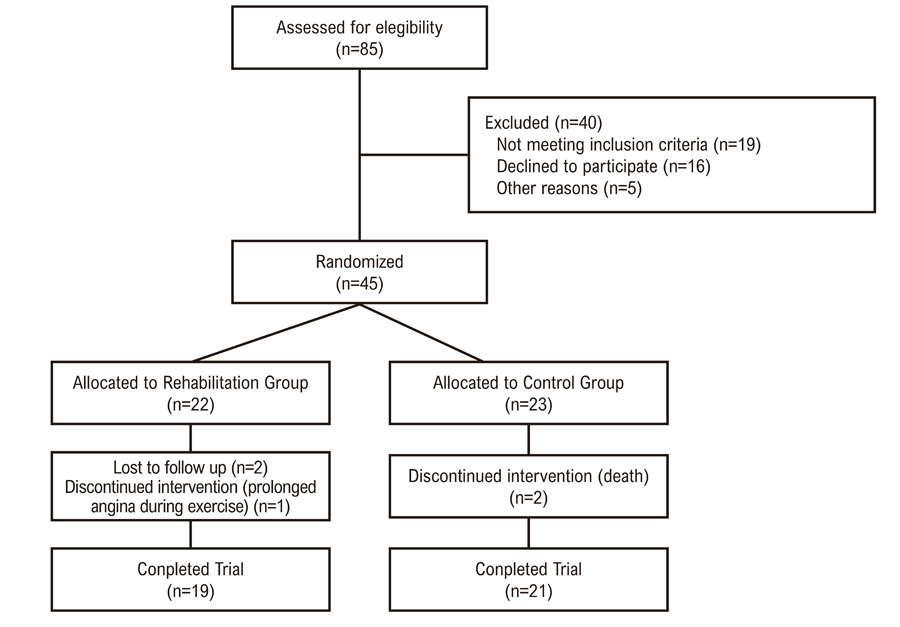
This was a prospective, single-center, randomized controlled trial evaluating a 12-week ECR program in patients with RA. Forty-five patients were randomized to either the rehabilitation group (RG), receiving ECR, or the control group (CG), receiving medical treatment (MT) alone. Outcomes included mortality, cardiovascular events, anginal symptoms, and parameters from ESE and cardiopulmonary exercise testing (CPET). Statistical significance was set at p < 0.05.
Results
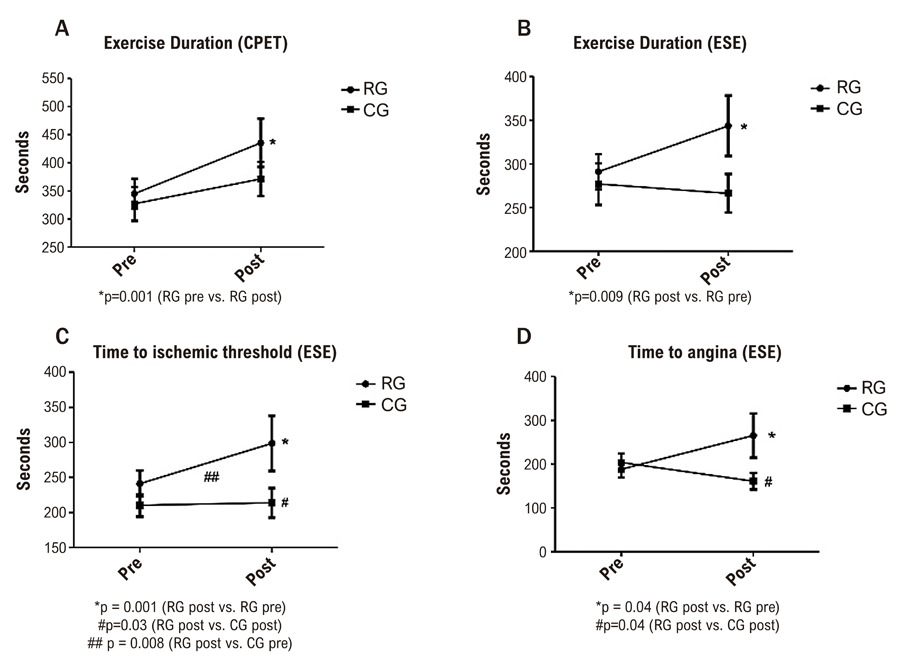
In ESE, exercise duration was significantly greater in RGpost (after ECR) compared to RGpre (before ECR) (∆ = 63.24 ± 19.87 s; p < 0.01). Angina quantification was lower in RGpost than in RGpre, CGpost (after MT alone), and CGpre (before MT alone) (∆ = –1.64 ± 0.48 n, p < 0.01; –3.10 ± 0.97 n, p < 0.01; and –2.73 ± 0.92 n, p = 0.01, respectively). The angina threshold was higher in RGpost than in RGpre and CGpost (∆ = 89.66 ± 33.16 s, p = 0.04; and 111.76 ± 42.25 s, p = 0.04, respectively). Improvement in ischemic burden on ESE was demonstrated by increased time to ischemic threshold in RGpost compared to RGpre, CGpost, and CGpre (∆ = 83.23 ± 21.84 s, p < 0.01; 98.44 ± 35.11 s, p = 0.03; and 109.34 ± 34.00 s, p < 0.01, respectively). In CPET, RGpost showed increased exercise duration (∆ = 104.54 ± 28.09 s, p < 0.01) and distance covered (∆ = 131.23 ± 30.48 m, p < 0.01) compared to RGpre. No significant differences in VO2 were observed between groups. Two patients in the CG group died. One patient in the RG group experienced prolonged angina during training. No significant differences in major cardiovascular events were observed between groups.
Conclusion
The 12-week ECR-program was safe and effective in improving exercise duration, distance covered and ischemic burden on ESE in patients with RA.
Images
Image gallery fullscreen viewer
Comments are moderated by the editorial team before publication. Discussions should be evidence-based and use scientific language. Conflicts of interest should be declared.