ABC Family Arquivos Brasileiros de Cardiologia International Journal of Cardiovascular Sciences ABC Heart Failure & Cardiomyopathy ABC Imagem Cardiovascular
Português English
ABC Family
Português English
  • About
    • About ABC Family
    • Internal Regulation
    • Editorial Board
    • Brazilian Society of Cardiology (SBC)
  • Issues
  • SBC Guidelines
  • Content
    • Videos
    • Podcasts
    • News
  • About
    • About ABC Family
    • Internal Regulation
    • Editorial Board
    • Brazilian Society of Cardiology (SBC)
  • Issues
  • SBC Guidelines
  • Content
    • Videos
    • Podcasts
    • News

ABC Family

  • ABC Family
  • Arquivos Brasileiros de Cardiologia
  • International Journal of Cardiovascular Sciences
  • ABC Heart Failure & Cardiomyopathy
  • ABC Imagem Cardiovascular
Search in

No content found.

Journals
Ordering
Article types
Others

  1. Home
  2. Keyword: Specificity
Figure 1
ABC
Original Article

Adjusting RFR by Predictors of Disagreement, “The Adjusted RFR”: An Alternative Methodology to Improve the Diagnostic Capacity of Coronary Indices

Diego Fernández-Rodríguez et al. Juan Casanova-Sandoval Ignacio Barriuso Kristian Rivera … Imanol Otaegui Bruno García del Blanco Teresa Gil Jiménez Manuel López-Pérez Marcos Rodríguez-Esteban Francisco Torres-Saura Víctor Jiménez Díaz Raymundo Ocaranza-Sánchez Vicente Peral Disdier Guillermo Sánchez Elvira Fernando Worner

Abstract

Background

Cutoff thresholds for the “resting full-cycle ratio” (RFR) oscillate in different series, suggesting that population characteristics may influence them. Likewise, predictors of discordance between the RFR and fractional flow reserve (FFR) have been documented. The RECOPA Study showed that diagnostic capacity is reduced in the RFR “grey zone”, requiring the performance of FFR to rule out or confirm ischemia.

Objectives

To determine predictors of discordance, integrate the information they provide in a clinical-physiological index, the “Adjusted RFR”, and compare its agreement with the FFR.

Methods

Using data from the RECOPA Study, predictors of discordance with respect to FFR were determined in the RFR “grey zone” (0.86 to 0.92) to construct an index (“Adjusted RFR”) that would weigh RFR together with predictors of discordance and evaluate its agreement with FFR.

Results

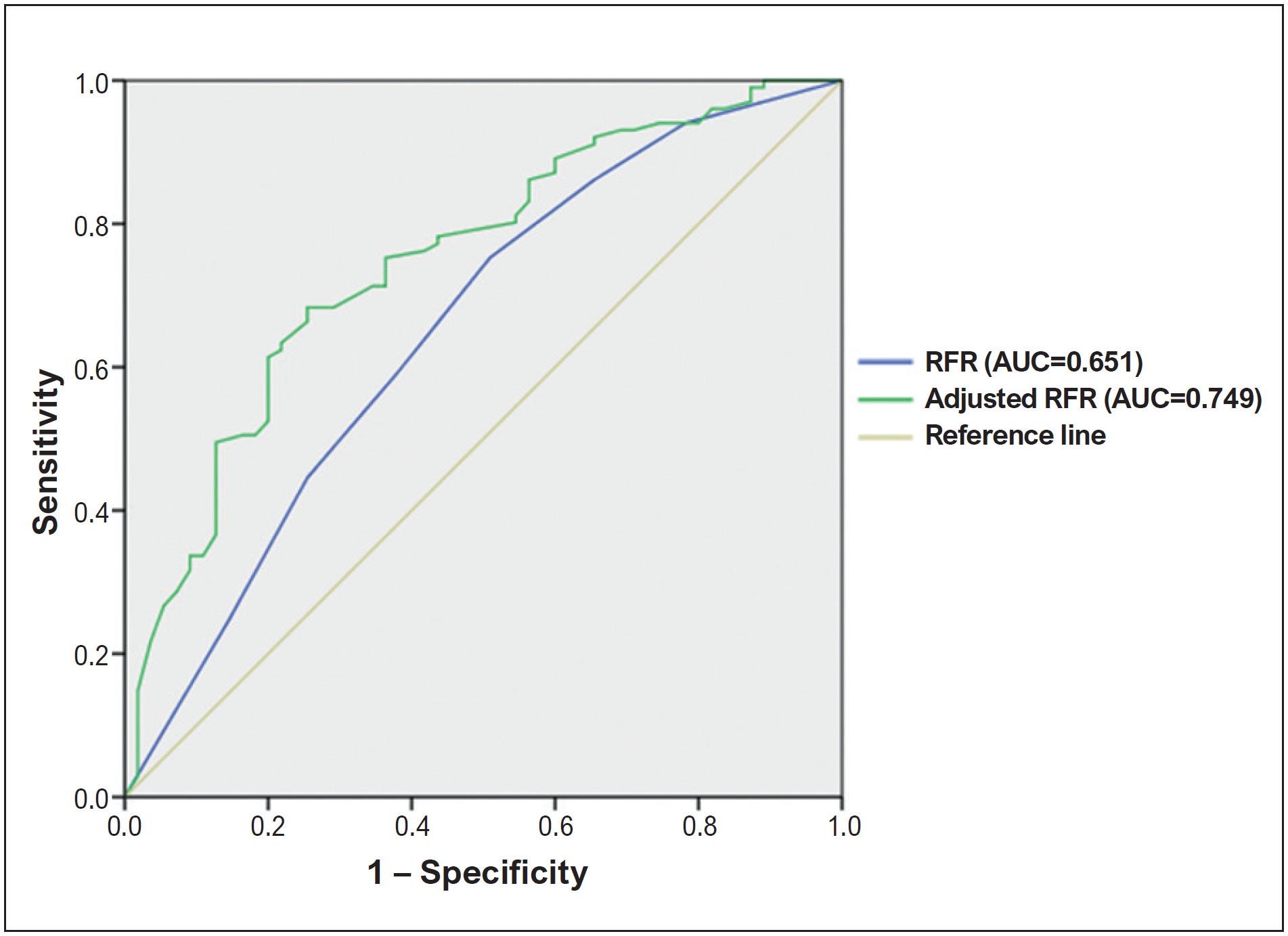
A total of 156 lesions were evaluated in 141 patients. Predictors of discordance were: chronic kidney disease, previous ischemic heart disease, lesions not involving the anterior descending artery, and acute coronary syndrome. Though limited, the “Adjusted RFR” improved the diagnostic capacity compared to the RFR in the “grey zone” (AUC-RFR = 0.651 versus AUC-“Adjusted RFR” = 0.749), also showing an improvement in all diagnostic indices when optimal cutoff thresholds were established (sensitivity: 59% to 68%; specificity: 62% to 75%; diagnostic accuracy: 60% to 71%; positive likelihood ratio: 1.51 to 2.34; negative likelihood ratio: 0.64 to 0.37).

Conclusions

Adjusting the RFR by integrating the information provided by predictors of discordance to obtain the “Adjusted RFR” improved the diagnostic capacity in our population. Further studies are required to evaluate whether clinical-physiological indices improve the diagnostic capacity of RFR or other coronary indices.

  • angina
  • Fractional Flow Reserve
  • Resting Full-cycle Ratio
  • Sensitivity
  • Specificity
Read Full Article
Creative Commons Attribution (CC BY) Creative Commons license
25/11/2022 DOI: 10.36660/abc.20220176

How to cite this article

EndNote RIS

Electronic Document Format (Vancouver)

Fernández-Rodríguez D, Casanova-Sandoval J, Barriuso I, Rivera K, Otaegui I, Blanco BG, Jiménez TG, et al. Adjusting RFR by Predictors of Disagreement, “The Adjusted RFR”: An Alternative Methodology to Improve the Diagnostic Capacity of Coronary Indices. Arquivos Brasileiros de Cardiologia 2022;119(5):705-13.

Electronic Document Format (ABNT)

Fernández-Rodríguez, Diego; Casanova-Sandoval, Juan; Barriuso, Ignacio; Rivera, Kristian; Otaegui, Imanol; Blanco, Bruno García del; Jiménez, Teresa Gil; López-Pérez, Manuel; Rodríguez-Esteban, Marcos; Torres-Saura, Francisco; Díaz, Víctor Jiménez; Ocaranza-Sánchez, Raymundo; Disdier, Vicente Peral; Elvira, Guillermo Sánchez; Worner, Fernando. Adjusting RFR by Predictors of Disagreement, “The Adjusted RFR”: An Alternative Methodology to Improve the Diagnostic Capacity of Coronary Indices. Arquivos Brasileiros de Cardiologia, v. 119, n. 5, p. 705-713, Nov. 2022.

Electronic Document Format (APA)

Fernández-Rodríguez, D., Casanova-Sandoval, J., Barriuso, I., Rivera, K., Otaegui, I., Blanco, B. G. , Jiménez, T. G., López-Pérez, M., Rodríguez-Esteban, M., Torres-Saura, F., Díaz, V. J., Ocaranza-Sánchez, R., Disdier, V. P., Elvira, G. S., & Worner, F. (2022). Adjusting RFR by Predictors of Disagreement, “The Adjusted RFR”: An Alternative Methodology to Improve the Diagnostic Capacity of Coronary Indices. Arquivos Brasileiros de Cardiologia, 119(5), 705-713.

Electronic Document Format (ISO)

Fernández-Rodríguez, Diego and Casanova-Sandoval, Juan and Barriuso, Ignacio and Rivera, Kristian and Otaegui, Imanol and Blanco, Bruno García del and Jiménez, Teresa Gil and López-Pérez, Manuel and Rodríguez-Esteban, Marcos and Torres-Saura, Francisco and Díaz, Víctor Jiménez and Ocaranza-Sánchez, Raymundo and Disdier, Vicente Peral and Elvira, Guillermo Sánchez and Worner, Fernando. Adjusting RFR by Predictors of Disagreement, “The Adjusted RFR”: An Alternative Methodology to Improve the Diagnostic Capacity of Coronary Indices. Arquivos Brasileiros de Cardiologia [online]. 2022, vol. 119, n. 5, [cited 2026-10-14], pp. 705-713. Available from: <https://journals.cardiol.br/en/article/adjusting-rfr-by-predictors-of-disagreement-the-adjusted-rfr-an-alternative-methodology-to-improve-the-diagnostic-capacity-of-coronary-indices/>. ISSN 0066-782X

  • About ABC Family
  • Internal Regulation
  • Editorial Board
  • Brazilian Society of Cardiology (SBC)

Issues

SBC Guidelines

  • Videos
  • Podcasts
  • News